


Asia-Pacific Medical Instruments Disinfection Market Size
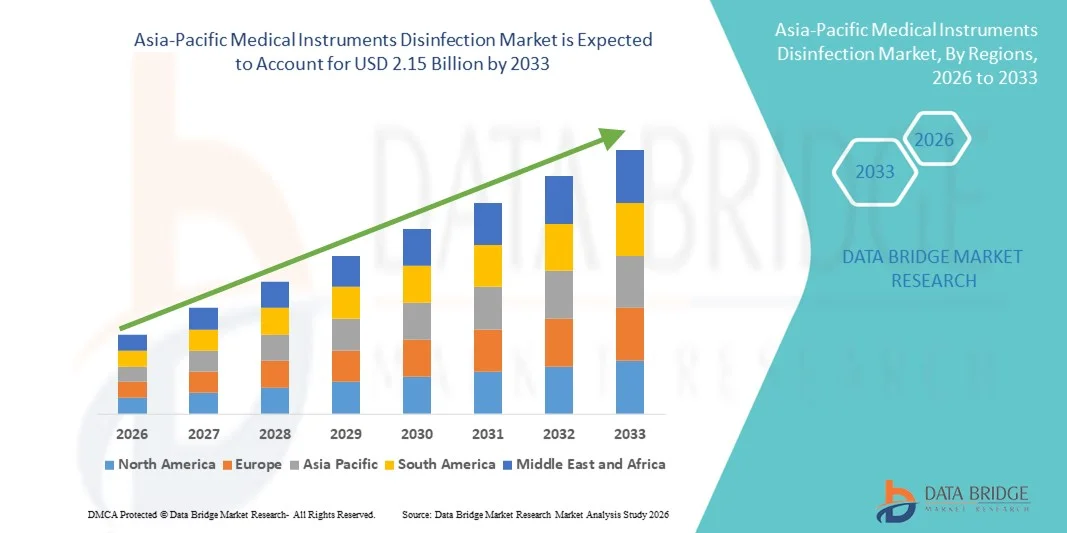
- The Asia-Pacific medical instruments disinfection market size was valued at USD 1.49 billion in 2025 and is expected to reach USD 2.15 billion by 2033, at a CAGR of 4.73% during the forecast period
- The market growth is primarily driven by increasing healthcare infrastructure development, rising awareness about infection control, and technological advancements in disinfection solutions, including automated and chemical-based systems
- In addition, growing patient safety concerns, stringent regulatory standards, and the adoption of hospital-acquired infection (HAI) prevention protocols are prompting healthcare providers to implement efficient disinfection methods. These combined factors are accelerating the deployment of medical instrument disinfection solutions, thereby strongly supporting the market’s expansion
Asia-Pacific Medical Instruments Disinfection Market Analysis
- Medical instruments disinfection solutions, including chemical disinfectants, automated washer-disinfectors, and ultraviolet (UV) systems, are increasingly critical in healthcare facilities across hospitals, clinics, and diagnostic centers due to their role in preventing healthcare-associated infections (HAIs) and ensuring patient safety
- The rising demand for medical instruments disinfection is primarily fueled by growing awareness about infection control, stringent regulatory compliance requirements, and the adoption of advanced technologies that enhance efficiency and reduce manual processing of instruments
- Japan dominated the Asia-Pacific medical instruments disinfection market with the largest revenue share of 35.4% in 2025, supported by advanced healthcare infrastructure, strict regulatory standards, and high adoption of automated and chemical-based disinfection systems
- China is expected to be the fastest-growing country in the Asia-Pacific medical instruments disinfection market during the forecast period driven by rapid expansion of hospitals and clinics, increasing government initiatives for infection prevention, rising healthcare expenditure, and growing awareness of patient safety
- The liquid segment dominated the market in 2025 with a market share of 42.6%, owing to its proven effectiveness, ease of use, compatibility with a wide range of medical instruments, and cost efficiency, making it the preferred choice for both small clinics and large hospitals
Report Scope and Asia-Pacific Medical Instruments Disinfection Market Segmentation
|
Attributes |
Asia-Pacific Medical Instruments Disinfection Key Market Insights |
|
Segments Covered |
|
|
Countries Covered |
Asia-Pacific
|
|
Key Market Players |
|
|
Market Opportunities |
|
|
Value Added Data Infosets |
In addition to the insights on market scenarios such as market value, growth rate, segmentation, geographical coverage, and major players, the market reports curated by the Data Bridge Market Research also include in-depth expert analysis, patient epidemiology, pipeline analysis, pricing analysis, and regulatory framework |
Asia-Pacific Medical Instruments Disinfection Market Trends
Adoption of Automated and Digital Disinfection Solutions
- A major and accelerating trend in the Asia-Pacific medical instruments disinfection market is the growing adoption of automated washer-disinfectors, UV disinfection systems, and digital monitoring technologies, enhancing efficiency and consistency in healthcare sterilization processes
- For instance, automated washer-disinfectors with real-time cycle monitoring are being deployed in large hospitals across Japan, reducing human error and improving instrument turnaround time. Similarly, UV-C disinfection systems in Chinese clinics are increasingly used for rapid, chemical-free sterilization of high-touch equipment
- Digital integration enables features such as monitoring disinfection cycles remotely, generating compliance reports, and providing alerts for maintenance or deviations, ensuring higher safety standards. For instance, some Steris and Getinge systems allow hospital staff to track washer-disinfector performance via cloud-based dashboards and receive notifications of failed cycles
- The seamless integration of automated and digital systems facilitates centralized infection control management, allowing healthcare administrators to monitor disinfection across multiple departments and locations, improving operational oversight
- This trend towards more intelligent, automated, and data-driven disinfection solutions is fundamentally changing expectations for instrument hygiene in healthcare settings. Consequently, companies such as Belimed are developing systems with automated cycle logging, remote monitoring, and digital compliance reporting
- The demand for automated and digitally monitored disinfection solutions is rising rapidly across both hospitals and diagnostic centers, as healthcare providers increasingly prioritize efficiency, compliance, and patient safety
- There is growing emphasis on environmentally friendly disinfection solutions, such as low-chemical or UV-based systems, driven by hospital sustainability initiatives and regulatory incentives promoting reduced chemical waste
Asia-Pacific Medical Instruments Disinfection Market Dynamics
Driver
Increasing Need Due to Rising Infection Control Awareness and Hospital Expansion
- The growing focus on infection prevention, coupled with rapid expansion of hospitals and diagnostic centers, is a key driver for heightened demand for medical instruments disinfection solutions
- For instance, in March 2025, Getinge launched an automated washer-disinfector for APAC hospitals, featuring real-time cycle monitoring and compliance reporting, aimed at improving sterilization efficiency. Such initiatives by leading companies are expected to drive market growth in the forecast period
- As healthcare providers become more aware of risks from HAIs, disinfection solutions that offer standardized cleaning, monitoring, and reporting provide a compelling alternative to manual cleaning processes
- Furthermore, increasing adoption of advanced healthcare technologies and hospital accreditation requirements are making automated disinfection systems an integral component of infection control strategies
- The convenience of automated cycles, real-time monitoring, and compliance reporting, combined with reduced human error and faster instrument turnaround, are key factors propelling the adoption of medical instruments disinfection systems in both public and private healthcare facilities
- Government initiatives and funding programs to strengthen infection control measures in APAC hospitals, particularly in China, India, and Southeast Asia, are further supporting market adoption
- Rising patient awareness and demand for safer hospital experiences are pushing healthcare facilities to invest in advanced disinfection technologies to enhance trust and improve overall care quality
Restraint/Challenge
High Costs and Regulatory Compliance Hurdles
- The relatively high cost of advanced automated and digital disinfection systems poses a significant challenge to broader adoption, especially for small clinics and budget-conscious hospitals
- For instance, high upfront investment for automated washer-disinfectors in India and Southeast Asia can delay adoption despite operational benefits, making some healthcare facilities hesitant
- Addressing these challenges through cost-effective solutions, leasing options, and scalable systems is critical. Companies such as Belimed and Getinge provide modular solutions and service contracts to ease financial barriers while maintaining compliance
- In addition, complex regulatory requirements across APAC countries, including standards for chemical disinfectants, washer-disinfectors, and UV devices, can complicate market entry for manufacturers
- Overcoming these challenges through tailored local regulatory support, staff training, and more affordable disinfection solutions will be vital for sustained market growth in the region
- Limited skilled personnel to operate advanced disinfection systems in smaller hospitals can restrict adoption, highlighting the need for training programs and simplified interfaces
- Potential resistance to change from traditional manual cleaning methods among healthcare staff can slow implementation, requiring awareness campaigns and demonstrations of efficiency and safety benefits
Asia-Pacific Medical Instruments Disinfection Market Scope
The market is segmented on the basis of type, environmental protection agency classification, product type, end-user, and distribution channel.
- By Type
On the basis of type, the Asia-Pacific medical instruments disinfection market is segmented into wipes, liquid, and sprays. The liquid segment dominated the market with the largest revenue share of 42.6% in 2025, driven by its proven effectiveness in disinfecting a wide range of medical instruments. Liquids are preferred in hospitals and clinics because they offer consistent antimicrobial activity, are compatible with various instrument materials, and are relatively easy to store and apply. The segment benefits from strong adoption in both routine cleaning and high-level disinfection processes. In addition, liquid disinfectants are often integrated into automated washer-disinfectors, further boosting usage in modern healthcare facilities. Their cost efficiency and availability of EPA-registered formulations make liquids the first choice for healthcare providers. Hospitals and diagnostic centers rely on liquids for both surface cleaning and immersion of critical instruments.
The wipes segment is anticipated to witness the fastest growth rate of 12.8% CAGR from 2026 to 2033, driven by their convenience, portability, and ability to quickly disinfect small instruments or high-touch surfaces. Wipes are increasingly used in outpatient clinics, diagnostic labs, and point-of-care settings where rapid, on-the-spot disinfection is required. Pre-soaked wipes with controlled chemical concentrations enhance safety, reduce handling risks, and simplify training for healthcare staff. They are particularly useful in busy hospital wards and emergency care areas. The growing emphasis on infection prevention in smaller clinics further supports wipes adoption.
- By Environmental Protection Agency Classification
On the basis of EPA classification, the market is segmented into low-level, intermediate-level, and high-level disinfectants. The high-level disinfectant segment dominated the market in 2025 due to its capability to eliminate a broad spectrum of microorganisms, including bacteria, viruses, and spores, making it essential for critical medical instruments such as endoscopes and surgical tools. High-level disinfectants are increasingly preferred in hospitals and surgical centers to ensure compliance with infection control protocols. The segment’s growth is supported by stringent regulations, rising awareness of healthcare-associated infections, and hospital accreditation standards. Their reliability, efficacy, and broad applicability make them indispensable in modern healthcare facilities. Hospitals implementing advanced washer-disinfector systems largely depend on high-level chemicals for automated sterilization cycles.
The intermediate-level disinfectant segment is expected to witness the fastest growth during the forecast period, driven by rising adoption in general hospitals and diagnostic centers where rapid disinfection of semi-critical instruments is required. Intermediate-level disinfectants provide effective microbial reduction while being safer and less corrosive than high-level chemicals. The segment benefits from ease of use, reduced chemical handling risks, and compatibility with a variety of semi-critical instruments.
- By Product Type
On the basis of product type, the market is segmented into disinfectors and others. The disinfector segment dominated the market in 2025 with the largest revenue share due to its ability to standardize and automate the disinfection process, reducing human error and ensuring compliance with hygiene standards. Disinfectors, including automated washer-disinfectors and UV systems, are widely adopted in large hospitals and surgical centers to manage high volumes of instruments efficiently. Their integration with digital monitoring and reporting systems further enhances appeal in healthcare settings. The segment is supported by hospital investments in infrastructure and infection control automation. Disinfectors also help maintain traceability and generate reports for regulatory compliance.
The others segment, which includes manual sterilization systems and chemical dosing kits, is expected to witness the fastest growth during the forecast period, supported by smaller healthcare facilities and clinics that require flexible, cost-effective disinfection solutions for limited instrument volumes. This growth is primarily supported by smaller healthcare facilities and clinics that require flexible and cost-effective disinfection solutions. These systems are suitable for handling limited instrument volumes without the need for large automated equipment. Manual sterilization and dosing kits offer ease of use, portability, and quick deployment in outpatient settings. They also allow healthcare staff to maintain compliance with infection control standards in resource-constrained environments.
- By End-User
On the basis of end-user, the market is segmented into hospitals, medical device manufacturers, pharma manufacturers, and laboratories. The hospitals segment dominated the market in 2025 with the largest revenue share as hospitals have the highest demand for reliable and standardized disinfection processes to prevent HAIs. Hospitals invest heavily in automated disinfectors and chemical disinfectants to maintain compliance with stringent infection control standards. The segment benefits from growing patient volumes, hospital expansions, and rising healthcare expenditure across APAC countries. Hospitals are also early adopters of innovative disinfection technologies, making them the largest consumers of medical instrument disinfection solutions. Hospitals require both liquid and high-level chemical disinfectants for critical and semi-critical instruments.
The laboratories segment is expected to witness the fastest growth during the forecast period, driven by the increasing number of diagnostic labs, research centers, and pharmaceutical testing facilities. Laboratories require precise and rapid disinfection of instruments to maintain experimental integrity and prevent cross-contamination, boosting adoption of specialized disinfectants and equipment. The growth is supported by the rising number of private diagnostic labs and outsourcing of pharmaceutical testing in APAC.
- By Distribution Channel
On the basis of distribution channel, the market is segmented into tender and over-the-counter (OTC). The tender segment dominated the market in 2025 as large hospitals, healthcare networks, and government institutions often procure medical instruments disinfection solutions through bulk tenders to ensure standardized quality and cost efficiency. Tender-based procurement allows for long-term contracts, predictable supply, and compliance with regulatory standards, making it the preferred distribution channel for large-scale healthcare buyers. Hospitals and government-funded facilities primarily rely on tender-based purchasing to reduce procurement costs and ensure regulatory compliance.
The over-the-counter segment is expected to witness the fastest growth during the forecast period, fueled by increasing demand from small clinics, outpatient centers, and diagnostic labs that prefer direct purchases for flexibility, convenience, and immediate availability. OTC sales are further supported by the rise of e-commerce platforms and local distributors catering to smaller healthcare facilities across APAC. OTC channels also allow quick adoption of innovative disinfectants and portable solutions.
Asia-Pacific Medical Instruments Disinfection Market Regional Analysis
- Japan dominated the Asia-Pacific medical instruments disinfection market with the largest revenue share of 35.4% in 2025, supported by advanced healthcare infrastructure, strict regulatory standards, and high adoption of automated and chemical-based disinfection systems
- Healthcare facilities in the country prioritize the efficiency, reliability, and compliance offered by automated washer-disinfectors, UV systems, and liquid disinfectants to ensure patient safety and reduce healthcare-associated infections (HAIs)
- This widespread adoption is further supported by a technologically advanced medical sector, high healthcare expenditure, and government initiatives promoting infection prevention, establishing automated and liquid-based disinfection as preferred solutions in hospitals, surgical centers, and diagnostic laboratories
The China Medical Instruments Disinfection Market Insight
The China medical instruments disinfection market captured the largest revenue share of 32% in 2025 within Asia-Pacific, driven by rapid expansion of hospitals, diagnostic centers, and surgical facilities. Healthcare providers are increasingly adopting automated washer-disinfectors, UV disinfection systems, and liquid chemical disinfectants to ensure patient safety and reduce healthcare-associated infections (HAIs). Government initiatives promoting infection prevention, hospital accreditation programs, and rising awareness of sterilization standards are further fueling market growth. The growing healthcare infrastructure, combined with investments in modern disinfection technologies, is enabling hospitals to implement efficient and standardized sterilization protocols.
Japan Medical Instruments Disinfection Market Insight
The Japan medical instruments disinfection market is gaining momentum due to the country’s advanced healthcare infrastructure, stringent infection control regulations, and high adoption of automated and digital disinfection solutions. Hospitals and surgical centers are increasingly integrating washer-disinfectors with digital monitoring systems, enabling real-time cycle tracking and compliance reporting. The market is also supported by a technologically advanced medical sector, high healthcare expenditure, and government initiatives promoting infection prevention. Aging populations in Japan further drive demand for reliable, easy-to-use disinfection systems that maintain safety across residential healthcare facilities and clinics.
India Medical Instruments Disinfection Market Insight
The India medical instruments disinfection market accounted for the largest revenue share in Asia-Pacific in 2025, attributed to the rapid expansion of hospitals, diagnostic labs, and outpatient care centers. The country’s growing middle class, rising awareness of healthcare-associated infections, and adoption of modern disinfection practices are major factors driving demand. Affordable automated washer-disinfectors, liquid disinfectants, and wipes are increasingly used in both public and private healthcare facilities. Government programs supporting hospital safety, smart hospital initiatives, and training for infection control practices further support market growth.
Australia Medical Instruments Disinfection Market Insight
The Australia medical instruments disinfection market is expected to expand at a substantial CAGR during the forecast period, driven by growing investments in healthcare infrastructure, strict regulatory compliance requirements, and rising adoption of automated disinfection systems. Hospitals and laboratories are increasingly using UV and chemical-based disinfectors to standardize cleaning processes and ensure high patient safety standards. The focus on reducing HAIs and maintaining compliance with healthcare accreditation programs is boosting demand for advanced solutions. Furthermore, awareness campaigns and training programs for healthcare staff are promoting adoption across both urban and regional medical centers.
Asia-Pacific Medical Instruments Disinfection Market Share
The Asia-Pacific Medical Instruments Disinfection industry is primarily led by well-established companies, including:
- STERIS Corporation (U.S.)
- Olympus Corporation (Japan)
- Shinva Medical Instrument Co., Ltd. (China)
- Getinge AB (Sweden)
- Ecolab Inc. (U.S.)
- Belimed AG (Switzerland)
- Tuttnauer Ltd. (Israel)
- Wassenburg Medical B.V. (Netherlands)
- Cantel Medical Corporation (U.S.)
- Medivators Inc. (U.S.)
- Miele & Cie. KG (Germany)
- Steelco S.p.A (Italy)
- Sakura Seiki Co., Ltd. (Japan)
- Hanshin Medical Co., Ltd. (Japan)
- AEGEA Medical (Turkey)
- Endo Technik (Germany)
- Medstar (India)
- Wellell (formerly Apex Medical) (Taiwan)
- Sakura SI Co., Ltd. (Japan)
- Sanqiang Medical Equipment Co., Ltd. (China)
What are the Recent Developments in Asia-Pacific Medical Instruments Disinfection Market?
- In November 2025, Cho Ray Hospital in Vietnam became the first public hospital to deploy advanced UV‑based disinfection robots, introducing two new robotic systems that use ultraviolet (UV) technology to disinfect operating rooms, transplant units, and drug preparation areas, significantly improving environmental safety before critical surgical procedures
- In September 2025, a major global news release highlighted rapid growth in UV disinfection technology across Asia‑Pacific, noting accelerated adoption of UV disinfection equipment (relevant to instrument and environmental disinfection) as governments and healthcare facilities increasingly prioritize safer, chemical‑free alternatives
- In May 2025, researchers from Pohang University of Science and Technology (POSTECH) unveiled an intelligent autonomous hospital disinfection robot that combines physical “wiping” capabilities with UV‑C sterilization to automate hospital sanitation tasks, reducing labor and enhancing consistent disinfection results in clinical environments
- In March 2024, Getinge launched its new Aquadis Index multi‑chamber washer‑disinfector, designed to help Central Sterile Supply Department (CSSD) staff achieve higher throughput and operational efficiency with up to 18 DIN‑sized trays per load. The system also reduces water and energy consumption, supporting hospital sustainability goals while maintaining robust disinfection performance
- In February 2021, Xech launched India’s first UV‑C based stethoscope sterilizer, the Xech Sterostet, providing rapid UV‑C disinfection of stethoscope diaphragms between patient examinations and aiming to reduce pathogen transmission risk in clinical settings

- Interactive Data Analysis Dashboard
- Company Analysis Dashboard for high growth potential opportunities
- Research Analyst Access for customization & queries
- Competitor Analysis with Interactive dashboard
- Latest News, Updates & Trend analysis
- Harness the Power of Benchmark Analysis for Comprehensive Competitor Tracking
Data collection and base year analysis are done using data collection modules with large sample sizes. The stage includes obtaining market information or related data through various sources and strategies. It includes examining and planning all the data acquired from the past in advance. It likewise envelops the examination of information inconsistencies seen across different information sources. The market data is analysed and estimated using market statistical and coherent models. Also, market share analysis and key trend analysis are the major success factors in the market report. To know more, please request an analyst call or drop down your inquiry.
The key research methodology used by DBMR research team is data triangulation which involves data mining, analysis of the impact of data variables on the market and primary (industry expert) validation. Data models include Vendor Positioning Grid, Market Time Line Analysis, Market Overview and Guide, Company Positioning Grid, Patent Analysis, Pricing Analysis, Company Market Share Analysis, Standards of Measurement, Global versus Regional and Vendor Share Analysis. To know more about the research methodology, drop in an inquiry to speak to our industry experts.
Data Bridge Market Research is a leader in advanced formative research. We take pride in servicing our existing and new customers with data and analysis that match and suits their goal. The report can be customized to include price trend analysis of target brands understanding the market for additional countries (ask for the list of countries), clinical trial results data, literature review, refurbished market and product base analysis. Market analysis of target competitors can be analyzed from technology-based analysis to market portfolio strategies. We can add as many competitors that you require data about in the format and data style you are looking for. Our team of analysts can also provide you data in crude raw excel files pivot tables (Fact book) or can assist you in creating presentations from the data sets available in the report.













