


Asia-Pacific Medical Waste Management Market Size
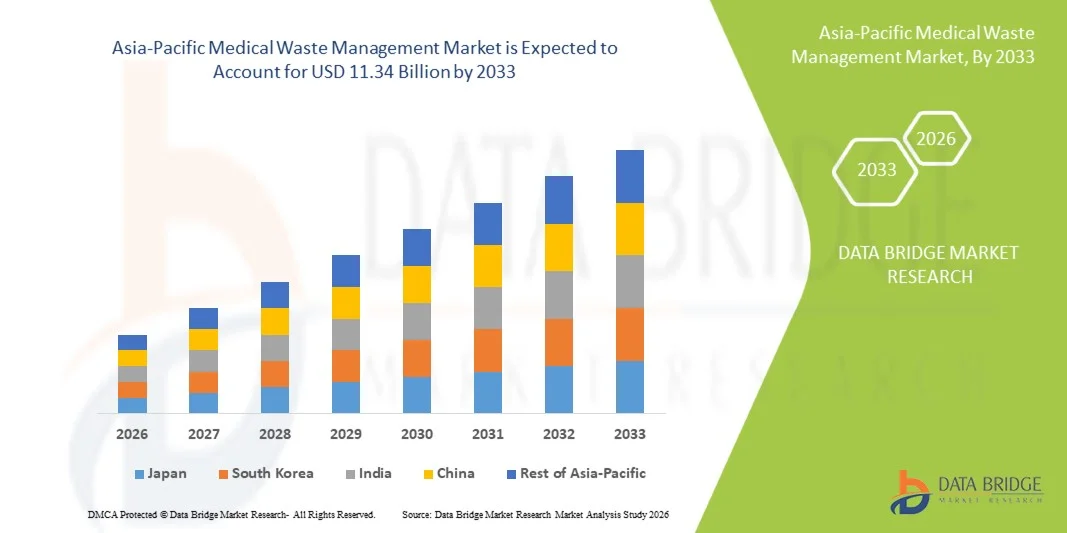
- The Asia-Pacific medical waste management market size was valued at USD 6.68 billion in 2025 and is expected to reach USD 11.34 billion by 2033, at a CAGR of 6.84% during the forecast period
- The market growth is largely fueled by the increasing healthcare infrastructure, rising number of hospitals, clinics, and diagnostic centers, and growing awareness about safe disposal practices of medical and biomedical waste across the region
- Furthermore, stringent government regulations, initiatives promoting sustainable waste management practices, and the adoption of advanced waste treatment technologies such as incineration, autoclaving, and chemical disinfection are driving demand for efficient medical waste management solutions. These converging factors are accelerating the uptake of modern waste management systems, thereby significantly boosting the industry's growth in Asia-Pacific
Asia-Pacific Medical Waste Management Market Analysis
- Medical waste management, covering the collection, transportation, treatment, and disposal of hazardous and non-hazardous healthcare waste, is increasingly a critical component of public health infrastructure in hospitals, clinics, laboratories, and other healthcare facilities due to its role in infection control, environmental safety, and regulatory compliance
- The escalating demand for medical waste management solutions is primarily fueled by the rapid expansion of healthcare infrastructure, increasing patient volumes, growing awareness of the risks associated with improper waste handling, and stringent government regulations on biomedical waste disposal across the region
- China dominated the Asia-Pacific medical waste management market with the largest revenue share of 28.5% in 2025, driven by its large number of healthcare facilities, increasing hospital admissions, and government initiatives to modernize waste treatment infrastructure
- India is expected to be the fastest-growing country in Asia-Pacific medical waste management market during the forecast period due to rapid urbanization, rising healthcare expenditure, and adoption of advanced treatment technologies such as autoclaving and chemical treatment for infectious waste
- Hazardous waste segment dominated the Asia-Pacific medical waste management market in 2025 with a market share of 61.3%, driven by its high-risk nature and strict regulatory requirements for safe handling, treatment, and disposal
Report Scope and Asia-Pacific Medical Waste Management Market Segmentation
|
Attributes |
Asia-Pacific Medical Waste Management Key Market Insights |
|
Segments Covered |
|
|
Countries Covered |
Asia-Pacific
|
|
Key Market Players |
|
|
Market Opportunities |
|
|
Value Added Data Infosets |
In addition to the insights on market scenarios such as market value, growth rate, segmentation, geographical coverage, and major players, the market reports curated by the Data Bridge Market Research also include in-depth expert analysis, patient epidemiology, pipeline analysis, pricing analysis, and regulatory framework |
Asia-Pacific Medical Waste Management Market Trends
“Integration of IoT and Smart Monitoring Systems”
- A significant and accelerating trend in the Asia-Pacific medical waste management market is the adoption of IoT-enabled smart monitoring systems that track waste generation, collection, and treatment in real-time, improving operational efficiency and regulatory compliance
- For instance, hospitals in Singapore are implementing sensor-based bins that alert staff when medical waste reaches capacity, ensuring timely collection and minimizing risk of contamination
- Smart monitoring systems enable predictive analytics for waste volumes, helping facilities optimize disposal schedules and reduce treatment costs while improving safety standards. For instance, some Chinese hospitals use IoT dashboards to monitor hazardous waste streams and automate reporting to local authorities
- The seamless integration of smart waste management systems with hospital IT infrastructure facilitates centralized oversight of multiple facilities, enabling compliance monitoring, digital record-keeping, and automated reporting to regulatory bodies
- This trend towards more intelligent, automated, and interconnected medical waste management systems is fundamentally reshaping operational expectations for healthcare facilities. For instance, Indian healthcare chains are deploying AI-assisted route optimization for waste collection vehicles to reduce operational costs
- The demand for smart, connected, and compliant medical waste management solutions is growing rapidly across hospitals, laboratories, and pharmaceutical facilities, as regulatory pressure and operational efficiency requirements continue to rise
- Partnerships between technology providers and healthcare facilities to implement automation in segregation, labeling, and tracking of medical waste are emerging as a key trend. For instance, Chinese startups are collaborating with hospitals to deploy AI-assisted waste sorting solutions
Asia-Pacific Medical Waste Management Market Dynamics
Driver
“Rising Healthcare Infrastructure and Regulatory Compliance Needs”
- The rapid expansion of hospitals, clinics, and diagnostic centers in Asia-Pacific, coupled with stringent biomedical waste regulations, is a significant driver for the growing adoption of advanced medical waste management solutions
- For instance, in April 2025, a major hospital chain in India deployed centralized autoclave treatment systems to ensure compliance with Bio-Medical Waste Management Rules and improve operational efficiency
- As healthcare facilities grow in number and scale, the volume of hazardous and infectious waste rises, creating demand for comprehensive collection, treatment, and disposal solutions that mitigate contamination risks
- Furthermore, government initiatives promoting safe disposal and environmentally sustainable practices are making medical waste management an essential service in both public and private healthcare sectors
- Operational efficiency, regulatory adherence, and risk mitigation remain key factors propelling adoption, while investments in smart waste treatment technologies further support market growth across the region
- The increasing number of diagnostic laboratories and outpatient centers is creating additional waste streams, driving demand for specialized medical waste management services. For instance, South Korean diagnostic networks are partnering with certified waste disposal firms to handle infectious and chemical waste
- Growing public awareness about environmental and health hazards of improper disposal is prompting hospitals and clinics to adopt certified waste management solutions proactively. For instance, campaigns in Australia have led to higher compliance with hazardous waste segregation and treatment protocol
Restraint/Challenge
“High Capital Costs and Compliance Complexity”
- The relatively high capital expenditure required for advanced treatment technologies such as incineration, autoclaving, and chemical treatment poses a significant challenge for smaller hospitals and clinics seeking to implement compliant waste management solutions
- For instance, many mid-sized healthcare facilities in rural India delay investments due to the high setup costs of modern waste treatment systems
- Addressing regulatory complexity across multiple countries with differing biomedical waste guidelines adds another layer of challenge for service providers and facility managers. For instance, variations in hazardous waste categorization between China and Japan necessitate customized operational protocols
- While costs may decrease with technology adoption, the perceived premium for advanced treatment and monitoring systems can still hinder uptake among budget-conscious healthcare facilities
- Overcoming these challenges through government subsidies, financing options, and technology-sharing initiatives will be critical for sustained market growth and wider adoption across the Asia-Pacific region
- Limited availability of skilled personnel to operate sophisticated treatment systems, such as autoclaves and chemical reactors, restricts adoption in smaller and rural healthcare facilities. For instance, some Indian hospitals rely on third-party operators due to lack of trained staff
- Variability in enforcement of waste management regulations across countries in the region can create compliance uncertainties, discouraging investment in advanced solutions. For instance, inconsistent inspections in Southeast Asia sometimes delay adoption of certified waste treatment technologies
Asia-Pacific Medical Waste Management Market Scope
The market is segmented on the basis of type of waste, service type, treatment type, treatment site, category, and source of generation.
- By Type of Waste
On the basis of type of waste, the Asia-Pacific medical waste management market is segmented into hazardous waste and non-hazardous waste. The hazardous waste segment dominated the market with the largest revenue share of 61.3% in 2025, driven by strict regulatory requirements for infectious, chemical, and pharmaceutical waste. Hospitals and laboratories generate the bulk of hazardous waste, creating consistent demand for collection, treatment, and disposal services. The high-risk nature of hazardous waste and the necessity for compliant handling also contribute to the dominance of this segment. Regulatory frameworks across China, India, Japan, and Australia mandate proper segregation and treatment, reinforcing market adoption. In addition, advanced treatment technologies such as incineration and autoclaving are predominantly utilized for hazardous waste, further boosting segment revenue.
The non-hazardous waste segment is expected to witness the fastest growth rate of 18.2% from 2026 to 2033, fueled by increasing healthcare facilities generating food, paper, and general waste that require environmentally sustainable disposal solutions. Hospitals and clinics are increasingly integrating recycling and waste minimization practices for non-hazardous streams, supported by government policies. The rising emphasis on sustainable operations and environmental safety in urban healthcare centers is accelerating demand for efficient non-hazardous waste management systems. Innovations in recycling and composting technologies for non-hazardous medical waste are contributing to growth in this segment.
- By Service Type
On the basis of service type, the market is segmented into collection, transportation and storage, treatment and disposal, recycling, and others. The treatment and disposal segment dominated with a market share of 42.5% in 2025, driven by hospitals and laboratories’ requirement for safe destruction of infectious and chemical waste. This segment encompasses technologies such as incineration, autoclaving, chemical treatment, and biological processes that ensure regulatory compliance. Medical waste service providers focus on providing centralized and onsite treatment solutions, further supporting dominance. The high risk associated with improper disposal of infectious and hazardous waste underpins the preference for professional treatment and disposal services. Stringent compliance mandates across countries such as China, India, and Japan also reinforce the leading position of this segment.
The recycling segment is anticipated to witness the fastest CAGR of 20.1% from 2026 to 2033, fueled by increasing awareness of sustainability in healthcare facilities and the growing emphasis on resource recovery from non-hazardous medical waste. Hospitals and laboratories are adopting recycling programs for plastics, glass, and packaging materials. Technological innovations in sterilization and safe reuse are further enabling the growth of this segment. The trend towards eco-friendly medical waste management and reduced environmental impact is accelerating adoption in urban and private healthcare facilities.
- By Treatment Type
On the basis of treatment type, the market is segmented into incineration, autoclaving, chemical treatment, irradiative, biological, and others. The incineration segment dominated the market with a revenue share of 36.4% in 2025, due to its ability to safely destroy infectious and hazardous waste while minimizing environmental impact when combined with advanced emission control systems. Incineration is widely adopted in hospitals and large-scale laboratories across China, Japan, and India for its high efficiency and compliance with regulatory standards. The segment also benefits from increasing investments in modern incineration plants with energy recovery capabilities. Healthcare facilities prioritize incineration for high-risk waste due to reliability and regulatory alignment.
The autoclaving segment is expected to witness the fastest growth rate of 22.8% from 2026 to 2033, driven by its cost-effectiveness and environmentally friendly profile for sterilizing infectious waste. Autoclaves are increasingly deployed in hospitals and diagnostic labs to treat sharps, culture media, and other biohazardous materials. Growing awareness of sustainable waste treatment practices and stricter emission regulations are supporting autoclave adoption. The compact design and suitability for onsite installation in mid-sized hospitals accelerate its uptake across Asia-Pacific.
- By Treatment Site
On the basis of treatment site, the market is segmented into offsite and onsite. The offsite segment dominated with a market share of 57.6% in 2025, as large hospitals and multi-hospital networks prefer centralized facilities for medical waste treatment due to higher efficiency, regulatory compliance, and cost-effectiveness. Offsite facilities offer advanced treatment technologies such as high-capacity incinerators and chemical sterilization units, which smaller onsite setups cannot afford. Outsourcing treatment also reduces operational burden on healthcare staff and ensures adherence to safety standards. Regulatory frameworks in countries such as Japan, China, and Australia encourage certified offsite disposal, reinforcing dominance.
The onsite segment is expected to witness the fastest growth rate of 19.3% from 2026 to 2033, fueled by increasing adoption in urban hospitals and clinics that aim to minimize storage time and reduce contamination risk. Onsite treatment with compact autoclaves and chemical units allows facilities to manage waste immediately, ensuring safety and faster compliance reporting. Smaller and mid-sized hospitals in India, Southeast Asia, and China increasingly prefer onsite solutions due to limited transport infrastructure and the need for rapid treatment.
- By Category
On the basis of category, the market is segmented into controlled and uncontrolled. The controlled category dominated with a market share of 63.2% in 2025, due to strict regulations mandating segregation, storage, treatment, and tracking of medical waste. Controlled waste management systems include secure storage, standardized collection procedures, and certified treatment methods. Hospitals, laboratories, and pharmaceutical manufacturers adhere to these protocols to avoid penalties and maintain safety standards. Advanced tracking and reporting systems further enhance compliance.
The uncontrolled category is expected to witness the fastest growth rate of 21.5% from 2026 to 2033, driven by emerging healthcare facilities and remote clinics in developing Asia-Pacific countries adopting gradual compliance practices. Efforts to implement basic treatment and segregation measures are gaining traction, supported by government training and monitoring programs. Rising awareness of health hazards and regulatory audits are accelerating adoption in previously uncontrolled segments.
- By Source of Generation
On the basis of source of generation, the market is segmented into hospitals, physician offices, clinical laboratories, manufacturers, and reverse distributors. The hospitals segment dominated with a market share of 54.1% in 2025, driven by high patient loads, complex procedures, and substantial volumes of infectious, chemical, and sharps waste generated. Hospitals require comprehensive collection, treatment, and disposal services to comply with regulations and maintain a safe environment for staff and patients. Centralized waste management systems and partnerships with certified providers further strengthen dominance.
The clinical laboratories segment is expected to witness the fastest growth rate of 20.4% from 2026 to 2033, fueled by the rise in diagnostic testing, biotechnology research, and pharmaceutical analysis across China, India, and Japan. Laboratories generate specialized waste streams requiring precise handling, treatment, and disposal solutions. Increasing investments in advanced diagnostic facilities and outsourcing of laboratory waste services are driving segment growth. The combination of growing laboratory activities, stringent compliance standards, and outsourcing trends is accelerating segment growth across Asia-Pacific.
Asia-Pacific Medical Waste Management Market Regional Analysis
- China dominated the Asia-Pacific medical waste management market with the largest revenue share of 28.5% in 2025, driven by its large number of healthcare facilities, increasing hospital admissions, and government initiatives to modernize waste treatment infrastructure
- Healthcare facilities in the country prioritize safe and compliant disposal of hazardous and infectious waste, adopting advanced technologies such as incineration, autoclaving, and chemical treatment to meet regulatory standards
- This widespread adoption is further supported by urbanization, rising healthcare expenditure, and increased awareness of environmental and public health risks associated with improper medical waste handling, establishing China as the leading market for medical waste management services in the region
The China Medical Waste Management Market Insight
The China medical waste management market captured the largest revenue share of 28.5% in 2025, driven by the rapid expansion of hospitals, diagnostic centers, and laboratories, alongside strict government regulations for hazardous and infectious waste disposal. Healthcare facilities are increasingly adopting centralized and onsite treatment solutions, including incineration, autoclaving, and chemical treatment, to ensure compliance and safety. Growing urbanization and rising healthcare expenditure are further propelling the market, while technological advancements in waste tracking, IoT-enabled monitoring, and automated reporting systems enhance operational efficiency. In addition, large-scale investments in eco-friendly treatment infrastructure are supporting sustainable practices and expanding market penetration.
India Medical Waste Management Market Insight
The India medical waste management market is expected to grow at the fastest CAGR during the forecast period of 2026 to 2033, fueled by rapid urbanization, rising patient volumes, and increasing healthcare infrastructure. Government initiatives promoting safe disposal of biomedical waste, coupled with the expansion of diagnostic labs and outpatient facilities, are driving demand for professional collection, treatment, and disposal services. Growing awareness of environmental and public health risks associated with improper waste handling is also encouraging hospitals and clinics to adopt certified waste management solutions. The outsourcing of medical waste treatment to specialized service providers is accelerating adoption, particularly in urban and semi-urban areas.
Japan Medical Waste Management Market Insight
The Japan medical waste management market is gaining momentum due to stringent regulatory frameworks, high healthcare standards, and the increasing number of hospitals and research laboratories. Healthcare facilities are adopting advanced treatment technologies, including autoclaving, chemical disinfection, and high-efficiency incineration, to safely manage hazardous waste streams. The integration of digital monitoring and reporting systems allows for better compliance tracking and risk reduction. Japan’s emphasis on sustainability and eco-friendly waste management practices is also driving adoption, while urbanization and high patient volumes ensure continued demand for professional waste management services across both residential and commercial healthcare facilities.
Australia Medical Waste Management Market Insight
The Australia medical waste management market is expected to expand steadily during the forecast period, driven by increasing healthcare expenditure, stringent environmental regulations, and growing awareness of safe biomedical waste disposal. Hospitals, clinics, and laboratories are adopting modern treatment methods, such as autoclaving, incineration, and chemical sterilization, to comply with government standards. The integration of waste tracking technologies and partnerships with certified service providers is improving efficiency and compliance. Growing urban populations and the expansion of healthcare infrastructure, combined with strong regulatory enforcement, are contributing to market growth across both public and private healthcare sectors.
Asia-Pacific Medical Waste Management Market Share
The Asia-Pacific Medical Waste Management industry is primarily led by well-established companies, including:
- Stericycle, Inc. (U.S.)
- Veolia Environnement S.A. (France)
- Waste Management, Inc. (U.S.)
- Clean Harbors, Inc. (U.S.)
- Suez Environmental Services (France)
- REMONDIS SE & Co. KG (Germany)
- Daniels Sharpsmart Inc. (Australia)
- BioMedical Waste Solutions, LLC (U.S.)
- Sharps Compliance, Inc. (U.S.)
- Republic Services, Inc. (U.S.)
- EcoMed Services (Canada)
- MedWaste Management, Inc. (U.S.)
- MedPro Disposal, LLC (U.S.)
- Triumvirate Environmental, Inc. (U.S.)
- Cyntox LLC (U.S.)
- Ecomed (U.S.)
- BWS Incorporated (U.S.)
- Hazardous Waste Experts, LLC (U.S.)
- All Medical Waste Australia Pty Ltd (Australia)
- Eco Industrial Environmental Engineering (Singapore)
What are the Recent Developments in Asia-Pacific Medical Waste Management Market?
- In September 2025, Vantive expanded its recycling programme across Southeast Asia and the Pacific to cut medical plastic waste from home‑based dialysis, partnering with local recyclers to transform used plastic medical components into new products—advancing circular economy efforts in the region
- In August 2025, the Madurai municipal corporation in India fined a hospital ₹1 lakh for illegally dumping biomedical waste, underscoring growing enforcement of medical waste regulations and heightened public health accountability for proper disposal practices
- In January 2025, a groundbreaking ceremony was held for a new medical waste incinerator facility at Kwikila District Hospital in Papua New Guinea, marking a major step in strengthening healthcare waste management infrastructure under the PNG COVID‑19 Emergency Response Project to enhance safe disposal for patients and workers
- In May 2024, the PacWastePlus programme commissioned a high‑temperature healthcare waste incinerator at Ronton Hospital in Kiribati, significantly improving local capacity to safely manage and dispose of medical waste and protect public health through compliant hazardous waste destruction at the facility
- In December 2023, a dedicated healthcare waste disposal facility was constructed at Baucau Hospital in Timor‑Leste, improving environmental safety and worker protection by enabling proper segregation and treatment of hospital waste with EU PacWaste Plus support

- Interactive Data Analysis Dashboard
- Company Analysis Dashboard for high growth potential opportunities
- Research Analyst Access for customization & queries
- Competitor Analysis with Interactive dashboard
- Latest News, Updates & Trend analysis
- Harness the Power of Benchmark Analysis for Comprehensive Competitor Tracking
Data collection and base year analysis are done using data collection modules with large sample sizes. The stage includes obtaining market information or related data through various sources and strategies. It includes examining and planning all the data acquired from the past in advance. It likewise envelops the examination of information inconsistencies seen across different information sources. The market data is analysed and estimated using market statistical and coherent models. Also, market share analysis and key trend analysis are the major success factors in the market report. To know more, please request an analyst call or drop down your inquiry.
The key research methodology used by DBMR research team is data triangulation which involves data mining, analysis of the impact of data variables on the market and primary (industry expert) validation. Data models include Vendor Positioning Grid, Market Time Line Analysis, Market Overview and Guide, Company Positioning Grid, Patent Analysis, Pricing Analysis, Company Market Share Analysis, Standards of Measurement, Global versus Regional and Vendor Share Analysis. To know more about the research methodology, drop in an inquiry to speak to our industry experts.
Data Bridge Market Research is a leader in advanced formative research. We take pride in servicing our existing and new customers with data and analysis that match and suits their goal. The report can be customized to include price trend analysis of target brands understanding the market for additional countries (ask for the list of countries), clinical trial results data, literature review, refurbished market and product base analysis. Market analysis of target competitors can be analyzed from technology-based analysis to market portfolio strategies. We can add as many competitors that you require data about in the format and data style you are looking for. Our team of analysts can also provide you data in crude raw excel files pivot tables (Fact book) or can assist you in creating presentations from the data sets available in the report.













