


What is the Asia-Pacific Microfluidics Market Size and Growth Rate?
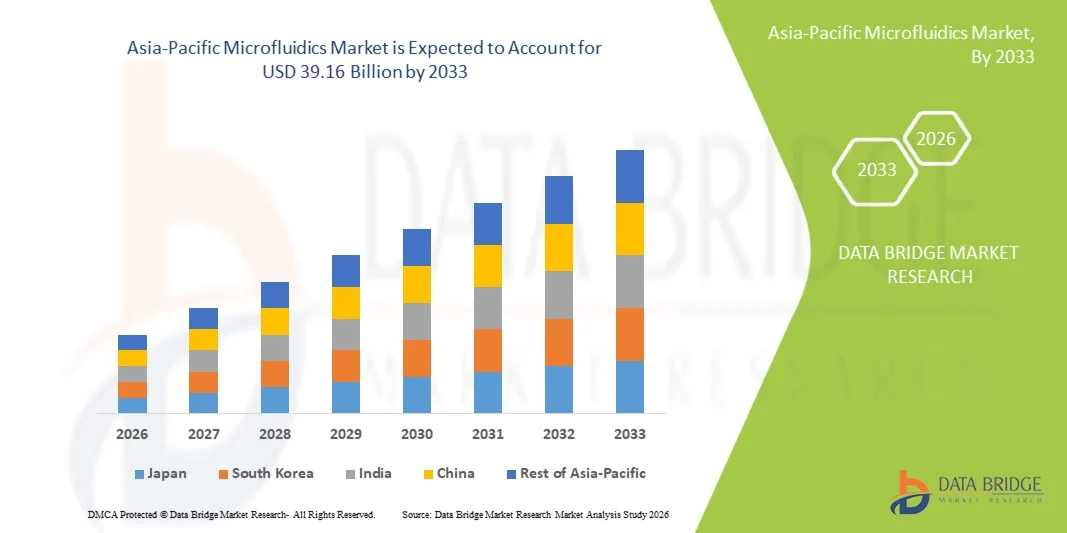
- As per Data Bridge Market Research Analysis the Asia-Pacific Microfluidics Market size was valued at USD 9.61 billion in 2025 and is expected to reach USD 39.16 billion by 2033, at a CAGR of 19.20% during the forecast period
- The market growth is largely fueled by the increasing adoption of microfluidic technologies in diagnostics, drug discovery, and point-of-care testing, along with rapid advancements in lab-on-a-chip systems, leading to enhanced precision and efficiency in healthcare and research applications
- Furthermore, rising demand for cost-effective, rapid, and portable diagnostic solutions, coupled with expanding biotechnology and pharmaceutical industries across the region, is establishing microfluidics as a critical component in modern healthcare and life sciences. These converging factors are accelerating the uptake of microfluidic solutions, thereby significantly boosting the industry's growth
Market Size & Forecast
- Global Market Value (2025): USD 9.61 billion
- Expected Market Value (2033): USD 39.16 billion
- Forecast CAGR (2026–2033): 19.20%
What are the Major Takeaways of Asia-Pacific Microfluidics Market?
- Microfluidics, involving the precise manipulation of small volumes of fluids within microscale channels, has become an essential technology in modern healthcare, life sciences, and analytical applications across both research and clinical settings due to its high accuracy, reduced sample requirements, and ability to enable rapid diagnostics and miniaturized systems
- The escalating demand for microfluidic solutions is primarily fueled by the growing adoption of point-of-care testing, increasing investments in biotechnology and pharmaceutical research, and a rising need for cost-effective, high-throughput screening and diagnostic platforms
- China dominated the Asia-Pacific Microfluidics Market with the largest revenue share of 38.50% in 2025, characterized by rapidly expanding healthcare infrastructure, strong government funding for biotechnology and life sciences, and a robust manufacturing ecosystem
- India is expected to be the fastest growing country in the Asia-Pacific Microfluidics Market during the forecast period due to increasing healthcare expenditure, rising prevalence of chronic diseases, and growing demand for affordable and advanced diagnostic solutions
- In Vitro Diagnostics segment dominated the Asia-Pacific Microfluidics Market with a market share of 41.80% in 2025, driven by its extensive use in disease detection, increasing reliance on rapid and accurate diagnostic techniques, and the growing adoption of microfluidic-based platforms in clinical and laboratory testing across the region
Report Scope and Asia-Pacific Microfluidics Market Segmentation
|
Attributes |
Asia-Pacific Microfluidics Key Market Insights |
|
Segments Covered |
|
|
Countries Covered |
Asia-Pacific
|
|
Key Market Players |
|
|
Market Opportunities |
|
|
Value Added Data Infosets |
In addition to the insights on market scenarios such as market value, growth rate, segmentation, geographical coverage, and major players, the market reports curated by the Data Bridge Market Research also include in-depth expert analysis, patient epidemiology, pipeline analysis, pricing analysis, and regulatory framework |
What is the Key Trend in the Asia-Pacific Microfluidics Market?
“Rising Adoption of Lab-on-a-Chip and Point-of-Care Technologies”
- A significant and accelerating trend in the Asia-Pacific Microfluidics Market is the increasing integration of lab-on-a-chip technologies and portable point-of-care diagnostic systems across healthcare and research settings. This convergence of miniaturization and automation is significantly enhancing diagnostic efficiency and accessibility
- For instance, microfluidic-based diagnostic platforms are being increasingly utilized in rapid disease detection and clinical analysis, allowing healthcare providers to perform complex tests with minimal sample volumes. Similarly, portable point-of-care devices enable faster results and real-time monitoring, improving patient outcomes
- Advancements in microfluidics enable features such as high-throughput screening, precise fluid manipulation, and integration with biosensors for enhanced analytical performance. For instance, emerging systems incorporate automated sample processing and multiplex testing capabilities, improving diagnostic accuracy and reducing turnaround times. Furthermore, these technologies offer scalability and cost efficiency, making them suitable for widespread adoption
- The seamless integration of microfluidic platforms with digital healthcare systems and laboratory automation tools facilitates centralized data management and improved workflow efficiency. Through a unified system, users can streamline diagnostics, research, and data analysis processes, creating a more efficient and interconnected healthcare ecosystem
- This trend towards more compact, efficient, and integrated microfluidic solutions is fundamentally reshaping expectations in diagnostics and life sciences. Consequently, companies are developing advanced microfluidic devices with features such as multi-analyte detection, automation, and compatibility with digital health platforms
- The demand for microfluidic technologies that offer rapid, accurate, and decentralized testing capabilities is growing rapidly across healthcare and research sectors, as stakeholders increasingly prioritize efficiency, scalability, and accessibility
Asia-Pacific Microfluidics Market Dynamics
Driver
“Growing Demand Due to Expanding Healthcare Infrastructure and Diagnostic Needs”
- The increasing demand for advanced diagnostic solutions, coupled with expanding healthcare infrastructure across Asia-Pacific, is a significant driver for the heightened adoption of microfluidic technologies
- For instance, in recent years, several regional healthcare initiatives have focused on strengthening diagnostic capabilities and promoting the adoption of innovative medical technologies. Such developments by governments and healthcare providers are expected to drive the Asia-Pacific Microfluidics Market growth in the forecast period
- As healthcare systems aim to improve early disease detection and patient outcomes, microfluidics offers advantages such as rapid testing, reduced reagent consumption, and high sensitivity, providing a compelling alternative to conventional diagnostic methods
- Furthermore, the growing prevalence of chronic and infectious diseases and the increasing need for decentralized healthcare services are making microfluidic systems an essential component of modern diagnostics, offering seamless integration with laboratory and clinical workflows
- The ability to perform complex analyses using minimal sample volumes, along with enhanced portability and automation, are key factors propelling the adoption of microfluidics in both clinical and research applications. The trend towards personalized medicine and precision diagnostics further contributes to market growth
- Increasing government funding and public-private partnerships in biotechnology and life sciences research are further accelerating the development and commercialization of microfluidic technologies across the region
- Rising demand for high-throughput screening in pharmaceutical and drug discovery processes is also driving the adoption of microfluidics, enabling faster and more efficient experimentation and analysis
Restraint/Challenge
“High Cost and Technical Complexity in Microfluidic System Integration”
- Concerns surrounding the high cost of advanced microfluidic systems and the complexity of device fabrication pose a significant challenge to broader market adoption. As microfluidics requires specialized materials and precise engineering, it can increase production costs and limit accessibility
- For instance, challenges related to scaling up production and ensuring consistent device performance have made some end-users hesitant to adopt microfluidic technologies in routine applications
- Addressing these cost and complexity concerns through standardized manufacturing processes, improved material selection, and technological advancements is crucial for wider adoption. Companies are focusing on developing cost-effective polymer-based devices and scalable fabrication techniques to overcome these barriers. In addition, the lack of skilled professionals and technical expertise in handling microfluidic systems can further restrict market growth in certain regions
- While technological advancements are gradually reducing costs, the initial investment and operational complexities can still hinder widespread adoption, particularly among small and mid-sized laboratories and healthcare providers
- Overcoming these challenges through continued innovation, workforce training, and strategic collaborations will be vital for sustained market growth
- Limited standardization and regulatory variability across different countries in Asia-Pacific can create hurdles in product approvals and commercialization of microfluidic devices
- Integration challenges with existing laboratory infrastructure and legacy systems can also slow down adoption, particularly in traditional healthcare and research environments
How is the Hormone Replacement Therapy Market Segmented?
The market is segmented on the basis of product type, material, application, sector, and end user.
- By Product Type
On the basis of product type, the Asia-Pacific Microfluidics Market is segmented into microfluidic-based devices and microfluidic components. The microfluidic-based devices segment dominated the market with the largest revenue share in 2025, driven by their extensive use in diagnostics, point-of-care testing, and integrated lab-on-a-chip platforms. These devices offer complete solutions by combining multiple laboratory functions into a single chip, significantly improving efficiency and reducing analysis time. Their growing adoption in clinical diagnostics and research laboratories, along with increasing demand for portable and automated systems, further supports their dominance. In addition, advancements in device miniaturization and integration capabilities have enhanced their applicability across healthcare and life sciences sectors.
The microfluidic components segment is anticipated to witness the fastest growth rate during the forecast period, fueled by increasing demand for modular and customizable systems in research and industrial applications. Components such as microchannels, pumps, and valves are essential building blocks for developing tailored microfluidic systems, enabling flexibility in design and functionality. The rising focus on research and development activities and the need for specialized applications are accelerating the demand for individual components. Furthermore, advancements in fabrication technologies and material innovation are making these components more efficient and cost-effective.
- By Material
On the basis of material, the market is segmented into polymer, glass, silicon, and other materials. The polymer segment dominated the market with the largest revenue share in 2025, driven by its cost-effectiveness, flexibility, and ease of mass production. Polymers such as PDMS are widely used due to their biocompatibility and suitability for disposable devices, making them ideal for healthcare and diagnostic applications. Their ability to support rapid prototyping and scalability further enhances their adoption across industries. In addition, polymer-based devices are lightweight and compatible with various manufacturing techniques, contributing to their widespread use.
The glass segment is expected to witness the fastest growth during the forecast period, driven by its superior chemical resistance, optical transparency, and stability. Glass materials are highly preferred in applications requiring high precision and durability, such as advanced diagnostics and analytical research. The increasing demand for high-performance microfluidic devices in pharmaceutical and laboratory settings is supporting the growth of this segment. Furthermore, ongoing innovations in glass fabrication techniques are improving its feasibility for large-scale production.
- By Application
On the basis of application, the market is segmented into in vitro diagnostics, point-of-care testing, clinical diagnostics, pharmaceutical research, lab analytics, microdispensing, microreaction, drug delivery, laboratory testing, and high throughput screening. The in vitro diagnostics segment dominated the market with the largest revenue share of 41.80% in 2025, driven by its extensive use in disease detection and monitoring. Microfluidic technologies enable rapid, accurate, and cost-effective diagnostic solutions, making them highly suitable for clinical and laboratory use. The increasing prevalence of chronic and infectious diseases and the growing need for early diagnosis are further boosting demand. In addition, the integration of microfluidics with advanced detection technologies enhances diagnostic capabilities and efficiency.
The point-of-care testing segment is anticipated to witness the fastest growth during the forecast period, fueled by the rising demand for decentralized and rapid diagnostic solutions. These systems allow testing at or near the site of patient care, reducing the need for centralized laboratories and enabling faster decision-making. The increasing focus on personalized healthcare and the need for portable diagnostic devices are driving adoption. Furthermore, technological advancements in miniaturization and automation are enhancing the performance and accessibility of point-of-care solutions.
- By Sector
On the basis of sector, the market is segmented into industrial and healthcare. The healthcare segment dominated the market with the largest revenue share in 2025, driven by the widespread use of microfluidics in diagnostics, drug delivery, and clinical research. The growing demand for advanced diagnostic technologies and the increasing adoption of personalized medicine are key factors supporting this dominance. Microfluidic systems enable faster and more accurate analysis, improving patient outcomes and operational efficiency in healthcare settings. In addition, the expansion of healthcare infrastructure across Asia-Pacific further contributes to segment growth.
The industrial segment is expected to witness the fastest growth during the forecast period, driven by increasing applications in chemical analysis, environmental testing, and food safety. Microfluidics offers precise control and efficient processing, making it suitable for various industrial processes. The rising demand for automation and high-throughput systems in industrial applications is further accelerating adoption. Moreover, advancements in microfabrication technologies are expanding the scope of microfluidics in non-healthcare sectors.
- By End User
On the basis of end user, the market is segmented into hospitals and diagnostic centers, academic and research institutes, and pharmaceutical and biotechnology companies. The hospitals and diagnostic centers segment dominated the market with the largest revenue share in 2025, driven by the increasing use of microfluidic devices in routine diagnostics and patient monitoring. These facilities rely on microfluidics for rapid and accurate testing, enhancing clinical decision-making and patient care. The growing patient population and rising demand for efficient diagnostic solutions further support this dominance. In addition, integration with automated laboratory systems improves workflow efficiency.
The pharmaceutical and biotechnology companies segment is anticipated to witness the fastest growth during the forecast period, fueled by increasing use of microfluidics in drug discovery, development, and testing. These companies leverage microfluidic technologies for high-throughput screening, reducing time and cost associated with traditional methods. The growing focus on precision medicine and biologics is further driving demand. Furthermore, continuous innovation and investment in R&D activities are accelerating the adoption of microfluidics in this segment.
Which Region Holds the Largest Share of the Asia-Pacific Microfluidics Market?
- China dominated the Asia-Pacific Microfluidics Market with the largest revenue share of 38.50% in 2025, characterized by rapidly expanding healthcare infrastructure, strong government funding for biotechnology and life sciences, and a robust manufacturing ecosystem
- End users in the country highly value the efficiency, precision, and rapid analysis capabilities offered by microfluidic systems, particularly in applications such as in vitro diagnostics, pharmaceutical research, and point-of-care testing
- This widespread adoption is further supported by government funding for life sciences, a rapidly growing research ecosystem, and increasing demand for cost-effective and high-throughput diagnostic solutions, establishing microfluidics as a critical technology across healthcare and industrial applications
The China Asia-Pacific Microfluidics Market Insight
The China Asia-Pacific Microfluidics Market captured the largest revenue share of 38.50% in 2025 within Asia-Pacific, fueled by strong government support for biotechnology and the rapid expansion of healthcare infrastructure. End users are increasingly prioritizing advanced diagnostic solutions through microfluidic technologies for faster and more accurate testing. The growing preference for integrated lab-on-a-chip systems, combined with robust demand for point-of-care diagnostics and pharmaceutical research, further propels the market. Moreover, increasing investments in life sciences and the presence of a strong manufacturing ecosystem are significantly contributing to the market's expansion.
Japan Asia-Pacific Microfluidics Market Insight
The Japan Asia-Pacific Microfluidics Market is projected to expand at a substantial CAGR throughout the forecast period, primarily driven by technological advancements and the increasing need for precision diagnostics and analytical tools. The increase in aging population, coupled with the demand for efficient healthcare solutions, is fostering the adoption of microfluidics. Japanese end users are also drawn to the accuracy and miniaturization capabilities these systems offer. The country is experiencing significant growth across clinical diagnostics, pharmaceutical research, and laboratory applications, with microfluidics being incorporated into both advanced research facilities and healthcare institutions.
India Asia-Pacific Microfluidics Market Insight
The India Asia-Pacific Microfluidics Market is anticipated to grow at a noteworthy CAGR during the forecast period, driven by the expanding healthcare sector and a desire for cost-effective and rapid diagnostic solutions. In addition, the rising burden of chronic and infectious diseases is encouraging healthcare providers and laboratories to adopt microfluidic technologies. India’s increasing focus on biotechnology and research, alongside its growing healthcare infrastructure, is expected to continue to stimulate market growth.
South Korea Asia-Pacific Microfluidics Market Insight
The South Korea Asia-Pacific Microfluidics Market is expected to expand at a considerable CAGR during the forecast period, fueled by increasing investments in research and development and the demand for technologically advanced diagnostic solutions. South Korea’s strong semiconductor and microfabrication capabilities, combined with its emphasis on innovation, promote the adoption of microfluidics across healthcare and industrial applications. The integration of microfluidic systems with digital health technologies is also becoming increasingly prevalent, aligning with the country’s focus on advanced and efficient healthcare solutions.
Which are the Top Companies in Hormone Replacement Therapy Market ?
The Asia-Pacific Microfluidics industry is primarily led by well-established companies, including:
- Agilent Technologies, Inc. (U.S.)
- Standard BioTools Inc. (U.S.)
- Bio-Rad Laboratories, Inc. (U.S.)
- Thermo Fisher Scientific Inc. (U.S.)
- PerkinElmer Inc. (U.S.)
- BD (U.S.)
- Illumina, Inc. (U.S.)
- Danaher (U.S.)
- Abbott (U.S.)
- F. Hoffmann-La Roche Ltd (Switzerland)
- Dolomite Microfluidics (U.K.)
- Fluigent (France)
- Micronit Microtechnologies B.V. (Netherlands)
- microfluidic ChipShop GmbH (Germany)
- Sphere Fluidics Limited (U.K.)
- 10x Genomics, Inc. (U.S.)
- ZEON Corporation (Japan)
- Shimadzu Corporation (Japan)
- CANON MEDICAL SYSTEMS CORPORATION (Japan)
- Microfluidics International Corporation (U.S.)
What are the Recent Developments in Asia-Pacific Microfluidics Market?
- In October 2025, the Lab-on-a-Chip & Microfluidics, Organoids & Organ-on-a-Chip Asia Conference was held in Tokyo, Japan, showcasing cutting-edge developments in organ-on-chip and microfluidic systems. The event gathered researchers and industry leaders to explore innovations in biomedical research and next-generation diagnostic technologies
- In October 2025, the Indian Institute of Technology Guwahati announced the International Conference on Micro Nano Fluidics (ICOM 2025), aimed at fostering innovation and collaboration among researchers and industry professionals. The conference focuses on emerging applications such as drug delivery, diagnostics, and integrated microfluidic platforms
- In March 2025, Manipal Academy of Higher Education (MAHE), India hosted a symposium on advancements in microfluidics and biomarkers, highlighting innovations in healthcare diagnostics and interdisciplinary research. The event emphasized the growing importance of microfluidics in modern healthcare applications and collaborative research in Asia-Pacific
- In February 2025, SelectBIO announced the Microfluidics for Biomedical Innovations Conference held in Hong Kong, bringing together key industry experts and researchers to showcase advancements in microfluidic technologies for diagnostics, drug discovery, and life sciences. The event emphasized emerging applications and collaborations across Asia-Pacific, reflecting the region’s increasing importance in microfluidics innovation
- In March 2024, a study published in Nature Scientific Reports demonstrated the use of microfluidics for developing advanced drug delivery systems in ovarian cancer treatment, highlighting its potential in improving therapeutic efficiency and reducing side effects. This advancement reflects the growing application of microfluidics in pharmaceutical research and precision medicine

- Interactive Data Analysis Dashboard
- Company Analysis Dashboard for high growth potential opportunities
- Research Analyst Access for customization & queries
- Competitor Analysis with Interactive dashboard
- Latest News, Updates & Trend analysis
- Harness the Power of Benchmark Analysis for Comprehensive Competitor Tracking
Data collection and base year analysis are done using data collection modules with large sample sizes. The stage includes obtaining market information or related data through various sources and strategies. It includes examining and planning all the data acquired from the past in advance. It likewise envelops the examination of information inconsistencies seen across different information sources. The market data is analysed and estimated using market statistical and coherent models. Also, market share analysis and key trend analysis are the major success factors in the market report. To know more, please request an analyst call or drop down your inquiry.
The key research methodology used by DBMR research team is data triangulation which involves data mining, analysis of the impact of data variables on the market and primary (industry expert) validation. Data models include Vendor Positioning Grid, Market Time Line Analysis, Market Overview and Guide, Company Positioning Grid, Patent Analysis, Pricing Analysis, Company Market Share Analysis, Standards of Measurement, Global versus Regional and Vendor Share Analysis. To know more about the research methodology, drop in an inquiry to speak to our industry experts.
Data Bridge Market Research is a leader in advanced formative research. We take pride in servicing our existing and new customers with data and analysis that match and suits their goal. The report can be customized to include price trend analysis of target brands understanding the market for additional countries (ask for the list of countries), clinical trial results data, literature review, refurbished market and product base analysis. Market analysis of target competitors can be analyzed from technology-based analysis to market portfolio strategies. We can add as many competitors that you require data about in the format and data style you are looking for. Our team of analysts can also provide you data in crude raw excel files pivot tables (Fact book) or can assist you in creating presentations from the data sets available in the report.













