


Asia-Pacific Microplate Reader Market Size
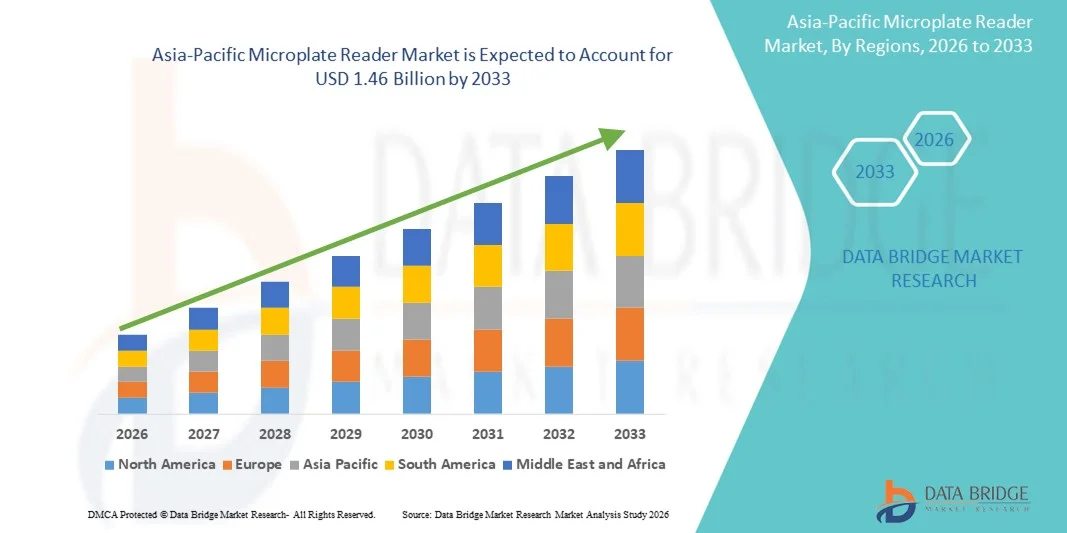
- The Asia-Pacific microplate reader market size was valued at USD 1.02 billion in 2025 and is expected to reach USD 1.46 billion by 2033, at a CAGR of 4.6% during the forecast period
- The market growth is mainly driven by expanding applications in biotechnology research, clinical diagnostics, and drug discovery, along with increasing adoption of point‑of‑care testing (POCT) and laboratory automation technologies across the region
- The rising investments in healthcare infrastructure, growing emphasis on rapid and accurate diagnostics, and increasing R&D activities in pharmaceutical and life science sectors are boosting demand for advanced microplate reader systems in countries such as China, Japan, and India
Asia-Pacific Microplate Reader Market Analysis
- Microplate readers, analytical instruments used to detect biological, chemical, or physical events in samples in microtiter plates, are increasingly vital components of modern laboratories, diagnostics, and research facilities in both academic and industrial settings due to their precision, high throughput, and ability to support diverse assay types
- The escalating demand for microplate readers is primarily fueled by growing investments in pharmaceutical and biotechnology R&D, increasing adoption of laboratory automation, rising healthcare spending, and expanding clinical diagnostics across Asia-Pacific countries
- China dominated the Asia-Pacific microplate reader market with the largest revenue share of 38.2% in 2025, driven by rapid expansion in pharmaceutical and biotechnology research infrastructure, government initiatives supporting innovation, and the presence of leading manufacturers
- India is expected to be the fastest-growing country in the Asia-Pacific microplate reader market during the forecast period due to advanced research ecosystems, expanding clinical and biotech pipelines, and increasing adoption of point-of-care testing technologies
- Multi-mode microplate readers segment dominated the market with a market share of 55.9% during the forecast period due to demand for versatile platforms capable of supporting high-throughput and multiplexed workflows
Report Scope and Asia-Pacific Microplate Reader Market Segmentation
|
Attributes |
Asia-Pacific Microplate Reader Key Market Insights |
|
Segments Covered |
|
|
Countries Covered |
Asia-Pacific
|
|
Key Market Players |
|
|
Market Opportunities |
|
|
Value Added Data Infosets |
In addition to the insights on market scenarios such as market value, growth rate, segmentation, geographical coverage, and major players, the market reports curated by the Data Bridge Market Research also include in-depth expert analysis, patient epidemiology, pipeline analysis, pricing analysis, and regulatory framework |
Asia-Pacific Microplate Reader Market Trends
Advancements in Multi-Mode and High-Throughput Automation
- A significant and accelerating trend in the Asia-Pacific microplate reader market is the increasing adoption of multi-mode readers combined with high-throughput automation, enhancing assay versatility and laboratory efficiency
- For instance, the BioTek Cytation 5 combines absorbance, fluorescence, and luminescence detection in a single platform, enabling automated workflows for drug discovery and clinical diagnostics
- Integration with AI and software analytics allows these readers to optimize assay conditions, track patterns in experimental data, and provide intelligent reporting for researchers
- The seamless integration of multi-mode readers with automated liquid handling systems and laboratory information management systems (LIMS) allows centralized control over multiple experiments and sample types, reducing manual intervention
- This trend towards versatile, automated, and data-driven microplate reader systems is reshaping expectations for laboratory throughput and precision, prompting companies such as Molecular Devices to develop next-generation readers with AI-enabled analytics
- The demand for microplate readers with multi-mode capability and automated high-throughput functions is growing rapidly across pharmaceutical, biotechnology, and clinical research laboratories as productivity and reproducibility become critical
- Rising interest in personalized medicine and biomarker research is driving demand for microplate readers capable of supporting multiplexed assays and sensitive detection methods
- Increasing collaborations between academic institutions, hospitals, and biotech companies in Asia-Pacific are promoting the adoption of advanced microplate readers for translational research and drug development projects
Asia-Pacific Microplate Reader Market Dynamics
Driver
Increasing Demand Due to Expanding Biotechnology and Clinical Research
- The growing investments in biotechnology R&D, clinical diagnostics, and pharmaceutical research in Asia-Pacific are significant drivers for the increasing demand for microplate readers
- For instance, in March 2025, Tecan announced the deployment of automated microplate readers in Indian pharmaceutical labs to accelerate drug discovery workflows
- As research intensity rises, microplate readers offer high-throughput, reproducible, and accurate assay measurements, providing a compelling advantage over manual laboratory techniques
- Furthermore, the proliferation of laboratory automation and adoption of LIMS in China, Japan, and India makes microplate readers an integral part of modern laboratory infrastructure
- Ease of use, software integration, and the ability to handle diverse assay types are key factors propelling microplate reader adoption in academic, industrial, and clinical research laboratories, with DIY automation setups gaining popularity in smaller labs
- Government initiatives supporting healthcare innovation and funding for R&D in countries such as China and India are further boosting the adoption of advanced laboratory instruments, including microplate readers
- Increasing outsourcing of drug discovery and diagnostic testing to contract research organizations (CROs) in the region is creating additional demand for high-throughput microplate readers
Restraint/Challenge
High Cost and Technical Complexity of Advanced Systems
- The relatively high cost of multi-mode and automated microplate reader systems poses a challenge to widespread adoption, particularly for small and medium-sized laboratories in developing countries
- For instance, advanced readers from PerkinElmer or BioTek may cost several times more than basic single-mode units, limiting access for budget-constrained labs
- Addressing technical complexity and the need for trained personnel to operate and maintain these systems is crucial for broader market penetration
- Although prices are gradually decreasing and training programs are becoming more available, the perceived difficulty of operating high-end readers can hinder adoption, especially in smaller academic and clinical labs
- Overcoming these challenges through cost-effective solutions, simplified interfaces, and local support services will be vital for sustained market growth in Asia-Pacific
- Limited awareness about advanced assay techniques and microplate reader functionalities in emerging markets can slow adoption rates among new users
- Maintenance and calibration requirements of sophisticated multi-mode readers add operational challenges for laboratories with limited technical expertise or infrastructure
Asia-Pacific Microplate Reader Market Scope
The market is segmented on the basis of well system, product type, application, end user, and distribution channel.
- By Well System
On the basis of well system, the Asia-Pacific microplate reader market is segmented into 96 wells, 384 wells, 1536 wells, and others. The 96-well segment dominated the market with the largest share of 52% in 2025, driven by its widespread use in routine laboratory workflows and compatibility with most assay types. Laboratories in China, Japan, and India often prefer 96-well plates for ELISA, protein, and nucleic acid detection due to standardization of protocols. The segment is cost-effective for academic, clinical, and industrial labs, ensuring steady demand. Integration with automated liquid handling systems allows efficient processing of multiple samples with reduced manual intervention. Smaller research labs and educational institutions also favor 96-well plates due to their simplicity and affordability. The reliability and versatility of 96-well formats continue to reinforce its dominance across end-user segments.
The 384-well segment is expected to witness the fastest growth at a CAGR of 7.5% from 2025 to 2033, fueled by increasing demand for high-throughput screening in drug discovery and biomarker research. Pharmaceutical and biotech companies in Japan and China are adopting 384-well plates to optimize reagent usage and accelerate experimental workflows. The trend of miniaturization in advanced research and multiplexed assays supports higher adoption rates. High-throughput systems reduce time and operational costs per assay, which is critical for large-scale projects. The growing focus on precision medicine and biomarker discovery further drives demand for 384-well systems. Emerging CROs in India are also deploying 384-well plates to improve efficiency in outsourced research projects.
- By Product Type
On the basis of product type, the market is segmented into multi-mode microplate readers, automated ELISA systems, automated nucleic acid purification systems, and single-mode microplate readers. The multi-mode microplate readers segment dominated the market with a market share of 55.9% in 2025, due to its versatility in supporting absorbance, fluorescence, and luminescence detection in a single platform. Multi-mode readers are widely adopted in pharmaceutical, biotechnology, and academic laboratories in China, Japan, and India for high-throughput screening, biomarker analysis, and protein/nucleic acid quantification. The integration with AI-based analytics and laboratory automation improves assay reproducibility, workflow efficiency, and data accuracy. Hospitals and diagnostic labs increasingly deploy multi-mode systems for ELISA, molecular biology, and multiplexed assays. The segment’s ability to consolidate multiple assay types into one instrument reduces operational costs and lab footprint, reinforcing its dominance. Strong demand from large research organizations and CROs further contributes to its leading position in the Asia-Pacific market.
The single-mode microplate reader segment is anticipated to witness the fastest growth at a CAGR of 8% during the forecast period, driven by increasing adoption in smaller laboratories, academic institutions, and diagnostic facilities. Single-mode readers are cost-effective, easy to operate, and compatible with standard 96-well plates, making them suitable for routine absorbance, fluorescence, or luminescence assays. Growing research activities in emerging biotech companies and hospitals in India and China are boosting the need for affordable, reliable single-mode readers. The segment benefits from increasing awareness of laboratory automation and integration with LIMS for data management. Single-mode readers are increasingly chosen for budget-conscious setups requiring basic yet precise assay capabilities. The combination of accessibility, simplicity, and versatility supports rapid adoption across a wide range of end users.
- By Application
On the basis of application, the market is segmented into protein and nucleic acid detection, enzyme-linked immunosorbent assay (ELISA), and others. The ELISA segment dominated with a market share of 50% in 2025, owing to its extensive use in diagnostics, immunology research, and clinical testing. Hospitals, diagnostic labs, and academic research institutes in China, Japan, and India extensively use ELISA assays for biomarker detection. The segment benefits from standardized protocols, high assay reproducibility, and widespread adoption in both small and large laboratories. ELISA readers are essential for routine testing and disease screening programs, ensuring consistent demand. Integration with automated systems and software analytics enhances efficiency and reduces human error. The segment’s reliability and accuracy continue to drive growth in both clinical and research applications.
The protein and nucleic acid detection segment is expected to witness the fastest growth at a CAGR of 7.8% from 2025 to 2033, driven by increasing genomics and proteomics research, molecular biology studies, and personalized medicine initiatives. High-throughput and multi-mode readers are increasingly deployed for these applications to handle complex workflows. Pharmaceutical and biotech companies in India and Japan are leveraging these systems for biomarker discovery and advanced research projects. Integration with laboratory automation and AI-based analytics improves data accuracy and reduces assay time. The rising focus on translational research in Asia-Pacific is creating additional demand. Emerging diagnostic labs are also adopting specialized detection assays to expand service offerings.
- By End User
On the basis of end user, the market is segmented into biotechnology and pharmaceutical companies, contract research organizations (CROs), diagnostic laboratories, hospitals, research and academic institutes, and others. The biotechnology and pharmaceutical companies segment dominated with a market share of 47% in 2025, due to large-scale adoption of microplate readers for drug discovery, biomarker analysis, and high-throughput screening. Companies in China, Japan, and India invest heavily in automation and multi-mode readers to improve efficiency and reproducibility. The segment benefits from ongoing R&D initiatives and government funding supporting healthcare innovation. Integration with laboratory information management systems allows centralized data collection and analysis. Pharmaceutical companies rely on these readers for routine and advanced assays, reinforcing their market dominance. Strong budgets and high research intensity make this segment the largest end-user group.
The contract research organization (CRO) segment is expected to witness the fastest growth at a CAGR of 8.2% during the forecast period, fueled by the increasing outsourcing of research and clinical testing in India and China. CROs require high-throughput and multi-mode readers to meet client demands efficiently. The adoption of automation and AI-enabled systems enhances reproducibility and reduces turnaround time for drug discovery projects. Emerging biotech startups also partner with CROs, further increasing demand. The expansion of clinical trials and preclinical research in Asia-Pacific drives additional procurement. CROs are investing in advanced instruments to stay competitive and support a growing portfolio of research services.
- By Distribution Channel
On the basis of distribution channel, the market is segmented into direct tenders and retail sales. The direct tenders segment dominated with a market share of 60% in 2025, driven by bulk procurement by hospitals, research institutes, and pharmaceutical companies. Direct tenders allow large laboratories to negotiate pricing, obtain technical support, and implement system integration for high-throughput workflows. Vendors in China and Japan provide customized solutions and long-term service contracts through direct channels. Integration with laboratory automation and software solutions is easier via direct procurement. Large-scale labs prefer direct tenders for reliability, after-sales service, and technical assistance. This segment’s dominance is reinforced by institutional purchasing policies and government funding.
The retail sales segment is expected to witness the fastest growth at a CAGR of 7% from 2025 to 2033, fueled by adoption in smaller academic labs, startup biotech companies, and individual research facilities. Retail channels allow access to compact and affordable microplate readers, including single-mode and low-throughput systems. Smaller labs benefit from ease of purchase, quicker delivery, and flexible payment options. Growing awareness about advanced laboratory tools among emerging researchers supports retail sales growth. Retail also enables rapid adoption of new instruments without lengthy procurement processes. Startups and small clinics are increasingly acquiring microplate readers through retail channels to support specialized assays and research projects.
Asia-Pacific Microplate Reader Market Regional Analysis
- China dominated the Asia-Pacific microplate reader market with the largest revenue share of 38.2% in 2025, driven by rapid expansion in pharmaceutical and biotechnology research infrastructure, government initiatives supporting innovation, and the presence of leading manufacturers
- Research laboratories, hospitals, and academic institutions in China highly value the accuracy, high-throughput capabilities, and versatile assay support offered by multi-mode microplate readers and automated systems
- This widespread adoption is further supported by the presence of leading instrument manufacturers, growing clinical diagnostics and biopharmaceutical sectors, and increasing demand for standardized and efficient laboratory workflows, establishing microplate readers as essential instruments in China’s research ecosystem
The China Microplate Reader Market Insight
The China microplate reader market captured the largest revenue share of 38.2% in Asia-Pacific in 2025, driven by extensive pharmaceutical, biotechnology, and clinical research activities. High-throughput screening, protein and nucleic acid analysis, and integration with laboratory automation are key factors fueling demand. Researchers increasingly prioritize accurate, reproducible, and efficient assay platforms to support drug discovery and diagnostics. The growing trend of multi-mode readers with AI-enabled analytics and software integration is further propelling market growth. Moreover, government-backed initiatives supporting laboratory modernization and biomedical research significantly contribute to market expansion. Academic, hospital, and industrial laboratories continue to invest in advanced microplate readers to meet increasing research and diagnostic demands.
Japan Microplate Reader Market Insight
The Japan microplate reader market is gaining momentum due to advanced research infrastructure, high-tech laboratories, and the growing demand for accurate and efficient assay platforms. Japanese laboratories increasingly adopt multi-mode readers and automated systems to support drug discovery, protein and nucleic acid research, and clinical diagnostics. Integration with laboratory automation and data analytics is fueling growth. Rapid urbanization and the rising number of smart laboratories are supporting adoption. Japan’s aging population and increasing focus on healthcare innovation are such asly to spur demand in hospitals and research institutes. Precision, reproducibility, and high-throughput capabilities further drive the market.
India Microplate Reader Market Insight
The India microplate reader market accounted for a significant revenue share in Asia-Pacific in 2025, attributed to increasing investments in biotechnology and pharmaceutical R&D, rapid urbanization, and rising healthcare expenditure. India is witnessing growing adoption of multi-mode and automated microplate readers in academic, clinical, and industrial laboratories. Government-backed programs supporting translational research, diagnostic testing, and pharmaceutical innovation are key factors propelling the market. Affordable microplate reader options and the presence of domestic instrument manufacturers further support adoption. The expansion of contract research organizations (CROs) and laboratory automation initiatives is increasing market penetration. Rising research intensity and industrial collaboration are driving consistent demand across the country.
South Korea Microplate Reader Market Insight
The South Korea microplate reader market is witnessing steady growth, driven by the country’s strong biotechnology and pharmaceutical research sectors. Hospitals, diagnostic laboratories, and academic institutions are increasingly adopting multi-mode and automated microplate readers to enhance assay accuracy and throughput. Government initiatives supporting R&D and laboratory modernization are further encouraging adoption. The integration of these readers with laboratory automation and data analytics platforms is improving workflow efficiency and reproducibility. South Korea’s emphasis on precision medicine and molecular diagnostics is creating additional demand for advanced microplate readers. Rising collaborations between domestic research institutes and global pharmaceutical companies are also contributing to market expansion.
Asia-Pacific Microplate Reader Market Share
The Asia-Pacific Microplate Reader industry is primarily led by well-established companies, including:
- Thermo Fisher Scientific Inc. (U.S.)
- Agilent Technologies Inc. (U.S.)
- Promega Corporation (U.S.)
- Bio Rad Laboratories, Inc. (U.S.)
- Berthold Technologies GmbH & Co. KG (Germany)
- BMG LABTECH GmbH (Germany)
- Revvity, Inc. (U.S.)
- Tecan Trading AG (Switzerland)
- Lonza (Switzerland)
- PerkinElmer (U.S.)
- Analytik Jena AG (Germany)
- Biochrom (U.K.)
- Beckman Coulter (U.S.)
- Hamilton Company (U.S.)
- Labcyte (U.S.)
- Phenix Research Products (U.S.)
- Porvair Sciences (U.K.)
- Corning Inc. (U.S.)
- Rayto Life and Analytical Sciences Co., Ltd. (China)
- Awareness Technology, Inc. (U.S.)
What are the Recent Developments in Asia-Pacific Microplate Reader Market?
- In July 2025, Molecular Devices announced the launch of its next‑generation SpectraMax® iD5e and iD3s Multi‑Mode Microplate Readers, designed to meet evolving research needs across absorbance, fluorescence, luminescence, and advanced detection assays with enhanced flexibility and precision, including dual injectors for rapid reagent mixing and optional environmental controls for live‑cell assays
- In February 2024, Thermo Fisher Scientific launched the SpectraMax iD5 Multi‑Mode Microplate Reader, featuring improved sensitivity and a larger dynamic range to support diverse bioassays and enhance laboratory efficiency in research and diagnostic workflows. This product introduction underscores the ongoing innovation in microplate reader technology aimed at high‑throughput and multifaceted research applications
- In August 2023, Lonza introduced the Nebula Absorbance Reader, a new microplate reader optimized for endotoxin and pyrogen testing, expanding the range of specialized instruments available to clinical and biopharmaceutical laboratories. This development highlights continued diversification of microplate reader products to support specific testing niches within life sciences
- In April 2023, BMG Labtech unveiled the PHERAstar FSX microplate reader, showcased at SLAS 2023, which offers enhanced performance and reliability for high‑throughput screening assays, improving data quality and consistency across research applications. This release demonstrates ongoing innovation in multi‑mode detection and throughput capabilities for drug discovery and academic research labs
- In April 2022, Molecular Devices launched the SpectraMax® Mini Multi‑Mode Microplate Reader, a compact and budget‑friendly reader that enables absorbance, fluorescence, and luminescence detection in a single unit ideal for academic and biotech laboratories with space or budget constraints. Its launch reflects growing demand for versatile instruments that balance performance with accessibility for smaller research settings

- Interactive Data Analysis Dashboard
- Company Analysis Dashboard for high growth potential opportunities
- Research Analyst Access for customization & queries
- Competitor Analysis with Interactive dashboard
- Latest News, Updates & Trend analysis
- Harness the Power of Benchmark Analysis for Comprehensive Competitor Tracking
Data collection and base year analysis are done using data collection modules with large sample sizes. The stage includes obtaining market information or related data through various sources and strategies. It includes examining and planning all the data acquired from the past in advance. It likewise envelops the examination of information inconsistencies seen across different information sources. The market data is analysed and estimated using market statistical and coherent models. Also, market share analysis and key trend analysis are the major success factors in the market report. To know more, please request an analyst call or drop down your inquiry.
The key research methodology used by DBMR research team is data triangulation which involves data mining, analysis of the impact of data variables on the market and primary (industry expert) validation. Data models include Vendor Positioning Grid, Market Time Line Analysis, Market Overview and Guide, Company Positioning Grid, Patent Analysis, Pricing Analysis, Company Market Share Analysis, Standards of Measurement, Global versus Regional and Vendor Share Analysis. To know more about the research methodology, drop in an inquiry to speak to our industry experts.
Data Bridge Market Research is a leader in advanced formative research. We take pride in servicing our existing and new customers with data and analysis that match and suits their goal. The report can be customized to include price trend analysis of target brands understanding the market for additional countries (ask for the list of countries), clinical trial results data, literature review, refurbished market and product base analysis. Market analysis of target competitors can be analyzed from technology-based analysis to market portfolio strategies. We can add as many competitors that you require data about in the format and data style you are looking for. Our team of analysts can also provide you data in crude raw excel files pivot tables (Fact book) or can assist you in creating presentations from the data sets available in the report.













