


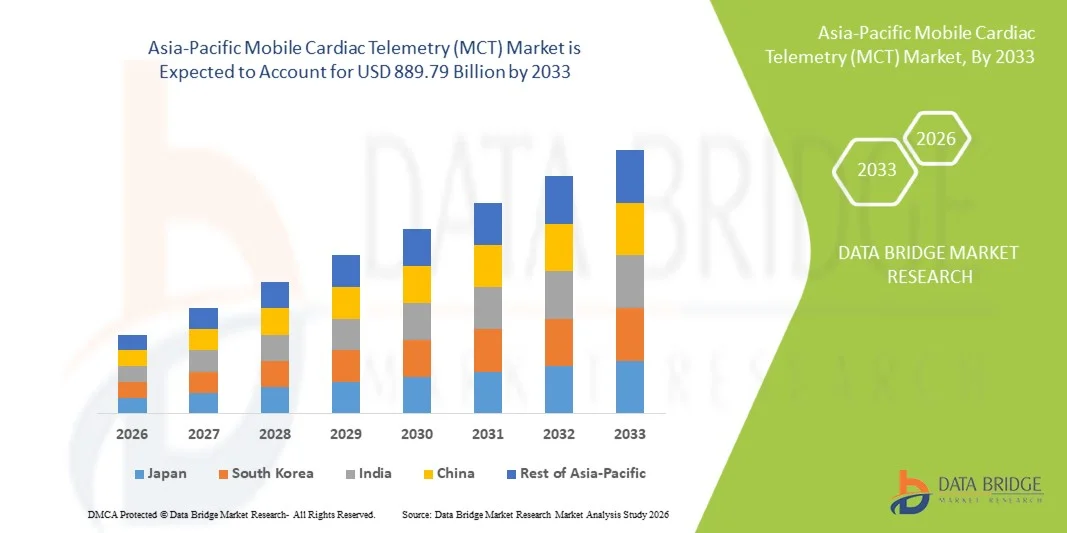
Asia-Pacific Mobile Cardiac Telemetry (MCT) Market Size
- The Asia-Pacific Mobile Cardiac Telemetry (MCT) market size was valued at USD 330.00 million in 2025 and is expected to reach USD 889.79 million by 2033, at a CAGR of 13.2% during the forecast period
- The market growth is largely fueled by the increasing prevalence of cardiovascular diseases, rising geriatric population, and the growing adoption of remote patient monitoring technologies in both urban and rural healthcare settings
- Furthermore, advancements in wearable devices, real-time data transmission, and AI-enabled cardiac monitoring solutions are driving demand for efficient, accurate, and patient-friendly cardiac care. These converging factors are accelerating the adoption of MCT solutions, thereby significantly boosting the industry's growth
Asia-Pacific Mobile Cardiac Telemetry (MCT) Market Analysis
- Mobile cardiac telemetry (MCT) devices, providing real-time remote monitoring of patients’ cardiac activity, are becoming essential tools in modern cardiovascular care in both hospital and home healthcare settings due to their continuous monitoring capabilities, early arrhythmia detection, and seamless integration with digital health platforms
- The escalating demand for MCT is primarily fueled by the rising prevalence of cardiovascular diseases, increasing awareness of remote patient monitoring, and a growing preference for non-invasive, real-time cardiac monitoring solutions
- Japan dominated the Asia-Pacific MCT market with the largest revenue share of 32.8% in 2025, characterized by advanced healthcare infrastructure, high adoption of digital health technologies, and a strong presence of key industry players, with innovations in wearable sensors, AI-based analytics, and cloud-enabled platforms driving growth
- China is expected to be the fastest growing country in the Asia-Pacific MCT market during the forecast period due to increasing healthcare digitization, rising geriatric population, and expanding remote cardiac monitoring initiatives in both urban and semi-urban areas
- Patch Based segment dominated the market with a market share of 46.7% in 2025, driven by their ease of use, patient comfort, and ability to provide continuous, real-time cardiac monitoring outside clinical settings
Report Scope and Asia-Pacific Mobile Cardiac Telemetry (MCT) Market Segmentation
|
Attributes |
Asia-Pacific Mobile Cardiac Telemetry (MCT) Key Market Insights |
|
Segments Covered |
|
|
Countries Covered |
Asia-Pacific
|
|
Key Market Players |
|
|
Market Opportunities |
|
|
Value Added Data Infosets |
In addition to the insights on market scenarios such as market value, growth rate, segmentation, geographical coverage, and major players, the market reports curated by the Data Bridge Market Research also include in-depth expert analysis, patient epidemiology, pipeline analysis, pricing analysis, and regulatory framework |
Asia-Pacific Mobile Cardiac Telemetry (MCT) Market Trends
“Advancements Through AI-Enabled Analytics and Cloud Integration”
- A significant and accelerating trend in the Asia-Pacific MCT market is the integration of artificial intelligence (AI) and cloud-based platforms with wearable cardiac monitoring devices, enabling real-time analysis and predictive insights for arrhythmia detection
- For instance, BioTelemetry’s AI-enabled MCT platform can analyze vast amounts of patient ECG data in real time, identifying irregularities and alerting clinicians immediately. Similarly, iRhythm’s Zio service leverages cloud analytics to provide comprehensive, remote cardiac monitoring reports to physicians
- AI integration in MCT devices facilitates continuous learning from patient cardiac patterns, enhancing diagnostic accuracy, reducing false positives, and providing predictive alerts for potential cardiac events. Furthermore, cloud connectivity allows physicians to access patient data remotely, improving workflow efficiency and patient management
- The seamless integration of MCT devices with electronic health record (EHR) systems and telehealth platforms enables centralized patient monitoring, allowing cardiologists to track multiple patients from a single interface and make timely clinical decisions
- This trend toward intelligent, connected, and remotely accessible cardiac monitoring is reshaping patient care models. Consequently, companies such as AliveCor are developing AI-assisted MCT devices with real-time data transmission, predictive arrhythmia detection, and cloud-based reporting features
- The demand for MCT devices that offer AI-driven analytics and cloud connectivity is growing rapidly across hospitals, clinics, and home healthcare settings, as healthcare providers prioritize efficient, accurate, and continuous cardiac monitoring
Asia-Pacific Mobile Cardiac Telemetry (MCT) Market Dynamics
Driver
“Increasing Cardiovascular Disease Burden and Telehealth Adoption”
- The rising prevalence of cardiovascular diseases in Asia-Pacific, combined with increasing acceptance of telehealth and remote patient monitoring solutions, is a major driver of MCT adoption
- For instance, in March 2025, iRhythm Technologies expanded its MCT services in India, targeting patients with high risk of arrhythmias and leveraging remote monitoring platforms to improve early detection and intervention
- As healthcare systems face growing pressure to manage chronic cardiac conditions efficiently, MCT devices offer continuous monitoring, real-time alerts, and actionable data for physicians, providing a compelling alternative to periodic ECGs or Holter monitoring
- Furthermore, government initiatives promoting digital health infrastructure and remote patient management in countries such as Japan and China are accelerating the integration of MCT devices into standard cardiac care practices
- The convenience of home-based monitoring, reduced hospital visits, and the ability to track multiple patients remotely are key factors propelling MCT adoption in both clinical and home healthcare settings. The increasing availability of wearable, user-friendly MCT devices further supports market growth
Restraint/Challenge
“Data Security Concerns and Regulatory Hurdles”
- Concerns regarding patient data privacy, cybersecurity vulnerabilities, and compliance with regulatory standards pose significant challenges to MCT market expansion. MCT devices transmit sensitive ECG data over networks, making them potential targets for data breaches
- For instance, reports of vulnerabilities in connected medical devices have made some hospitals and patients cautious about adopting remote cardiac monitoring solutions, including MCT
- Addressing these concerns through secure data encryption, compliance with HIPAA and regional data privacy regulations, and frequent software updates is critical for building trust among healthcare providers and patients. Companies such as BioTelemetry emphasize secure cloud infrastructure and encrypted data transmission in their offerings. In addition, the relatively high cost of advanced MCT devices compared to traditional Holter monitors can restrict adoption in price-sensitive markets, particularly in emerging countries
- While lower-cost alternatives are gradually entering the market, premium features such as AI-based predictive analytics, extended monitoring duration, and cloud-enabled reporting often come at a higher price point, limiting accessibility for some healthcare providers
- Overcoming these challenges through stronger cybersecurity protocols, regulatory adherence, and the development of cost-effective, reliable MCT solutions will be essential for sustained growth in the Asia-Pacific market
Asia-Pacific Mobile Cardiac Telemetry (MCT) Market Scope
The market is segmented on the basis of technology, type, cellular connection, and end user.
- By Technology
On the basis of technology, the Asia-Pacific MCT market is segmented into lead-based and patch-based devices. The patch-based segment dominated the market with the largest revenue share of 46.7% in 2025, driven by their non-invasive design, patient comfort, and continuous cardiac monitoring capability. Patch-based devices are widely preferred in home healthcare and hospital settings due to their ease of application and minimal interference with daily activities. They are also compatible with advanced telehealth platforms, allowing remote data transmission and real-time monitoring by clinicians. The convenience of disposable patches, longer wear duration, and integration with AI-enabled analytics further enhance their adoption. In addition, healthcare providers favor patch-based MCT for its ability to capture high-quality ECG data over extended periods, improving diagnostic accuracy for arrhythmias and other cardiac abnormalities.
The lead-based segment is anticipated to witness the fastest growth rate from 2026 to 2033, fueled by its multi-channel monitoring capability and adoption in hospitals and specialized cardiac centers. Lead-based devices are preferred for patients requiring detailed, clinical-grade ECG analysis, particularly for complex cardiac cases. Their ability to provide multiple lead recordings simultaneously allows for precise arrhythmia detection and better-informed treatment decisions. Moreover, hospitals and diagnostic facilities increasingly deploy lead-based MCT as part of integrated cardiac monitoring programs, supporting early detection and proactive patient management.
- By Type
On the basis of type, the MCT market is segmented into single-channel and multi-channel devices. The single-channel segment dominated the market in 2025 due to its simplicity, affordability, and suitability for routine monitoring of patients with mild to moderate arrhythmia risk. Single-channel devices are widely used in home healthcare settings where ease of use, comfort, and minimal maintenance are priorities. They provide reliable ECG data for initial screening and follow-up, making them a popular choice among general practitioners and remote patient monitoring providers. Their lightweight and compact design enhances patient compliance, while smartphone integration allows seamless data sharing with healthcare professionals. In addition, single-channel MCT devices are increasingly being adopted in emerging markets due to cost-effectiveness and minimal training requirements for both patients and caregivers.
The multi-channel segment is expected to witness the fastest growth from 2026 to 2033, driven by the increasing prevalence of complex cardiovascular conditions and the need for detailed cardiac analysis. Multi-channel devices are preferred in hospitals, cardiac centers, and IDTFs where comprehensive, high-fidelity ECG data is essential for diagnosis and treatment planning. Their ability to monitor multiple cardiac vectors simultaneously allows clinicians to detect subtle abnormalities that single-channel devices might miss. Furthermore, advancements in compact, multi-channel MCT devices with wireless connectivity are supporting broader adoption in both clinical and home-based monitoring programs.
- By Cellular Connection
On the basis of cellular connection, the market is segmented into wireless (Wi-Fi) and Bluetooth (BT) enabled devices. The wireless (Wi-Fi) segment held the largest revenue share in 2025 due to its capability to provide continuous, real-time data transmission to remote monitoring platforms. Wi-Fi-enabled MCT devices are widely used in hospital and home healthcare settings where uninterrupted monitoring and cloud-based data storage are critical. They allow healthcare providers to access patient ECG data instantly, enhancing clinical decision-making and response time for cardiac events. Integration with telehealth platforms and AI-based analytics further strengthens the adoption of Wi-Fi MCT devices. In addition, Wi-Fi connectivity supports remote updates and software enhancements, ensuring devices remain compliant with evolving clinical standards.
The Bluetooth segment is expected to witness the fastest CAGR from 2026 to 2033, driven by its low power consumption, easy pairing with smartphones, and localized data transmission capabilities. Bluetooth-enabled MCT devices are particularly suited for home healthcare and ambulatory settings, where mobility and patient convenience are priorities. They offer secure, short-range communication with minimal interference, making them reliable for day-to-day monitoring. The growing use of smartphone apps to manage patient data and share ECG reports with clinicians is also driving Bluetooth MCT adoption across Asia-Pacific.
- By End User
On the basis of end user, the Asia-Pacific MCT market is segmented into home healthcare, hospitals, independent diagnostic testing facilities (IDTFs), cardiac centers, and ambulatory surgical centers. The hospitals segment dominated the market in 2025 due to the high volume of cardiac patients, advanced monitoring requirements, and established telehealth infrastructure. Hospitals prefer MCT devices that offer continuous monitoring, AI-enabled analysis, and cloud connectivity to manage patient care efficiently. The ability to track multiple patients simultaneously and integrate with hospital information systems enhances workflow efficiency and clinical outcomes. In addition, hospitals are investing in both patch-based and lead-based MCT devices to address diverse patient needs, from routine monitoring to complex cardiac diagnostics.
The home healthcare segment is expected to witness the fastest growth from 2026 to 2033, fueled by the rising geriatric population, increasing awareness of remote cardiac monitoring, and the convenience of in-home care. Patients and caregivers prefer wearable MCT devices for continuous monitoring without frequent hospital visits. Telehealth integration allows physicians to receive real-time ECG data, provide timely interventions, and manage chronic cardiac conditions effectively from a distance. Furthermore, government initiatives and reimbursement programs supporting remote healthcare services in countries such as Japan, China, and India are accelerating the adoption of MCT in home healthcare settings.
Asia-Pacific Mobile Cardiac Telemetry (MCT) Market Regional Analysis
- Japan dominated the Asia-Pacific MCT market with the largest revenue share of 32.8% in 2025, characterized by advanced healthcare infrastructure, high adoption of digital health technologies, and a strong presence of key industry players, with innovations in wearable sensors, AI-based analytics, and cloud-enabled platforms driving growth
- Patients and healthcare providers in the region highly value the convenience, continuous monitoring, and real-time data access offered by MCT devices, enabling timely diagnosis and intervention for arrhythmias and other cardiac conditions
- This widespread adoption is further supported by strong government initiatives promoting telehealth, high healthcare expenditure, and the integration of AI-enabled analytics and cloud-based platforms, establishing MCT as a preferred solution in hospitals, cardiac centers, and home healthcare settings
The Japan Mobile Cardiac Telemetry (MCT) Market Insight
The Japan MCT market is gaining momentum due to the country’s advanced healthcare infrastructure, high technology adoption, and rising incidence of cardiovascular diseases. Continuous cardiac monitoring, integration with telehealth platforms, and AI-enabled predictive analytics are fueling market growth. Moreover, Japan’s aging population is driving demand for convenient, reliable, and non-invasive cardiac monitoring solutions in both residential and hospital settings, making MCT a preferred technology. Government support for digital health initiatives and reimbursement policies further accelerates adoption across home healthcare and clinical environments.
India Mobile Cardiac Telemetry (MCT) Market Insight
The India MCT market accounted for the largest revenue share in Asia-Pacific in 2025, attributed to the growing prevalence of cardiac conditions, expanding geriatric population, and rapid adoption of wearable healthcare technologies. Home healthcare programs and hospitals are increasingly leveraging MCT solutions for early arrhythmia detection. Government initiatives promoting telemedicine, the push toward smart health cities, and availability of affordable MCT devices are key factors driving adoption. The rising awareness among patients and healthcare providers about continuous cardiac monitoring is also fueling market growth.
China Mobile Cardiac Telemetry (MCT) Market Insight
The China MCT market is expected to witness significant growth during the forecast period, driven by the rising burden of cardiovascular diseases, increasing geriatric population, and government focus on digital health and remote patient monitoring. Hospitals and cardiac centers are increasingly deploying MCT devices to improve arrhythmia detection and reduce hospital readmissions. The integration of AI-enabled analytics and cloud-based monitoring platforms is enhancing the efficiency and accuracy of cardiac telemetry services. Furthermore, growing healthcare infrastructure in tier-2 and tier-3 cities is expanding access to MCT solutions.
Australia Mobile Cardiac Telemetry (MCT) Market Insight
The Australia MCT market is poised for growth due to the high prevalence of cardiovascular diseases and the country’s strong focus on home-based healthcare solutions. Adoption of wearable and patch-based cardiac monitoring devices is increasing among patients for remote arrhythmia detection. The government’s digital health initiatives, telemedicine infrastructure, and reimbursement policies for remote monitoring services are significant drivers. In addition, increasing patient awareness and preference for non-invasive, continuous cardiac monitoring is boosting market penetration across hospitals and home healthcare services.
Asia-Pacific Mobile Cardiac Telemetry (MCT) Market Share
The Asia-Pacific Mobile Cardiac Telemetry (MCT) industry is primarily led by well-established companies, including:
- iRhythm Technologies, Inc. (U.S.)
- Koninklijke Philips N.V. (Netherlands)
- Biotricity, Inc. (U.S.)
- Medtronic (Ireland)
- GE Healthcare (U.S.)
- Boston Scientific Corporation (U.S.)
- Hill‑Rom Holdings, Inc. (U.S.)
- Spacelabs Healthcare (U.S.)
- CardioNet, Inc. (U.S.)
- ScottCare Corporation (U.S.)
- Applied Cardiac Systems, Inc. (U.S.)
- Medicomp, Inc. (U.S.)
- ZOLL Medical Corporation (U.S.)
- Bittium Corporation (Finland)
- NIHON KOHDEN CORPORATION (Japan)
- Schiller AG (Switzerland)
- Cardiac Science Corporation (U.S.)
- BPL Medical Technologies (India)
- VivaLNK, Inc. (U.S.)
- Qardio, Inc. (U.S.)
What are the Recent Developments in Asia-Pacific Mobile Cardiac Telemetry (MCT) Market?
- In November 2025, At the 2025 joint scientific session of Asia Pacific Heart Rhythm Society (APHRS) and Japanese Heart Rhythm Society (JHRS), iRhythm presented new real‑world data from over 400,000 patients showing that the Zio long‑term continuous ECG monitoring (LTCM) system performs equivalently in Asian and non‑Asian populations in terms of wear-time, analyzable data, and arrhythmia detection yield supporting generalizability of the technology for APAC deployment
- In May 2025, iRhythm Technologies launched its Zio ECG Recording and Analysis System commercially in Japan, offering up to 14 days of continuous AI‑powered ECG monitoring. This represents a substantial upgrade over traditional 24–48 hour Holter monitors, addressing rising arrhythmia detection needs in an aging Japanese population
- In September 2024, The Zio monitor (next‑generation patch‑based LTCM device from iRhythm) received regulatory approval from Japan’s Pharmaceuticals and Medical Devices Agency (PMDA), making it the first 14‑day cardiac monitoring service in its category cleared in Japan clearing the regulatory barrier for long-term ambulatory monitoring in one of APAC’s largest cardiac markets
- In September 2024, At the HRX 2024 Meeting (Heart Rhythm Society’s conference), iRhythm unveiled real-world evidence that its next‑generation Zio monitor delivers superior performance compared to its predecessor (Zio XT): fewer early wear terminations, longer wear duration, longer analyzable ECG time, fewer reports of skin irritation, and higher detection yield for arrhythmias enhancing patient comfort and diagnostic reliability
- In September 2024, iRhythm Technologies announced that its Zio ECG Monitoring System received regulatory approval from the Pharmaceuticals and Medical Devices Agency (PMDA) in Japan making it the first 14‑day continuous, AI‑powered ambulatory ECG monitoring service approved in that country

- Interactive Data Analysis Dashboard
- Company Analysis Dashboard for high growth potential opportunities
- Research Analyst Access for customization & queries
- Competitor Analysis with Interactive dashboard
- Latest News, Updates & Trend analysis
- Harness the Power of Benchmark Analysis for Comprehensive Competitor Tracking
Data collection and base year analysis are done using data collection modules with large sample sizes. The stage includes obtaining market information or related data through various sources and strategies. It includes examining and planning all the data acquired from the past in advance. It likewise envelops the examination of information inconsistencies seen across different information sources. The market data is analysed and estimated using market statistical and coherent models. Also, market share analysis and key trend analysis are the major success factors in the market report. To know more, please request an analyst call or drop down your inquiry.
The key research methodology used by DBMR research team is data triangulation which involves data mining, analysis of the impact of data variables on the market and primary (industry expert) validation. Data models include Vendor Positioning Grid, Market Time Line Analysis, Market Overview and Guide, Company Positioning Grid, Patent Analysis, Pricing Analysis, Company Market Share Analysis, Standards of Measurement, Global versus Regional and Vendor Share Analysis. To know more about the research methodology, drop in an inquiry to speak to our industry experts.
Data Bridge Market Research is a leader in advanced formative research. We take pride in servicing our existing and new customers with data and analysis that match and suits their goal. The report can be customized to include price trend analysis of target brands understanding the market for additional countries (ask for the list of countries), clinical trial results data, literature review, refurbished market and product base analysis. Market analysis of target competitors can be analyzed from technology-based analysis to market portfolio strategies. We can add as many competitors that you require data about in the format and data style you are looking for. Our team of analysts can also provide you data in crude raw excel files pivot tables (Fact book) or can assist you in creating presentations from the data sets available in the report.













