


Asia-Pacific Nurse Call System Market Size)
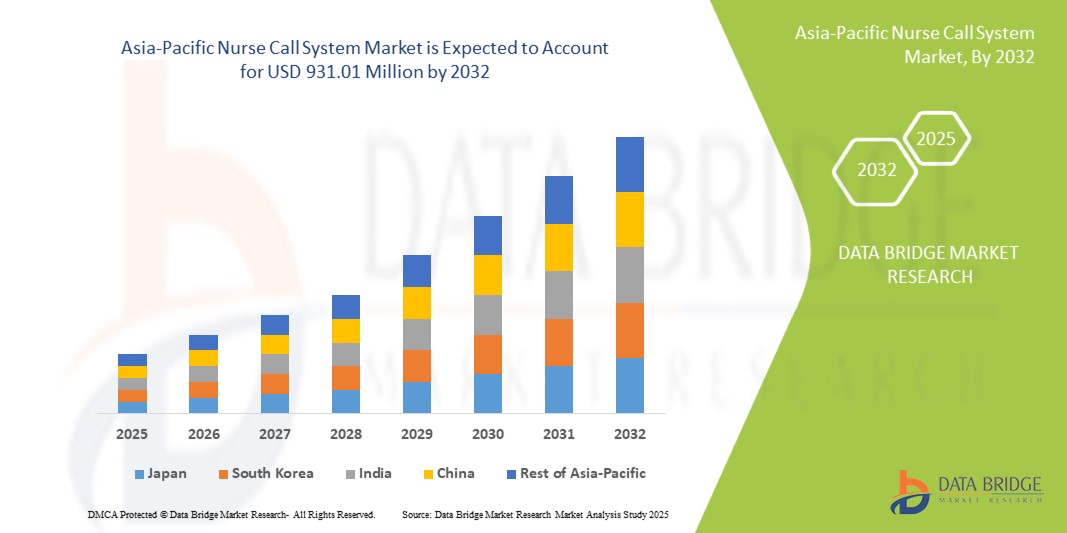
- The Asia-Pacific nurse call system market size was valued at USD 428.06 million in 2024 and is expected to reach USD 931.01 million by 2032, at a CAGR of 10.20% during the forecast period
- The market growth is largely driven by the increasing aging population, rising hospital admissions, and the need for efficient patient monitoring and communication technologies across healthcare facilities
- Furthermore, growing investments in hospital infrastructure, government initiatives to modernize healthcare systems, and the adoption of advanced digital healthcare solutions are positioning nurse call systems as a critical component in patient care delivery. These aligned factors are driving widespread adoption of nurse call solutions, thereby propelling the market's expansion across the region
Asia-Pacific Nurse Call System Market Analysis
- Nurse call systems, enabling effective communication between patients and healthcare staff, are becoming indispensable tools in hospitals and elder care facilities across Asia-Pacific due to their ability to enhance response times, patient monitoring, and clinical workflows
- The rising demand for nurse call systems is primarily driven by the growing elderly population, increasing burden of chronic illnesses, and expanding investments in healthcare infrastructure modernization
- China dominated the Asia-Pacific nurse call system market with the largest revenue share of 35.2% in 2024, supported by strong government healthcare reforms, rapid urbanization, and high demand for hospital automation and elder care technologies
- India is expected to be the fastest growing country in the Asia-Pacific nurse call system market during the forecast period, due to improving healthcare access, rising disposable incomes, and adoption of digital health communication tools
- Wired communication dominated the nurse call system market with a market share of 61.8% in 2024, owing to their reliability, cost-effectiveness, and continued use in existing healthcare facilities with legacy infrastructure
Report Scope and Asia-Pacific Nurse Call System Market Segmentation
|
Attributes |
Asia-Pacific Nurse Call System Key Market Insights |
|
Segments Covered |
|
|
Countries Covered |
Asia-Pacific
|
|
Key Market Players |
|
|
Market Opportunities |
|
|
Value Added Data Infosets |
In addition to the insights on market scenarios such as market value, growth rate, segmentation, geographical coverage, and major players, the market reports curated by the Data Bridge Market Research also include in-depth expert analysis, pricing analysis, brand share analysis, consumer survey, demography analysis, supply chain analysis, value chain analysis, raw material/consumables overview, vendor selection criteria, PESTLE Analysis, Porter Analysis, and regulatory framework. |
Asia-Pacific Nurse Call System Market Trends
“Technological Advancements Driving Intelligent and Wireless Communication”
- A prominent and accelerating trend in the Asia-Pacific nurse call system market is the shift toward advanced wireless communication systems and smart hospital integration, enabling real-time communication between patients and caregivers across diverse healthcare environments
- For instance, leading providers are developing nurse call solutions integrated with real-time location systems (RTLS) and mobile devices, allowing nurses to receive alerts on smartphones or tablets, ensuring quicker and more efficient patient response
- Innovations such as speech-enabled call points, automated bed-exit alerts, and interoperability with electronic health records (EHR) are enhancing patient safety and care coordination. Hospitals in countries such as Japan, South Korea, and Singapore are increasingly adopting such digital solutions as part of broader smart hospital initiatives
- Wireless systems offer flexibility, scalability, and cost-effectiveness, making them ideal for both new healthcare infrastructure and retrofitting older facilities. Their deployment is particularly growing in community hospitals and elder care homes, where installation disruption must be minimized
- This trend toward intelligent nurse call platforms with enhanced data analytics, mobility, and IoT integration is transforming the healthcare communication landscape in Asia-Pacific. Consequently, companies such as Ascom, Hillrom (Baxter), and Nobi are investing in AI-powered and voice-interactive nurse call solutions to meet evolving care delivery needs
- The demand for connected and intelligent nurse call systems is rapidly increasing as healthcare providers seek tools to improve clinical workflows, ensure timely patient care, and comply with evolving patient safety standards
Asia-Pacific Nurse Call System Market Dynamics
Driver
“Rising Elderly Population and Healthcare Infrastructure Development”
- The rapidly aging population across Asia-Pacific, especially in countries such as Japan, China, and South Korea, is driving a growing need for efficient and reliable communication systems in hospitals and long-term care facilities
- For instance, Japan, with nearly 30% of its population aged 65 and above, has been a leader in deploying advanced nurse call systems to ensure continuous patient monitoring and reduce response times in elder care
- Furthermore, significant investments in healthcare infrastructure and government-led digital health initiatives are accelerating the adoption of modern nurse call systems across the region. The expansion of hospitals, elderly care centers, and home-based healthcare services is contributing to this growth
- These systems enhance staff coordination, streamline workflows, and reduce operational inefficiencies, making them critical tools for improving patient outcomes in both urban and rural settings
- As countries across Asia-Pacific continue to invest in upgrading healthcare facilities and implementing smart health solutions, the nurse call system market is expected to witness robust growth, especially in regions transitioning to connected care ecosystems
Restraint/Challenge
“Cost Constraints and Interoperability Issues in Legacy Facilities”
- Despite their benefits, high installation and maintenance costs associated with advanced nurse call systems can be a significant barrier to adoption, particularly in low- and middle-income countries or smaller healthcare settings
- In addition, legacy hospitals and clinics across parts of Southeast Asia may lack the IT infrastructure needed to support fully integrated systems, leading to implementation delays or limited system capabilities
- Interoperability issues with existing hospital information systems (HIS) and electronic medical records (EMR) can further hinder the deployment of next-generation nurse call platforms
- For instance, integrating wireless nurse call systems with older analog systems or outdated nurse stations often requires custom configuration and higher investment, discouraging adoption
- Overcoming these challenges through modular system offerings, government support, vendor training programs, and open architecture platforms will be essential for improving market accessibility and enabling seamless integration across diverse healthcare environments
Asia-Pacific Nurse Call System Market Scope
The market is segmented on the basis of type, technology, application, and end user.
- By Type
On the basis of type, the Asia-Pacific nurse call system market is segmented into button-based systems, integrated communication systems, digital and mobile nurse call systems, intercom systems, basic audio/visual nurse call systems, and others. The integrated communication systems segment dominated the market with the largest market revenue share in 2024, driven by the increasing demand for streamlined communication across hospital departments. These systems integrate with other hospital technologies such as real-time location systems (RTLS), mobile devices, and electronic health records (EHR), enhancing coordination between patients and caregivers and optimizing response times.
The digital and mobile nurse call systems segment is anticipated to witness the fastest growth rate from 2025 to 2032, fueled by the rising adoption of smartphones and mobile-based platforms in healthcare environments. These systems enable nurses to receive alerts and respond on-the-go, significantly improving response efficiency and patient satisfaction. The increased penetration of mobile health infrastructure in countries such as Japan and South Korea further supports this growth.
- By Technology
On the basis of technology, the Asia-Pacific nurse call system market is segmented into wired communication, wireless communication, and hybrid nurse call systems. The wired communication segment held the largest market revenue share of 61.8% in 2024, attributed to its high reliability, minimal latency, and widespread use in established hospitals and care facilities. Wired systems are often preferred in high-dependency care units where continuous, fail-safe communication is essential.
The wireless communication segment is expected to witness the fastest CAGR from 2025 to 2032, driven by ease of installation, flexibility in design, and cost-effectiveness, especially in expanding outpatient departments and aged care facilities. Wireless systems also enable easier scalability and integration with mobile platforms and cloud-based services, making them increasingly popular in emerging healthcare settings.
- By Application
On the basis of application, the Asia-Pacific nurse call system market is segmented into alarms & communications, wanderer control, workflow optimization, fall detection & prevention, and visitor management. The alarms & communications segment dominated the market with the largest market revenue share in 2024, as it represents the core functionality of nurse call systems. Timely alerts and effective communication between patients and staff are crucial for safety and service quality, particularly in high-acuity environments.
The fall detection & prevention segment is anticipated to witness the fastest growth rate from 2025 to 2032, fueled by the growing elderly population across Asia-Pacific. Technologies such as bed-exit alarms, motion sensors, and predictive analytics are increasingly being integrated into nurse call systems to proactively prevent falls and improve patient safety in geriatric and rehabilitation settings.
- By End User
On the basis of end user, the Asia-Pacific nurse call system market is segmented into hospitals, ambulatory surgery centers, nursing homes, medical assisted living centers, long-term care facilities, clinics, physician offices, rehabilitation centers, outpatient departments, and others. The hospital segment dominated the market with the largest market revenue share in 2024, driven by the increasing need for efficient communication systems to manage large patient volumes, particularly in urban and tertiary care hospitals. Hospitals are adopting advanced nurse call systems to improve workflow efficiency, reduce staff fatigue, and ensure better patient engagement.
The long-term care facilities segment is expected to witness the fastest growth rate from 2025 to 2032, driven by the rising prevalence of chronic diseases and the growing aging population across countries such as China, Japan, and South Korea. These facilities are investing in advanced nurse call technologies to provide better supervision, timely interventions, and improved quality of life for residents.
Asia-Pacific Nurse Call System Market Regional Analysis
- China dominated the Asia-Pacific nurse call system market with the largest revenue share of 35.2% in 2024, supported by strong government healthcare reforms, rapid urbanization, and high demand for hospital automation and elder care technologies
- The country’s large aging population, rising burden of chronic diseases, and focus on digital transformation in healthcare have made nurse call systems a critical component in both public and private medical facilities
- This dominance is further supported by growing adoption in tier 2 and tier 3 cities, increased penetration of wireless systems, and active participation from domestic and international vendors offering integrated, scalable, and cost-effective nurse call solutions across hospitals, elderly care centers, and rehabilitation facilities
The China Nurse Call System Market Insight
The China nurse call system market captured the largest revenue share in Asia-Pacific in 2024, fueled by rapid expansion of hospital networks, substantial government investment in healthcare digitalization, and increasing demand for elderly care services. The country’s aging population and urbanization are contributing to widespread adoption of advanced communication systems in both public and private hospitals. The presence of local manufacturers offering cost-effective and scalable solutions further supports China's dominant market position.
Japan Nurse Call System Market Insight
The Japan nurse call system market continues to grow steadily, driven by its aging population and highly advanced healthcare infrastructure. Japanese healthcare providers are at the forefront of adopting integrated communication systems that support real-time alerts, mobility, and patient tracking. The country’s emphasis on patient safety, hospital automation, and long-term elder care is fueling demand for high-performance nurse call solutions. In addition, smart home health technologies are also contributing to growth beyond traditional hospital settings.
India Nurse Call System Market Insight
The India nurse call system market is expected to expand at the fastest CAGR during the forecast period, driven by rapid urbanization, a growing middle-class population, and strong investments in both private and government healthcare sectors. India's ongoing push toward healthcare modernization, including smart hospital initiatives and expanded medical infrastructure in tier 2 and tier 3 cities, is driving the adoption of digital nurse call systems. Affordability, mobile integration, and wireless solutions are especially appealing in the country’s cost-sensitive and rapidly growing market.
South Korea Nurse Call System Market Insight
The South Korea nurse call system market is gaining momentum due to strong government focus on healthcare technology innovation and a rising aging population. Advanced hospitals in South Korea are increasingly integrating nurse call systems with IoT and AI-based tools to enable predictive alerts and workflow optimization. The country’s leadership in mobile and wireless technologies supports widespread adoption of modern, intelligent nurse communication platforms across acute care and elder care settings.
Asia-Pacific Nurse Call System Market Share
The Asia-Pacific nurse call system industry is primarily led by well-established companies, including:
- Ascom (Switzerland)
- Rauland (U.S.)
- Hillrom (U.S.)
- Jeron Electronic Systems, Inc. (U.S.)
- Televic Healthcare (Belgium)
- Cornell Communications, Inc. (U.S.)
- Honeywell International Inc. (U.S.)
- Azure Healthcare Limited (Australia)
- Schrack Seconet AG (Austria)
- Tyco International (Ireland)
- Stanley Healthcare (U.S.)
- Tunstall Healthcare Group Ltd. (U.K.)
- Nobi (Belgium)
- Intercall Systems, Inc. (U.S.)
- Kongsberg Digital (Norway)
- System Technologies Pte Ltd. (Singapore)
- iCall GmbH (Germany)
- Nurse Call Systems Ltd. (U.K.)
- ZKR GmbH (Germany)
- Bosch Security Systems (Germany)
What are the Recent Developments in Asia-Pacific Nurse Call System Market?
- In May 2024, Ascom partnered with a major healthcare provider in Japan to implement its advanced nurse call and clinical workflow solutions across a new network of smart hospitals. The deployment includes integration with electronic medical records (EMRs) and mobile alert systems, aiming to enhance patient safety, streamline care coordination, and improve response times. This development reflects Ascom’s strategic focus on expanding its presence in Asia-Pacific by delivering comprehensive, digital communication platforms tailored to high-tech medical environments
- In March 2024, Hillrom (now part of Baxter International Inc.) announced the launch of an upgraded nurse call system across several long-term care facilities in South Korea. This system includes fall detection sensors, voice-enabled patient stations, and mobile caregiver alerts, offering greater flexibility and improved patient monitoring. The initiative demonstrates Hillrom’s commitment to addressing the needs of aging populations through intelligent and connected care technologies
- In February 2024, Rauland expanded its Responder platform into select hospitals in India as part of a broader initiative to modernize communication infrastructure in emerging healthcare markets. The implementation includes features such as centralized communication dashboards and integration with nurse mobility tools. This move underscores Rauland’s aim to support India’s growing hospital network with scalable and efficient communication systems
- In January 2024, Nobi, a Belgium-based healthcare technology company, entered the Asia-Pacific market through a pilot program in Australia, installing its AI-powered nurse call lamps in elderly care homes. These smart lamps detect falls and communicate instantly with caregivers, combining safety with ambient care. The pilot success indicates growing demand for integrated fall detection and communication tools in the region’s expanding elder care sector
- In December 2023, Televic Healthcare partnered with a regional distributor in Malaysia to deploy its IQ Messenger-based nurse call system in a new private hospital. The system supports wireless integration, mobile notifications, and data logging, offering a flexible communication solution for dynamic care environments. This partnership reflects Televic’s strategy to increase its footprint in Southeast Asia through tailored, interoperable systems that meet regional infrastructure needs

- Interactive Data Analysis Dashboard
- Company Analysis Dashboard for high growth potential opportunities
- Research Analyst Access for customization & queries
- Competitor Analysis with Interactive dashboard
- Latest News, Updates & Trend analysis
- Harness the Power of Benchmark Analysis for Comprehensive Competitor Tracking
Data collection and base year analysis are done using data collection modules with large sample sizes. The stage includes obtaining market information or related data through various sources and strategies. It includes examining and planning all the data acquired from the past in advance. It likewise envelops the examination of information inconsistencies seen across different information sources. The market data is analysed and estimated using market statistical and coherent models. Also, market share analysis and key trend analysis are the major success factors in the market report. To know more, please request an analyst call or drop down your inquiry.
The key research methodology used by DBMR research team is data triangulation which involves data mining, analysis of the impact of data variables on the market and primary (industry expert) validation. Data models include Vendor Positioning Grid, Market Time Line Analysis, Market Overview and Guide, Company Positioning Grid, Patent Analysis, Pricing Analysis, Company Market Share Analysis, Standards of Measurement, Global versus Regional and Vendor Share Analysis. To know more about the research methodology, drop in an inquiry to speak to our industry experts.
Data Bridge Market Research is a leader in advanced formative research. We take pride in servicing our existing and new customers with data and analysis that match and suits their goal. The report can be customized to include price trend analysis of target brands understanding the market for additional countries (ask for the list of countries), clinical trial results data, literature review, refurbished market and product base analysis. Market analysis of target competitors can be analyzed from technology-based analysis to market portfolio strategies. We can add as many competitors that you require data about in the format and data style you are looking for. Our team of analysts can also provide you data in crude raw excel files pivot tables (Fact book) or can assist you in creating presentations from the data sets available in the report.













