


Asia-Pacific Protein Hydrolysates Market Size
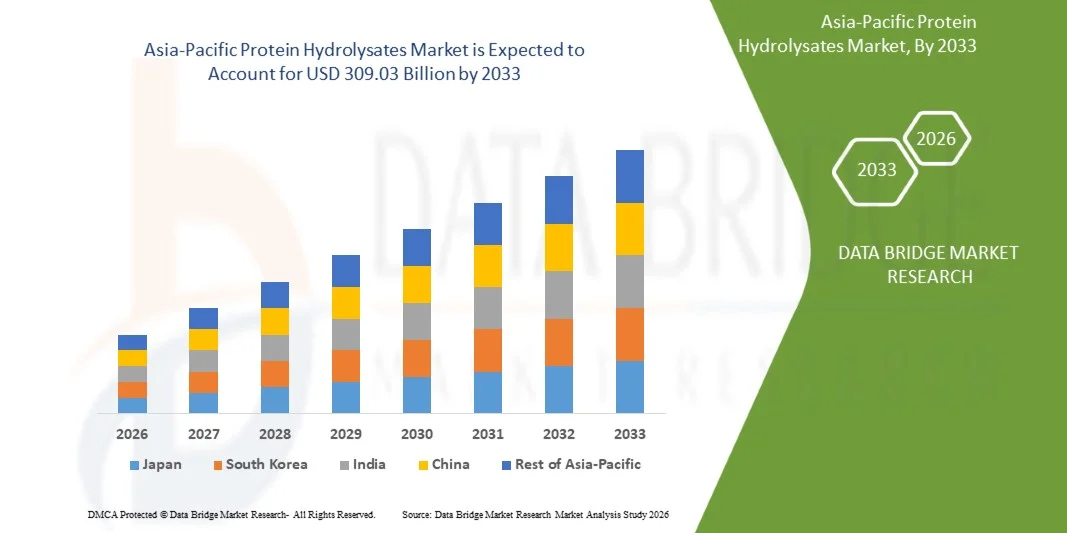
- The Asia-Pacific protein hydrolysates market size was valued at USD 155.54 million in 2025 and is expected to reach USD 309.03 million by 2033, at a CAGR of 6.10% during the forecast period
- The market growth is largely fuelled by the rising demand for functional and high-protein nutritional ingredients across food, beverage, and sports nutrition applications
- Increasing consumer preference for easily digestible protein sources and bioactive peptides is further accelerating product adoption across dietary supplements and clinical nutrition segments
Asia-Pacific Protein Hydrolysates Market Analysis
- The market is witnessing steady growth driven by rising health awareness, increasing fitness trends, and growing demand for protein-enriched diets across Asia-Pacific consumers
- Strong presence of dairy and food processing industries is supporting large-scale adoption of protein hydrolysates in multiple end-use applications
- China held a significant position in the global protein hydrolysates market in 2025, driven by large-scale demand in infant nutrition and dietary supplements. The country’s expanding middle-class population and rising awareness of protein-based health products strongly support market growth
- Japan is expected to witness the highest compound annual growth rate (CAGR) in the Asia-Pacific protein hydrolysates market due to its aging population driving demand for clinical and geriatric nutrition, strong emphasis on high-quality functional food products, and increasing innovation in medical and specialized protein formulations
- The milk protein hydrolysates segment held the largest market revenue share in 2025, driven by its high digestibility, strong amino acid profile, and widespread use in infant formula and clinical nutrition. Milk-based hydrolysates are widely preferred in therapeutic diets and specialized nutritional formulations due to their proven bioavailability and functional benefits. They also play a key role in managing food allergies and digestive sensitivities, further strengthening demand in healthcare applications. Increasing product innovation in hypoallergenic formulations is further supporting segment dominance across global markets
Report Scope and Asia-Pacific Protein Hydrolysates Market Segmentation
|
Attributes |
Asia-Pacific Protein Hydrolysates Key Market Insights |
|
Segments Covered |
|
|
Countries Covered |
Asia-Pacific
|
|
Key Market Players |
|
|
Market Opportunities |
• Expansion In Sports Nutrition And Performance Supplements |
|
Value Added Data Infosets |
In addition to the insights on market scenarios such as market value, growth rate, segmentation, geographical coverage, and major players, the market reports curated by the Data Bridge Market Research also include in-depth expert analysis, pricing analysis, brand share analysis, consumer survey, demography analysis, supply chain analysis, value chain analysis, raw material/consumables overview, vendor selection criteria, PESTLE Analysis, Porter Analysis, and regulatory framework. |
Asia-Pacific Protein Hydrolysates Market Trends
“Rising Demand For Functional And Bioactive Protein Ingredients”
• The increasing focus on functional nutrition is significantly shaping the protein hydrolysates market, as consumers shift toward easily digestible and high bioavailability protein sources. Protein hydrolysates are gaining traction due to their rapid absorption and suitability for sports nutrition, clinical nutrition, and dietary supplements. This trend is strengthening their adoption across food and beverage formulations, encouraging manufacturers to develop advanced protein-based solutions aligned with health and wellness needs
• Growing awareness of health, fitness, and preventive healthcare has accelerated demand for protein hydrolysates in infant nutrition, elderly nutrition, and medical food applications. Health-conscious consumers are increasingly seeking protein ingredients that support muscle recovery, immunity, and digestive health, driving innovation in enzymatic hydrolysis technologies. This has also led to collaborations between ingredient suppliers and nutrition brands to enhance protein functionality and nutritional performance
• Clean-label and high-protein dietary trends are influencing purchasing behavior, with manufacturers focusing on transparency, natural processing methods, and improved protein quality. These factors are helping brands differentiate products in a competitive nutrition market while building consumer trust. Companies are also emphasizing allergen-reduced and hypoallergenic protein solutions to expand product applications across sensitive nutrition categories
• For instance, in 2024, several global nutrition companies introduced advanced whey and plant-based protein hydrolysate formulations for sports recovery and medical nutrition applications. These launches were driven by rising demand for fast-absorbing protein solutions, with distribution across online nutrition platforms, specialty stores, and healthcare channels. The products were positioned to improve recovery time and digestive efficiency, strengthening brand positioning in the functional nutrition segment
• While demand is rising, sustained market expansion depends on cost-effective enzymatic processing, raw material availability, and consistent functional performance. Manufacturers are also focusing on improving taste masking technologies and formulation stability to enhance consumer acceptance across broader food applications
Asia-Pacific Protein Hydrolysates Market Dynamics
Driver
“Growing Demand For Sports Nutrition And Clinical Protein Solutions”
• Rising consumer demand for performance nutrition is a major driver for the protein hydrolysates market, as athletes and fitness-focused individuals prefer rapidly absorbed protein sources. Manufacturers are increasingly incorporating hydrolyzed proteins into supplements to enhance muscle recovery, endurance, and metabolic efficiency. This trend is also encouraging research into improved enzymatic hydrolysis techniques to enhance protein functionality and absorption rate
• Expanding applications in clinical nutrition, infant formula, and geriatric diets are influencing market growth, as protein hydrolysates offer improved digestibility and reduced allergenic potential. Their use in medical nutrition products supports recovery in patients with dietary restrictions and digestive sensitivities, enabling manufacturers to address specialized nutritional needs across diverse consumer groups
• Food, beverage, and nutraceutical companies are actively promoting protein hydrolysate-based formulations through product innovation, fortified foods, and functional beverages. These efforts are supported by growing consumer preference for high-protein diets and preventive healthcare, encouraging partnerships between ingredient suppliers and health-focused brands to enhance product efficacy and nutritional value
• For instance, in 2023, multiple global nutrition manufacturers launched hydrolyzed protein-based recovery shakes and medical nutrition formulations targeting athletes and clinical patients. These introductions were driven by increasing demand for fast-digesting protein solutions, resulting in improved product differentiation and stronger consumer retention in the functional nutrition category
• Although demand continues to rise, wider adoption depends on cost optimization, improved taste profiles, and scalable production technologies. Investment in advanced processing methods and ingredient innovation will be essential to meet growing global demand and maintain competitive positioning
Restraint/Challenge
“High Production Costs And Sensory Limitations Compared To Conventional Proteins”
• The relatively high production cost of protein hydrolysates compared to conventional protein ingredients remains a key challenge, limiting adoption in price-sensitive applications. Enzymatic hydrolysis processes require specialized equipment and controlled conditions, increasing manufacturing complexity and cost. In addition, raw material price fluctuations can further impact overall production economics
• Sensory challenges such as bitterness and off-flavors restrict broader application in food and beverage products. These taste-related limitations require additional processing or flavor masking solutions, increasing formulation complexity. Limited consumer awareness in certain segments also slows adoption, particularly where conventional protein sources remain dominant
• Supply chain constraints and quality consistency issues also affect market growth, as protein hydrolysates require standardized enzymatic processes and strict quality control. Variations in raw material sources can impact product consistency, leading manufacturers to invest in advanced purification and standardization technologies to ensure product reliability
• For instance, in 2024, several nutrition manufacturers reported formulation challenges while integrating hydrolyzed plant and dairy proteins into ready-to-drink beverages due to bitterness masking requirements. Additional flavor optimization steps increased production complexity and cost, impacting product scalability and retail pricing strategies
• Overcoming these challenges will require advancements in enzymatic processing efficiency, improved flavor masking technologies, and cost-effective production methods. Collaboration between ingredient suppliers and food manufacturers will be essential to enhance product quality, reduce costs, and support wider adoption across global nutrition markets
Asia-Pacific Protein Hydrolysates Market Scope
The market is segmented on the basis of type, source, form, process, and application.
• By Type
On the basis of type, the protein hydrolysates market is segmented into milk, meat, marine, plant, eggs, and others. The milk protein hydrolysates segment held the largest market revenue share in 2025, driven by its high digestibility, strong amino acid profile, and widespread use in infant formula and clinical nutrition. Milk-based hydrolysates are widely preferred in therapeutic diets and specialized nutritional formulations due to their proven bioavailability and functional benefits. They also play a key role in managing food allergies and digestive sensitivities, further strengthening demand in healthcare applications. Increasing product innovation in hypoallergenic formulations is further supporting segment dominance across global markets.
The plant protein hydrolysates segment is expected to witness the fastest growth rate from 2026 to 2033, driven by increasing demand for vegan, allergen-free, and sustainable protein sources. Plant-based hydrolysates are gaining strong traction in sports nutrition and dietary supplements, supported by the rising shift toward clean-label and environmentally friendly ingredients. Growing consumer preference for plant-derived alternatives is encouraging manufacturers to expand product portfolios. Advancements in extraction and enzymatic processing are also improving taste and functionality, making plant proteins more competitive in multiple end-use industries.
• By Source
On the basis of source, the market is segmented into animals, plants, and microbes. The animal-based segment held the largest market share in 2025, driven by its extensive use in clinical and infant nutrition due to its high protein quality and established production base. Animal-derived hydrolysates continue to dominate due to their superior functional and nutritional properties. They are widely used in medical formulations where rapid absorption and high bioavailability are essential. Strong supply chains and established processing infrastructure further support the dominance of this segment across developed regions.
The microbial-based segment is expected to witness the fastest growth rate from 2026 to 2033, driven by advancements in fermentation technologies and increasing demand for sustainable and bioactive protein ingredients. Microbial sources are gaining popularity due to their scalability, lower environmental impact, and consistent product quality. These proteins also offer customizable nutritional profiles, making them suitable for specialized applications. Rising investment in biotechnology and precision fermentation is further accelerating innovation in this segment.
• By Form
On the basis of form, the market is segmented into liquid and powder. The powder segment held the largest market revenue share in 2025, driven by its longer shelf life, ease of storage, and wide application across infant formula, sports nutrition, and dietary supplements. Powdered hydrolysates are preferred for their stability and cost-effectiveness in large-scale manufacturing. They are also easier to transport and integrate into various formulations without affecting product consistency. Strong demand from industrial nutrition producers continues to reinforce segment leadership globally.
The liquid segment is expected to witness the fastest growth rate from 2026 to 2033, driven by increasing demand for ready-to-use formulations in clinical nutrition and medical feeding applications. Liquid hydrolysates offer faster absorption and convenience in specialized healthcare settings. They are particularly useful in hospital-based nutrition where immediate delivery and ease of consumption are required. Growing adoption in pediatric and geriatric nutrition is further supporting expansion of this segment.
• By Process
On the basis of process, the market is segmented into enzymatic hydrolysis and acid hydrolysis. The enzymatic hydrolysis segment held the largest market share in 2025, driven by its ability to produce high-quality, clean-label, and bioactive peptides with controlled functionality. Enzymatic processes are widely preferred in premium nutrition applications due to better nutritional retention and safety. This method also allows precise control over peptide size, improving digestibility and functional performance. Increasing consumer preference for natural processing methods further strengthens adoption across food and nutrition industries.
The enzymatic hydrolysis segment is also expected to witness the fastest growth rate from 2026 to 2033, driven by rising demand for natural processing methods and advanced enzyme technologies. Increasing focus on high-value nutritional products is further accelerating adoption across multiple end-use industries. Continuous improvements in enzyme engineering are enhancing efficiency and yield, reducing production costs. This is making enzymatic hydrolysis more commercially viable across both large and small manufacturers.
• By Application
On the basis of application, the market is segmented into animal feed, infant nutrition, clinical nutrition, sports nutrition, dietary supplements, and others. The sports nutrition segment held the largest market revenue share in 2025, driven by rising fitness awareness, increasing protein supplementation, and growing demand for fast-absorbing protein sources among athletes and active consumers. Protein hydrolysates are widely used for muscle recovery and performance enhancement due to their rapid digestion. The growing trend of gym culture and active lifestyles is further fueling demand globally. Continuous product innovation in flavored and functional supplements is also strengthening segment growth.
The clinical nutrition segment is expected to witness the fastest growth rate from 2026 to 2033, driven by the rising prevalence of chronic diseases, aging population, and increasing demand for specialized therapeutic diets. Protein hydrolysates are widely used in medical nutrition due to their high digestibility and improved nutrient absorption. They are particularly important in managing conditions such as malnutrition, gastrointestinal disorders, and post-surgical recovery. Expanding healthcare infrastructure and rising hospital admissions are further accelerating adoption in this segment.
Asia-Pacific Protein Hydrolysates Market Regional Analysis
- China held a significant position in the global protein hydrolysates market in 2025, driven by large-scale demand in infant nutrition and dietary supplements. The country’s expanding middle-class population and rising awareness of protein-based health products strongly support market growth
- Rapid industrialization of the food processing sector and increasing investments in nutrition-based R&D further strengthen demand
- Moreover, government initiatives promoting improved nutrition and health standards continue to enhance adoption across various applications
Japan Protein Hydrolysates Market Insight
Japan protein hydrolysates market is expected to witness the fastest growth during 2026 to 2033 due to increasing demand for clinical and functional nutrition products, especially among the aging population. Rising focus on preventive healthcare and high protein intake in elderly nutrition is a key growth driver. Consumers in Japan strongly prefer high-quality, easy-to-digest protein formulations, supporting hydrolysates adoption. In addition, advancements in food technology and growing innovation in medical nutrition products are further accelerating market expansion.
Asia-Pacific Protein Hydrolysates Market Share
The Asia-Pacific protein hydrolysates industry is primarily led by well-established companies, including:
- Ajinomoto Co., Inc. (Japan)
- Meiji Holdings Co., Ltd. (Japan)
- Yakult Honsha Co., Ltd. (Japan)
- Morinaga Milk Industry Co., Ltd. (Japan)
- Asahi Group Holdings, Ltd. (Japan)
- Fonterra Co-operative Group Limited (New Zealand)
- Synlait Milk Limited (New Zealand)
- The a2 Milk Company Limited (New Zealand)
- Inner Mongolia Yili Industrial Group Co., Ltd. (China)
- Inner Mongolia Mengniu Dairy (Group) Co., Ltd. (China)
- Bright Dairy & Food Co., Ltd. (China)
- Fufeng Group Limited (China)
- GCMMF – Amul (India)
- Tata Consumer Products Limited (India)
- Binggrae Co., Ltd. (South Korea)

- Interactive Data Analysis Dashboard
- Company Analysis Dashboard for high growth potential opportunities
- Research Analyst Access for customization & queries
- Competitor Analysis with Interactive dashboard
- Latest News, Updates & Trend analysis
- Harness the Power of Benchmark Analysis for Comprehensive Competitor Tracking
Asia Pacific Protein Hydrolysates Market, Supply Chain Analysis and Ecosystem Framework
To support market growth and help clients navigate the impact of geopolitical shifts, DBMR has integrated in-depth supply chain analysis into its Asia Pacific Protein Hydrolysates Market research reports. This addition empowers clients to respond effectively to global changes affecting their industries. The supply chain analysis section includes detailed insights such as Asia Pacific Protein Hydrolysates Market consumption and production by country, price trend analysis, the impact of tariffs and geopolitical developments, and import and export trends by country and HSN code. It also highlights major suppliers with data on production capacity and company profiles, as well as key importers and exporters. In addition to research, DBMR offers specialized supply chain consulting services backed by over a decade of experience, providing solutions like supplier discovery, supplier risk assessment, price trend analysis, impact evaluation of inflation and trade route changes, and comprehensive market trend analysis.
Data collection and base year analysis are done using data collection modules with large sample sizes. The stage includes obtaining market information or related data through various sources and strategies. It includes examining and planning all the data acquired from the past in advance. It likewise envelops the examination of information inconsistencies seen across different information sources. The market data is analysed and estimated using market statistical and coherent models. Also, market share analysis and key trend analysis are the major success factors in the market report. To know more, please request an analyst call or drop down your inquiry.
The key research methodology used by DBMR research team is data triangulation which involves data mining, analysis of the impact of data variables on the market and primary (industry expert) validation. Data models include Vendor Positioning Grid, Market Time Line Analysis, Market Overview and Guide, Company Positioning Grid, Patent Analysis, Pricing Analysis, Company Market Share Analysis, Standards of Measurement, Global versus Regional and Vendor Share Analysis. To know more about the research methodology, drop in an inquiry to speak to our industry experts.
Data Bridge Market Research is a leader in advanced formative research. We take pride in servicing our existing and new customers with data and analysis that match and suits their goal. The report can be customized to include price trend analysis of target brands understanding the market for additional countries (ask for the list of countries), clinical trial results data, literature review, refurbished market and product base analysis. Market analysis of target competitors can be analyzed from technology-based analysis to market portfolio strategies. We can add as many competitors that you require data about in the format and data style you are looking for. Our team of analysts can also provide you data in crude raw excel files pivot tables (Fact book) or can assist you in creating presentations from the data sets available in the report.













