


Asia-Pacific Radioimmunoassay Market Size
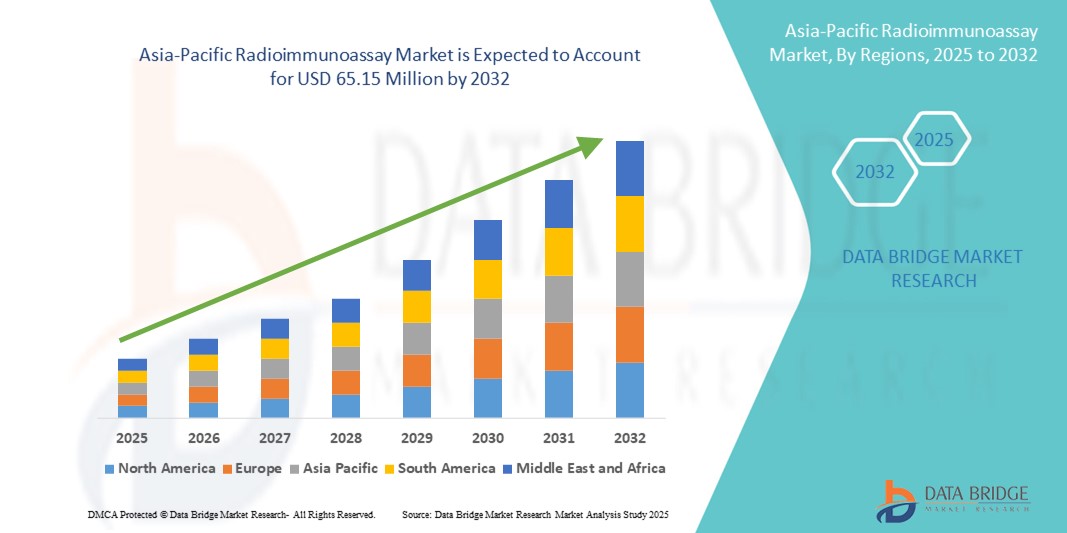
- The Asia-Pacific radioimmunoassay market size was valued at USD 49.47 million in 2024 and is expected to reach USD 65.15 million by 2032, at a CAGR of 3.50% during the forecast period
- The market growth is largely fueled by increasing awareness, rising healthcare access, and advancements in diagnostic technologies across Asia-Pacific, enabling timely detection and monitoring of various diseases using radioimmunoassay techniques. The region is witnessing growing demand for sensitive and accurate diagnostic tools, particularly in rapidly developing countries such as India, China, and Indonesia, contributing to the expanding adoption of radioimmunoassay applications
- Furthermore, escalating investments in healthcare infrastructure, expansion of laboratory services in rural and semi-urban areas, and increasing public-private partnerships are driving innovation and availability of advanced radioimmunoassay technologies. Government health screening initiatives, coupled with the growing presence of international diagnostic companies and strengthening local manufacturing capabilities, are significantly boosting the growth of the Asia-Pacific radioimmunoassay market
Asia-Pacific Radioimmunoassay Market Analysis
- The Asia-Pacific radioimmunoassay market is witnessing significant growth, propelled by increasing investments in healthcare infrastructure, rising prevalence of chronic diseases, and expanding diagnostic capabilities across countries such as China, India, Japan, South Korea, Australia, Thailand, Indonesia, and Vietnam
- Growing awareness about early disease detection and the integration of advanced diagnostic technologies are further accelerating market expansion
- China dominated the Asia-Pacific radioimmunoassay market with the largest revenue share of 47.5% in 2024, supported by its well-established healthcare system, increasing government funding for medical diagnostics, and a strong network of domestic manufacturers and distributors. The country’s emphasis on innovation and large patient population continue to drive demand for radioimmunoassay products
- India is projected to register the fastest CAGR of 14.2% in the Asia-Pacific radioimmunoassay market during the forecast period, fueled by rising healthcare expenditure, expanding diagnostic centers, and growing adoption of cost-effective testing solutions in semi-urban and rural areas. Government initiatives aimed at improving healthcare access and local manufacturing expansion are key growth drivers in the Indian market
- The clinical diagnosis segment dominated the Asia-Pacific radioimmunoassay market with a market share of 68.3% in 2024, driven by growing prevalence of chronic and infectious diseases that necessitate precise and early diagnosis using radioimmunoassay techniques
Report Scope and Asia-Pacific Radioimmunoassay Market Segmentation
|
Attributes |
Asia-Pacific Radioimmunoassay Key Market Insights |
|
Segments Covered |
|
|
Countries Covered |
Asia-Pacific
|
|
Key Market Players |
|
|
Market Opportunities |
|
|
Value Added Data Infosets |
In addition to the insights on market scenarios such as market value, growth rate, segmentation, geographical coverage, and major players, the market reports curated by the Data Bridge Market Research also include in-depth expert analysis, pricing analysis, brand share analysis, consumer survey, demography analysis, supply chain analysis, value chain analysis, raw material/consumables overview, vendor selection criteria, PESTLE Analysis, Porter Analysis, and regulatory framework. |
Asia-Pacific Radioimmunoassay Market Trends
Growing Focus on Advanced Diagnostic Innovation and Clinical Research
- A notable and accelerating trend in the Asia-Pacific radioimmunoassay market is the increased emphasis on innovation in diagnostic technologies and clinical research aimed at improving disease detection and patient outcomes. This includes advancements in assay sensitivity, automation, and integration with digital health platforms
- Leading manufacturers and research organizations in countries such as China, Japan, South Korea, and Australia are collaborating to develop next-generation radioimmunoassay kits and instruments that offer higher accuracy, faster turnaround times, and multiplex testing capabilities. For instance, in 2024, a partnership between a South Korean diagnostics firm and a university research center resulted in a novel radioimmunoassay method for early cancer biomarker detection
- The rising adoption of radioimmunoassay testing in hospitals, diagnostic centers, and research institutes is driving market growth by enabling earlier diagnosis and better monitoring of chronic diseases such as cancer, thyroid disorders, and infectious diseases
- Academic and clinical research institutions across the region are actively conducting studies to validate the efficacy of new radioimmunoassay techniques, improving diagnostic precision and patient care protocols. Countries such as India and Australia have seen significant increases in government-funded projects focusing on assay development and validation
- As Asia-Pacific continues to prioritize healthcare innovation, regulatory support, and patient-centric diagnostics, the Radioimmunoassay market is expected to sustain robust growth—powered by technological advancements, clinical research breakthroughs, and expanding healthcare infrastructure
Asia-Pacific Radioimmunoassay Market Dynamics
Driver
Growing Demand Driven by Rising Health Awareness and Diagnostic Advancements
- The Asia-Pacific radioimmunoassay market is witnessing significant growth fueled by increasing health awareness and the rising need for accurate, early disease diagnosis across countries such as China, India, Japan, and Australia. Greater emphasis on preventive healthcare and chronic disease management is encouraging adoption of advanced radioimmunoassay technologies in hospitals and diagnostic labs
- For instance, in March 2024, a leading diagnostics company in South Korea introduced an enhanced radioimmunoassay platform featuring faster processing times and improved sensitivity for detecting hormone imbalances and tumor markers, targeting both urban medical centers and expanding semi-urban markets
- The rising prevalence of autoimmune diseases, cancers, and infectious conditions has accelerated demand for precise and reliable radioimmunoassay testing, especially among aging populations and patients requiring ongoing monitoring
- Government initiatives to strengthen healthcare infrastructure and promote local manufacturing capabilities in countries such as India and China are further boosting market growth. Regulatory support for quality diagnostics and increased funding for laboratory modernization projects are enabling broader accessibility of radioimmunoassay solutions
- Expansion of e-commerce platforms and direct-to-laboratory sales models is improving market reach, allowing manufacturers to provide customizable assay kits and instruments with simplified ordering and timely delivery across urban and semi-urban regions
Restraint/Challenge
Challenges in Market Penetration Among Price-Sensitive and Rural Healthcare Sectors
- Despite positive growth trends, the Asia-Pacific radioimmunoassay market faces significant challenges related to affordability and accessibility, especially in price-sensitive segments and rural healthcare markets in regions such as Southeast Asia and South Asia. The relatively high cost of advanced radioimmunoassay instruments and consumables often limits adoption in smaller clinics and underfunded healthcare centers
- Infrastructure deficiencies and low awareness about the benefits and applications of radioimmunoassay testing in rural and non-urban areas further constrain market penetration. Many primary healthcare facilities lack the technical capabilities and resources required to operate sophisticated diagnostic equipment effectively
- The distribution of radioimmunoassay products is often hindered by fragmented retail networks and logistical challenges, affecting the timely delivery of instruments and reagents and impeding after-sales support in remote locations
- Moreover, dependence on imported assay reagents and critical components in certain countries raises production costs, resulting in less competitive pricing compared to alternative diagnostic methods and limiting broader adoption
- To address these barriers, leading market players are increasingly investing in localized manufacturing initiatives to reduce costs, launching targeted educational campaigns to increase awareness about radioimmunoassay benefits, and developing budget-friendly assay kits. These strategic measures aim to enhance penetration in underserved rural regions and price-sensitive healthcare segments, ultimately driving inclusive market growth across the Asia-Pacific region
Asia-Pacific Radioimmunoassay Market Scope
The market is segmented on the basis of product type, application, end user, and distribution channel.
- By Product Type
On the basis of product type, the Asia-Pacific radioimmunoassay market is segmented into radio immunoassay reagents and kits, and radio immunoassay analyser. The radio immunoassay reagents and kits segment dominated the market with the largest revenue share of 62.5% in 2024, attributed to its wide usage in diagnostic laboratories and research institutions. Its extensive applications in disease detection and monitoring continue to drive demand across the region.
The radio immunoassay analyser segment is projected to register the fastest CAGR of 8.7% from 2025 to 2032, fueled by rapid technological advancements and increasing integration of automated systems in clinical diagnostics.
- By Application
On the basis of application, the Asia-Pacific radioimmunoassay market is segmented into scientific research and clinical diagnosis. The clinical diagnosis segment held a dominant share of 68.3% in 2024, driven by growing prevalence of chronic and infectious diseases that necessitate precise and early diagnosis using radioimmunoassay techniques.
The scientific research segment is expected to witness a robust CAGR of 7.9% during the forecast period, supported by expanding biomedical research activities and pharmaceutical development programs within the Asia-Pacific region.
- By End User
On the basis of end user, the Asia-Pacific radioimmunoassay market is segmented into hospitals, clinical diagnostic laboratories, academic and research institutes, pharmaceutical and biopharmaceutical industry, contract research organizations, and others. Hospitals accounted for the largest share of 54.6% in 2024, reflecting the increased patient influx and growing demand for diagnostic testing facilities in healthcare institutions.
Contract Research Organizations are expected to grow at the fastest CAGR of 9.2% from 2025 to 2032, driven by rising outsourcing of clinical trials and research activities by pharmaceutical companies.
- By Distribution Channel
On the basis of distribution channel, the Asia-Pacific radioimmunoassay market is segmented into direct tender, online sales, third party distribution, and others. The direct tender segment led the market with a share of 47.8% in 2024, supported by government procurement policies and bulk purchasing by healthcare providers.
Online Sales are anticipated to expand at the fastest CAGR of 11.3% from 2025 to 2032, owing to increasing digital adoption, ease of access, and the growing trend of purchasing diagnostic reagents and instruments through e-commerce platforms.
Asia-Pacific Radioimmunoassay Market Regional Analysis
- Asia-Pacific held a market share of the global radioimmunoassay market, capturing the largest revenue share of 21.2% in 2024. This leadership is driven by the region’s vast population, increasing consumer focus on advanced medical diagnostics, and rising investments in healthcare infrastructure
- The growing demand for accurate and efficient diagnostic solutions across countries such as China, India, Japan, and Southeast Asia is further bolstering market expansion
- The market growth is supported by strong domestic manufacturing capabilities in countries such as China, India, and Vietnam, complemented by expanding distribution channels across the region. Government initiatives aimed at enhancing healthcare access, funding for medical innovation, and the rise of private diagnostic centers are accelerating market penetration in both urban and semi-urban areas
China Asia-Pacific Radioimmunoassay Market Insight
The China radioimmunoassay market led the Asia-Pacific market with the largest revenue share of 47.5% in 2024. This dominance stems from its well-established healthcare system, substantial government funding for medical diagnostics, and a robust network of domestic manufacturers and distributors. The country’s commitment to innovation, combined with a large patient population requiring diagnostic services, continues to drive high demand for radioimmunoassay products. Additionally, rapid urbanization and improved healthcare infrastructure further strengthen China’s market leadership position.
India Asia-Pacific Radioimmunoassay Market Insight
The India radioimmunoassay market is projected to register the fastest CAGR of 14.2% during the forecast period, fueled by increasing healthcare expenditure, the proliferation of diagnostic centers, and growing adoption of cost-effective testing solutions, especially in semi-urban and rural regions. Government programs focused on improving healthcare accessibility, along with the expansion of local manufacturing facilities, are key contributors to India’s rapid market growth. Furthermore, rising public awareness about early disease detection and the expansion of public-private partnerships are enhancing market opportunities across the country.
Asia-Pacific Radioimmunoassay Market Share
The Asia-Pacific radioimmunoassay industry is primarily led by well-established companies, including:
- Merck KGaA (Germany)
- PerkinElmer (U.S.)
- EUROIMMUN Medizinische Labordiagnostika AG (Germany)
- Immuno-Biological Laboratories Co., Ltd. (Japan)
- Beckman Coulter, Inc. (U.S.)
- Abcam plc (U.K.)
- Tecan Trading AG (Switzerland)
- MP BIOMEDICALS (U.S.)
- Berthold Technologies GmbH & Co. KG (Germany)
- Hidex Oy (Finland)
Latest Developments in Asia-Pacific Radioimmunoassay market
- In July 2023, Beckman Coulter introduced the DxI 9000 Immunoassay Analyzer at the 2023 AACC Annual Scientific Meeting in the U.S. This analyzer offers increased assay development sensitivity, enhancing diagnostic capabilities
- In April 2022, Merck, a leading science and technology company, announced several organizational changes and a new operating model to support the life science business sector's long-term growth strategy and better serve its customers' evolving needs. This has helped the company to expand its life sciences business segment
- In June 2022, EUROIMMUN, a PerkinElmer, Inc. company, announced the launch of two CE-marked assays – the Anti-SARS-CoV-2 RBD ChLIA (IgG) and the Anti-SARS-CoV-2 Omicron ELISA (IgG). Both test systems enable the detection of IgG antibodies formed against SARS-CoV-2 and are available to laboratories in countries that accept the CE mark. This has helped the company to expand its business in the market

- Interactive Data Analysis Dashboard
- Company Analysis Dashboard for high growth potential opportunities
- Research Analyst Access for customization & queries
- Competitor Analysis with Interactive dashboard
- Latest News, Updates & Trend analysis
- Harness the Power of Benchmark Analysis for Comprehensive Competitor Tracking
Data collection and base year analysis are done using data collection modules with large sample sizes. The stage includes obtaining market information or related data through various sources and strategies. It includes examining and planning all the data acquired from the past in advance. It likewise envelops the examination of information inconsistencies seen across different information sources. The market data is analysed and estimated using market statistical and coherent models. Also, market share analysis and key trend analysis are the major success factors in the market report. To know more, please request an analyst call or drop down your inquiry.
The key research methodology used by DBMR research team is data triangulation which involves data mining, analysis of the impact of data variables on the market and primary (industry expert) validation. Data models include Vendor Positioning Grid, Market Time Line Analysis, Market Overview and Guide, Company Positioning Grid, Patent Analysis, Pricing Analysis, Company Market Share Analysis, Standards of Measurement, Global versus Regional and Vendor Share Analysis. To know more about the research methodology, drop in an inquiry to speak to our industry experts.
Data Bridge Market Research is a leader in advanced formative research. We take pride in servicing our existing and new customers with data and analysis that match and suits their goal. The report can be customized to include price trend analysis of target brands understanding the market for additional countries (ask for the list of countries), clinical trial results data, literature review, refurbished market and product base analysis. Market analysis of target competitors can be analyzed from technology-based analysis to market portfolio strategies. We can add as many competitors that you require data about in the format and data style you are looking for. Our team of analysts can also provide you data in crude raw excel files pivot tables (Fact book) or can assist you in creating presentations from the data sets available in the report.













