


Rheology Modifiers Market Size
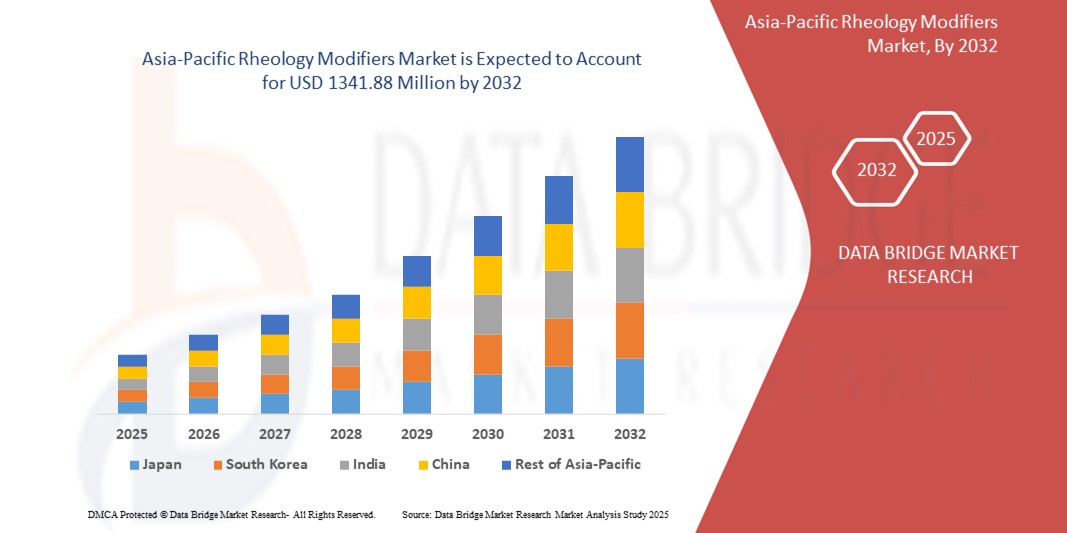
- The Asia-Pacific rheology modifiers market size was valued at USD 861.22 million in 2024 and is expected to reach USD 1341.88 million by 2032, at a CAGR of 5.7% during the forecast period
- The market growth is primarily driven by increasing demand for advanced material formulations across industries such as paints & coatings, personal care, and construction, fueled by rapid industrialization and urbanization in the region
- Rising consumer preference for high-performance, sustainable, and eco-friendly products is positioning rheology modifiers as critical components in modern industrial applications, accelerating market expansion
Rheology Modifiers Market Analysis
- Rheology modifiers, essential for controlling the flow and viscosity of formulations, are increasingly integral to industries such as paints & coatings, cosmetics, and adhesives due to their ability to enhance product performance, stability, and application properties
- The surge in demand is driven by the booming construction sector, growing personal care and cosmetics industry, and advancements in eco-friendly waterborne formulations
- China dominated the Asia-Pacific rheology modifiers market with the largest revenue share of 38.5% in 2024, driven by its robust manufacturing base, large-scale infrastructure projects, and strong presence of key industry players
- Japan is expected to be the fastest-growing country in the Asia-Pacific rheology modifiers market during the forecast period due to increasing adoption of advanced materials in automotive, electronics, and sustainable construction applications
- The waterborne segment dominated the largest market revenue share of 62.3% in 2024, driven by increasing demand for eco-friendly and low-VOC formulations, particularly in paints and coatings, due to stringent environmental regulations in countries such as China
Report Scope and Rheology Modifiers Market Segmentation
|
Attributes |
Rheology Modifiers Key Market Insights |
|
Segments Covered |
|
|
Countries Covered |
Asia-Pacific
|
|
Key Market Players |
|
|
Market Opportunities |
|
|
Value Added Data Infosets |
In addition to the insights on market scenarios such as market value, growth rate, segmentation, geographical coverage, and major players, the market reports curated by the Data Bridge Market Research also include import export analysis, production capacity overview, production consumption analysis, price trend analysis, climate change scenario, supply chain analysis, value chain analysis, raw material/consumables overview, vendor selection criteria, PESTLE Analysis, Porter Analysis, and regulatory framework. |
Rheology Modifiers Market Trends
“Increasing Integration of Waterborne and Solventborne Solutions”
- The Asia-Pacific rheology modifiers market is experiencing a significant trend toward the integration of waterborne and solventborne solutions
- These technologies enable enhanced control over viscosity, flow behavior, and stability, providing improved performance in various applications such as paints, coatings, and personal care products
- Waterborne rheology modifiers, in particular, are gaining traction due to their eco-friendly nature and compatibility with low-VOC (volatile organic compound) formulations, aligning with stringent environmental regulations in the region
- For instance, companies are developing advanced waterborne rheology modifiers to optimize paint application properties, such as brushability and sag resistance, while solventborne modifiers are used for high-performance industrial coatings
- This trend is increasing the appeal of rheology modifiers for manufacturers in industries such as construction, automotive, and cosmetics, driving innovation and market growth
- Advanced formulations are being tailored to analyze and adjust material properties, such as shear-thinning and thixotropic behavior, to meet specific application needs across diverse industries
Rheology Modifiers Market Dynamics
Driver
“Rising Demand for High-Performance Coatings and Personal Care Products”
- The growing consumer and industrial demand for high-performance paints, coatings, and personal care products is a major driver for the Asia-Pacific rheology modifiers market
- Rheology modifiers enhance product quality by providing desirable viscosity, texture, and stability in applications such as architectural paints, automotive coatings, and skincare formulations
- Government regulations in countries such as China and Japan, promoting eco-friendly and low-VOC products, are accelerating the adoption of rheology modifiers, particularly waterborne types
- The rapid expansion of IoT and digital manufacturing technologies in the region is enabling real-time formulation adjustments, improving efficiency and product consistency in industries such as construction and cosmetics
- Manufacturers are increasingly incorporating rheology modifiers as standard components in formulations to meet consumer expectations for sustainable, high-quality products, particularly in China, which dominates the market
Restraint/Challenge
“High Implementation Costs and Regulatory Compliance Issues”
- The significant initial investment required for developing, testing, and integrating rheology modifiers into formulations can be a barrier, particularly for small and medium-sized enterprises in emerging markets within the Asia-Pacific region
- The complexity of formulating products with rheology modifiers, especially for specialized applications such as high-performance coatings or pharmaceuticals, adds to the cost and technical challenges
- Data security and regulatory compliance concerns pose significant challenges, as rheology modifiers must meet strict safety and environmental standards, particularly in countries with robust regulations such as Japan and South Korea
- The fragmented regulatory landscape across Asia-Pacific countries regarding chemical formulations, environmental impact, and product safety complicates operations for manufacturers and suppliers operating internationally
- These factors can deter adoption, particularly in cost-sensitive markets or regions with heightened regulatory scrutiny, potentially limiting market expansion despite strong demand in countries such as Japan, the fastest-growing market
Rheology Modifiers market Scope
The market is segmented on the basis of type, nature, distribution channel, and application.
- By Type
On the basis of type, the Asia-Pacific rheology modifiers market is segmented into waterborne and solventborne. The waterborne segment dominated the largest market revenue share of 62.3% in 2024, driven by increasing demand for eco-friendly and low-VOC formulations, particularly in paints and coatings, due to stringent environmental regulations in countries such as China. Waterborne rheology modifiers offer superior compatibility with sustainable formulations, enhancing their adoption across various industries.
The solventborne segment is anticipated to witness steady growth from 2025 to 2032, driven by its continued use in high-performance applications such as industrial coatings and adhesives, where durability and specific flow properties are critical.
-
- By Nature
On the basis of nature, the Asia-Pacific rheology modifiers market is segmented into organic and inorganic. The organic segment dominated the market with a revenue share of 58.6% in 2024, attributed to its wide applicability in paints, coatings, and personal care products, offering superior thickening, anti-settling, and suspension properties. The demand for organic rheology modifiers is particularly strong in China due to the expanding construction and cosmetics industries.
The inorganic segment is expected to experience significant growth from 2025 to 2032, driven by its use in high-performance applications such as drilling fluids and industrial coatings, especially in Japan, where technological advancements and industrial growth fuel demand.
-
- By Distribution Channel
On the basis of distribution channel, the Asia-Pacific rheology modifiers market is segmented into direct sales/B2B, distributor/third-party distributor/agent/trader, e-commerce, and others. The direct sales/B2B segment is expected to hold the largest market revenue share of 72.1% in 2024, driven by the increasing demand for rheology modifiers as raw materials in large-scale manufacturing, particularly in China’s paint and coating industries. This segment benefits from strong relationships between manufacturers and end-users, ensuring consistent supply chains.
The e-commerce segment is anticipated to witness the fastest growth rate of 8.2% from 2025 to 2032, fueled by the rising adoption of online procurement platforms and digital marketplaces, particularly in Japan, where technological advancements and efficient logistics support rapid market expansion.
- By Application
On the basis of application, the Asia-Pacific rheology modifiers market is segmented into paints & coatings, inks, personal care and cosmetics, adhesives & sealants, textiles, home care, pharmaceuticals, construction, pulp & paper, and others. The paints & coatings segment dominated the market with a revenue share of 35.7% in 2024, driven by rapid infrastructure development and industrialization in China, where rheology modifiers are essential for controlling viscosity and enhancing coating performance.
The personal care and cosmetics segment is expected to witness the fastest growth rate of 6.7% from 2025 to 2032, particularly in Japan, driven by increasing consumer demand for high-quality skincare and makeup products with enhanced texture and stability, supported by innovations in bio-based rheology modifiers.
Rheology Modifiers Market Regional Analysis
- China dominated the Asia-Pacific rheology modifiers market with the largest revenue share of 38.5% in 2024, driven by its robust manufacturing base, large-scale infrastructure projects, and strong presence of key industry players
- Japan is expected to be the fastest-growing country in the Asia-Pacific rheology modifiers market during the forecast period due to increasing adoption of advanced materials in automotive, electronics, and sustainable construction applications
China Rheology Modifiers Market Insight
China holds the largest share of the Asia-Pacific rheology modifiers market share of 72.8% in 2024, propelled by rapid urbanization, booming construction and automotive industries, and increasing demand for high-performance paints, coatings, and personal care products. The country’s growing middle class and focus on sustainable formulations drive the adoption of organic and waterborne rheology modifiers. Strong domestic manufacturing capabilities and competitive pricing further enhance market accessibility, making China the dominating country in the region.
Japan Rheology Modifiers Market Insight
Japan’s rheology modifiers market is expected to witness the fastest growth rate, projected at a CAGR of 5% through 2032, driven by strong consumer preference for high-quality, technologically advanced rheology modifiers that enhance product performance in paints, coatings, and cosmetics. The presence of major manufacturers and the integration of rheology modifiers in OEM applications, particularly in the automotive sector, accelerate market penetration. Rising interest in eco-friendly and bio-based modifiers also contributes to growth in Japan.
Rheology Modifiers Market Share
The rheology modifiers industry is primarily led by well-established companies, including:
- ALTANA AG (Germany)
- Evonik Industries AG (Germany)
- BASF SE (Germany)
- Clariant (Switzerland)
- Ashland (U.S.)
- Dow (U.S.)
- Arkema (France)
- Cargill Incorporated. (U.S.)
- Wanhua Chemical Group Co., Ltd. (China)
- DuPont (U.S.)
- Nouryon (Netherlands)
- Eastman Chemical Company (U.S.)
- PPG Industries, Inc. (U.S.)
- Croda International Plc (U.K.)
- ELEMENTIS PLC (U.K.)
What are the Recent Developments in Asia-Pacific Rheology Modifiers Market?
- In December 2024, Ohio-based Lubrizol unveiled a wave of breakthrough innovations across multiple industries, reinforcing its commitment to science-driven, sustainable solutions. The company introduced dozens of new technologies aimed at enhancing mobility, well-being, and modern living. Notably, Lubrizol expanded its local-for-local innovation strategy by investing in regional R&D centers and deepening its sustainability efforts. These included the launch of bio-based dispersants, biodegradable polymers, and low-VOC coatings, all designed to meet evolving market demands while reducing environmental impact. This innovation surge reflects Lubrizol’s mission to align product development with global sustainability goals and customer-centric performance
- In April 2024, BASF, headquartered in Germany, launched its "Beyond Beauty" campaign as part of its Care Chemicals initiative, Care 360° – Solutions for Sustainable Life. This campaign spotlighted BASF’s commitment to reshaping the personal care industry through innovative and sustainable solutions. It emphasized transparency in Product Carbon Footprints (PCF) and showcased the potential of bioactives to meet growing consumer demand for eco-conscious and health-driven beauty products. By integrating digital services and sustainable ingredients, BASF aims to empower manufacturers and consumers alike to make informed, responsible choices in personal care
- In February 2024, Arkema, a French specialty materials leader, showcased its latest sustainable innovations at Paint India 2024, held in Mumbai. The company highlighted cutting-edge technologies designed to enhance circularity, energy efficiency, decarbonization, and living comfort in the paints and coatings sector. These included low-VOC and low-carbon solutions such as bio-based waterborne resins, powder coatings, and UV/LED/EB curing technologies. Arkema also emphasized its commitment to the Indian market through continued investments in its Navi Mumbai site, which features a modern manufacturing unit and a dedicated R&D lab to support local innovation and customer needs
- In July 2024, Tate & Lyle PLC, a UK-based leader in food and beverage solutions, acquired CP Kelco, marking a pivotal step in its transformation toward healthier, clean-label ingredient offerings. This strategic acquisition expands Tate & Lyle’s portfolio with natural rheology modifiers such as pectin and specialty gums—ingredients increasingly favored by consumers seeking simpler, more transparent food labels. The move also strengthens the company’s position in the global specialty ingredients market, aligning with its long-term vision to deliver tastier, more sustainable, and health-conscious food and drink solutions
- In March 2023, Elementis expanded its RHEOLATE® Powder NiSAT range with the launch of RHEOLATE® PHX 7025, a 100% solid urethane rheology modifier tailored for paints and coatings. This powdered solution delivers high shear efficiency, improved stain resistance, and superior spatter control—all while supporting sustainability goals. Thanks to its VOC-free, biocide-free, and surfactant-free formulation, it enables manufacturers to create safer, eco-labeled products. The solid form also reduces transportation emissions and storage needs, aligning with industry trends toward greener, high-performance materials

- Interactive Data Analysis Dashboard
- Company Analysis Dashboard for high growth potential opportunities
- Research Analyst Access for customization & queries
- Competitor Analysis with Interactive dashboard
- Latest News, Updates & Trend analysis
- Harness the Power of Benchmark Analysis for Comprehensive Competitor Tracking
Asia Pacific Rheology Modifiers Market, Supply Chain Analysis and Ecosystem Framework
To support market growth and help clients navigate the impact of geopolitical shifts, DBMR has integrated in-depth supply chain analysis into its Asia Pacific Rheology Modifiers Market research reports. This addition empowers clients to respond effectively to global changes affecting their industries. The supply chain analysis section includes detailed insights such as Asia Pacific Rheology Modifiers Market consumption and production by country, price trend analysis, the impact of tariffs and geopolitical developments, and import and export trends by country and HSN code. It also highlights major suppliers with data on production capacity and company profiles, as well as key importers and exporters. In addition to research, DBMR offers specialized supply chain consulting services backed by over a decade of experience, providing solutions like supplier discovery, supplier risk assessment, price trend analysis, impact evaluation of inflation and trade route changes, and comprehensive market trend analysis.
Data collection and base year analysis are done using data collection modules with large sample sizes. The stage includes obtaining market information or related data through various sources and strategies. It includes examining and planning all the data acquired from the past in advance. It likewise envelops the examination of information inconsistencies seen across different information sources. The market data is analysed and estimated using market statistical and coherent models. Also, market share analysis and key trend analysis are the major success factors in the market report. To know more, please request an analyst call or drop down your inquiry.
The key research methodology used by DBMR research team is data triangulation which involves data mining, analysis of the impact of data variables on the market and primary (industry expert) validation. Data models include Vendor Positioning Grid, Market Time Line Analysis, Market Overview and Guide, Company Positioning Grid, Patent Analysis, Pricing Analysis, Company Market Share Analysis, Standards of Measurement, Global versus Regional and Vendor Share Analysis. To know more about the research methodology, drop in an inquiry to speak to our industry experts.
Data Bridge Market Research is a leader in advanced formative research. We take pride in servicing our existing and new customers with data and analysis that match and suits their goal. The report can be customized to include price trend analysis of target brands understanding the market for additional countries (ask for the list of countries), clinical trial results data, literature review, refurbished market and product base analysis. Market analysis of target competitors can be analyzed from technology-based analysis to market portfolio strategies. We can add as many competitors that you require data about in the format and data style you are looking for. Our team of analysts can also provide you data in crude raw excel files pivot tables (Fact book) or can assist you in creating presentations from the data sets available in the report.













