


Europe Bioinformatics Market Size
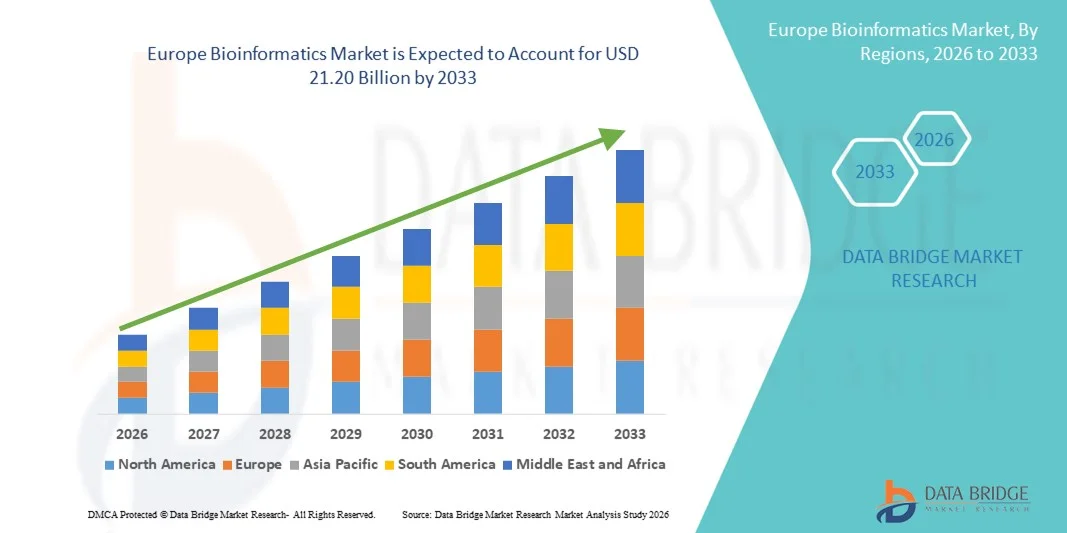
- The Europe bioinformatics market size was valued at USD 5.10 billion in 2025 and is expected to reach USD 21.20 billion by 2033, at a CAGR of 19.5% during the forecast period
- The market growth is largely fueled by the expanding application of bioinformatics in genomics, proteomics, and drug discovery, along with increasing investments in precision medicine and large-scale sequencing projects across Europe, leading to accelerated data generation and analysis in both research and clinical environments
- Furthermore, rising demand for advanced data analytics, cloud-based platforms, and AI-driven tools for managing complex biological datasets is positioning bioinformatics as a critical enabler of modern life sciences innovation. These converging factors are accelerating the adoption of bioinformatics solutions, thereby significantly boosting the region’s market growth
Europe Bioinformatics Market Analysis
- Bioinformatics, encompassing the development and application of computational tools to collect, store, analyze, and interpret complex biological data, has become an essential component of modern life sciences research and healthcare systems across Europe due to its critical role in genomics, proteomics, drug discovery, and precision medicine initiatives
- The escalating demand for bioinformatics solutions is primarily fueled by the rapid growth in next-generation sequencing (NGS) data, increasing investments in personalized medicine, expanding pharmaceutical and biotechnology R&D activities, and the rising need for efficient management and interpretation of large-scale biological datasets
- Germany dominated the Europe bioinformatics market with the largest revenue share of 24.18% in 2025, characterized by strong government funding for genomics research, a well-established biotechnology sector, and the presence of leading academic and research institutions, with the country witnessing substantial growth in clinical bioinformatics applications supported by collaborations between research centers and industry players
- The United Kingdom is expected to be the fastest growing country in the Europe bioinformatics market during the forecast period due to expanding precision medicine programs, increasing integration of AI in healthcare research, and strong support from national genomics initiatives
- Genomics & Drug Development segment dominated the Europe bioinformatics market with a market share of 41.6% in 2025, driven by widespread adoption of sequencing technologies and the growing focus on population-scale genome projects and biomarker discovery
Report Scope and Europe Bioinformatics Market Segmentation
|
Attributes |
Europe Bioinformatics Key Market Insights |
|
Segments Covered |
|
|
Countries Covered |
Europe
|
|
Key Market Players |
|
|
Market Opportunities |
|
|
Value Added Data Infosets |
In addition to the insights on market scenarios such as market value, growth rate, segmentation, geographical coverage, and major players, the market reports curated by the Data Bridge Market Research also include in-depth expert analysis, patient epidemiology, pipeline analysis, pricing analysis, and regulatory framework |
Europe Bioinformatics Market Trends
Integration of AI and Cloud-Based Analytics
- A significant and accelerating trend in the Europe bioinformatics market is the increasing integration of artificial intelligence (AI) and cloud-based analytics platforms into genomics, proteomics, and drug discovery workflows, enhancing data processing, interpretation, and predictive modeling capabilities
- For instance, Illumina’s BaseSpace Sequence Hub provides cloud-enabled bioinformatics tools allowing researchers to analyze and visualize sequencing data in real time, facilitating collaborative research across institutions
- AI applications in bioinformatics enable predictive modeling of gene expression, identification of potential biomarkers, and accelerated drug target discovery. For instance, platforms such as Deep Genomics utilize AI to predict genetic mutation impacts on diseases and guide therapeutic development
- The seamless integration of bioinformatics software with cloud computing allows centralized access to large-scale datasets, enabling cross-institutional collaboration and reducing computational infrastructure costs for research laboratories
- This trend towards AI-driven, cloud-enabled bioinformatics solutions is reshaping research efficiency and innovation expectations. Consequently, companies such as SOPHiA GENETICS are developing AI-powered platforms capable of automatically interpreting complex genomic data and providing actionable clinical insights
- The demand for bioinformatics solutions that combine AI and cloud-based analytics is growing rapidly across pharmaceutical, academic, and clinical research sectors, as stakeholders increasingly prioritize efficiency, scalability, and collaborative capabilities
- Collaborative bioinformatics platforms are increasingly being adopted to support pan-European research initiatives, standardizing data formats and accelerating multi-center clinical studies
Europe Bioinformatics Market Dynamics
Driver
Rising Demand for Precision Medicine and Genomics Research
- The increasing focus on personalized medicine, genomics research, and large-scale sequencing projects across Europe is a significant driver for the growing adoption of bioinformatics solutions
- For instance, in March 2025, the UK Biobank launched an AI-driven data analytics initiative to improve disease prediction and personalized healthcare strategies, demonstrating the need for advanced bioinformatics platforms
- As pharmaceutical and biotechnology companies expand R&D activities, bioinformatics solutions offer efficient data management, predictive modeling, and target identification, providing a compelling advantage over traditional research methods
- Furthermore, the growing availability of high-throughput sequencing technologies and multi-omics datasets is making bioinformatics an indispensable tool in both research and clinical settings, enabling faster discovery and validation of biomarkers
- The ability to integrate diverse datasets, perform advanced analyses, and accelerate translational research is propelling bioinformatics adoption in Europe’s academic, pharmaceutical, and healthcare sectors
- Supportive government initiatives and public-private partnerships in Europe to enhance genomic infrastructure and precision medicine programs are further driving the bioinformatics market growth
- Increasing collaborations between academic institutions and biotech companies to develop AI-based bioinformatics pipelines for drug discovery are opening new avenues for market expansion
Restraint/Challenge
Data Privacy Concerns and High Implementation Costs
- Concerns regarding data privacy, protection of sensitive genomic information, and compliance with GDPR regulations pose significant challenges to broader market adoption
- For instance, high-profile reports of genomic data breaches have made some healthcare institutions cautious about deploying cloud-based bioinformatics solutions, slowing adoption rates
- Addressing these concerns through secure data storage, encryption, access controls, and compliance with regulatory frameworks is critical to building trust among users. For instance, companies such as QIAGEN emphasize compliance with GDPR and HIPAA standards in their bioinformatics platforms
- In addition, the relatively high cost of advanced bioinformatics software, cloud computing services, and computational infrastructure can limit adoption, particularly for smaller research laboratories or budget-constrained institutions
- While pricing models are gradually adapting through subscription-based and cloud-hosted solutions, the perceived high cost and regulatory complexity continue to challenge widespread adoption
- Overcoming these challenges through enhanced security measures, regulatory compliance support, and cost-effective delivery models will be vital for sustained growth in the Europe bioinformatics market
- Limited availability of skilled bioinformatics professionals capable of managing complex datasets remains a challenge for research and clinical institutions
- Interoperability issues among heterogeneous bioinformatics platforms and legacy systems can hinder seamless data sharing and collaborative research, restricting market growth
Europe Bioinformatics Market Scope
The market is segmented on the basis of type, sector, application, purchase mode, method, and end-user.
- By Type
On the basis of type, the Europe bioinformatics market is segmented into knowledge management tools, bioinformatics software, and services. The bioinformatics software segment dominated the market with the largest revenue share in 2025, driven by widespread adoption in genomics, proteomics, and drug discovery research. Software platforms provide comprehensive solutions for data management, analysis, and visualization, allowing researchers to efficiently process complex multi-omics datasets. Pharmaceutical and biotech companies increasingly rely on these platforms to accelerate R&D workflows and improve predictive modeling accuracy. Continuous innovations, such as AI-driven analytics and cloud-based deployment, further strengthen the segment’s market position. Researchers use these software platforms for variant analysis, functional annotation, and therapeutic target identification, making them indispensable in modern life sciences.
The knowledge management tools segment is anticipated to witness the fastest growth rate from 2026 to 2033, fueled by increasing collaboration among research institutions and the need for centralized data repositories. Knowledge management solutions enable efficient documentation, sharing, and interpretation of biological data across multiple projects and teams. The adoption of AI and cloud infrastructure allows better data curation, annotation, and identification of trends across studies. Multi-center European research projects are driving rapid uptake, as standardized knowledge tools support consistency in methodology. Academic and clinical users increasingly leverage these tools to streamline workflow, enhance reproducibility, and improve decision-making efficiency.
- By Sector
On the basis of sector, the Europe bioinformatics market is segmented into medical biotechnology, academics, animal biotechnology, agricultural biotechnology, environmental biotechnology, forensic biotechnology, and others. The medical biotechnology segment dominated the market in 2025, driven by the growing focus on genomics, proteomics, and precision medicine. Pharmaceutical companies and hospitals increasingly rely on bioinformatics to identify drug targets, biomarkers, and therapeutic pathways. Heavy investments in R&D, government funding, and collaborative projects further reinforce the segment’s leadership. Bioinformatics platforms enable large-scale sequencing data analysis and clinical trial optimization, making them critical for new drug development. The segment benefits from ongoing innovations in AI-based predictive modeling and multi-omics integration.
The academics segment is expected to witness the fastest CAGR from 2026 to 2033 due to increasing integration of bioinformatics in universities and research institutes. Academic adoption is fueled by initiatives to train students and researchers in computational biology, alongside the growing demand for multi-omics research. Open-source and cloud-based platforms make bioinformatics more accessible for academic users. Cross-institutional collaborations and pan-European research initiatives further accelerate adoption. These tools enhance research efficiency, support hypothesis-driven studies, and promote data reproducibility.
- By Application
On the basis of application, the Europe bioinformatics market is segmented into genomics & drug development, proteomics, evolutionary studies, agricultural studies, veterinary science, metabolomics, transcriptomics, and others. The genomics & drug development segment dominated the market in 2025 with a market share of 41.6%, driven by widespread use of next-generation sequencing and high-throughput analysis for drug target identification and personalized therapies. Pharmaceutical and biotech companies rely on bioinformatics for biomarker validation, clinical trial design, and population-scale genomics studies. Government-funded initiatives in Europe, such as population genomics projects, further strengthen the segment. The availability of AI and cloud-based platforms accelerates analysis, visualization, and interpretation of genomic datasets. Bioinformatics tools also help in predictive modeling, disease association studies, and precision medicine applications, consolidating dominance.
The proteomics segment is expected to witness the fastest growth rate from 2026 to 2033 due to increasing research on protein expression, post-translational modifications, and disease biomarker discovery. Mass spectrometry advances, coupled with AI-assisted analysis tools, are driving adoption. Proteomics research is critical for oncology, immunology, and personalized therapy development. Bioinformatics platforms are used to integrate proteomics with genomics and metabolomics data. Pharmaceutical companies increasingly rely on these solutions to accelerate drug development and biomarker discovery. The focus on multi-omics approaches ensures strong growth momentum for proteomics applications.
- By Purchase Mode
On the basis of purchase mode, the Europe bioinformatics market is segmented into group purchase and individual purchase. The group purchase segment dominated the market in 2025, driven by institutional subscriptions from universities, hospitals, and biotech companies. Multi-center projects and research consortia prefer group licenses to reduce costs per user. Bulk licensing also facilitates standardized workflows and shared access to bioinformatics platforms. This model supports collaboration among teams and departments working on large datasets. Academic and clinical institutions benefit from centralized data management and easier maintenance.
The individual purchase segment is expected to witness the fastest CAGR from 2026 to 2033, fueled by independent researchers, startups, and freelance bioinformaticians. Subscription-based individual licenses provide flexibility and lower upfront costs. Researchers can access specialized features without institutional constraints. Startups and small biotech firms increasingly rely on individual purchases to manage genomic or proteomic analyses efficiently. The adoption of cloud-based tools makes individual licensing scalable and cost-effective. Flexibility, affordability, and accessibility are key growth drivers in this segment.
- By Method
On the basis of method, the Europe bioinformatics market is segmented into genomics and proteomics. The genomics segment dominated the market in 2025, driven by population genomics projects, personalized medicine programs, and increasing genome-wide studies. Bioinformatics tools for genomics support variant analysis, functional annotation, and gene expression profiling. Pharmaceutical and biotech companies rely on these platforms for target identification and clinical research applications. High-throughput sequencing initiatives strengthen the segment’s dominance. Cloud-based genomics tools accelerate data sharing, analysis, and visualization. The segment’s dominance is reinforced by the growing importance of precision medicine across Europe.
The proteomics segment is expected to witness the fastest growth from 2026 to 2033 due to rising demand for protein biomarker discovery, therapeutic target validation, and systems biology studies. AI-assisted proteomics platforms allow integration with genomics and metabolomics datasets. Research in oncology, immunology, and precision medicine fuels rapid adoption. The segment benefits from technological advancements in mass spectrometry and computational tools. Companies and academic institutions increasingly invest in proteomics bioinformatics pipelines. Growing multi-omics integration drives strong growth momentum for this method.
- By End-User
On the basis of end-user, the Europe bioinformatics market is segmented into research and academic institutes, clinical research organizations, biotech and pharmaceutical companies, research laboratories, hospitals, and others. Biotech and pharmaceutical companies dominated the market in 2025, driven by large-scale R&D investments, clinical trial optimization, and regulatory pressure to accelerate drug discovery. Bioinformatics solutions enable efficient multi-omics analysis and predictive modeling. Companies leverage these tools to reduce time-to-market for new therapies. The segment benefits from heavy adoption of AI and cloud platforms to manage complex datasets. Pharmaceutical collaborations with academic institutions reinforce the segment’s market leadership.
Research and academic institutes are expected to witness the fastest growth rate from 2026 to 2033 due to integration of bioinformatics courses, expansion of collaborative research projects, and accessibility of open-source tools. Pan-European research funding and initiatives support adoption in universities and institutes. Academic users rely on cloud-based platforms to manage multi-omics data efficiently. Students and researchers increasingly leverage bioinformatics for genomics, proteomics, and metabolomics studies. Inter-institutional collaborations and AI-based analysis tools further accelerate growth.
Europe Bioinformatics Market Regional Analysis
- Germany dominated the Europe bioinformatics market with the largest revenue share of 24.18% in 2025, characterized by strong government funding for genomics research, a well-established biotechnology sector, and the presence of leading academic and research institutions, with the country witnessing substantial growth in clinical bioinformatics applications supported by collaborations between research centers and industry players
- The country hosts leading academic and research institutions, hospitals, and biotech firms that extensively utilize bioinformatics platforms for drug discovery, clinical research, and multi-omics studies, strengthening its market leadership
- This widespread adoption is further supported by a highly skilled workforce, robust R&D funding, and strong collaboration between academia and industry, positioning Germany as the primary hub for bioinformatics innovation in Europe
The Germany Bioinformatics Market Insight
Germany dominated the Europe bioinformatics market with the largest revenue share in 2025, fueled by its advanced research infrastructure, strong biotechnology and pharmaceutical sectors, and substantial government and private investments in genomics and precision medicine initiatives. Academic institutions, hospitals, and biotech firms extensively utilize AI-assisted bioinformatics platforms for drug discovery, clinical research, and multi-omics analysis. Government-funded projects and collaborative programs enhance adoption and innovation across both research and clinical applications. Germany’s focus on data security, privacy, and compliance with GDPR aligns with institutional requirements, supporting market growth. Integration of bioinformatics in population-scale genomics and personalized therapy programs further reinforces its leading position.
United Kingdom Bioinformatics Market Insight
The U.K. bioinformatics market is expected to grow at a noteworthy CAGR during the forecast period, driven by government-backed genomics initiatives such as the 100,000 Genomes Project and expanding precision medicine programs. Research hospitals, universities, and biotech companies are increasingly adopting AI-driven and cloud-based bioinformatics tools for drug discovery, multi-omics studies, and clinical research. Strong public-private partnerships and regulatory support stimulate adoption. Widespread access to advanced computational infrastructure enhances research efficiency. Increasing demand for personalized healthcare solutions and predictive analytics further boosts market growth.
France Bioinformatics Market Insight
The France bioinformatics market is witnessing steady growth due to rising investments in genomics, proteomics, and translational medicine. Leading academic and research institutions leverage bioinformatics platforms for multi-omics data analysis, biomarker discovery, and drug development. Government initiatives supporting healthcare innovation and clinical research infrastructure further accelerate adoption. Pharmaceutical and biotech companies are adopting AI-assisted analytics tools for predictive modeling and therapeutic target identification. Cloud-based bioinformatics solutions facilitate collaboration across institutions. The market is driven by a combination of technological advancement, regulatory support, and strong research capabilities.
Italy Bioinformatics Market Insight
The Italy bioinformatics market is expanding steadily, fueled by the increasing integration of bioinformatics in research and clinical workflows. Universities, hospitals, and biotech firms are adopting computational tools for genomics, proteomics, and metabolomics studies. Government-funded research programs and collaborations with European research consortia enhance the market’s growth. AI and cloud-enabled platforms are increasingly used to streamline multi-omics data analysis and interpretation. The growing focus on personalized medicine and translational research supports bioinformatics adoption. Availability of skilled professionals and open-source platforms further accelerates market penetration.
Europe Bioinformatics Market Share
The Europe Bioinformatics industry is primarily led by well-established companies, including:
- Seqera (Spain)
- Genedata AG (Switzerland)
- European Bioinformatics Institute (U.K.)
- QIAGEN (Netherlands)
- Eurofins Scientific SE (Luxembourg)
- Illumina, Inc. (U.S.)
- Thermo Fisher Scientific Inc. (U.S.)
- Agilent Technologies Inc. (U.S.)
- BC Platforms Ltd. (Finland)
- R Studio (Austria)
- BioLizard (Belgium)
- Genostar (France)
- AstridBio Ltd. (Hungary)
- Fios Genomics Ltd. (U.K.)
- Era7 Bioinformatics (Spain)
- Euretos (Netherlands)
- MiLaboratories (Spain)
- SciGenom (Belgium)
- Adarza BioSystems Europe (France)
- Genome Opinion (U.K.)
What are the Recent Developments in Europe Bioinformatics Market?
- In September 2025, the European Molecular Biology Laboratory’s European Bioinformatics Institute (EMBL‑EBI) launched its AI Training Assistant, a large‑language‑model‑driven tool to help users navigate the institute’s extensive bioinformatics training catalogue more easily, improving accessibility and personalized learning for scientists worldwide
- In July 2025, the East European Bioinformatics and Computational Genomics (EEBG) Workshop 2025 was scheduled to bring together researchers across Europe for hands‑on training in genomic data analysis, promoting skills in modern bioinformatics techniques such as variant calling, transcriptomics, and AI integration
- In November 2024, the European Partnership for Personalised Medicine (EP PerMed) pre‑announced its joint transnational funding call JTC2025, planned to support multinational research in pharmacogenomics and personalised medicine across Europe under the Horizon Europe programme
- In September 2024, Sequentia Biotech, a Barcelona‑based bioinformatics company, secured a €10 million Series A investment co‑led by French VC Seventure Partners and the European Innovation Council (EIC) Fund to accelerate deployment of its flagship MICK omics‑analysis platform for clinical and research use
- In June 2024, Sweden‑based Qlucore AB announced that it had started a new EU‑backed project after receiving a €2.5 million EIC Accelerator grant to develop RNA‑seq based, IVDR‑compliant clinical diagnostics software for acute leukemia and bladder cancer

- Interactive Data Analysis Dashboard
- Company Analysis Dashboard for high growth potential opportunities
- Research Analyst Access for customization & queries
- Competitor Analysis with Interactive dashboard
- Latest News, Updates & Trend analysis
- Harness the Power of Benchmark Analysis for Comprehensive Competitor Tracking
Data collection and base year analysis are done using data collection modules with large sample sizes. The stage includes obtaining market information or related data through various sources and strategies. It includes examining and planning all the data acquired from the past in advance. It likewise envelops the examination of information inconsistencies seen across different information sources. The market data is analysed and estimated using market statistical and coherent models. Also, market share analysis and key trend analysis are the major success factors in the market report. To know more, please request an analyst call or drop down your inquiry.
The key research methodology used by DBMR research team is data triangulation which involves data mining, analysis of the impact of data variables on the market and primary (industry expert) validation. Data models include Vendor Positioning Grid, Market Time Line Analysis, Market Overview and Guide, Company Positioning Grid, Patent Analysis, Pricing Analysis, Company Market Share Analysis, Standards of Measurement, Global versus Regional and Vendor Share Analysis. To know more about the research methodology, drop in an inquiry to speak to our industry experts.
Data Bridge Market Research is a leader in advanced formative research. We take pride in servicing our existing and new customers with data and analysis that match and suits their goal. The report can be customized to include price trend analysis of target brands understanding the market for additional countries (ask for the list of countries), clinical trial results data, literature review, refurbished market and product base analysis. Market analysis of target competitors can be analyzed from technology-based analysis to market portfolio strategies. We can add as many competitors that you require data about in the format and data style you are looking for. Our team of analysts can also provide you data in crude raw excel files pivot tables (Fact book) or can assist you in creating presentations from the data sets available in the report.













