


Europe Cardiac Pacemakers Market Size
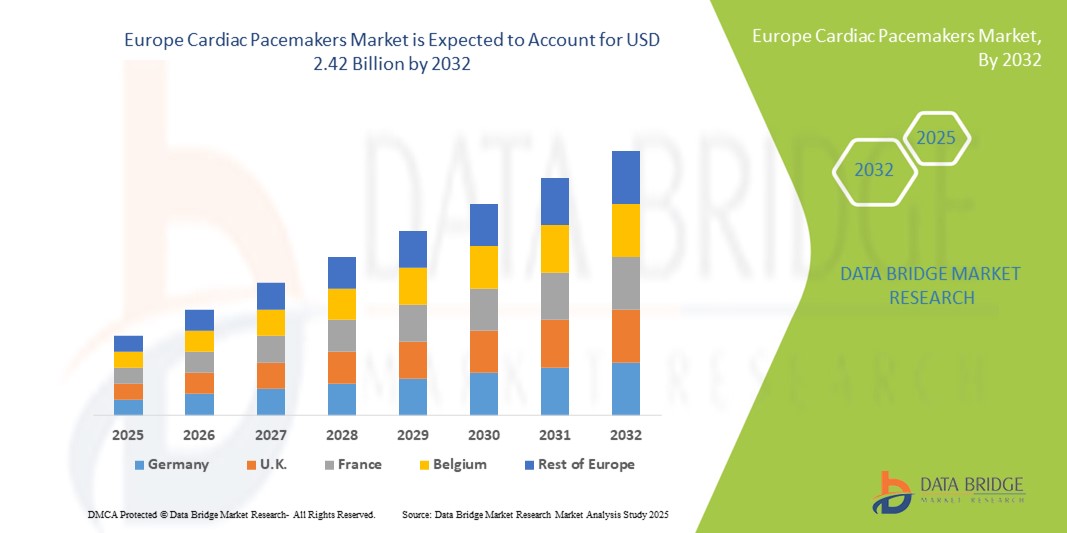
- The Europe cardiac pacemakers market size was valued at USD 1.57 billion in 2024 and is expected to reach USD 2.42 billion by 2032, at a CAGR of 5.50% during the forecast period
- The market growth is primarily driven by the rising prevalence of cardiovascular diseases and the increasing aging population across the region, which is contributing to higher demand for advanced cardiac rhythm management solutions
- Moreover, continuous technological advancements such as MRI-compatible pacemakers, remote monitoring features, and minimally invasive implantation techniques are strengthening adoption rates, positioning cardiac pacemakers as a critical solution in improving patient outcomes and expanding the market’s growth trajectory
Europe Cardiac Pacemakers Market Analysis
- Cardiac pacemakers, which regulate abnormal heart rhythms through electronic stimulation, are critical devices in modern cardiology, playing an essential role in improving patient survival and quality of life across both hospital and outpatient settings due to their reliability, programmability, and long-term effectiveness
- The rising demand for cardiac pacemakers is primarily fueled by the growing prevalence of cardiovascular diseases, the expanding elderly population, and increasing awareness of early diagnosis and treatment options for arrhythmia and heart block conditions
- Germany dominated the Europe cardiac pacemakers market with the largest revenue share of 24.6% in 2024, supported by strong healthcare infrastructure, favorable reimbursement policies, and the presence of leading medtech companies, with significant adoption of advanced pacing solutions such as MRI-compatible and leadless pacemakers
- Poland is expected to be the fastest growing country in the Europe cardiac pacemakers market during the forecast period due to rising healthcare investments, improving cardiac care accessibility, and increasing uptake of advanced medical technologies
- Dual-chamber pacemakers segment dominated the Europe cardiac pacemakers market with a market share of 45.8% in 2024, attributed to their ability to mimic natural heart rhythms more effectively and provide superior patient outcomes compared to single-chamber devices
Report Scope and Europe Cardiac Pacemakers Market Segmentation
|
Attributes |
Europe Cardiac Pacemakers Key Market Insights |
|
Segments Covered |
|
|
Countries Covered |
Europe
|
|
Key Market Players |
|
|
Market Opportunities |
|
|
Value Added Data Infosets |
In addition to the insights on market scenarios such as market value, growth rate, segmentation, geographical coverage, and major players, the market reports curated by the Data Bridge Market Research also include in-depth expert analysis, pricing analysis, brand share analysis, consumer survey, demography analysis, supply chain analysis, value chain analysis, raw material/consumables overview, vendor selection criteria, PESTLE Analysis, Porter Analysis, and regulatory framework. |
Europe Cardiac Pacemakers Market Trends
Advancements in Remote Monitoring and AI-Enabled Pacemakers
- A significant and accelerating trend in the Europe cardiac pacemakers market is the integration of AI-enabled pacemakers and remote monitoring technologies, which improve patient care through real-time heart rhythm tracking and predictive diagnostics
- For instance, the Medtronic Azure pacemaker allows clinicians to remotely monitor patient heart activity, adjust pacing parameters, and receive alerts for abnormal events without requiring frequent hospital visits
- AI integration in pacemakers enables features such as adaptive pacing based on patient activity, predictive alerts for arrhythmia, and automated adjustments to optimize therapy, while remote monitoring facilitates timely medical interventions and improved patient outcomes
- The seamless connectivity of pacemakers with hospital IT systems and mobile health platforms allows centralized management of patient data, enabling cardiologists to monitor multiple patients simultaneously and make informed decisions quickly
- This trend towards more intelligent, connected, and patient-centric cardiac devices is fundamentally reshaping expectations for cardiac care. Consequently, companies such as Boston Scientific are developing AI-assisted pacemakers with predictive diagnostics and remote monitoring capabilities
- The demand for pacemakers offering AI-enabled and remote monitoring features is growing rapidly across both hospital and outpatient settings, as healthcare providers increasingly prioritize efficiency, personalized treatment, and improved patient adherence
Europe Cardiac Pacemakers Market Dynamics
Driver
Increasing Cardiovascular Disease Prevalence and Aging Population
- The rising prevalence of cardiovascular disorders, particularly arrhythmias and heart block conditions, coupled with an expanding elderly population, is a significant driver for the growing demand for cardiac pacemakers
- For instance, in March 2024, Abbott launched a new line of MRI-compatible pacemakers in Europe designed to support aging patients with complex cardiac conditions, expected to drive adoption across hospitals and clinics
- As awareness of early diagnosis and timely treatment increases, pacemakers provide advanced solutions such as dual-chamber pacing, programmable settings, and enhanced longevity, offering superior patient outcomes compared to conventional therapies
- Furthermore, government healthcare initiatives, favorable reimbursement policies, and national programs for cardiovascular disease management are facilitating wider adoption of pacemaker technologies
- The convenience of remote monitoring, ease of implantation, and ability to manage therapy adjustments digitally are key factors propelling pacemaker adoption across hospitals, cardiology centers, and outpatient facilities in Europe
Restraint/Challenge
High Device Costs and Regulatory Compliance Hurdles
- The relatively high cost of advanced pacemaker devices and accessories, including AI-enabled and MRI-compatible models, poses a challenge to market penetration, particularly in price-sensitive markets
- For instance, smaller hospitals or clinics in Eastern European countries may delay adoption of high-end pacemakers due to budget constraints and limited reimbursement coverage
- Addressing regulatory compliance, such as CE marking, ISO certification, and strict clinical trial requirements, is crucial for market entry and maintaining device safety standards, as any delay can slow product launch timelines
- In addition, concerns about device longevity, battery replacement procedures, and potential surgical complications can impact physician and patient adoption decisions
- While innovations and cost optimization are gradually improving affordability, perceived high treatment expenses and complex regulatory approval processes continue to restrict rapid adoption, particularly in emerging European markets
- Overcoming these challenges through pricing strategies, streamlined regulatory approvals, and education on long-term device benefits will be vital for sustained market growth
Europe Cardiac Pacemakers Market Scope
The market is segmented on the basis of type, technology, application, and end user.
- By Type
On the basis of type, the Europe cardiac pacemakers market is segmented into Magnetic Resonance Imaging (MRI) compatible pacemaker, conventional pacemaker, implantable pacemaker, and external pacemaker. The implantable pacemaker segment dominated the market with the largest revenue share of 48.5% in 2024, driven by its widespread use in long-term cardiac rhythm management and its ability to provide continuous pacing therapy. Implantable pacemakers are preferred by cardiologists for patients with chronic arrhythmias or bradycardia due to their reliability, durability, and programmable features. These devices are also compatible with advanced technologies such as remote monitoring and AI-assisted therapy adjustments, enhancing patient outcomes. The market demand is further supported by growing awareness among patients about the benefits of permanent pacing solutions and increasing hospital adoption of implantable devices for routine cardiac care.
The MRI-compatible pacemaker segment is anticipated to witness the fastest growth rate of 19.6% from 2025 to 2032, fueled by the rising need for devices that are safe for imaging procedures. MRI-compatible pacemakers allow patients to undergo critical diagnostic scans without removing or compromising their device, offering both safety and convenience. The increasing prevalence of cardiovascular patients requiring frequent imaging examinations is driving adoption. In addition, technological advancements in materials and device miniaturization are improving safety and patient comfort, encouraging physicians to recommend MRI-compatible models. The growing awareness of non-MRI compatible pacemaker limitations also supports rapid uptake of these advanced devices.
- By Technology
On the basis of technology, the market is segmented into single-chamber pacemaker, dual-chamber pacemaker, and biventricular/cardiac resynchronization therapy (CRT) pacemaker. The dual-chamber pacemaker segment dominated the market with a share of 45.8% in 2024, owing to its ability to more closely mimic natural heart rhythms and provide superior hemodynamic benefits over single-chamber devices. Dual-chamber pacemakers are widely used for patients with atrioventricular block and other complex arrhythmias, offering better synchronization of atrial and ventricular contractions. The segment’s dominance is further strengthened by the availability of advanced features such as rate-responsive pacing, remote monitoring, and programmable settings, which improve patient outcomes and reduce hospital visits. Clinical preference for dual-chamber devices in standard cardiac care protocols also supports market leadership.
The biventricular/CRT pacemaker segment is expected to register the fastest CAGR of 21.2% from 2025 to 2032, driven by growing incidence of heart failure and increasing clinical evidence supporting CRT therapy for improved cardiac function. Biventricular pacemakers provide coordinated pacing of both ventricles, reducing symptoms of heart failure and enhancing patient quality of life. The rising number of patients with advanced heart failure, coupled with favorable reimbursement policies in Europe, is accelerating adoption. Continuous innovation in device miniaturization, battery longevity, and remote monitoring compatibility further contributes to rapid market growth.
- By Application
On the basis of application, the Europe cardiac pacemakers market is segmented into arrhythmia, atrial fibrillation, bradycardia, tachycardia, and others. The bradycardia segment dominated the market with the largest revenue share in 2024, as pacemakers are primarily prescribed to manage slow heart rates that can lead to fatigue, dizziness, or sudden cardiac arrest. The high prevalence of bradycardia among the aging population and increasing awareness of its complications drive the demand. Hospitals and cardiac centers prefer pacemakers for bradycardia management due to their proven effectiveness, long-term reliability, and ability to be programmed according to patient-specific requirements. Continuous innovations in pacing technology, such as rate-responsive pacing and AI-assisted monitoring, further reinforce the segment’s dominance.
The atrial fibrillation segment is projected to witness the fastest growth during the forecast period, driven by rising prevalence of AF among elderly and comorbid patients. Pacemakers equipped with atrial sensing and pacing capabilities help manage irregular heart rhythms, reduce stroke risk, and improve patient quality of life. The increasing number of diagnostic procedures leading to early detection of AF, along with the growing adoption of CRT devices in AF patients, supports rapid growth. Awareness campaigns by healthcare providers and patient education initiatives are further accelerating adoption.
- By End User
On the basis of end user, the Europe cardiac pacemakers market is segmented into hospitals and cardiac centers, and ambulatory surgical centers (ASCs). The hospitals and cardiac centers segment dominated the market with the largest revenue share in 2024, owing to well-equipped infrastructure, availability of specialized cardiologists, and capability to perform complex implantation procedures. Hospitals provide comprehensive pre- and post-operative care, including remote monitoring and follow-up, making them the preferred setting for pacemaker implantation. The dominance is further supported by government reimbursement policies and high patient footfall in tertiary care centers.
The ambulatory surgical centers segment is expected to witness the fastest growth rate from 2025 to 2032 due to increasing preference for outpatient procedures, cost-effectiveness, and shorter recovery times. ASCs are becoming attractive for routine pacemaker implantations, particularly for low-risk patients, as they reduce hospital burden and improve patient convenience. Advances in minimally invasive techniques, shorter procedure durations, and improved device safety are driving adoption in ASCs. In addition, growing awareness among patients about the availability of outpatient cardiac procedures supports the expansion of this end-user segment.
Europe Cardiac Pacemakers Market Regional Analysis
- Germany dominated the cardiac pacemakers market with the largest revenue share of 24.6% in 2024, supported by strong healthcare infrastructure, favorable reimbursement policies, and the presence of leading medtech companies, with significant adoption of advanced pacing solutions such as MRI-compatible and leadless pacemakers
- Patients and healthcare providers in Germany highly value the reliability, programmability, and remote monitoring capabilities offered by modern pacemakers, which improve treatment outcomes and reduce hospital visits
- This widespread adoption is further supported by favorable reimbursement policies, the presence of leading medical device manufacturers, and growing awareness of early diagnosis and treatment of arrhythmias, establishing pacemakers as a critical solution in both hospital and outpatient care settings across the country
The U.K. Cardiac Pacemakers Market Insight
The U.K. cardiac pacemakers market accounted for a significant revenue share in Europe in 2024, driven by the rising prevalence of cardiovascular diseases and increasing awareness of arrhythmia management. Patients and healthcare providers are increasingly prioritizing advanced pacing solutions such as dual-chamber and MRI-compatible pacemakers to improve treatment outcomes. The growing adoption of remote monitoring technologies, coupled with supportive healthcare policies and reimbursement schemes, is further propelling market growth. In addition, increasing hospital infrastructure and specialized cardiac centers across the U.K. are enhancing access to advanced pacemaker therapies for both chronic and acute cardiac conditions. The trend towards minimally invasive implantation procedures and improved device longevity is also encouraging widespread adoption.
Germany Cardiac Pacemakers Market Insight
The Germany cardiac pacemakers market dominated Europe in 2024 with the largest revenue share, supported by well-established healthcare infrastructure, a high geriatric population, and a strong presence of leading medical device manufacturers. German patients and cardiologists highly value the reliability, programmability, and remote monitoring capabilities of modern pacemakers, which reduce hospital visits and improve patient quality of life. Favorable reimbursement policies and nationwide cardiovascular care programs are further supporting market expansion. Hospitals and cardiac centers in Germany are adopting advanced pacing technologies such as biventricular pacemakers and AI-assisted devices, enhancing patient outcomes. Technological innovation, including MRI-compatible pacemakers, is also boosting adoption rates.
France Cardiac Pacemakers Market Insight
The France cardiac pacemakers market is expected to grow at a notable CAGR during the forecast period, driven by the rising incidence of heart failure and arrhythmias. French healthcare providers are increasingly implementing advanced pacing devices, including dual-chamber and CRT pacemakers, to optimize cardiac function and improve patient prognosis. Government initiatives supporting cardiovascular disease management and early detection programs are enhancing patient access to pacemaker therapies. The country’s sophisticated hospital infrastructure, coupled with awareness campaigns on arrhythmia management, is fueling adoption. In addition, integration of remote monitoring and telehealth features is enabling better post-implantation care and follow-up.
Poland Cardiac Pacemakers Market Insight
The Poland cardiac pacemakers market is expected to register the fastest CAGR in Europe during the forecast period, driven by improving healthcare infrastructure, increased availability of advanced cardiac devices, and rising awareness of arrhythmia management. Hospitals and cardiac centers are adopting MRI-compatible and dual-chamber pacemakers to provide safe and effective treatment for cardiovascular patients. Government initiatives and insurance coverage for pacemaker implantation are enhancing accessibility. Technological innovations, coupled with growing patient awareness and increasing prevalence of heart disorders, are driving rapid market adoption. The trend toward outpatient procedures and minimally invasive implantation is further contributing to growth.
Europe Cardiac Pacemakers Market Share
The Europe Cardiac Pacemakers industry is primarily led by well-established companies, including:
- Medtronic (Ireland)
- BIOTRONIK SE & Co. KG (Germany)
- Abbott (U.S.)
- Boston Scientific Corporation (U.S.)
- MicroPort Scientific Corporation (China)
- LivaNova PLC (U.K.)
- Medico S.p.A. (Italy)
- Sorin Group (Italy)
- St. Jude Medical (U.S.)
- Vitatron (Netherlands)
- Cardiac Science (U.S.)
- Physio-Control (U.S.)
- Zoll Medical Corporation (U.S.)
- Koninklijke Philips N.V., (Netherlands)
- GE Healthcare (U.K.)
- Siemens Healthineers AG (Germany)
- Schiller AG (Switzerland)
- Welch Allyn (U.S.)
- NIHON KOHDEN CORPORATION (Japan)
- Biotronik (Germany)
What are the Recent Developments in Europe Cardiac Pacemakers Market?
- In July 2025, BIOTRONIK and CardioFocus announced a partnership to expand access to pulsed field ablation (PFA) technology in Europe. This collaboration aims to enhance treatment options for atrial fibrillation patients by introducing the Centauri™ PFA System across 17 European markets
- In June 2024, Abbott announced the receipt of the CE Mark for its AVEIR™ DR dual-chamber leadless pacemaker system. This innovative device enables wireless, beat-to-beat communication between two leadless pacemakers, providing synchronized pacing for patients with complex arrhythmias
- In January 2024, Medtronic received CE Mark approval for its next-generation Micra leadless pacemakers: the Micra AV2 and Micra VR2. These devices offer longer battery life and simplified programming compared to previous models, enhancing patient outcomes and reducing complications associated with traditional pacemakers
- In August 2023, BIOTRONIK conducted the first European implant of its Amvia Sky pacemaker, the world's first device approved for left bundle branch area pacing (LBBAP). This advancement offers a more physiological pacing option for patients with conduction disorders, potentially improving clinical outcomes
- In December 2022, the European Commission launched the Horizon Europe program, funding research into innovative cardiac pacemaker technologies. The program supports the development of next-generation pacemakers with improved functionalities, such as remote monitoring capabilities and enhanced patient compatibility, aiming to address the growing demand for advanced cardiac care solutions in Europe

- Interactive Data Analysis Dashboard
- Company Analysis Dashboard for high growth potential opportunities
- Research Analyst Access for customization & queries
- Competitor Analysis with Interactive dashboard
- Latest News, Updates & Trend analysis
- Harness the Power of Benchmark Analysis for Comprehensive Competitor Tracking
Data collection and base year analysis are done using data collection modules with large sample sizes. The stage includes obtaining market information or related data through various sources and strategies. It includes examining and planning all the data acquired from the past in advance. It likewise envelops the examination of information inconsistencies seen across different information sources. The market data is analysed and estimated using market statistical and coherent models. Also, market share analysis and key trend analysis are the major success factors in the market report. To know more, please request an analyst call or drop down your inquiry.
The key research methodology used by DBMR research team is data triangulation which involves data mining, analysis of the impact of data variables on the market and primary (industry expert) validation. Data models include Vendor Positioning Grid, Market Time Line Analysis, Market Overview and Guide, Company Positioning Grid, Patent Analysis, Pricing Analysis, Company Market Share Analysis, Standards of Measurement, Global versus Regional and Vendor Share Analysis. To know more about the research methodology, drop in an inquiry to speak to our industry experts.
Data Bridge Market Research is a leader in advanced formative research. We take pride in servicing our existing and new customers with data and analysis that match and suits their goal. The report can be customized to include price trend analysis of target brands understanding the market for additional countries (ask for the list of countries), clinical trial results data, literature review, refurbished market and product base analysis. Market analysis of target competitors can be analyzed from technology-based analysis to market portfolio strategies. We can add as many competitors that you require data about in the format and data style you are looking for. Our team of analysts can also provide you data in crude raw excel files pivot tables (Fact book) or can assist you in creating presentations from the data sets available in the report.













