


Europe Critical Care Equipment Market Size
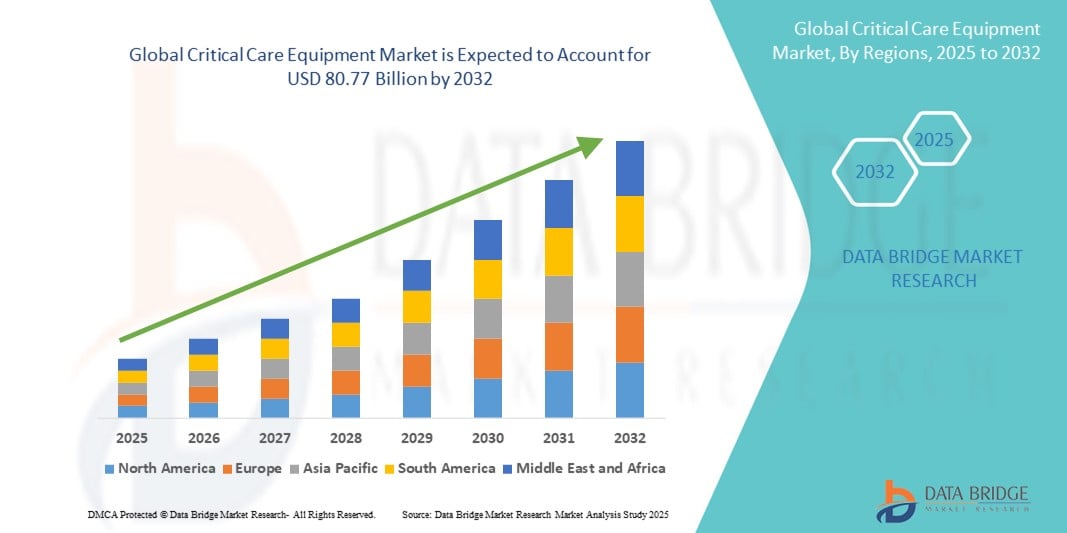
- The Europe critical care equipment market size was valued at USD 10.97 billion in 2024 and is expected to reach USD 20.32 billion by 2032, at a CAGR of 8.0% during the forecast period
- The market growth is largely fueled by the rising prevalence of chronic diseases, an aging population requiring intensive care, and growing demand for advanced monitoring and life-support technologies across healthcare facilities in Europe
- Furthermore, increasing healthcare expenditure, technological advancements in ventilators, patient monitoring systems, and infusion pumps, along with heightened emphasis on preparedness for emergencies and pandemics, are accelerating the adoption of critical care equipment, thereby significantly boosting the region’s market growth
Europe Critical Care Equipment Market Analysis
- Critical care equipment, including ventilators, infusion pumps, patient monitoring systems, and ICU units, plays a pivotal role in supporting patients with life-threatening conditions, offering advanced monitoring, therapeutic, and diagnostic capabilities to ensure effective intensive care delivery across hospitals and specialized centers
- The escalating demand for critical care equipment is primarily fueled by the rising prevalence of chronic and infectious diseases, an aging population requiring intensive treatment, and continuous technological advancements in life-support and monitoring devices
- Germany dominated the Europe critical care equipment market with the largest revenue share of 29.5% in 2024, supported by its advanced healthcare infrastructure, high ICU bed capacity, and strong presence of leading global medical device manufacturers driving adoption
- The U.K. is expected to be the fastest growing country in the Europe critical care equipment market during the forecast period, driven by healthcare modernization programs, increasing investments in ICU capacity, and adoption of AI-integrated monitoring and ventilator systems
- Patient Monitoring Devices segment dominated the Europe critical care equipment market with a market share of 37% in 2024, attributed to their critical role in real-time tracking of vital signs, growing demand for remote monitoring, and the integration of smart analytics in intensive care settings
Report Scope and Europe Critical Care Equipment Market Segmentation
|
Attributes |
Europe Critical Care Equipment Key Market Insights |
|
Segments Covered |
|
|
Countries Covered |
Europe
|
|
Key Market Players |
|
|
Market Opportunities |
|
|
Value Added Data Infosets |
In addition to the insights on market scenarios such as market value, growth rate, segmentation, geographical coverage, and major players, the market reports curated by the Data Bridge Market Research also include in-depth expert analysis, pricing analysis, brand share analysis, consumer survey, demography analysis, supply chain analysis, value chain analysis, raw material/consumables overview, vendor selection criteria, PESTLE Analysis, Porter Analysis, and regulatory framework. |
Europe Critical Care Equipment Market Trends
Integration of AI and Remote Patient Monitoring in ICUs
- A significant and accelerating trend in the Europe critical care equipment market is the integration of artificial intelligence (AI), tele-ICU platforms, and remote patient monitoring systems into critical care settings. This fusion of technologies is enhancing decision-making, optimizing ICU workflows, and enabling proactive patient management
- For instance, Philips introduced AI-enabled monitoring systems that provide predictive analytics for early detection of patient deterioration, helping healthcare professionals make timely interventions. Similarly, Dräger offers advanced ventilators with integrated decision-support features
- AI integration in patient monitoring devices enables continuous analysis of vital signs and can trigger predictive alerts, reducing adverse events and improving clinical outcomes. Remote monitoring solutions also allow intensivists to manage multiple ICUs across different hospital sites, addressing workforce shortages in Europe
- The seamless integration of critical care devices with hospital information systems (HIS) and electronic health records (EHR) allows for centralized patient data management, improving clinical workflows and supporting precision medicine
- This trend toward smarter, connected, and data-driven intensive care units is fundamentally reshaping expectations in European healthcare systems. Consequently, companies such as Siemens Healthineers and GE Healthcare are developing AI-driven monitoring and imaging systems, enabling real-time, evidence-based care in critical care environments
- The demand for AI-enabled and interoperable critical care devices is rapidly expanding across Europe, particularly in advanced hospital settings, as providers prioritize patient safety, efficiency, and improved outcomes in intensive care units
Europe Critical Care Equipment Market Dynamics
Driver
Rising ICU Admissions Due to Aging Population and Chronic Diseases
- The increasing burden of chronic conditions such as cardiovascular diseases, respiratory disorders, and sepsis, coupled with Europe’s aging population, is a major driver for critical care equipment demand
- For instance, Eurostat reported that over 21% of the EU’s population was aged 65 or above in 2024, significantly raising ICU admission rates. This demographic shift is pushing hospitals to upgrade and expand their critical care infrastructure
- Patient monitoring devices and ventilators are becoming essential for managing the growing number of elderly patients with multi-organ complications, leading to strong adoption across European hospitals
- Furthermore, government healthcare investments and policies aimed at strengthening ICU capacity and preparedness for health crises (such as pandemics) are fueling the market
- The dominance of Patient Monitoring Devices with a market share of 36.5% in 2024 reflects the region’s need for continuous monitoring solutions that can detect complications early and support clinical decision-making in high-risk patients
Restraint/Challenge
High Equipment Costs and Stringent Regulatory Hurdles
- The high cost of advanced critical care equipment, including AI-enabled monitoring systems and next-generation ventilators, presents a significant barrier to adoption, particularly for smaller hospitals and specialty clinics across Europe
- For instance, premium devices with predictive analytics or remote connectivity features often require substantial upfront investments, making procurement difficult under constrained healthcare budgets
- In addition, strict regulatory frameworks in Europe, such as the EU Medical Device Regulation (MDR), increase compliance costs and lengthen approval timelines for new devices, slowing down innovation and product launches
- Cybersecurity concerns associated with connected devices also remain a challenge, as data breaches or system vulnerabilities in hospital networks can compromise patient safety and data integrity
- Overcoming these hurdles through cost-effective solutions, regulatory harmonization, and stronger cybersecurity protocols will be essential for driving broader adoption across both developed and mid-sized healthcare facilities in Europe
Europe Critical Care Equipment Market Scope
The market is segmented on the basis of product type, patient population, end user, and distribution channel.
- By Product Type
On the basis of product type, the Europe critical care equipment market is segmented into therapeutic devices, patient monitoring devices, diagnostic devices, ICU units & system, and other devices. The patient monitoring devices segment dominated the market with the largest revenue share of 37% in 2024, driven by the rising need for continuous vital sign monitoring in ICUs and the growing adoption of AI-integrated monitoring systems for early detection of complications. The increasing prevalence of chronic diseases and sepsis cases across Europe has further reinforced the demand for advanced monitoring solutions.
The therapeutic devices segment is anticipated to witness the fastest growth rate of 7.9% CAGR from 2025 to 2032, fueled by advancements in ventilators, infusion pumps, and dialysis machines. The post-pandemic demand for sophisticated respiratory support systems and the expansion of ICU capacity across hospitals in Europe are driving rapid growth in this segment. Technological improvements, such as portable ventilators and AI-enabled infusion pumps, are enhancing patient outcomes and operational efficiency.
- By Patient Population
On the basis of patient population, the Europe critical care equipment market is segmented into neonatal, pediatric, adults, and geriatric. The adult segment dominated the market with the largest revenue share of 48.7% in 2024, as adults represent the majority of ICU admissions due to higher incidences of trauma, cardiac events, and lifestyle-related chronic diseases. Hospitals across Europe are investing heavily in monitoring and therapeutic solutions to meet the growing demand for adult critical care.
The geriatric segment is expected to grow at the fastest CAGR of 8.2% from 2025 to 2032, as Europe faces a rapidly aging population, leading to a surge in ICU admissions for age-related conditions such as respiratory insufficiency, multi-organ failure, and cardiovascular complications. The geriatric segment is increasingly benefitting from AI-integrated monitoring solutions and minimally invasive therapeutic devices, allowing clinicians to provide safer, more personalized care.
- By End User
On the basis of end user, the Europe critical care equipment market is segmented into hospitals, specialty clinics, ambulatory surgical centers, and others. The hospitals segment dominated the market with the largest revenue share of 62.4% in 2024, as hospitals account for the majority of ICU beds and receive substantial funding for advanced critical care infrastructure. Their capacity to adopt cutting-edge technologies such as AI-enabled monitoring devices and advanced ventilators also strengthens their leadership position.
The ambulatory surgical centers (ASCs) segment is projected to register the fastest growth at a CAGR of 7.4% from 2025 to 2032, supported by the rising number of day-care surgeries, cost-effectiveness of treatment in ASCs, and increasing adoption of compact and portable monitoring and therapeutic equipment. ASCs are also leveraging digital and remote monitoring technologies to manage post-operative patients effectively.
- By Distribution Channel
On the basis of distribution channel, the Europe critical care equipment market is segmented into direct tenders, retail sales, third-party distribution, and others. The direct tenders segment dominated the market with the largest revenue share of 54.2% in 2024, as bulk procurement by government healthcare systems and large hospital networks ensures cost efficiency, timely supply, and standardization of equipment. Direct tenders are particularly strong in Western Europe where public healthcare systems dominate procurement.
The retail sales segment is expected to expand at the fastest CAGR of 6.8% from 2025 to 2032, driven by the increasing adoption of portable monitoring devices and point-of-care equipment in smaller clinics and homecare settings, coupled with growing e-commerce and distributor networks across Europe. E-commerce platforms and healthcare distributors are increasing accessibility, enabling smaller clinics and even homecare setups to adopt advanced critical care solutions.
Europe Critical Care Equipment Market Regional Analysis
- Germany dominated the Europe critical care equipment market with the largest revenue share of 29.5% in 2024, supported by its advanced healthcare infrastructure, high ICU bed capacity, and strong presence of leading global medical device manufacturers driving adoption
- Hospitals and healthcare providers in Germany highly value the precision, reliability, and advanced features offered by patient monitoring devices, ventilators, and infusion systems, which play a critical role in managing high patient volumes in intensive care units
- This strong market position is further supported by substantial healthcare expenditure, government-backed investments in critical care preparedness, and a rising geriatric population requiring intensive care services, establishing Germany as the central hub for critical care equipment adoption in Europe
The Germany Critical Care Equipment Market Insight
The Germany critical care equipment market captured the largest revenue share of 29.5% in 2024 within Europe, driven by its advanced healthcare infrastructure, high ICU bed capacity, and strong presence of global medical device manufacturers such as Drägerwerk and Siemens Healthineers. German hospitals are at the forefront of adopting AI-powered patient monitoring systems and next-generation ventilators, with a focus on precision, interoperability, and sustainability. The country’s robust public healthcare spending and high standards for ICU care reinforce Germany’s position as the leading market in Europe.
U.K. Critical Care Equipment Market Insight
The U.K. critical care equipment market is expected to grow at a noteworthy CAGR during the forecast period, supported by government-driven initiatives to expand ICU capacity, improve critical care preparedness, and modernize healthcare infrastructure post-pandemic. Rising adoption of remote patient monitoring systems and non-invasive ventilators is shaping market growth. Concerns around patient safety and the need for real-time data analytics are encouraging hospitals to integrate advanced AI-enabled monitoring platforms. In addition, the U.K.’s strong digital health ecosystem is fostering rapid adoption of connected critical care devices.
France Critical Care Equipment Market Insight
The France critical care equipment market is witnessing robust expansion, fueled by rising healthcare expenditure, modernization of ICU facilities, and a growing need for infusion devices and therapeutic equipment. The French government’s focus on digitization of healthcare systems and remote monitoring capabilities is creating opportunities for AI-driven patient monitoring solutions. Ventilators and patient monitoring devices are leading adoption in French hospitals, particularly in tertiary care centers handling complex critical care cases.
Italy Critical Care Equipment Market Insight
The Italy critical care equipment market is expected to expand steadily, driven by increasing ICU admissions due to respiratory diseases and cardiovascular conditions. Italian hospitals are focusing on upgrading ICU infrastructure with portable monitoring devices and infusion pumps, which offer flexibility and cost-effectiveness. The aging population is further contributing to strong demand for geriatric-focused critical care solutions, including advanced ventilators and dialysis machines.
Spain Critical Care Equipment Market Insight
The Spain critical care equipment market is projected to grow significantly during the forecast period, supported by healthcare reforms, rising government spending, and an increasing focus on modernizing ICU facilities. Hospitals in Spain are prioritizing the adoption of non-invasive ventilators, advanced therapeutic devices, and AI-enabled patient monitoring systems to improve patient outcomes. Spain’s growing elderly population is also driving higher demand for multi-organ support equipment in intensive care units.
Europe Critical Care Equipment Market Share
The Europe Critical Care Equipment industry is primarily led by well-established companies, including:
- Getinge AB (Sweden)
- Drägerwerk AG & Co. KGaA (Germany)
- Siemens Healthineers AG (Germany)
- GE Healthcare (U.S.)
- Koninklijke Philips N.V. (Netherlands)
- Fresenius Medical Care AG & Co. KGaA (Germany)
- B. Braun SE (Germany)
- Hamilton Medical AG (Switzerland)
- Medtronic (Ireland)
- ICU Medical, Inc. (U.S.)
- LivaNova PLC (U.K.)
- Schiller AG (Switzerland)
- Mindray Medical International Limited (China)
- Nihon Kohden Corporation (Japan)
- Stryker (U.S.)
- Cardinal Health, Inc. (U.S.)
- Fisher & Paykel Healthcare Corporation Limited (New Zealand)
What are the Recent Developments in Europe Critical Care Equipment Market?
- In August 2025, Getinge regained the EU CE Mark for its Cardiosave Intra-Aortic Balloon Pump (IABP) following a period of suspension. The device’s reaffirmed certification reflects successful implementation of required design improvements, enabling Getinge to resume deliveries to CE-mark-accepting European markets starting in Q4 2025. This reinstatement ensures continued access to this vital cardiovascular support tool in critical care
- In April 2025, CBM Lifemotion launched its Lifemotion System, a next-generation extracorporeal life support (ECLS) device, in Europe following CE-marking. The first clinical cases were performed in Germany and Spain, marking its initial use outside China
- In April 2024, Asahi Kasei Medical (in collaboration with AW Technologies) highlighted the TrachFlush, a medical device designed to reduce discomfort during tracheal suctioning while easing caregiver workload. The device, already CE-marked in Europe since 2020, applies a unique cuff pressure control system to better manage airway secretions
- In November 2023, Resvent Medical showcased its latest respiratory care innovations at MEDICA 2023 in Düsseldorf. Featured products included the EIT-iNueview (thoracic electrical impedance tomography), a high-flow non-invasive respiratory humidification therapy device, iBreeze III (third-generation home ventilator), and iApneaMate (sleep apnea monitor)
- In May 2021, CorVent Medical received CE Mark approval for its RESPOND-19™ Ventilator, enabling its commercial launch across Europe. This cost-effective device provides both invasive and non-invasive respiratory support, offering hospitals a flexible and reliable solution to expand critical care ventilation capabilities

- Interactive Data Analysis Dashboard
- Company Analysis Dashboard for high growth potential opportunities
- Research Analyst Access for customization & queries
- Competitor Analysis with Interactive dashboard
- Latest News, Updates & Trend analysis
- Harness the Power of Benchmark Analysis for Comprehensive Competitor Tracking
Data collection and base year analysis are done using data collection modules with large sample sizes. The stage includes obtaining market information or related data through various sources and strategies. It includes examining and planning all the data acquired from the past in advance. It likewise envelops the examination of information inconsistencies seen across different information sources. The market data is analysed and estimated using market statistical and coherent models. Also, market share analysis and key trend analysis are the major success factors in the market report. To know more, please request an analyst call or drop down your inquiry.
The key research methodology used by DBMR research team is data triangulation which involves data mining, analysis of the impact of data variables on the market and primary (industry expert) validation. Data models include Vendor Positioning Grid, Market Time Line Analysis, Market Overview and Guide, Company Positioning Grid, Patent Analysis, Pricing Analysis, Company Market Share Analysis, Standards of Measurement, Global versus Regional and Vendor Share Analysis. To know more about the research methodology, drop in an inquiry to speak to our industry experts.
Data Bridge Market Research is a leader in advanced formative research. We take pride in servicing our existing and new customers with data and analysis that match and suits their goal. The report can be customized to include price trend analysis of target brands understanding the market for additional countries (ask for the list of countries), clinical trial results data, literature review, refurbished market and product base analysis. Market analysis of target competitors can be analyzed from technology-based analysis to market portfolio strategies. We can add as many competitors that you require data about in the format and data style you are looking for. Our team of analysts can also provide you data in crude raw excel files pivot tables (Fact book) or can assist you in creating presentations from the data sets available in the report.













