


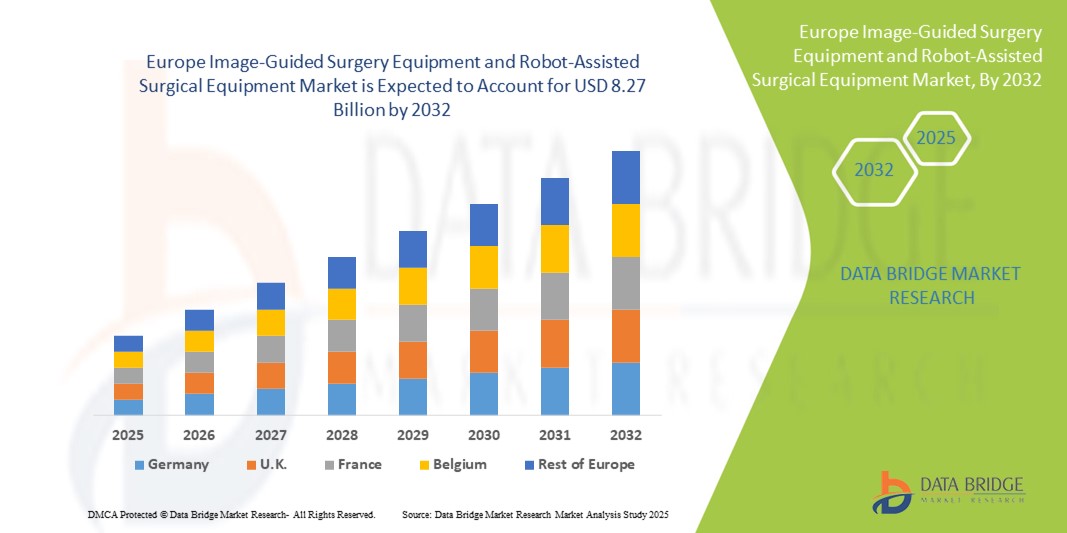
Europe Image-Guided Surgery Equipment and Robot-Assisted Surgical Equipment Market Size
- The Europe image-guided surgery equipment and robot-assisted surgical equipment market size was valued at USD 3.91 billion in 2024 and is expected to reach USD 8.27 billion by 2032, at a CAGR of 9.80% during the forecast period
- The market growth is largely fueled by the increasing adoption of minimally invasive surgical procedures, advancements in robotic technologies, and rising demand for precision and efficiency in surgical operations
- Furthermore, the growing prevalence of chronic diseases and the need for complex surgeries are establishing image-guided and robot-assisted surgical systems as essential tools in modern healthcare. These converging factors are accelerating the uptake of these solutions, thereby significantly boosting the industry's growth in Europe
Europe Image-Guided Surgery Equipment and Robot-Assisted Surgical Equipment Market Analysis
- Image-guided surgery and robot-assisted surgical systems, offering enhanced precision, minimally invasive capabilities, and real-time navigation for complex procedures, are increasingly vital components of modern surgical care in both hospitals and specialty clinics due to their ability to improve patient outcomes and reduce recovery times
- The escalating demand for these systems is primarily fueled by the growing adoption of minimally invasive surgeries, technological advancements in robotic and navigation-assisted platforms, and the rising need for precision and efficiency in complex surgical procedures
- Germany dominated the Europe image-guided surgery equipment and robot-assisted surgical equipment market with the largest revenue share of 39.2% in 2024, characterized by well-established healthcare infrastructure, high adoption of advanced surgical technologies, and a strong presence of key industry players, with substantial growth in robot-assisted surgical installations driven by innovations from both established medical device companies and startups focusing on AI-assisted surgical planning and augmented reality navigation
- Poland is expected to be the fastest-growing country in the Europe image-guided surgery equipment and robot-assisted surgical equipment market during the forecast period due to increasing healthcare investments, modernization of surgical facilities, and rising patient demand for advanced surgical procedures
- Robotic Systems segment dominated the Europe image-guided surgery equipment and robot-assisted surgical equipment market with a share of 45.8% in 2024, driven by its established reputation for precision, versatility across multiple surgical specialties, and integration with image-guided systems
Report Scope and Europe Image-Guided Surgery Equipment and Robot-Assisted Surgical Equipment Market Segmentation
|
Attributes |
Europe Image-Guided Surgery Equipment and Robot-Assisted Surgical Equipment Key Market Insights |
|
Segments Covered |
|
|
Countries Covered |
Europe
|
|
Key Market Players |
|
|
Market Opportunities |
|
|
Value Added Data Infosets |
In addition to the insights on market scenarios such as market value, growth rate, segmentation, geographical coverage, and major players, the market reports curated by the Data Bridge Market Research also include in-depth expert analysis, pricing analysis, brand share analysis, consumer survey, demography analysis, supply chain analysis, value chain analysis, raw material/consumables overview, vendor selection criteria, PESTLE Analysis, Porter Analysis, and regulatory framework. |
Europe Image-Guided Surgery Equipment and Robot-Assisted Surgical Equipment Market Trends
Advancements Through AI and Augmented Reality Integration
- A significant and accelerating trend in the Europe image-guided and robot-assisted surgery market is the integration of artificial intelligence (AI) and augmented reality (AR) into surgical systems, enhancing procedural precision, planning, and real-time navigation
- For Instance, the ROSA® Brain robot integrates AI-based planning with real-time imaging guidance, allowing surgeons to perform complex neurosurgeries with higher accuracy and reduced operative time
- AI-enabled systems can analyze patient imaging data to optimize surgical approaches, predict potential complications, and provide intraoperative guidance, while AR overlays allow surgeons to visualize anatomy and instrument positioning during procedures
- Integration with hospital information systems and imaging platforms facilitates centralized control over surgical workflows, enabling seamless coordination of preoperative planning, intraoperative execution, and postoperative assessment
- This trend towards more intelligent, intuitive, and interconnected surgical solutions is reshaping clinical expectations for patient outcomes. Consequently, companies such as Medtronic and Brainlab are developing AI and AR-enabled surgical platforms for improved accuracy and efficiency
- The adoption of AI and AR-enhanced surgical systems is growing rapidly across hospitals and specialty clinics, as healthcare providers increasingly prioritize precision, safety, and procedural efficiency
Europe Image-Guided Surgery Equipment and Robot-Assisted Surgical Equipment Market Dynamics
Driver
Rising Demand Due to Complex Surgeries and Minimally Invasive Procedures
- The increasing prevalence of chronic diseases and the rising adoption of minimally invasive procedures are significant drivers of demand for image-guided and robot-assisted surgical systems
- For Instance, in March 2024, Intuitive Surgical expanded its da Vinci robotic system installations across European hospitals to support complex urological and gynecological procedures
- As healthcare providers aim to reduce patient recovery times and improve surgical accuracy, these systems offer advanced features such as real-time imaging, precision instrument control, and reduced intraoperative risks
- Furthermore, the growing preference for integrated surgical solutions and digital operating rooms is making image-guided and robotic systems essential components of modern hospitals, providing seamless coordination across surgical workflows
- The enhanced operational efficiency, reduced hospital stay durations, and improved procedural outcomes are key factors driving adoption across public and private healthcare sectors
Restraint/Challenge
High Cost and Regulatory Compliance Hurdles
- The relatively high cost of advanced image-guided and robot-assisted surgical systems, combined with stringent regulatory requirements, poses a significant challenge to broader market penetration
- For Instance, some European hospitals delayed procurement of new surgical robots due to budget constraints and complex CE-marking approvals for novel AI-enabled platforms
- Addressing these cost and compliance concerns through leasing models, government funding programs, and phased regulatory approvals is crucial for enabling wider adoption
- In addition, ensuring proper staff training and integration with existing hospital infrastructure can be challenging, potentially delaying implementation and reducing operational efficiency
- While technological advancements are ongoing, perceived high upfront investment and regulatory complexities can hinder rapid adoption, especially in smaller healthcare facilities or emerging European markets
- Overcoming these challenges through cost optimization, structured training programs, and regulatory alignment will be vital for sustained market growth
Europe Image-Guided Surgery Equipment and Robot-Assisted Surgical Equipment Market Scope
The market is segmented on the basis of type, application, procedure type, end user, and distribution
- By Type
On the basis of type, the Europe image-guided surgery equipment and robot-assisted surgical equipment market is segmented into robotic systems, instruments and accessories, interventional imaging systems, and services. The robotic systems segment dominated the market with the largest revenue share of 45.8% in 2024, driven by their capability to perform precise and complex surgical procedures with minimal invasiveness. Hospitals and specialty clinics prefer robotic systems due to their proven clinical efficacy, ability to reduce intraoperative errors, and enhanced recovery outcomes for patients. The adoption of robotic platforms is further fueled by continuous technological advancements, such as AI-assisted planning and haptic feedback, which improve surgical accuracy. Integration with interventional imaging systems allows real-time navigation, making robotic systems essential for neurology, urology, and gynecological procedures. Moreover, established medical device companies in Germany, France, and the UK are continuously expanding robotic system installations, reinforcing market dominance. The growing focus on patient safety, reduced hospital stay durations, and high precision surgeries also contributes to sustained adoption of robotic systems.
The instruments and accessories segment is expected to witness the fastest growth from 2025 to 2032 due to rising demand for specialized surgical instruments that complement robotic systems. Instruments such as articulating tools, robotic arms, and endoscopic accessories are increasingly adopted in minimally invasive procedures, particularly in orthopedic trauma, spine, and thoracic surgeries. The growth is also supported by hospitals upgrading existing robotic systems with advanced instrument kits rather than investing in entirely new platforms. In addition, the affordability of instruments compared to full robotic systems makes them attractive for emerging European markets. The segment’s versatility across multiple surgical specialties and compatibility with existing robotic systems further accelerates its adoption. Continuous innovation and introduction of procedure-specific instruments drive growth, making this subsegment the fastest-growing type in the market.
- By Application
On the basis of application, the Europe image-guided surgery equipment and robot-assisted surgical equipment market is segmented into abdominal surgery, urology, otorhinolaryngology, orthopedic trauma surgery, oncology, gynecology, neurology, spine surgery, cardiology, respiratory, thoracic surgery, and others. The urology segment dominated the market in 2024, driven by the increasing prevalence of prostate, kidney, and bladder disorders requiring minimally invasive interventions. Robot-assisted procedures in urology provide enhanced precision for complex surgeries, reducing postoperative complications and shortening recovery periods. Hospitals in Germany, France, and the UK have been early adopters of robotic urology solutions, contributing significantly to revenue share. The integration of real-time imaging and AI-assisted planning further enhances surgical outcomes. High patient preference for minimally invasive procedures and growing insurance coverage for robotic surgeries also support this dominance. In addition, collaborations between medical device manufacturers and leading hospitals facilitate clinical adoption and training, further cementing urology’s leadership.
The gynecology segment is anticipated to witness the fastest growth from 2025 to 2032 due to increasing adoption of minimally invasive surgeries for conditions such as fibroids, endometriosis, and hysterectomies. Robot-assisted systems enhance surgical precision, reduce intraoperative blood loss, and minimize hospital stays for gynecological procedures. Rising awareness among patients and surgeons about the benefits of robotic gynecology drives demand. Investment in specialized robotic instruments and AI-enabled imaging further accelerates adoption. Countries such as Poland, Spain, and Italy are expected to show high growth due to expansion of hospital infrastructure and surgical centers. The growing preference for fertility-preserving procedures also contributes to the segment’s rapid growth.
- By Procedure Type
On the basis of procedure type, the Europe image-guided surgery equipment and robot-assisted surgical equipment market is segmented into open surgery and minimally invasive surgery. The minimally invasive surgery segment dominated the market in 2024 due to the increasing preference for reduced recovery times, lower risk of infection, and improved patient outcomes. Surgeons and hospitals favor minimally invasive approaches for complex procedures across urology, neurology, and orthopedic surgeries. The adoption is driven by continuous advancements in robotic systems, interventional imaging, and instrument precision. European healthcare facilities are increasingly upgrading operating rooms with digital navigation and robotic assistance to support minimally invasive procedures. Patient demand for less traumatic surgeries also fuels this segment. In addition, insurance coverage and government incentives for minimally invasive surgeries enhance market penetration.
The open surgery segment is expected to witness the fastest growth during the forecast period as healthcare providers in emerging European countries upgrade surgical infrastructure and integrate hybrid systems combining robotic assistance with traditional open surgery. Hospitals and surgical centers continue to rely on open procedures for highly complex or emergency interventions where robotic systems are supplementary. The segment benefits from rising investments in training programs for surgeons and the introduction of hybrid operating rooms. Growth is further supported by an increase in surgical cases where open surgery remains the preferred approach. The combination of technological upgrades and clinical need drives the segment’s adoption.
- By End User
On the basis of end user, the Europe image-guided surgery equipment and robot-assisted surgical equipment market is segmented into hospitals, ambulatory surgical centers, clinics, and others. The hospitals segment dominated the market in 2024 due to large-scale adoption of robotic and image-guided systems across public and private hospitals, particularly in Germany, France, and the UK. Hospitals offer high patient volumes and complex surgical procedures, making them primary buyers of advanced surgical systems. The dominance is supported by infrastructure availability, trained surgical teams, and budgets to invest in high-cost robotic platforms. Hospitals also focus on patient safety, surgical efficiency, and integration of digital workflows, reinforcing demand. Collaboration with device manufacturers for training and research further boosts adoption. Government initiatives to modernize surgical facilities and reduce hospital stay durations also contribute to hospital segment leadership.
The ambulatory surgical centers segment is expected to witness the fastest growth from 2025 to 2032 due to rising outpatient surgeries and increasing adoption of minimally invasive robotic procedures. These centers prefer compact robotic systems and specialized instruments to support day surgeries, enhancing procedural efficiency. Growth is fueled by rising patient demand for quicker recovery and cost-effective surgical solutions. Expansion of specialized surgical centers in countries such as Poland, Spain, and Italy is supporting adoption. The segment benefits from lower operational costs compared to hospitals while providing advanced surgical capabilities.
- By Distribution Channel
On the basis of distribution channel, the Europe image-guided surgery equipment and robot-assisted surgical equipment market is segmented into direct tender and retail sales. The direct tender segment dominated the market in 2024, driven by bulk procurement of robotic and imaging systems by hospitals and government institutions. Large-scale tenders allow cost efficiencies, long-term service agreements, and customized system configurations. European healthcare providers often prefer direct dealings with manufacturers for training, support, and maintenance, contributing to market dominance. Strategic partnerships between hospitals and manufacturers also support tender-based procurement. The segment is further strengthened by high-value contracts for multi-unit installations across multiple facilities.
The retail sales segment is expected to witness the fastest growth during the forecast period due to increasing adoption of standalone robotic instruments, imaging devices, and modular systems by smaller clinics and surgical centers. Retail channels provide flexibility, quicker procurement, and lower investment barriers for emerging facilities. Countries such as Poland, Spain, and Italy are showing higher adoption through retail channels, driven by expanding private healthcare infrastructure. The availability of plug-and-play instruments and smaller-scale robotic platforms accelerates this segment’s growth.
Europe Image-Guided Surgery Equipment and Robot-Assisted Surgical Equipment Market Regional Analysis
- Germany dominated the Europe image-guided surgery equipment and robot-assisted surgical equipment market with the largest revenue share of 39.2% in 2024, characterized by well-established healthcare infrastructure, high adoption of advanced surgical technologies, and a strong presence of key industry players, with substantial growth in robot-assisted surgical installations driven by innovations from both established medical device companies and startups focusing on AI-assisted surgical planning and augmented reality navigation
- Hospitals and specialty clinics across Germany prioritize precision, efficiency, and minimally invasive procedures, leading to widespread deployment of robotic systems and image-guided surgical platforms
- This strong adoption is further supported by a highly skilled surgical workforce, continuous technological innovations, and government initiatives to modernize operating rooms, establishing robotic and navigation-assisted systems as preferred solutions for complex surgeries across multiple specialties
The Germany Europe Image-Guided Surgery Equipment and Robot-Assisted Surgical Equipment Market Insight
The Germany dominated the Europe market with the largest revenue share in 2024, driven by the country’s advanced healthcare infrastructure, early adoption of surgical robotics, and strong presence of key medical device manufacturers. Hospitals emphasize precision, efficiency, and minimally invasive procedures, resulting in widespread deployment of robotic systems and image-guided surgical platforms. Continuous technological innovation, a skilled surgical workforce, and integration with digital hospital workflows further support market growth. The adoption of AI and augmented reality in surgeries is improving patient outcomes, while collaborations between hospitals and manufacturers drive clinical training and research initiatives.
France Europe Image-Guided Surgery Equipment and Robot-Assisted Surgical Equipment Market Insight
The France market is expected to grow at a considerable CAGR during the forecast period, supported by increasing investments in healthcare infrastructure and adoption of advanced surgical technologies. Hospitals and surgical centers are increasingly implementing robot-assisted systems for urology, gynecology, and orthopedic procedures. The focus on improving surgical precision, reducing complications, and enabling minimally invasive procedures fuels demand. Government initiatives to promote digital operating rooms and training programs for surgeons further accelerate adoption. The integration of image-guided systems with robotic platforms enhances workflow efficiency and clinical outcomes.
Italy Europe Image-Guided Surgery Equipment and Robot-Assisted Surgical Equipment Market Insight
The Italy market is anticipated to grow steadily during the forecast period, driven by modernization of hospitals and rising patient demand for minimally invasive procedures. The adoption of robotic-assisted and image-guided systems is increasing in specialties such as spine surgery, oncology, and thoracic procedures. Investments in surgical infrastructure and training programs for healthcare professionals support the market. The emphasis on patient safety, precision, and reduced hospital stay times drives adoption. Hospitals are increasingly integrating robotic systems with imaging platforms for improved intraoperative guidance.
Poland Europe Image-Guided Surgery Equipment and Robot-Assisted Surgical Equipment Market Insight
The Poland market is expected to witness the fastest growth in Europe during the forecast period due to expanding healthcare infrastructure and modernization of surgical facilities. Hospitals and clinics are adopting robot-assisted systems for urology, gynecology, and orthopedic procedures to improve precision and patient outcomes. Increasing government initiatives, foreign investments, and rising awareness among surgeons about minimally invasive procedures are driving adoption. Integration of image-guided systems with robotic platforms enhances procedural efficiency. Rising patient preference for advanced surgical care further supports market expansion.
Europe Image-Guided Surgery Equipment and Robot-Assisted Surgical Equipment Market Share
The Europe image-guided surgery equipment and robot-assisted surgical equipment industry is primarily led by well-established companies, including:
- Brainlab AG (Germany)
- General Electric Company (U.S.)
- Medion AG (Germany)
- PS- tech (Netherlands)
- Renishaw plc (U.K.)
- Intuitive Surgical Operations, Inc. (U.S.)
- Zimmer Biomet. (U.S.)
- Siemens Healthineers AG (Germany)
- Medtronic (Ireland)
- Hitachi Ltd. (Japan)
- Integra LifeSciences Corporation (U.S.)
- Smith + Nephew (U.K.)
- Koninklijke Philips N.V. (Netherlands)
- ICU Medical, Inc. (U.S.)
- Stryker (U.S.)
- Johnson & Johnson and its affiliates (U.S.)
- Vicarious Surgical, Inc. (U.S.)
What are the Recent Developments in Europe Image-Guided Surgery Equipment and Robot-Assisted Surgical Equipment Market?
- In July 2025, Intuitive Surgical's latest innovation, the da Vinci 5 Surgical System, has received CE Mark approval in Europe. This advanced multiport robotic-assisted surgical system offers enhanced integration and improved capabilities for complex procedures, marking a significant advancement in robotic surgery technology
- In June 2025, Medtronic's Hugo robotic-assisted surgery system was recognized at the Surgical Robotics Industry Awards 2025. This acknowledgment underscores the system's impact in various surgical fields, including urology, gynecology, and general surgery, highlighting its role in enhancing surgical precision and patient care
- In October 2024, ZEISS introduced the KINEVO 900 S, a state-of-the-art robotic visualization system for neurosurgery, at the European Association of Neurosurgeons (EANS) Congress in Sofia, Bulgaria. This system enhances surgical precision and visualization, contributing to improved patient outcomes in complex brain surgeries
- In October 2024, Medical Microinstruments' Symani Surgical System was named one of TIME's Best Inventions of 2024 in the Robotics category. This accolade highlights the system's innovative approach to microsurgery, offering enhanced precision and control for delicate procedures
- In October 2023. DePuy Synthes officially launched the VELYS Robotic-Assisted Solution for Total Knee Arthroplasty across Europe. This system aims to improve surgical outcomes and efficiency in knee replacement procedures, reflecting a commitment to advancing orthopedic care through digital health innovation

- Interactive Data Analysis Dashboard
- Company Analysis Dashboard for high growth potential opportunities
- Research Analyst Access for customization & queries
- Competitor Analysis with Interactive dashboard
- Latest News, Updates & Trend analysis
- Harness the Power of Benchmark Analysis for Comprehensive Competitor Tracking
Data collection and base year analysis are done using data collection modules with large sample sizes. The stage includes obtaining market information or related data through various sources and strategies. It includes examining and planning all the data acquired from the past in advance. It likewise envelops the examination of information inconsistencies seen across different information sources. The market data is analysed and estimated using market statistical and coherent models. Also, market share analysis and key trend analysis are the major success factors in the market report. To know more, please request an analyst call or drop down your inquiry.
The key research methodology used by DBMR research team is data triangulation which involves data mining, analysis of the impact of data variables on the market and primary (industry expert) validation. Data models include Vendor Positioning Grid, Market Time Line Analysis, Market Overview and Guide, Company Positioning Grid, Patent Analysis, Pricing Analysis, Company Market Share Analysis, Standards of Measurement, Global versus Regional and Vendor Share Analysis. To know more about the research methodology, drop in an inquiry to speak to our industry experts.
Data Bridge Market Research is a leader in advanced formative research. We take pride in servicing our existing and new customers with data and analysis that match and suits their goal. The report can be customized to include price trend analysis of target brands understanding the market for additional countries (ask for the list of countries), clinical trial results data, literature review, refurbished market and product base analysis. Market analysis of target competitors can be analyzed from technology-based analysis to market portfolio strategies. We can add as many competitors that you require data about in the format and data style you are looking for. Our team of analysts can also provide you data in crude raw excel files pivot tables (Fact book) or can assist you in creating presentations from the data sets available in the report.













