


Europe Leber Congenital Amaurosis Market Size
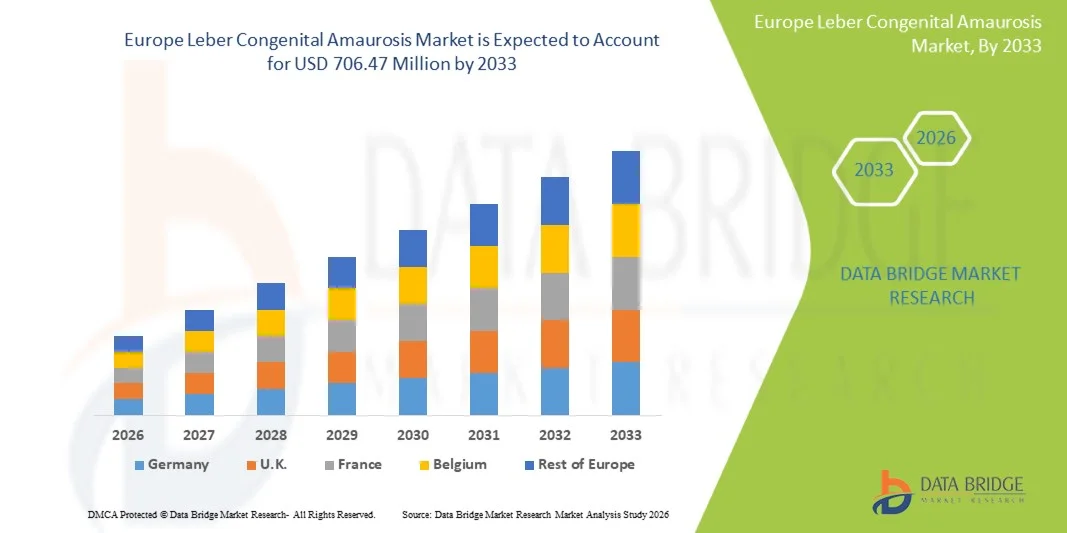
- The Europe Leber Congenital Amaurosis market size was valued at USD 450.00 million in 2025and is expected to reach USD 706.47 million by 2033, at a CAGR of 5.8% during the forecast period
- The market growth is largely driven by increasing prevalence of inherited retinal disorders, rapid advancements in gene therapy approaches (such as AAV-based treatments), and expanding clinical research activities across Europe
- Furthermore, rising demand for early genetic diagnosis, growing availability of orphan drug designations, and increasing focus on precision medicine for rare ophthalmic diseases are strengthening treatment adoption, thereby significantly supporting the overall market expansion
Europe Leber Congenital Amaurosis Market Analysis
- Leber Congenital Amaurosis (LCA) is a rare inherited retinal disorder characterized by severe early-onset vision loss, and the Europe Leber Congenital Amaurosis market is increasingly driven by advancements in gene therapy, molecular diagnostics, and expanding access to specialized ophthalmic care centers across key countries
- The escalating demand in the Europe Leber Congenital Amaurosis market is primarily fueled by rising diagnosis rates of rare genetic eye diseases, increasing adoption of next-generation sequencing for early detection, and strong clinical progress in gene-based therapies targeting underlying mutations
- Germany dominated the Europe Leber Congenital Amaurosis market with the largest revenue share of 28.4% in 2025, characterized by strong rare disease research infrastructure, advanced genetic testing capabilities, and active gene therapy clinical trials
- The United Kingdom is expected to be the fastest growing country in the Europe Leber Congenital Amaurosis market during the forecast period due to strong clinical research activity, expanding gene therapy trials, and increasing adoption of advanced retinal treatment approaches
- The therapy segment dominated the Europe Leber Congenital Amaurosis market with a market share of 52.6% in 2025, driven by strong clinical success of AAV-based therapies and their ability to directly target the genetic root cause of vision loss
Report Scope and Europe Leber Congenital Amaurosis Market Segmentation
|
Attributes |
Europe Leber Congenital Amaurosis Key Market Insights |
|
Segments Covered |
|
|
Countries Covered |
Europe · Germany · France · U.K. · Netherlands · Switzerland · Belgium · Russia · Italy · Spain · Turkey · Rest of Europe |
|
Key Market Players |
|
|
Market Opportunities |
· Expanding adoption of AAV-based and next-generation gene editing therapies · Increasing integration of AI-driven genetic screening and newborn retinal diagnostics programs |
|
Value Added Data Infosets |
In addition to the insights on market scenarios such as market value, growth rate, segmentation, geographical coverage, and major players, the market reports curated by the Data Bridge Market Research also include in-depth expert analysis, patient epidemiology, pipeline analysis, pricing analysis, and regulatory framework |
Europe Leber Congenital Amaurosis Market Trends
“Advancements in Gene Therapy and Precision Ophthalmic Treatment”
- A significant and accelerating trend in the Europe Leber Congenital Amaurosis market is the rapid advancement of gene therapy and precision medicine approaches, particularly adeno-associated virus (AAV)-based therapies targeting underlying genetic mutations causing vision loss
- For instance, Luxturna (voretigene neparvovec) has demonstrated transformative outcomes for RPE65 mutation-associated LCA, paving the way for broader gene therapy adoption across Europe
- Increasing use of next-generation sequencing (NGS) for early and accurate genetic diagnosis is enabling earlier intervention and better patient stratification for targeted therapies
- Furthermore, growing integration of personalized medicine approaches is allowing ophthalmologists to tailor treatment strategies based on specific gene mutations and disease severity profiles
- The expansion of rare disease registries and cross-border clinical collaborations in Europe is accelerating research and improving access to innovative treatment options
- The demand for gene-based, potentially curative therapies is rapidly increasing across both pediatric and specialized ophthalmology centers, reshaping expectations in the Europe Leber Congenital Amaurosis market
- Furthermore, increasing adoption of AI-enabled retinal imaging tools is improving early detection accuracy and supporting faster clinical decision-making in LCA diagnosis
- In addition, growing pipeline diversification beyond RPE65 targeting therapies is expanding treatment prospects for multiple genetic subtypes of Leber Congenital Amaurosis
Europe Leber Congenital Amaurosis Market Dynamics
Driver
“Rising Prevalence Awareness and Expansion of Genetic Diagnosis Infrastructure”
- The increasing awareness of rare inherited retinal disorders and expansion of genetic testing infrastructure is a major driver for growth in the Europe Leber Congenital Amaurosis market
- For instance, in April 2025, several European rare disease initiatives expanded funding for newborn genetic screening programs targeting early detection of inherited retinal dystrophies, including LCA
- Growing availability of advanced diagnostic tools such as whole-exome sequencing is significantly improving early identification rates of LCA patients across Europe
- Furthermore, increasing investment in gene therapy research programs supported by public and private institutions is accelerating treatment development pipelines
- Rising collaboration between ophthalmology centers and genetic research institutes is strengthening clinical trial participation and therapy accessibility
- Expanding awareness campaigns and patient advocacy groups are further driving early diagnosis and improving treatment uptake across the Europe Leber Congenital Amaurosis market
- Furthermore, increasing government funding for rare disease research initiatives is strengthening long-term therapeutic development efforts
- In addition, growing availability of specialized pediatric ophthalmology centers is improving early intervention rates across Europe
Restraint/Challenge
“High Treatment Cost and Limited Accessibility of Advanced Gene Therapies”
- The high cost of gene therapy treatments and limited reimbursement coverage remain a significant challenge in the Europe Leber Congenital Amaurosis market, restricting patient access across several countries
- For instance, therapies such as Luxturna require specialized administration and long-term monitoring, making overall treatment costs substantially high for healthcare systems
- Limited availability of specialized retinal treatment centers capable of delivering gene therapy further constrains patient access in certain European regions
- Furthermore, stringent regulatory approval timelines for novel gene therapies delay market entry and restrict widespread adoption
- Uneven healthcare funding across European countries creates disparities in access to advanced LCA treatments and diagnostic facilities
- Addressing affordability barriers and improving reimbursement frameworks will be critical for sustained adoption in the Europe Leber Congenital Amaurosis market
- Furthermore, limited availability of long-term efficacy and safety data for newer gene therapies creates hesitation among clinicians and payers
- In addition, shortage of trained retinal specialists and gene therapy administration expertise restricts large-scale treatment rollout across the region
Europe Leber Congenital Amaurosis Market Scope
The market is segmented on the basis of disease type, type, end user, and distribution channel
- By Disease Type
On the basis of disease type, the Europe Leber Congenital Amaurosis market is segmented into infantile type, juvenile type, and others. The infantile type segment dominated the market with the largest revenue share of 61.3% in 2025, as symptoms appear within the first months of life, enabling earlier clinical suspicion and genetic testing. This segment benefits from strong neonatal screening programs and pediatric ophthalmology referrals across Europe. Increasing availability of next-generation sequencing has significantly improved early diagnosis rates for infantile cases. Furthermore, higher clinical trial focus on early-onset LCA has strengthened treatment development for this segment. Growing adoption of gene therapy in pediatric patients is also supporting dominance. In addition, awareness among parents and healthcare providers is improving early intervention outcomes.
The juvenile type segment is expected to witness the fastest growth rate of 8.1% from 2026 to 2033, driven by improved detection of later-onset cases that were previously underdiagnosed. Advancements in genetic diagnostics are enabling better identification of juvenile patients during school-age vision assessments. Rising clinical recognition of mild-to-moderate retinal degeneration cases is also expanding the diagnosed patient pool. Furthermore, increasing availability of mutation-specific therapies is supporting treatment uptake in this group. Expanding ophthalmic screening programs in Europe are further contributing to growth. In addition, growing research focus on genotype variability in LCA is improving disease classification and management.
- By Type
On the basis of type, the Europe Leber Congenital Amaurosis market is segmented into therapy and diagnosis. The therapy segment dominated the market with the largest market revenue share of 52.6% in 2025, driven by the increasing adoption of gene therapy approaches that target the underlying genetic mutations responsible for vision loss. Strong clinical success of AAV-based therapies, particularly for RPE65 mutations, has significantly increased physician confidence in treatment outcomes. Expanding regulatory approvals for orphan drugs in Europe is further accelerating therapy adoption. Rising investments by biotechnology companies in retinal gene therapy development are strengthening the treatment pipeline. Furthermore, increasing participation in clinical trials is improving patient access to advanced therapies. In addition, growing demand for potential vision-restoring treatments is shifting focus toward curative approaches.
The diagnosis segment is expected to witness the fastest growth rate of 9.4% from 2026 to 2033, driven by the rising importance of early genetic identification before therapeutic intervention. Increasing use of next-generation sequencing and whole-exome sequencing is significantly improving diagnostic accuracy. Expanding national rare disease screening programs across Europe are supporting early detection. Furthermore, growing availability of advanced retinal imaging technologies is enhancing clinical evaluation of patients. Rising awareness among ophthalmologists regarding genetic testing for retinal disorders is also contributing to growth. In addition, increasing integration of AI-based diagnostic tools is improving speed and precision of LCA identification.
- .By End User
On the basis of end user, the Europe Leber Congenital Amaurosis market is segmented into hospitals, specialty clinics, ambulatory surgical centers, home healthcare, and others. The hospitals segment dominated the market with the largest revenue share of 46.8% in 2025, as hospitals serve as primary hubs for genetic diagnosis, advanced imaging, and gene therapy administration. Most LCA patients are referred to tertiary hospitals with specialized ophthalmology departments. Furthermore, hospitals are actively involved in rare disease clinical trials and research collaborations. Strong availability of multidisciplinary care teams supports comprehensive disease management. Increasing government funding for hospital-based rare disease programs is also strengthening this segment. In addition, high-cost treatment procedures are mostly centralized in hospital settings.
The specialty clinics segment is expected to witness the fastest growth rate of 10.2% from 2026 to 2033, driven by increasing demand for focused retinal care and personalized treatment pathways. These clinics are rapidly expanding across Europe due to rising preference for specialized ophthalmic services. Growing adoption of gene therapy follow-up and monitoring services is strengthening their role. Furthermore, shorter waiting times compared to hospitals are attracting more patients. Increasing collaboration between clinics and genetic testing laboratories is improving diagnosis-to-treatment timelines. In addition, rising private healthcare investments are supporting expansion of specialty ophthalmology centers.
- By Distribution Channel
On the basis of distribution channel, the Europe Leber Congenital Amaurosis market is segmented into direct tender and retail sales. The direct tender segment dominated the market with the largest revenue share of 72.4% in 2025, due to centralized procurement of high-cost gene therapies and diagnostic solutions by public healthcare systems. Hospitals and government agencies prefer bulk purchasing through tender agreements to manage rare disease treatment costs. Furthermore, strict regulatory frameworks in Europe encourage centralized distribution for advanced therapies. Increasing involvement of national health authorities in rare disease funding is strengthening this channel. In addition, most gene therapies require institutional administration, supporting direct procurement dominance. Long-term treatment contracts between manufacturers and healthcare systems further reinforce this segment.
The retail sales segment is expected to witness the fastest growth rate of 8.7% from 2026 to 2033, driven by increasing availability of genetic testing kits and outpatient diagnostic services. Growing patient awareness is encouraging use of private diagnostic laboratories for early screening. Furthermore, expansion of digital health platforms is enabling easier access to testing services. Rising demand for decentralized healthcare solutions is also supporting retail channel growth. Increasing affordability of diagnostic tools is improving accessibility for patients. In addition, growth of home-based genetic testing services is contributing to segment expansion across Europe.
Europe Leber Congenital Amaurosis Market Regional Analysis
- Germany dominated the Europe Leber Congenital Amaurosis market with the largest revenue share of 28.4% in 2025, characterized by strong rare disease research infrastructure, advanced genetic testing capabilities, and active gene therapy clinical trials
- Healthcare providers in the country highly prioritize early diagnosis, precision medicine, and access to innovative orphan therapies, leading to widespread use of next-generation sequencing and advanced retinal imaging for LCA detection
- This dominance is further supported by high healthcare expenditure, strong government funding for rare disease programs, and active participation in international clinical trials focused on inherited retinal disorders
The Germany Leber Congenital Amaurosis Market Insight
The Germany Leber Congenital Amaurosis market captured the largest revenue share of 28.4% in 2025 within Europe, fueled by a highly advanced rare disease research ecosystem and strong adoption of genetic diagnostic technologies. Patients and healthcare providers are increasingly prioritizing early and precise identification of inherited retinal disorders through next-generation sequencing and advanced ophthalmic imaging. The growing availability of gene therapy clinical trials and specialized retinal treatment centers is further strengthening market growth. Moreover, Germany’s strong healthcare funding system and active participation in international rare disease programs are significantly contributing to the expansion of the Leber Congenital Amaurosis market.
France Leber Congenital Amaurosis Market Insight
The France Leber Congenital Amaurosis market is projected to expand at a substantial CAGR throughout the forecast period, primarily driven by strong government support for rare disease management and well-established national healthcare programs. Increasing focus on early diagnosis of inherited retinal disorders through genetic screening initiatives is fostering market adoption. French consumers and healthcare providers are also benefiting from expanding access to innovative gene therapy clinical trials and specialized ophthalmology centers. In addition, rising collaboration between research institutes and biotech companies is supporting advancements in precision medicine for Leber Congenital Amaurosis.
U.K. Leber Congenital Amaurosis Market Insight
The U.K. Leber Congenital Amaurosis market is anticipated to grow at a noteworthy CAGR during the forecast period, driven by strong clinical research activity and increasing focus on rare disease treatment innovation. The country has a well-established framework for gene therapy trials, which is accelerating patient access to advanced treatment options. Rising awareness of inherited retinal diseases among ophthalmologists and patients is further supporting early diagnosis rates. Moreover, the UK’s strong healthcare infrastructure and emphasis on precision medicine are contributing to the growing adoption of genetic testing and targeted therapies.
Italy Leber Congenital Amaurosis Market Insight
The Italy Leber Congenital Amaurosis market is witnessing growing traction due to expanding access to rare disease diagnostic services and increasing participation in European gene therapy research programs. Rising awareness among ophthalmologists regarding inherited retinal disorders is improving early detection rates across the country. The presence of specialized ophthalmology hospitals and academic research institutes is further supporting clinical advancements. In addition, increasing government focus on rare disease treatment access and reimbursement support is contributing to steady market growth.
Europe Leber Congenital Amaurosis Market Share
The Europe Leber Congenital Amaurosis industry is primarily led by well-established companies, including:
- Spark Therapeutics, Inc. (U.S.)
- Novartis AG (Switzerland)
- MeiraGTx Holdings PLC (U.K.)
- Regenxbio Inc. (U.S.)
- Editas Medicine, Inc. (U.S.)
- Atsena Therapeutics, Inc. (U.S.)
- ProQR Therapeutics N.V. (Netherlands)
- Applied Genetic Technologies Corporation (U.S.)
- Orchard Therapeutics PLC (U.K.)
- Sarepta Therapeutics, Inc. (U.S.)
- Ultragenyx Pharmaceutical Inc. (U.S.)
- Biogen Inc. (U.S.)
- Oxford Biomedica PLC (U.K.)
- GenSight Biologics S.A. (France)
- Sangamo Therapeutics, Inc. (U.S.)
- Krystal Biotech, Inc. (U.S.)
- AvroBio, Inc. (U.S.)
- Opus Genetics, Inc. (U.S.)
What are the Recent Developments in Europe Leber Congenital Amaurosis Market?
- In April 2026, scientists including Jean Bennett, Albert Maguire, and Katherine High were awarded the prestigious Breakthrough Prize for their pioneering work on Luxturna (voretigene neparvovec), the first FDA-approved gene therapy for Leber Congenital Amaurosis (RPE65 mutation)
- In January 2026, Opus Genetics announced advancement of its OPGx-LCA5 gene therapy program into pivotal Phase 3 development for LCA5-related inherited retinal disease. Early clinical data showed durable improvements in cone sensitivity and visual function in treated patients. This represents one of the most advanced late-stage gene therapy pipelines in Europe for LCA treatment development
- In October 2025, European clinical researchers reported that intravitreal AAV-based gene therapy targeting LCA led to partial vision restoration in patients, enabling them to recognize objects and navigate environments. This marked a significant advancement as it avoided more invasive subretinal procedures while still delivering functional visual improvement. The study highlighted growing innovation in delivery methods for retinal gene therapies
- In June 2025, clinical updates from inherited retinal disease trials in Europe showed that CRISPR-based therapy (EDIT-101) achieved functional vision improvements in 11 of 14 patients with LCA linked to CEP290 mutations. The treatment demonstrated safety with only mild inflammation cases, marking a major step toward gene-editing-based therapies beyond traditional gene replacement. This development supports expanding mutation-targeted treatment options in Europe
- In February 2025, researchers in London reported successful gene therapy outcomes in children with severe LCA caused by AIPL1 mutations. The treatment involved delivering healthy gene copies directly into the retina via keyhole surgery, leading to significant vision improvement such as recognizing faces and navigating independently. This marked one of the most advanced real-world applications of LCA gene therapy in Europe, highlighting strong progress toward curative treatment options

- Interactive Data Analysis Dashboard
- Company Analysis Dashboard for high growth potential opportunities
- Research Analyst Access for customization & queries
- Competitor Analysis with Interactive dashboard
- Latest News, Updates & Trend analysis
- Harness the Power of Benchmark Analysis for Comprehensive Competitor Tracking
Data collection and base year analysis are done using data collection modules with large sample sizes. The stage includes obtaining market information or related data through various sources and strategies. It includes examining and planning all the data acquired from the past in advance. It likewise envelops the examination of information inconsistencies seen across different information sources. The market data is analysed and estimated using market statistical and coherent models. Also, market share analysis and key trend analysis are the major success factors in the market report. To know more, please request an analyst call or drop down your inquiry.
The key research methodology used by DBMR research team is data triangulation which involves data mining, analysis of the impact of data variables on the market and primary (industry expert) validation. Data models include Vendor Positioning Grid, Market Time Line Analysis, Market Overview and Guide, Company Positioning Grid, Patent Analysis, Pricing Analysis, Company Market Share Analysis, Standards of Measurement, Global versus Regional and Vendor Share Analysis. To know more about the research methodology, drop in an inquiry to speak to our industry experts.
Data Bridge Market Research is a leader in advanced formative research. We take pride in servicing our existing and new customers with data and analysis that match and suits their goal. The report can be customized to include price trend analysis of target brands understanding the market for additional countries (ask for the list of countries), clinical trial results data, literature review, refurbished market and product base analysis. Market analysis of target competitors can be analyzed from technology-based analysis to market portfolio strategies. We can add as many competitors that you require data about in the format and data style you are looking for. Our team of analysts can also provide you data in crude raw excel files pivot tables (Fact book) or can assist you in creating presentations from the data sets available in the report.












