


What is the Europe Medicinal Chemistry for Drug Discovery Market Size and Growth Rate?
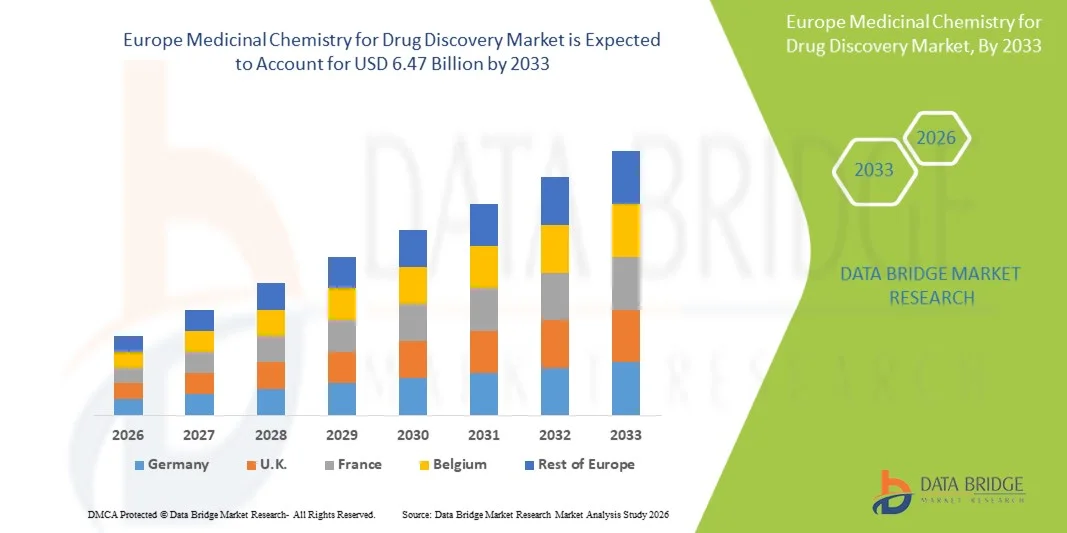
- As per Data Bridge Market Research Analysis the Europe medicinal chemistry for drug discovery market size was valued at USD 2.32 billion in 2025and is expected to reach USD 6.47 billion by 2033, at a CAGR of 13.7% during the forecast period
- The market growth is largely fueled by increasing investment in pharmaceutical R&D, expansion of biotechnology firms, and strong collaboration between academic institutions and industry players across key countries such as Germany, United Kingdom, and France, leading to accelerated innovation in drug discovery processes
- Furthermore, rising demand for targeted therapies, advancements in computational chemistry and AI-driven drug design, and supportive regulatory frameworks are establishing medicinal chemistry as a critical component in modern pharmaceutical development. These converging factors are accelerating the adoption of advanced drug discovery techniques, thereby significantly boosting the industry's growth
Market Size & Forecast
Global Market Value (2025): USD 2.32 billion
Expected Market Value (2033): USD 6.47 billion
Forecast CAGR (2026–2033): 13.7%
What are the Major Takeaways of Europe Medicinal Chemistry for Drug Discovery Market?
- Medicinal chemistry for drug discovery, focusing on the design, synthesis, and optimization of bioactive compounds, is a critical component of pharmaceutical innovation across Europe, playing a vital role in developing novel therapeutics for complex diseases through advanced molecular modeling, structure-based drug design, and integration with emerging technologies
- The escalating demand for medicinal chemistry services is primarily fueled by increasing prevalence of chronic diseases, growing investment in pharmaceutical and biotechnology research, and a rising emphasis on precision medicine and targeted therapies across the region
- Germany dominated the Europe medicinal chemistry for drug discovery market with the largest revenue share of 29.4% in 2025, characterized by strong pharmaceutical R&D capabilities, robust funding support, and the presence of leading drug developers, with continuous innovation in small molecule drug discovery and collaborations between academia and industry
- United Kingdom is expected to be the fastest growing country during the forecast period due to increasing investments in life sciences, expansion of biotech startups, and strong government initiatives supporting drug discovery and development
- Lead optimization segment dominated the market with a significant share of 39.7% in 2025, driven by its essential role in refining drug candidates for improved efficacy, safety, and pharmacokinetic properties, making it a cornerstone of successful drug discovery programs
Report Scope and Europe Medicinal Chemistry for Drug Discovery Market Segmentation
|
Attributes |
Europe Medicinal Chemistry for Drug Discovery Key Market Insights |
|
Segments Covered |
|
|
Countries Covered |
Europe · Germany · France · U.K. · Netherlands · Switzerland · Belgium · Russia · Italy · Spain · Turkey · Rest of Europe |
|
Key Market Players |
|
|
Market Opportunities |
· Growing integration of AI-driven drug design platforms with medicinal chemistry workflows · Increasing outsourcing of early-stage drug discovery to specialized CROs |
|
Value Added Data Infosets |
In addition to the insights on market scenarios such as market value, growth rate, segmentation, geographical coverage, and major players, the market reports curated by the Data Bridge Market Research also include in-depth expert analysis, patient epidemiology, pipeline analysis, pricing analysis, and regulatory framework |
What is the Key Trend in the Europe Medicinal Chemistry for Drug Discovery Market?
“Integration of AI and Computational Tools in Drug Design”
- A significant and accelerating trend in the Europe medicinal chemistry for drug discovery market is the deepening integration with artificial intelligence (AI) and advanced computational platforms such as molecular modeling, machine learning, and structure-based drug design systems. This fusion of technologies is significantly enhancing efficiency and precision in drug discovery processes
- For instance, several European pharmaceutical and biotechnology firms are increasingly leveraging AI-driven platforms to accelerate compound screening and optimize lead identification, while organizations collaborate with tech providers to enhance predictive modeling and reduce drug development timelines
- AI integration in medicinal chemistry enables features such as prediction of molecular interactions, optimization of pharmacokinetic properties, and identification of potential toxicity risks at early stages. For instance, AI-powered platforms can analyze vast chemical datasets to suggest optimized compounds and provide intelligent insights for decision-making in drug discovery. Furthermore, automation capabilities offer researchers improved productivity, allowing them to streamline complex synthesis and testing processes
- The seamless integration of medicinal chemistry with bioinformatics, cheminformatics, and high-throughput screening platforms facilitates centralized control over various stages of drug discovery. Through a unified system, researchers can manage compound libraries, biological data, and experimental results, creating a more efficient and collaborative research environment
- This trend towards more intelligent, data-driven, and interconnected drug discovery systems is fundamentally reshaping research methodologies across Europe. Consequently, companies such as Evotec SE are developing AI-enabled drug discovery platforms with features such as automated compound design and predictive analytics for faster innovation
- The demand for advanced medicinal chemistry solutions that offer seamless AI and computational integration is growing rapidly across pharmaceutical and biotechnology sectors, as organizations increasingly prioritize efficiency, accuracy, and accelerated time-to-market for new therapeutics
- The growing use of fragment-based drug discovery and high-throughput experimentation techniques is also contributing to faster identification of viable drug candidates, strengthening the role of medicinal chemistry in early-stage drug development
Europe Medicinal Chemistry for Drug Discovery Market Dynamics
Driver
“Growing Need Due to Rising Chronic Disease Burden and R&D Investments”
- The increasing prevalence of chronic diseases across Europe, coupled with rising investments in pharmaceutical research and development, is a significant driver for the heightened demand for medicinal chemistry in drug discovery
- For instance, in recent years, several European governments and private organizations have increased funding for life sciences research, focusing on accelerating drug discovery programs and fostering innovation through public-private partnerships. Such strategies by key stakeholders are expected to drive the medicinal chemistry market growth in the forecast period
- As healthcare systems face growing pressure to address unmet medical needs, medicinal chemistry offers advanced capabilities such as rational drug design, molecular optimization, and targeted therapy development, providing a compelling approach for modern drug discovery
- Furthermore, the growing emphasis on precision medicine and biologically targeted treatments is making medicinal chemistry an integral component of pharmaceutical innovation, offering seamless integration with genomics, proteomics, and other advanced scientific disciplines
- The ability to design high-efficacy compounds, improve safety profiles, and accelerate clinical success rates are key factors propelling the adoption of medicinal chemistry across pharmaceutical and biotechnology companies. The trend towards outsourcing drug discovery services and increasing collaboration between academia and industry further contribute to market growth
- Increasing investments from venture capital firms and government-backed funding programs are enabling startups and small biotech companies to expand their medicinal chemistry capabilities, thereby strengthening the overall innovation ecosystem
- The rising number of strategic collaborations, licensing agreements, and mergers among pharmaceutical companies is further accelerating drug discovery pipelines and enhancing the demand for advanced medicinal chemistry expertise
Restraint/Challenge
“High R&D Costs and Regulatory Compliance Hurdles”
- Concerns surrounding the high cost and complexity of drug discovery processes, including medicinal chemistry activities, pose a significant challenge to broader market expansion. As drug development requires substantial investment in research infrastructure and skilled expertise, it creates financial barriers for smaller organizations
- For instance, stringent regulatory requirements imposed by authorities such as the European Medicines Agency have made the approval process more complex, leading to increased timelines and higher development costs for new drug candidates
- Addressing these challenges through improved efficiency, cost optimization strategies, and regulatory harmonization is crucial for sustaining innovation. Companies are increasingly adopting advanced computational tools and collaborative research models to mitigate costs and enhance productivity. In addition, the high failure rate of drug candidates during clinical trials can be a barrier to investment, particularly for early-stage research programs
- While technological advancements are helping reduce some inefficiencies, the overall cost burden and regulatory complexity can still hinder widespread innovation, especially for smaller biotech firms and academic institutions with limited resources
- Overcoming these challenges through enhanced research funding, streamlined regulatory pathways, and adoption of innovative technologies will be vital for sustained market growth
- Limited availability of highly skilled medicinal chemists and interdisciplinary experts in certain regions can further constrain research capabilities and slow down drug development timelines
- Intellectual property complexities and patent expiration challenges may also impact innovation incentives, creating uncertainties for companies investing heavily in new drug discovery programs
How is the Europe Medicinal Chemistry for Drug Discovery Market Segmented?
The market is segmented on the basis of process, design, drug type, therapeutic area, and end user.
- By Process
On the basis of process, the Europe medicinal chemistry for drug discovery market is segmented into target selection, target validation, hit-to-lead identification, lead optimization, and candidate validation. The lead optimization segment dominated the market with the largest revenue share of 39.7% in 2025, driven by its critical role in refining chemical compounds to enhance efficacy, selectivity, and pharmacokinetic properties. This stage is essential for transforming initial hits into viable drug candidates with improved safety and performance profiles. Pharmaceutical companies across countries such as Germany and Switzerland heavily invest in this phase to reduce late-stage failures. Advanced computational tools and AI-based modeling further strengthen this segment’s dominance. In addition, increasing demand for precision medicine is pushing the need for optimized molecules tailored to specific biological targets.
The hit-to-lead identification segment is anticipated to witness the fastest growth rate from 2026 to 2033, fueled by the growing adoption of high-throughput screening and AI-driven compound identification techniques. This phase is gaining traction as companies aim to accelerate early-stage drug discovery timelines. Increasing collaboration between biotech firms and academic institutes is enhancing the efficiency of hit identification processes. The integration of cheminformatics and data analytics is also improving success rates in identifying promising leads. Moreover, rising outsourcing to CROs is contributing to rapid advancements in this segment. The need for faster and cost-effective drug discovery solutions is further driving its growth.
- By Design
On the basis of design, the market is segmented into fragment-based variation, structure-based drug design, diversity oriented synthesis, chemogenomics, natural products, and others. The structure-based drug design segment dominated the market with the largest share in 2025, driven by its precision in designing molecules based on the 3D structure of biological targets. This approach significantly improves the success rate of drug candidates by enabling targeted interactions at the molecular level. Countries such as United Kingdom have strong capabilities in structural biology, supporting this segment’s leadership. The use of computational modeling and crystallography enhances accuracy and reduces development timelines. Pharmaceutical firms prefer this method for complex disease targets such as cancer and neurological disorders. Its integration with AI tools further strengthens its adoption across Europe.
The fragment-based variation segment is expected to witness the fastest growth during the forecast period due to its efficiency in identifying small chemical fragments that bind to target sites. This method requires fewer compounds compared to traditional screening approaches, making it cost-effective and highly efficient. Increasing use in early-stage drug discovery is accelerating its adoption across biotech companies. The approach also allows for better optimization of lead compounds with improved binding affinity. Growing investment in innovative drug discovery technologies is further supporting this segment. In addition, its compatibility with advanced screening technologies is driving rapid expansion.
- By Drug Type
On the basis of drug type, the market is segmented into small molecules and biologics. The small molecules segment dominated the market with the largest revenue share in 2025, driven by their well-established role in medicinal chemistry and ease of synthesis, modification, and scalability. These drugs are widely used due to their ability to penetrate cells and interact with intracellular targets effectively. European pharmaceutical companies have a strong legacy in small molecule drug development, ensuring continued dominance. The availability of advanced chemical synthesis techniques further supports this segment. In addition, lower manufacturing costs compared to biologics make them highly attractive. Continuous innovation in medicinal chemistry is also enhancing their therapeutic potential.
The biologics segment is expected to witness the fastest growth from 2026 to 2033, fueled by increasing demand for targeted therapies and advancements in biotechnology. Biologics offer high specificity and effectiveness for complex diseases such as cancer and autoimmune disorders. Rising investments in biologics research across Europe are accelerating this segment’s growth. The integration of medicinal chemistry with biologics development is also creating new opportunities. Furthermore, regulatory support for advanced therapies is boosting adoption. Increasing collaboration between biotech firms and research institutes is further driving expansion.
- By Therapeutic Area
On the basis of therapeutic area, the market is segmented into oncology, neurology, infectious and immune system diseases, cardiovascular diseases, digestive system diseases, and others. The oncology segment dominated the market with the largest share in 2025, driven by the high prevalence of cancer and the continuous demand for innovative treatments. Medicinal chemistry plays a crucial role in developing targeted cancer therapies with improved efficacy and reduced side effects. Countries such as France are actively investing in oncology research and drug development. The growing adoption of precision medicine is further strengthening this segment. Pharmaceutical companies are focusing on novel drug mechanisms to address unmet needs. Increased funding and clinical trials also contribute to its dominance.
The neurology segment is expected to witness the fastest growth during the forecast period due to rising cases of neurological disorders such as Alzheimer’s and Parkinson’s disease. The complexity of these diseases is driving demand for advanced drug discovery approaches. Medicinal chemistry enables the design of compounds capable of crossing the blood-brain barrier, which is critical for neurological treatments. Increasing research funding and government support are boosting innovation in this area. Collaborations between academia and industry are also accelerating development. The urgent need for effective therapies is further propelling growth.
- By End User
On the basis of end user, the market is segmented into contract research organizations, pharmaceuticals and biotechnology companies, academic and research institutes, and others. The pharmaceuticals and biotechnology companies segment dominated the market with the largest revenue share in 2025, driven by their extensive R&D capabilities and strong financial resources. These companies are the primary drivers of drug discovery and heavily invest in medicinal chemistry processes. The presence of major pharmaceutical firms across Europe supports this dominance. Continuous innovation and pipeline development further strengthen their position. In addition, increasing focus on personalized medicine is boosting demand. Strategic collaborations and acquisitions also contribute to market leadership.
The contract research organization segment is expected to witness the fastest growth from 2026 to 2033, fueled by the rising trend of outsourcing drug discovery activities. CROs offer cost-effective and specialized services, enabling companies to accelerate development timelines. Increasing demand for flexible and scalable research solutions is driving this segment. The availability of skilled professionals and advanced infrastructure supports growth. Pharmaceutical companies are increasingly partnering with CROs to optimize costs and improve efficiency. This trend is expected to continue, significantly boosting the segment’s expansion.
Which Region Holds the Largest Share of the Europe Medicinal Chemistry for Drug Discovery Market?
- Germany dominated the Europe medicinal chemistry for drug discovery market with the largest revenue share of 29.4% in 2025, characterized by strong pharmaceutical R&D capabilities, robust funding support, and the presence of leading drug developers, with continuous innovation in small molecule drug discovery and collaborations between academia and industry
- Organizations in the region highly value advanced drug discovery capabilities, precision medicine approaches, and the integration of computational chemistry and AI-driven platforms for efficient molecular design and development
- This widespread growth is further supported by favorable regulatory frameworks, increasing collaborations between academia and industry, and the presence of leading pharmaceutical companies, establishing medicinal chemistry as a critical component for both early-stage research and advanced drug development programs
The Germany Medicinal Chemistry for Drug Discovery Market Insight
The Germany medicinal chemistry for drug discovery market captured the largest revenue share in Europe in 2025, fueled by the country’s strong pharmaceutical industry and well-established research ecosystem. Companies are increasingly focusing on accelerating drug discovery through advanced medicinal chemistry capabilities and collaborative research initiatives. The growing preference for innovative therapeutics, combined with robust investment in biotechnology and life sciences, further propels the market. Moreover, the increasing integration of AI-driven drug discovery platforms and advanced laboratory technologies is significantly contributing to market expansion.
U.K. Medicinal Chemistry for Drug Discovery Market Insight
The United Kingdom medicinal chemistry for drug discovery market is anticipated to grow at a noteworthy CAGR during the forecast period, driven by the increasing emphasis on life sciences innovation and a strong academic research base. In addition, rising demand for precision medicine and advanced drug development solutions is encouraging pharmaceutical and biotech companies to invest in medicinal chemistry capabilities. The country’s supportive regulatory environment, alongside its robust research infrastructure and funding initiatives, is expected to continue to stimulate market growth.
France Medicinal Chemistry for Drug Discovery Market Insight
The France medicinal chemistry for drug discovery market is expected to expand at a considerable CAGR during the forecast period, fueled by increasing focus on pharmaceutical innovation and rising investments in healthcare research. France’s strong network of research institutes, combined with its emphasis on scientific advancement, promotes the adoption of advanced drug discovery techniques. The integration of medicinal chemistry with biotechnology and genomics is also becoming increasingly prevalent, with a strong preference for innovative and efficient therapeutic solutions aligning with national healthcare priorities.
Italy Medicinal Chemistry for Drug Discovery Market Insight
The Italy medicinal chemistry for drug discovery market is gaining momentum due to the country’s expanding pharmaceutical sector and increasing investment in research and development. The Italian market places a significant emphasis on improving drug discovery efficiency, and the adoption of advanced medicinal chemistry approaches is driven by the growing number of research collaborations. The integration of medicinal chemistry with modern analytical and computational tools is fueling growth. Moreover, Italy’s focus on enhancing healthcare outcomes is likely to spur demand for innovative and effective drug development solutions.
Which are the Top Companies in Europe Medicinal Chemistry for Drug Discovery Market?
The Europe Medicinal Chemistry for Drug Discovery industry is primarily led by well-established companies, including:
- Pfizer Inc. (U.S.)
- Merck & Co., Inc. (U.S.)
- AbbVie Inc. (U.S.)
- Amgen Inc. (U.S.)
- Gilead Sciences, Inc. (U.S.)
- Bristol-Myers Squibb Company (U.S.)
- Eli Lilly and Company (U.S.)
- Biogen Inc. (U.S.)
- Regeneron Pharmaceuticals, Inc. (U.S.)
- Vertex Pharmaceuticals Incorporated (U.S.)
- Agios Pharmaceuticals, Inc. (U.S.)
- Schrödinger, Inc. (U.S.)
- Certara, Inc. (U.S.)
- Charles River Laboratories International, Inc. (U.S.)
- IQVIA Inc. (U.S.)
- Thermo Fisher Scientific Inc. (U.S.)
- Danaher Corporation (U.S.)
- Illumina, Inc. (U.S.)
- Labcorp (U.S.)
What are Latest Developments in Europe Medicinal Chemistry for Drug Discovery Market?
- In April 2026, Boehringer Ingelheim announced the launch of a new artificial intelligence (AI) and machine learning research center in London to strengthen its drug discovery and development capabilities. The center focuses on optimizing clinical trial processes, molecular research, and data-driven drug design. This development highlights the growing integration of AI in medicinal chemistry across Europe, aiming to accelerate innovation and improve efficiency in pharmaceutical R&D
- In February 2026, IRBM, a leading European contract research organization, announced a breakthrough in Zika virus drug discovery through its advanced medicinal chemistry and preclinical research capabilities. The development focuses on identifying novel therapeutic candidates using integrated drug discovery platforms and advanced screening technologies
- In December 2025, the European Union reached a major agreement to overhaul pharmaceutical regulations aimed at accelerating patient access to innovative medicines and boosting competitiveness in drug discovery. The reform introduces incentives such as extended data protection and market exclusivity for novel therapies, along with clearer frameworks for generics and biosimilars\
- In September 2025, Merck & Co., Inc. (MSD in Europe) announced the cancellation of its £1 billion London discovery research center, citing challenges such as regulatory pressures and investment climate concerns. The decision included relocation of research activities outside the UK and reduction of scientific jobs. This development highlights ongoing structural and regulatory challenges impacting medicinal chemistry and drug discovery investments in parts of Europe
- In March 2025, Isomorphic Labs, a Europe-linked AI drug discovery firm spun out of DeepMind, secured USD 600 million in funding to accelerate AI-driven drug design and development. The investment supports expansion of its AI-powered platforms and collaborations with major pharmaceutical companies for discovering novel therapeutics

- Interactive Data Analysis Dashboard
- Company Analysis Dashboard for high growth potential opportunities
- Research Analyst Access for customization & queries
- Competitor Analysis with Interactive dashboard
- Latest News, Updates & Trend analysis
- Harness the Power of Benchmark Analysis for Comprehensive Competitor Tracking
Data collection and base year analysis are done using data collection modules with large sample sizes. The stage includes obtaining market information or related data through various sources and strategies. It includes examining and planning all the data acquired from the past in advance. It likewise envelops the examination of information inconsistencies seen across different information sources. The market data is analysed and estimated using market statistical and coherent models. Also, market share analysis and key trend analysis are the major success factors in the market report. To know more, please request an analyst call or drop down your inquiry.
The key research methodology used by DBMR research team is data triangulation which involves data mining, analysis of the impact of data variables on the market and primary (industry expert) validation. Data models include Vendor Positioning Grid, Market Time Line Analysis, Market Overview and Guide, Company Positioning Grid, Patent Analysis, Pricing Analysis, Company Market Share Analysis, Standards of Measurement, Global versus Regional and Vendor Share Analysis. To know more about the research methodology, drop in an inquiry to speak to our industry experts.
Data Bridge Market Research is a leader in advanced formative research. We take pride in servicing our existing and new customers with data and analysis that match and suits their goal. The report can be customized to include price trend analysis of target brands understanding the market for additional countries (ask for the list of countries), clinical trial results data, literature review, refurbished market and product base analysis. Market analysis of target competitors can be analyzed from technology-based analysis to market portfolio strategies. We can add as many competitors that you require data about in the format and data style you are looking for. Our team of analysts can also provide you data in crude raw excel files pivot tables (Fact book) or can assist you in creating presentations from the data sets available in the report.












