


What is the Europe Molecular Spectroscopy Market Size and Growth Rate?
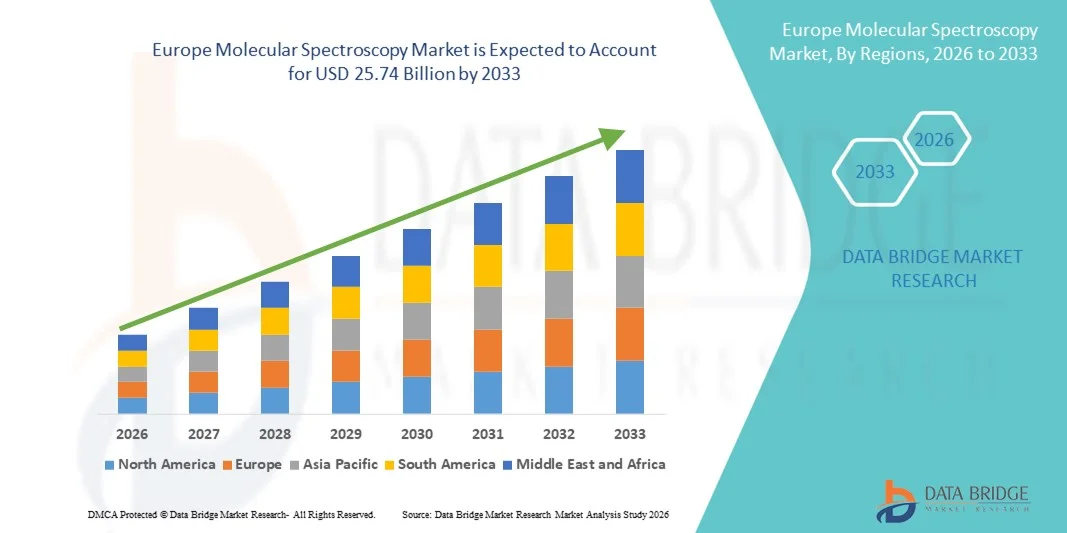
- As per Data Bridge Market Research Analysis the Europe molecular spectroscopy market size was valued at USD 14.87 billion in 2025 and is expected to reach USD 25.74 billion by 2033, at a CAGR of 7.10% during the forecast period
- The market growth is largely fueled by increasing adoption of advanced analytical techniques across pharmaceutical, biotechnology, and academic research sectors, combined with regulatory emphasis on environmental monitoring and quality control, which is driving demand for molecular spectroscopic instruments and solutions across Europe
- Furthermore, rising investments in R&D, growing focus on precision in chemical and biological analysis, and strong integration of spectroscopy technologies in research applications are positioning molecular spectroscopy as a vital tool in life sciences and industrial laboratories, thereby significantly boosting the industry’s growth
Market Size & Forecast
- Market Value (2025): USD 14.87 billion
- Expected Market Value (2033):USD 25.74 billion
- Forecast CAGR (2026–2033): 7.10%
Europe Molecular Spectroscopy Market Analysis
- Molecular spectroscopy, encompassing techniques such as infrared (IR), ultraviolet-visible (UV-Vis), nuclear magnetic resonance (NMR), and Raman spectroscopy, is increasingly essential in modern analytical laboratories across pharmaceuticals, biotechnology, environmental testing, and academic research due to its precision, non-destructive analysis, and capability for complex molecular characterization
- The escalating demand for molecular spectroscopy is primarily driven by growing R&D activities in life sciences and chemical industries, stringent regulatory requirements for quality control and environmental monitoring, and rising adoption of advanced analytical instrumentation for accurate molecular and chemical analysis
- Germany dominated the molecular spectroscopy market with the largest revenue share of 28.5% in 2025, supported by its strong pharmaceutical and biotech sectors, high research investments, and the presence of major instrument manufacturers, with substantial adoption of advanced spectroscopy instruments in both academic and industrial laboratories
- Poland is expected to be the fastest growing country in the molecular spectroscopy market during the forecast period driven by increasing industrialization, expanding research infrastructure, and rising government support for scientific and environmental initiatives
- Infrared Spectroscopy segment dominated the Europe molecular spectroscopy market with a market share of 35.9% in 2025, fueled by its versatility in qualitative and quantitative analysis, non-destructive testing capability, and widespread application across pharmaceuticals, chemicals, and food testing laboratories
Report Scope and Europe Molecular Spectroscopy Market Segmentation
|
Attributes |
Europe Molecular Spectroscopy Key Market Insights |
|
Segments Covered |
|
|
Countries Covered |
Europe
|
|
Key Market Players |
|
|
Market Opportunities |
|
|
Value Added Data Infosets |
In addition to the insights on market scenarios such as market value, growth rate, segmentation, geographical coverage, and major players, the market reports curated by the Data Bridge Market Research also include in-depth expert analysis, patient epidemiology, pipeline analysis, pricing analysis, and regulatory framework |
What is the Key Trend in the Europe Molecular Spectroscopy Market?
Advancements in AI-Driven Spectroscopic Analysis
- A significant and accelerating trend in the Europe molecular spectroscopy market is the integration of artificial intelligence (AI) and machine learning algorithms with spectroscopic instruments, enhancing automation, data interpretation, and predictive analysis capabilities
- For instance, Bruker’s OPUS software suite incorporates AI-based spectral interpretation to streamline IR and NMR analysis, improving throughput in pharmaceutical and chemical research laboratories
- AI integration in spectroscopy enables features such as automated peak assignment, anomaly detection in spectra, and predictive modeling for chemical composition, reducing human error and accelerating research outcomes
- The seamless incorporation of AI with spectroscopy systems allows centralized data management and multi-instrument connectivity, facilitating coordinated analysis across labs and research facilities
- This trend towards more intelligent, automated, and interconnected spectroscopy solutions is fundamentally reshaping user expectations for laboratory efficiency and accuracy. Consequently, companies such as Thermo Fisher Scientific are developing AI-enabled spectroscopy platforms capable of predictive analysis and real-time spectral anomaly detection
- The demand for spectroscopy instruments with AI-assisted data analysis is growing rapidly across both academic and industrial laboratories, as organizations increasingly prioritize efficiency, accuracy, and advanced research capabilities
- Miniaturization and portability of spectroscopic instruments, such as handheld Raman and IR devices, are enabling on-site analysis in industrial, environmental, and pharmaceutical settings, expanding the practical applications of spectroscopy
Europe Molecular Spectroscopy Market Dynamics
Driver
Rising Demand for Precision in Research and Quality Control
- The growing emphasis on precise molecular characterization in pharmaceutical, chemical, and environmental research is a significant driver for the heightened adoption of spectroscopy instruments
- For instance, in March 2025, Agilent Technologies introduced enhanced NMR solutions aimed at improving analytical throughput in drug discovery and quality control applications, demonstrating the rising market adoption
- As regulatory standards tighten for product safety and environmental compliance, spectroscopy provides accurate, non-destructive analysis for both qualitative and quantitative assessments
- Furthermore, increasing R&D investments and the adoption of advanced laboratory technologies in Europe are making spectroscopy an essential tool in chemical, biotech, and academic sectors
- The ability to generate detailed molecular fingerprints, monitor chemical reactions in real time, and ensure regulatory compliance is propelling the adoption of spectroscopy solutions across laboratories, research institutions, and industrial facilities
- Growing collaborations between instrument manufacturers and research institutions are accelerating technology adoption, enabling access to cutting-edge spectroscopy solutions for complex scientific challenges
- Rising awareness of spectroscopy’s role in environmental monitoring, such as detecting pollutants and ensuring compliance with EU environmental directives, is further fueling demand for advanced instruments across Europe
Restraint/Challenge
High Instrument Costs and Technical Expertise Requirements
- The high cost of advanced spectroscopy instruments and the need for trained personnel to operate and interpret data pose challenges to broader market penetration
- For instance, the acquisition of high-resolution NMR and Raman spectroscopy systems can require substantial capital investment, limiting adoption among small-scale laboratories or academic institutions with budget constraints
- Addressing these challenges through more affordable, compact, and user-friendly instruments, along with training programs and software-assisted interpretation, is crucial for expanding market access
- In addition, the complexity of multi-modal spectroscopic techniques may require specialized technical expertise, which can slow adoption in emerging research markets
- While modular and AI-assisted platforms are reducing the learning curve, the perceived high cost and technical barriers can still hinder widespread adoption, particularly in smaller laboratories or startups
- Overcoming these challenges through cost-effective instrument designs, cloud-based analysis solutions, and expanded training initiatives will be vital for sustained growth of the Europe molecular spectroscopy market
- Maintenance and calibration requirements for high-precision instruments can increase operational costs, deterring small laboratories from investing in advanced spectroscopy technologies
- Rapid technological advancements may render older instruments obsolete, creating concerns about return on investment and forcing frequent upgrades for laboratories aiming to remain competitive
Europe Molecular Spectroscopy Market Scope
The market is segmented on the basis of technology and application.
- By Technology
On the basis of technology, the Europe molecular spectroscopy market is segmented into Nuclear Magnetic Resonance (NMR) Spectroscopy, UV-Visible Spectroscopy, Infrared (IR) Spectroscopy, Near-Infrared (NIR) Spectroscopy, Colour Measurement Spectroscopy, Raman Spectroscopy, and Other Technologies. The Infrared (IR) Spectroscopy segment dominated the market with the largest revenue share of 35.9% in 2025, driven by its versatility in qualitative and quantitative molecular analysis across multiple industries. IR spectroscopy is widely adopted in pharmaceuticals for drug identification, in chemicals for quality control, and in food testing for compositional analysis. Laboratories favor IR spectroscopy due to its non-destructive nature, rapid results, and ease of integration with automated systems. The availability of both Fourier-transform infrared (FTIR) and conventional IR instruments enhances flexibility for research and industrial applications. Furthermore, IR spectroscopy instruments are increasingly compatible with AI-assisted software for spectral interpretation, improving data accuracy and throughput. Strong adoption in regulated sectors with high compliance requirements further cements its dominant market position.
The Near-Infrared (NIR) Spectroscopy segment is anticipated to witness the fastest growth rate of 6.8% CAGR from 2026 to 2033, fueled by increasing adoption in process analytical technology (PAT) applications and real-time quality monitoring. NIR spectroscopy offers rapid, non-destructive analysis for moisture, protein, and fat content in food, pharmaceuticals, and agricultural products. Its ability to provide online and inline monitoring of industrial processes reduces production downtime and enhances operational efficiency. The rising demand for compact and handheld NIR devices also supports growth in both laboratory and field-based applications. In addition, integration with cloud-based analytics and AI-driven prediction models is accelerating the adoption of NIR spectroscopy across European research and industrial sectors.
- By Application
On the basis of application, the Europe molecular spectroscopy market is segmented into pharmaceutical applications, food and beverage testing, biotechnology and biopharmaceutical applications, environmental testing, academic research, and other applications. The Pharmaceutical Applications segment dominated the market with the largest revenue share of 38% in 2025, driven by strict regulatory standards for drug quality, safety, and efficacy. Spectroscopy is essential for molecular characterization, polymorph detection, and purity analysis in drug development and manufacturing. Pharmaceutical companies increasingly rely on IR, NMR, and UV-Vis spectroscopy for quality control, stability testing, and process monitoring. Adoption is further supported by the integration of spectroscopy with AI-assisted predictive analysis, ensuring compliance with Good Manufacturing Practices (GMP). Moreover, the high R&D investments in Europe’s pharmaceutical sector strengthen demand for advanced spectroscopy instruments. Academic and industrial partnerships also contribute to the widespread adoption of spectroscopy in drug discovery and formulation development.
The Food and Beverage Testing segment is expected to witness the fastest growth rate of 7.2% CAGR from 2026 to 2033, driven by rising consumer awareness of food quality, authenticity, and safety regulations across Europe. Spectroscopic techniques such as NIR, IR, and UV-Vis are extensively used for compositional analysis, contamination detection, and nutritional profiling. The increasing demand for rapid, non-destructive testing in processing lines supports the adoption of handheld and inline spectroscopy devices. In addition, regulatory pressures from EU food safety directives and growing interest in organic and functional foods are boosting market growth. Integration with real-time monitoring systems and AI-based prediction models enhances the efficiency of quality control, further accelerating adoption in food and beverage laboratories.
Europe Molecular Spectroscopy Market Regional Analysis
- Germany dominated the molecular spectroscopy market with the largest revenue share of 28.5% in 2025, supported by its strong pharmaceutical and biotech sectors, high research investments, and the presence of major instrument manufacturers, with substantial adoption of advanced spectroscopy instruments in both academic and industrial laboratories
- Laboratories and research institutions in Germany highly value the precision, non-destructive analysis, and versatility offered by spectroscopy instruments such as IR, NMR, and UV-Vis systems for quality control, drug development, and environmental testing
- This widespread adoption is further supported by the presence of leading spectroscopy instrument manufacturers, advanced research infrastructure, and stringent regulatory standards, establishing Germany as a key hub for molecular spectroscopy solutions in Europe
The Germany Molecular Spectroscopy Market Insight
The Germany molecular spectroscopy market is expected to expand at a considerable CAGR during the forecast period, fueled by the country’s strong pharmaceutical, chemical, and biotech sectors and high investment in research infrastructure. Germany’s emphasis on innovation, precision manufacturing, and regulatory compliance promotes the adoption of spectroscopy instruments in both industrial and academic laboratories. Laboratories highly value spectroscopy for drug development, process monitoring, and environmental testing. Integration with AI-driven analysis and automated data management systems is becoming increasingly prevalent, aligning with Germany’s focus on efficiency, sustainability, and high-quality scientific outputs.
U.K. Molecular Spectroscopy Market Insight
The U.K. molecular spectroscopy market is anticipated to grow at a noteworthy CAGR during the forecast period, driven by the expanding life sciences sector and increasing government and private R&D funding. Laboratories are adopting spectroscopy technologies for pharmaceutical research, food quality testing, and academic research applications. Growing awareness of compliance requirements and environmental monitoring is further driving adoption. The U.K.’s strong research infrastructure, coupled with collaboration between instrument manufacturers and universities, is stimulating market growth, with increasing incorporation of AI-assisted spectroscopy solutions in laboratory workflows.
France Molecular Spectroscopy Market Insight
The France molecular spectroscopy market is poised for steady growth during the forecast period, driven by high demand from pharmaceutical and chemical industries, stringent quality control standards, and robust R&D investments. Spectroscopy instruments are extensively utilized for drug analysis, environmental testing, and chemical characterization. Government support for scientific research and industrial innovation, along with adoption of automated and AI-integrated spectroscopy platforms, is boosting market penetration. France’s well-established laboratory infrastructure further supports the adoption of advanced spectroscopic solutions across academic and industrial applications.
Poland Molecular Spectroscopy Market Insight
The Poland molecular spectroscopy market is expected to witness the fastest CAGR in Europe during the forecast period, driven by increasing industrialization, expanding pharmaceutical and food testing laboratories, and rising government initiatives for research infrastructure development. Adoption is further supported by the growing trend of integrating spectroscopy instruments with AI and cloud-based analytical platforms. Polish laboratories are increasingly implementing compact and cost-efficient spectroscopic instruments for both academic research and industrial quality control applications. Moreover, rising awareness of environmental monitoring and food safety regulations is accelerating demand for spectroscopy technologies in the country.
Which are the Top Companies in Europe Molecular Spectroscopy Market?
The Europe Molecular Spectroscopy industry is primarily led by well-established companies, including:
- Thermo Fisher Scientific Inc. (U.S.)
- Agilent Technologies, Inc. (U.S.)
- Bruker Corporation (U.S.)
- Horiba, Ltd. (Japan)
- Shimadzu Corporation (Japan)
- JEOL Ltd. (Japan)
- JASCO Corp. (Japan)
- Merck KGaA (Germany)
- PerkinElmer, Inc. (U.S.)
- ABB Ltd (Switzerland)
- Eurofins Scientific (Luxembourg)
- Metrohm AG (Switzerland)
- Malvern Panalytical Ltd (U.K.)
- Analytik Jena GmbH + Co. KG (Germany)
- Oxford Instruments plc (U.K.)
- Teledyne Technologies, Inc. (U.S.)
- FOSS A/S (Denmark)
- Metrohm UK Ltd (U.K.)
- WITec Wissenschaftliche Instrumente & Technologie GmbH (Germany)
- Polytec GmbH (Germany)
What are the Recent Developments in Europe Molecular Spectroscopy Market?
- In January 2026, Thermo Fisher Scientific launched the Thermo Scientific DXR3 SmartRaman+ Raman spectrometer designed for at‑line quality control and non‑destructive analysis, enabling more confident detection of defects and contaminants through final product containers in pharmaceutical and industrial environments. This launch highlights continued innovation in Raman spectroscopy tools for molecular and industrial quality assurance workflows
- In November 2025, the EU‑funded SERSing project was announced to develop ultrasensitive microdevice platforms based on surface‑enhanced Raman spectroscopy (SERS) that can be integrated into low‑weight handheld equipment to detect and identify chemical hazards on‑site. The initiative aims to create rugged, portable lab‑on‑chip Raman systems for first responders and hazardous environments, showcasing a push toward miniaturised, field‑ready spectroscopy solutions in Europe
- In December 2025, Renishaw announced a breakthrough in Raman spectroscopy with Time‑Resolved Raman Spectroscopy (TRRS) integration a technological advancement enabling clearer Raman spectra from fluorescent and otherwise difficult samples, significantly improving molecular analysis in materials, chemical, and food research contexts
- In October 2024, Institut Químic de Sarrià (IQS) inaugurated the new IQS‑JEOL NMR Platform a state‑of‑the‑art nuclear magnetic resonance laboratory equipped with next‑generation JEOL NMR spectrometers, marking the first such facility in the Iberian Peninsula and boosting research capabilities in chemistry, pharmaceuticals, and materials science across Southern Europe
- In November 2023, MJH Life Sciences and Spectroscopy announced the acquisition of Spectroscopy Europe and Spectroscopy World expanding the reach of these leading analytical science publications and strengthening the platform for sharing cutting‑edge spectroscopy research, insights, and developments within the European scientific community

- Interactive Data Analysis Dashboard
- Company Analysis Dashboard for high growth potential opportunities
- Research Analyst Access for customization & queries
- Competitor Analysis with Interactive dashboard
- Latest News, Updates & Trend analysis
- Harness the Power of Benchmark Analysis for Comprehensive Competitor Tracking
Data collection and base year analysis are done using data collection modules with large sample sizes. The stage includes obtaining market information or related data through various sources and strategies. It includes examining and planning all the data acquired from the past in advance. It likewise envelops the examination of information inconsistencies seen across different information sources. The market data is analysed and estimated using market statistical and coherent models. Also, market share analysis and key trend analysis are the major success factors in the market report. To know more, please request an analyst call or drop down your inquiry.
The key research methodology used by DBMR research team is data triangulation which involves data mining, analysis of the impact of data variables on the market and primary (industry expert) validation. Data models include Vendor Positioning Grid, Market Time Line Analysis, Market Overview and Guide, Company Positioning Grid, Patent Analysis, Pricing Analysis, Company Market Share Analysis, Standards of Measurement, Global versus Regional and Vendor Share Analysis. To know more about the research methodology, drop in an inquiry to speak to our industry experts.
Data Bridge Market Research is a leader in advanced formative research. We take pride in servicing our existing and new customers with data and analysis that match and suits their goal. The report can be customized to include price trend analysis of target brands understanding the market for additional countries (ask for the list of countries), clinical trial results data, literature review, refurbished market and product base analysis. Market analysis of target competitors can be analyzed from technology-based analysis to market portfolio strategies. We can add as many competitors that you require data about in the format and data style you are looking for. Our team of analysts can also provide you data in crude raw excel files pivot tables (Fact book) or can assist you in creating presentations from the data sets available in the report.













