


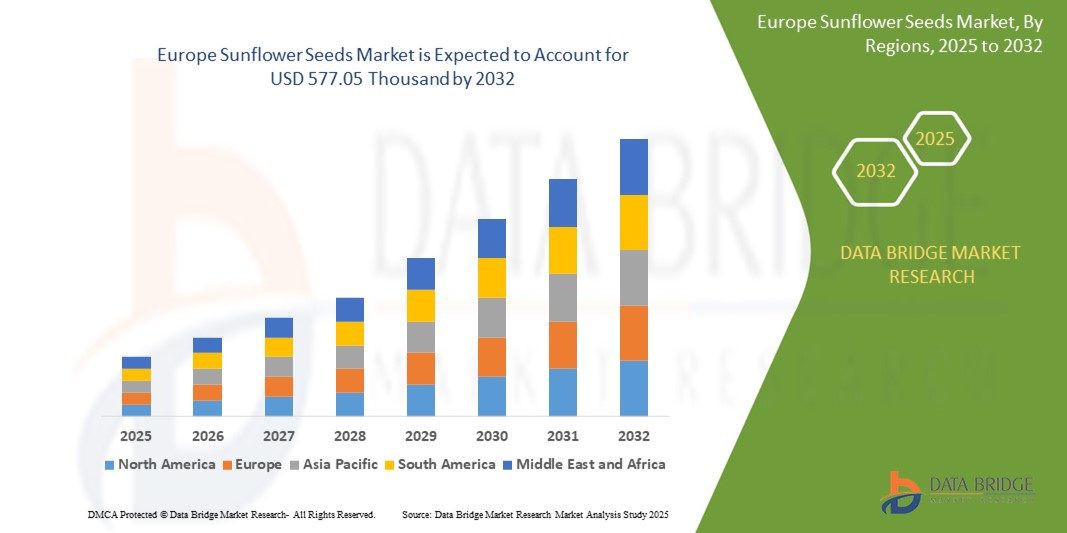
Europe Sunflower Seeds Market Size
- The Europe sunflower seeds market size was valued at USD 387.60 thousand in 2024 and is expected to reach USD 577.05 thousand by 2032, at a CAGR of 5.10% during the forecast period
- The market growth is largely fuelled by the rising demand for healthier snacking options, increasing awareness about the nutritional benefits of sunflower seeds, and their growing use in the food processing and oil extraction industries
- In addition, the expanding popularity of plant-based diets and sustainable agricultural practices is contributing to the increased consumption and cultivation of sunflower seeds across the region
Europe Sunflower Seeds Market Analysis
- The market is witnessing steady growth due to rising consumer inclination toward functional foods rich in vitamins, minerals, and antioxidants, which sunflower seeds provide
- Sunflower seeds are widely consumed in roasted form and are increasingly used in breakfast cereals, energy bars, and bakery products, enhancing their visibility in the health food segment
- Germany dominated the Europe sunflower seeds market with the largest revenue share in 2024, driven by high consumer awareness of nutritional foods, strong demand for organic ingredients, and a well-established food processing sector
- U.K. is expected to witness the highest compound annual growth rate (CAGR) in the Europe sunflower seeds market due to rising consumer preference for plant-based and nutrient-dense snacks, growing demand for clean-label and organic products, and the rapid expansion of online health food retailing across the country
- The kernel/hulled segment held the largest revenue share in 2024, driven by its widespread use in ready-to-eat snacks, bakery products, and cooking ingredients. Consumers favor hulled sunflower seeds due to their convenience and ease of use in both household and industrial applications. In addition, this type is often preferred by food processors for its versatility and nutritional profile
Report Scope and Europe Sunflower Seeds Market Segmentation
|
Attributes |
Europe Sunflower Seeds Key Market Insights |
|
Segments Covered |
|
|
Countries Covered |
Europe
|
|
Key Market Players |
|
|
Market Opportunities |
• Expansion Of Organic and Flavored Sunflower Seed Products • Rising Demand in Functional Food and Nutraceutical Applications |
|
Value Added Data Infosets |
In addition to the insights on market scenarios such as market value, growth rate, segmentation, geographical coverage, and major players, the market reports curated by the Data Bridge Market Research also include in-depth expert analysis, pricing analysis, brand share analysis, consumer survey, demography analysis, supply chain analysis, value chain analysis, raw material/consumables overview, vendor selection criteria, PESTLE Analysis, Porter Analysis, and regulatory framework. |
Europe Sunflower Seeds Market Trends
“Rising Popularity of Sunflower Seeds in Plant-Based and Vegan Diets”
- Sunflower seeds are gaining popularity as a protein-rich, allergen-friendly alternative in vegan and plant-based formulations, driven by the growing demand for nutritious, nut-free ingredients. Their natural abundance of vitamin E, healthy fats, and minerals aligns well with clean-label expectations and functional food innovation
- Their neutral taste and smooth texture make sunflower seeds ideal for creating creamy dairy-free products, especially in cheese and yogurt alternatives
- For instance, several European plant-based cheese brands such as Jay & Joy and Nurishh have transitioned to using sunflower seeds instead of cashews to cater to allergy-sensitive consumers and reduce production costs
- Food manufacturers are increasingly incorporating sunflower seeds in protein bars, vegan spreads, and seed-based snacks, capitalizing on their nutrient density and sustainability benefits. These products often appeal to consumers seeking high-protein, low-allergen options for everyday snacking
- The rising awareness around nut allergies and sustainability is accelerating innovation in seed-based food solutions, with sunflower seeds offering an accessible and environmentally friendly base. Their cultivation requires less water and emits fewer greenhouse gases compared to nuts, further supporting eco-conscious branding
- Sunflower seeds support the development of clean-label, functional foods by enhancing nutritional value without artificial additives, making them an appealing ingredient for health-focused product lines. This trend is evident in markets such as Germany and the Netherlands, where retailers are expanding shelf space for sunflower-based vegan offerings
Europe Sunflower Seeds Market Dynamics
Driver
“Growing Health Awareness and Nutritional Demand”
- The rising emphasis on wellness and active lifestyles is fueling the demand for nutrient-rich and functional ingredients such as sunflower seeds, particularly among health-conscious consumers. Their dense nutritional profile—rich in protein, fiber, and antioxidants—makes them an appealing option for balanced diets and fitness-focused eating habits
- Sunflower seeds are increasingly appreciated for their heart-healthy monounsaturated fats, plant-based protein content, and vitamin E, which collectively contribute to cardiovascular health, satiety, and immune function. These benefits make them suitable for consumers aiming to manage weight, boost energy, or support long-term health
- The versatility of sunflower seeds has led to their incorporation in a growing variety of health-centric food products, including granola bars, trail mixes, protein-rich smoothies, multigrain cereals, and gluten-free baked goods
- For instance, brands such as KIND and RXBAR feature sunflower seeds in their product lines to meet clean nutrition standards.
- With consumers gravitating toward clean-label and minimally processed foods, sunflower seeds are emerging as a natural, additive-free ingredient, aligning with demand for transparency and simplicity in packaged foods. Their unprocessed nature supports labeling claims such as “non-GMO,” “organic,” and “no added sugar.”
- Product developers are leveraging sunflower seeds not only for nutrition but also for texture and taste, enhancing the appeal of healthy snacks without compromising on sensory experience. This is particularly evident in markets across North America and Europe, where seed-based snacks and baked goods are capturing increased shelf space in health and organic food aisles
Restraint/Challenge
“Climate Dependency and Fluctuating Crop Yields”
- Sunflower cultivation is particularly vulnerable to changing climate conditions, especially fluctuations in rainfall, soil moisture levels, and extreme heat or frost, which directly affect germination, flowering, and seed maturity stages. This sensitivity poses a significant challenge to stable production
- Unpredictable weather events often lead to reduced yields and poor seed quality, which disrupt both local and international supply chains
- For instance, in 2022, drought conditions across parts of Eastern Europe led to a sharp decline in sunflower seed output, causing ripple effects in oil processing industries
- Climatic uncertainty contributes to price volatility, which negatively impacts growers, traders, and downstream food manufacturers. A sudden drop in harvest volumes due to excessive heat or flooding can drive prices upward, straining procurement budgets for edible oil producers and snack food brands
- The lack of viable alternative cultivation zones compounds the risk during unfavorable weather seasons, especially since major sunflower-growing countries such as Ukraine, Russia, and Argentina dominate global supply. Limited diversification in production zones leaves the industry more susceptible to climate-related disruptions
- To mitigate risks, stakeholders are exploring adaptive strategies such as drought-resistant seed varieties and smarter irrigation practices, though these solutions are still evolving and not widely accessible. Efforts by agricultural institutes in India and France to trial resilient hybrids are examples of early-stage adaptation underway
Europe Sunflower Seeds Market Scope
The market is segmented on the basis of type, product, product type, category, packaging, packaging size, and distribution channel.
• By Type
On the basis of type, the Europe sunflower seeds market is segmented into kernel/hulled, inshelled, and semi-shelled. The kernel/hulled segment held the largest revenue share in 2024, driven by its widespread use in ready-to-eat snacks, bakery products, and cooking ingredients. Consumers favor hulled sunflower seeds due to their convenience and ease of use in both household and industrial applications. In addition, this type is often preferred by food processors for its versatility and nutritional profile.
The inshelled segment is expected to witness the fastest growth rate from 2025 to 2032, supported by increasing demand for natural and traditional snacking options. Inshelled seeds are particularly popular in Eastern Europe and among consumers seeking minimally processed foods, offering a healthier and more engaging snacking experience.
• By Product
On the basis of product, the Europe sunflower seeds market is segmented into roasted and unroasted. The roasted segment dominated the market in 2024 due to its enhanced flavor, texture, and longer shelf life, making it a preferred option for packaged snacks and seed-based products. Roasted seeds are also widely used in salad toppings and trail mixes across European households.
The unroasted segment is expected to witness the fastest growth rate from 2025 to 2032, owing to rising awareness about raw and minimally processed food consumption. Health-conscious consumers are increasingly opting for unroasted variants to retain the natural nutrients of sunflower seeds.
• By Product Type
On the basis of product type, the Europe sunflower seeds market is segmented into original and flavored. The original segment captured the highest revenue share in 2024, driven by its broad acceptance and versatility in multiple applications, including direct consumption and cooking.
The flavored segment is expected to witness the fastest growth rate from 2025 to 2032, supported by the rising preference for taste-enhanced healthy snacks. Varieties such as spicy, salted, and herb-seasoned sunflower seeds are gaining popularity among younger consumers in urban areas.
• By Category
On the basis of category, the Europe sunflower seeds market is segmented into organic and inorganic. The inorganic segment led the market in 2024, attributed to its wide availability, cost-effectiveness, and large-scale production across Europe.
The organic segment is expected to witness the fastest growth rate from 2025 to 2032, due to increasing demand for chemical-free and eco-friendly food products. Rising awareness about food safety and sustainability is encouraging consumers to shift toward organically grown sunflower seeds.
• By Packaging
On the basis of packaging, the Europe sunflower seeds market is segmented into pouches, bottles, and jars. The pouches segment held the largest share in 2024 due to their portability, affordability, and suitability for on-the-go consumption.
Jars is expected to witness the fastest growth rate from 2025 to 2032, particularly in premium segments, as they offer better preservation and visual appeal for retail shelf presentation.
• By Packaging Size
On the basis of packaging size, the Europe sunflower seeds market is segmented into 50 oz. The 50 oz packaging size segment has gained traction due to its value-for-money proposition for regular consumers and family-size usage. This size is commonly preferred in both online and store-based retail channels for its convenience and cost-efficiency.
• By Distribution Channel
On the basis of distribution channel, the Europe sunflower seeds market is segmented into store-based retailing and non-store retailing. Store-based retailing dominated the market in 2024, supported by the strong presence of supermarkets, hypermarkets, and health food stores offering a wide range of sunflower seed products.
Non-store retailing is expected to witness the fastest growth rate from 2025 to 2032, driven by increasing consumer preference for e-commerce platforms and doorstep delivery. Online retailers are expanding their organic and flavored sunflower seed offerings, further fueling segment growth.
Europe Sunflower Seeds Market Regional Analysis
- Germany dominated the Europe sunflower seeds market with the largest revenue share in 2024, driven by high consumer awareness of nutritional foods, strong demand for organic ingredients, and a well-established food processing sector
- The country’s emphasis on clean-label and sustainable products has encouraged widespread usage of sunflower seeds in snacks, bakery goods, and edible oils, making it a key contributor to regional growth
- Growing health consciousness, along with government support for organic farming practices, continues to support market expansion in both retail and industrial applications
U.K. Sunflower Seeds Market Insight
The U.K. sunflower seeds market is expected to witness the fastest growth rate from 2025 to 2032, driven by increasing adoption of plant-based diets, rising demand for healthy snacking alternatives, and growing consumer interest in superfoods. The country’s expanding e-commerce landscape and preference for clean-label, minimally processed products are further supporting market growth. Food manufacturers are increasingly incorporating sunflower seeds in cereals, bars, and baked goods, reflecting a broader shift toward functional and nutrient-rich ingredients among U.K. consumers.
Europe Sunflower Seeds Market Share
The Europe Sunflower Seeds industry is primarily led by well-established companies, including:
- Schweizer Samen GmbH (Germany)
- Graines Voltz S.A. (France)
- KWS SAAT SE & Co. KGaA (Germany)
- Syngenta AG (Switzerland)
- DSV Deutsche Saatveredelung AG (Germany)
- Limagrain Europe (France)
- Bayer CropScience AG (Germany)
- Enza Zaden (Netherlands)
- Sakata Vegetables Europe S.A.S. (France)
- Thompson & Morgan (U.K.)

- Interactive Data Analysis Dashboard
- Company Analysis Dashboard for high growth potential opportunities
- Research Analyst Access for customization & queries
- Competitor Analysis with Interactive dashboard
- Latest News, Updates & Trend analysis
- Harness the Power of Benchmark Analysis for Comprehensive Competitor Tracking
Europe Sunflower Seeds Market, Supply Chain Analysis and Ecosystem Framework
To support market growth and help clients navigate the impact of geopolitical shifts, DBMR has integrated in-depth supply chain analysis into its Europe Sunflower Seeds Market research reports. This addition empowers clients to respond effectively to global changes affecting their industries. The supply chain analysis section includes detailed insights such as Europe Sunflower Seeds Market consumption and production by country, price trend analysis, the impact of tariffs and geopolitical developments, and import and export trends by country and HSN code. It also highlights major suppliers with data on production capacity and company profiles, as well as key importers and exporters. In addition to research, DBMR offers specialized supply chain consulting services backed by over a decade of experience, providing solutions like supplier discovery, supplier risk assessment, price trend analysis, impact evaluation of inflation and trade route changes, and comprehensive market trend analysis.
Data collection and base year analysis are done using data collection modules with large sample sizes. The stage includes obtaining market information or related data through various sources and strategies. It includes examining and planning all the data acquired from the past in advance. It likewise envelops the examination of information inconsistencies seen across different information sources. The market data is analysed and estimated using market statistical and coherent models. Also, market share analysis and key trend analysis are the major success factors in the market report. To know more, please request an analyst call or drop down your inquiry.
The key research methodology used by DBMR research team is data triangulation which involves data mining, analysis of the impact of data variables on the market and primary (industry expert) validation. Data models include Vendor Positioning Grid, Market Time Line Analysis, Market Overview and Guide, Company Positioning Grid, Patent Analysis, Pricing Analysis, Company Market Share Analysis, Standards of Measurement, Global versus Regional and Vendor Share Analysis. To know more about the research methodology, drop in an inquiry to speak to our industry experts.
Data Bridge Market Research is a leader in advanced formative research. We take pride in servicing our existing and new customers with data and analysis that match and suits their goal. The report can be customized to include price trend analysis of target brands understanding the market for additional countries (ask for the list of countries), clinical trial results data, literature review, refurbished market and product base analysis. Market analysis of target competitors can be analyzed from technology-based analysis to market portfolio strategies. We can add as many competitors that you require data about in the format and data style you are looking for. Our team of analysts can also provide you data in crude raw excel files pivot tables (Fact book) or can assist you in creating presentations from the data sets available in the report.













