


What is the Europe Wet-Milling Market Size and Growth Rate?
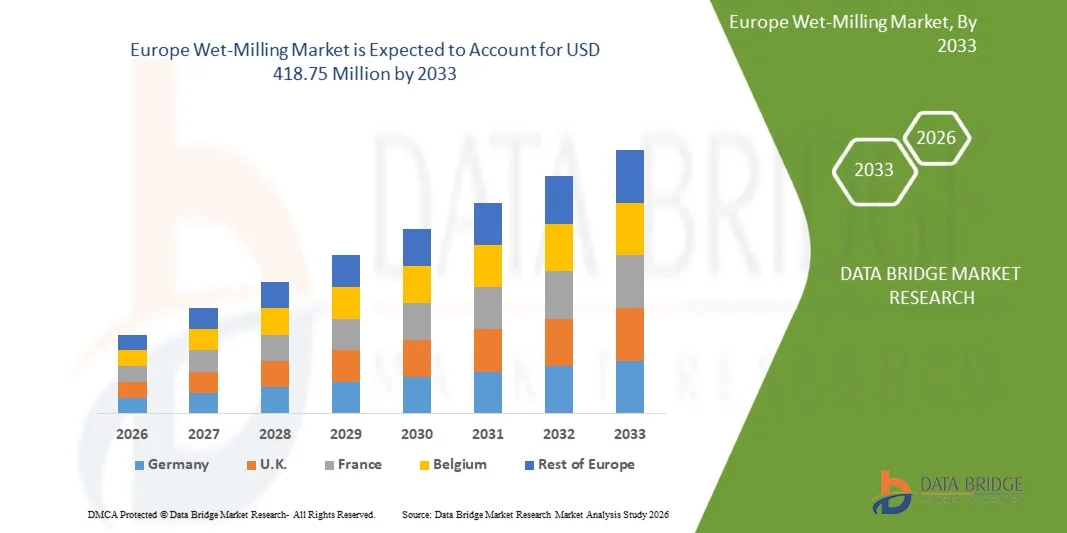
- As per Data Bridge Market Research analysis, the Europe wet-milling market was valued at USD 289.50 million in 2025 and is projected to reach USD 418.75 million by 2033, growing at a CAGR of 4.75% from 2026 to 2033.
- The market is experiencing steady growth driven by rising demand for plant-based starches and sweeteners across food & beverage processing, growing use of corn gluten feed and meal in animal nutrition, and expanding biofuel and ethanol blending mandates across the European Union.
- The increasing focus on clean-label, non-GMO, and specialty starches, combined with growing investment in enzymatic and water-efficient wet-milling technologies to meet EU sustainability and effluent-discharge regulations, is compelling processors to modernize existing facilities. Rising pharmaceutical and paper industry demand for high-purity starch derivatives is further supporting steady market expansion across the region.
Market Size & Forecast
- Europe Market Value (2025): USD 289.50 Million
- Expected Market Value (2033): USD 418.75 Million
- Forecast CAGR (2026–2033): 4.75%
- Leading Country in 2025: Germany
- Fastest Growing Country: Netherlands
What are the Major Takeaways of the Europe Wet-Milling Market?
- Germany dominated the Europe wet-milling market with the largest revenue share of 28.65% in 2025, supported by its strong grain-processing base, well-established starch and sweetener industry, and presence of major integrated wet-milling facilities.
- The Netherlands is expected to be the fastest-growing country at a CAGR of 6.10% from 2026 to 2033, fueled by expanding potato and wheat wet-milling capacity, strong port and logistics infrastructure, and rising demand for specialty and clean-label starches.
- The corn/maize segment led the raw material category with a 52.30% share in 2025, driven by its widespread availability, cost-effectiveness, and established processing infrastructure across major European grain belts.
- The starch segment dominated the product type category with a 41.80% revenue share in 2025, owing to its broad application across food, paper, pharmaceutical, and industrial end uses.
- Sweeteners are the fastest-growing product type, projected to register a CAGR of 5.80%, reflecting rising demand for glucose syrup and specialty sweeteners across the European food and beverage industry.
- The food & beverages application segment accounted for 46.40% of the market share in 2025, supported by extensive use of starch and sweetener derivatives in bakery, confectionery, and processed food manufacturing.
- The biofuel & ethanol application segment is the fastest-growing category, with a CAGR of 6.40%, driven by EU renewable energy directives and growing demand for bio-based fuel blending components.
Report Scope and Europe Wet-Milling Market Segmentation
|
Attributes |
Europe Wet-Milling Key Market Insights |
|
Segments Covered |
|
|
Countries Covered |
|
|
Key Market Players |
|
|
Market Opportunities |
|
|
Value Added Data Infosets |
In addition to the insights on market scenarios such as market value, growth rate, segmentation, geographical coverage, and major players, the market reports curated by the Data Bridge Market Research also include in-depth expert analysis, geographically represented company-wise production and capacity, network layouts of distributors and partners, detailed and updated price trend analysis and deficit analysis of supply chain and demand. |
What is the Key Trend in the Europe Wet-Milling Market?
- European starch and sweetener producers are increasingly expanding their specialty and clean-label ingredient portfolios, reformulating products to meet rising demand for non-GMO, plant-based, and functional starches across food and beverage applications.
- For instance, in 2024, Roquette Frères expanded its texturizing solutions portfolio with the launch of new tapioca-based cook-up starches designed to meet evolving textural requirements across European food manufacturing.
- Growing consolidation and capacity-sharing activity among major European starch producers is reshaping the competitive landscape, as companies seek to expand regional production footprints and diversify raw-material sourcing.
- For instance, in December 2024, Ingredion Incorporated agreed to acquire a 49% stake in AGRANA's Romanian starch facility and form a joint venture to expand regional starch production capacity, a transaction that received regulatory clearance in 2025.
What are the Key Drivers of the Europe Wet-Milling Market?
- Rising demand for starch and glucose-based sweeteners across food and beverage processing, including bakery, confectionery, and dairy applications, continues to drive steady consumption of wet-milled corn, wheat, and potato derivatives across Europe.
- For instance, in 2024, Ingredion Incorporated launched a new non-GMO functional native corn starch designed to deliver improved texture in dairy, alternative-dairy, and dessert applications, reflecting rising European demand for clean-label functional ingredients.
- EU renewable energy and biofuel blending mandates are strengthening demand for ethanol produced from wet-milling co-products, encouraging processors to expand fermentation and renewables-linked production capacity.
- Growing use of corn gluten feed and meal as a high-protein livestock feed additive, supported by rising demand from Europe's dairy and animal nutrition sectors, is further reinforcing steady market growth for wet-milling co-products.
Which Factors are Challenging the Growth of the Europe Wet-Milling Market?
- Wet-milling is a water- and energy-intensive process, and stringent EU environmental regulations on effluent discharge, water usage, and carbon emissions continue to raise compliance costs for processors across the region.
- For instance, environmental regulations enforcing limits on effluent discharge and emissions across Europe can account for a meaningful share of facility operating budgets, restricting the pace of capacity expansion at older processing plants.
- Volatility in raw material prices, particularly for corn and wheat, driven by weather variability, geopolitical disruptions, and shifting EU agricultural policy, continues to pressure processor margins and complicate long-term production planning.
- The high capital investment required for new or upgraded wet-milling facilities, combined with rising energy costs across Europe, continues to restrict entry for smaller processors and slow overall capacity growth in price-sensitive markets.
How is the Europe Wet-Milling Market Segmented?
The Europe wet-milling market is segmented on the basis of raw material, product type, application, technology, end-use industry, and distribution channel.
- By Raw Material
On the basis of raw material, the Europe wet-milling market is segmented into corn/maize, wheat, rice, potato, cassava, and other grains. The corn/maize segment dominated the market with a 52.30% share in 2025, owing to its wide availability, cost-effectiveness, and well-established processing infrastructure across major European grain-producing regions.
The wheat segment is projected to register the fastest growth at a CAGR of 5.60% from 2026 to 2033, driven by rising demand for wheat starch and gluten across bakery, industrial, and pharmaceutical applications, particularly in leading wheat-processing countries such as France and Germany.
- By Product Type
On the basis of product type, the Europe wet-milling market is segmented into starch, sweeteners, corn oil, corn gluten meal, corn gluten feed, and fiber. The starch segment led the market with a 41.80% share in 2025, supported by its broad application across food, paper, pharmaceutical, and industrial manufacturing.
The sweeteners segment is expected to witness the fastest growth at a CAGR of 5.80% from 2026 to 2033, driven by rising demand for glucose syrup, dextrose, and specialty sweeteners across the European food and beverage industry.
- By Application
On the basis of application, the Europe wet-milling market is segmented into food & beverages, animal feed, pharmaceuticals, paper & textile, biofuel & ethanol, and industrial applications. The food & beverages segment dominated the market with a share of 46.40% in 2025 due to extensive use of starch and sweetener derivatives across bakery, confectionery, and processed food manufacturing.
The biofuel & ethanol segment is anticipated to witness the fastest CAGR of 6.40% from 2026 to 2033, driven by EU renewable energy directives and growing demand for bio-based fuel-blending components derived from wet-milling co-products.
- By Technology
On the basis of technology, the Europe wet-milling market is segmented into traditional wet milling and enzymatic & advanced wet milling. The traditional wet milling segment dominated the market with a share of 68.90% in 2025 due to its widespread installed base and lower capital intensity compared with newer processing methods.
The enzymatic & advanced wet milling segment is expected to witness the fastest CAGR of 6.90% from 2026 to 2033, driven by growing processor investment in water-efficient, lower-emission processing technologies that align with EU sustainability targets.
- By End-Use Industry
On the basis of end-use industry, the Europe wet-milling market is segmented into food processing, beverage manufacturing, animal nutrition, pharmaceutical, biofuel production, and paper & packaging. The food processing segment dominated the market with a share of 38.75% in 2025, supported by consistent demand for starch and sweetener ingredients across bakery, dairy, and confectionery manufacturing.
The biofuel production segment is expected to witness the fastest CAGR of 6.50% from 2026 to 2033, driven by expanding renewable fuel blending mandates and rising investment in ethanol production capacity linked to wet-milling co-products.
- By Distribution Channel
On the basis of distribution channel, the Europe wet-milling market is segmented into direct sales and distributors. The direct sales segment dominated the market with a share of 64.20% in 2025, supported by long-term supply agreements between processors and large-volume food, beverage, and industrial customers.
The distributors segment is expected to witness the fastest CAGR of 5.40% from 2026 to 2033, driven by growing demand from small and mid-sized food manufacturers seeking flexible, smaller-volume sourcing of starch and sweetener ingredients.
Which Country Holds the Largest Share of the Europe Wet-Milling Market?
- Germany dominated the Europe wet-milling market and accounted for the largest revenue share of 28.65% in 2025, supported by its strong grain-processing base, well-established starch and sweetener industry, and presence of major integrated wet-milling facilities.
- The country also benefits from strong logistics and export infrastructure, a large domestic food and beverage manufacturing base, and growing investment in specialty and clean-label starch production. Continued focus on process efficiency and sustainability continues to strengthen Germany's leadership position in the regional market.
France Wet-Milling Market Insight
The France wet-milling market is expanding steadily, supported by the country's strong wheat and corn processing base and the presence of major global starch and sweetener producers. Continued investment in specialty starch derivatives for food, pharmaceutical, and industrial applications, along with growing bioethanol production, is reinforcing France's position as a leading wet-milling hub in Europe.
U.K. Wet-Milling Market Insight
The U.K. wet-milling market is witnessing steady growth, supported by rising demand for starch-based ingredients across the food and beverage sector and growing focus on non-GMO and clean-label product formulations. Continued modernization of processing infrastructure and increasing use of starch derivatives in pharmaceutical and industrial applications are further supporting market growth.
Netherlands Wet-Milling Market Insight
The Netherlands wet-milling market is expected to witness the fastest growth in the region, driven by expanding potato and wheat processing capacity, strong port and logistics infrastructure, and rising demand for specialty and clean-label starches. The presence of established cooperative processors and growing investment in sustainable, water-efficient processing technologies continue to strengthen the country's competitive position.
Which are the Top Companies in Europe Wet-Milling Market?
The Europe wet-milling industry is primarily led by well-established companies, including:
- Cargill, Incorporated (U.S.)
- ADM (U.S.)
- Ingredion Incorporated (U.S.)
- Tate & Lyle PLC (U.K.)
- Roquette Frères (France)
- Tereos Group (France)
- AGRANA Beteiligungs-AG (Austria)
- Südzucker AG / BENEO GmbH (Germany)
- Emsland Group (Germany)
- Royal Avebe U.A. (Netherlands)
- KMC Kartoffelmelcentralen amba (Denmark)
- Crespel & Deiters GmbH & Co. KG (Germany)
- Meelunie B.V. (Netherlands)
- Grain Processing Corporation (U.S.)
- Novidon B.V. / Duynie Group (Netherlands)
- Global Bio-Chem Technology Group Company Limited (China)
- Lantmännen (Sweden)
- Royal Cosun (Netherlands)
- Anora Group (Finland)
- Manildra Group (Australia)
What are Latest Developments in Europe Wet-Milling Market?
- In December 2024, Ingredion Incorporated agreed to acquire a 49% stake in AGRANA's Romanian starch facility and form a joint venture to expand regional starch production capacity, with the transaction receiving regulatory clearance in June 2025.
- In November 2024, Tate & Lyle PLC completed its acquisition of CP Kelco, a specialty gums and pectins manufacturer, strengthening its European specialty food and beverage ingredients platform with expanded gellan, pectin, carrageenan, and gum offerings.
- In August 2024, Roquette Frères expanded its texturizing solutions portfolio with the launch of new tapioca-based cook-up starches designed to meet evolving textural requirements across European food manufacturing applications.
- In February 2024, Ingredion Incorporated introduced a new non-GMO functional native corn starch aimed at delivering improved texture in dairy, alternative-dairy, and dessert applications, expanding its European clean-label ingredient portfolio.
- In May 2024, Roquette Frères presented its hydroxypropyl pea starch excipient line at Vitafoods Europe 2024, highlighting new plant-based options for vegetarian and vegan dietary supplement formulations.
- In May 2026, Tereos Group reported full-year results for its Starch, Sweeteners and Renewables division, reflecting the scale of its European starch and sweetener operations amid a broader downturn across sugar and starch markets.

- Interactive Data Analysis Dashboard
- Company Analysis Dashboard for high growth potential opportunities
- Research Analyst Access for customization & queries
- Competitor Analysis with Interactive dashboard
- Latest News, Updates & Trend analysis
- Harness the Power of Benchmark Analysis for Comprehensive Competitor Tracking
Europe Wet Milling Market, Supply Chain Analysis and Ecosystem Framework
To support market growth and help clients navigate the impact of geopolitical shifts, DBMR has integrated in-depth supply chain analysis into its Europe Wet Milling Market research reports. This addition empowers clients to respond effectively to global changes affecting their industries. The supply chain analysis section includes detailed insights such as Europe Wet Milling Market consumption and production by country, price trend analysis, the impact of tariffs and geopolitical developments, and import and export trends by country and HSN code. It also highlights major suppliers with data on production capacity and company profiles, as well as key importers and exporters. In addition to research, DBMR offers specialized supply chain consulting services backed by over a decade of experience, providing solutions like supplier discovery, supplier risk assessment, price trend analysis, impact evaluation of inflation and trade route changes, and comprehensive market trend analysis.
Data collection and base year analysis are done using data collection modules with large sample sizes. The stage includes obtaining market information or related data through various sources and strategies. It includes examining and planning all the data acquired from the past in advance. It likewise envelops the examination of information inconsistencies seen across different information sources. The market data is analysed and estimated using market statistical and coherent models. Also, market share analysis and key trend analysis are the major success factors in the market report. To know more, please request an analyst call or drop down your inquiry.
The key research methodology used by DBMR research team is data triangulation which involves data mining, analysis of the impact of data variables on the market and primary (industry expert) validation. Data models include Vendor Positioning Grid, Market Time Line Analysis, Market Overview and Guide, Company Positioning Grid, Patent Analysis, Pricing Analysis, Company Market Share Analysis, Standards of Measurement, Global versus Regional and Vendor Share Analysis. To know more about the research methodology, drop in an inquiry to speak to our industry experts.
Data Bridge Market Research is a leader in advanced formative research. We take pride in servicing our existing and new customers with data and analysis that match and suits their goal. The report can be customized to include price trend analysis of target brands understanding the market for additional countries (ask for the list of countries), clinical trial results data, literature review, refurbished market and product base analysis. Market analysis of target competitors can be analyzed from technology-based analysis to market portfolio strategies. We can add as many competitors that you require data about in the format and data style you are looking for. Our team of analysts can also provide you data in crude raw excel files pivot tables (Fact book) or can assist you in creating presentations from the data sets available in the report.













