What is the Global 3D Printed Food Solutions Market Size and Growth Rate?
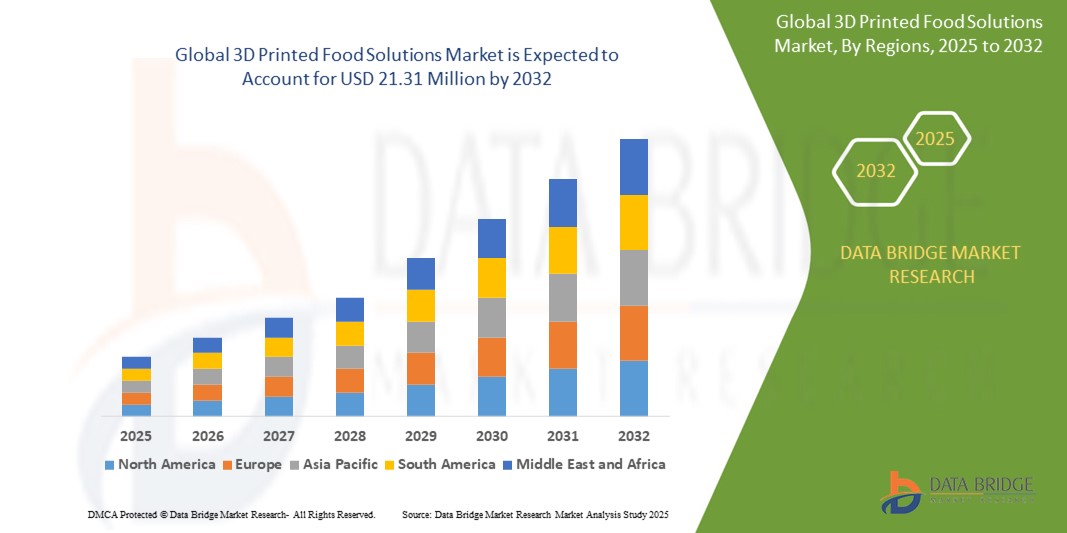
- The global 3D printed food solutions market size was valued at USD 345.21 million in 2024 and is expected to reach USD 21.31 million by 2032, at a CAGR of 34.22% during the forecast period
- This growth is driven by factors such as rising demand for personalized nutrition, technological advancements, sustainable production with reduced food waste, and growing adoption in the foodservice and manufacturing sectors
What are the Major Takeaways of 3D Printed Food Solutions Market?
- 3D food printing involves the layer-by-layer fabrication of edible products using food-grade materials such as purees, pastes, or dough. It enables precise customization in shape, texture, and nutritional content, making it ideal for applications in personalized nutrition, culinary creativity, and food service innovation
- The 3D food printing market is witnessing strong growth driven by increasing demand for personalized and functional foods, advancements in food-grade printing technologies, growing interest in sustainable and low-waste food production, expanding use in high-end restaurants and institutional catering, and rising health consciousness fueling the development of nutrient-rich, customized meals
- North America dominated the 3D printed food solutions market with the largest revenue share of 41.8% in 2024, driven by rapid technological advancements in food processing and the rising demand for customized nutrition and convenience foods
- Asia-Pacific is expected to register the fastest CAGR of 13.4% from 2025 to 2032, driven by rising disposable incomes, urbanization, and strong government initiatives supporting smart food technologies and automation
- The Hardware segment dominated the 3D printed food solutions market with the largest market revenue share of 46.3% in 2024, attributed to the high cost and critical role of 3D printers, nozzles, extruders, and other machinery in the food printing process
Report Scope and 3D Printed Food Solutions Market Segmentation
|
Attributes |
3D Printed Food Solutions Key Market Insights |
|
Segments Covered |
|
|
Countries Covered |
North America
Europe
Asia-Pacific
Middle East and Africa
South America
|
|
Key Market Players |
|
|
Market Opportunities |
|
|
Value Added Data Infosets |
In addition to the insights on market scenarios such as market value, growth rate, segmentation, geographical coverage, and major players, the market reports curated by the Data Bridge Market Research also include in-depth expert analysis, pricing analysis, brand share analysis, consumer survey, demography analysis, supply chain analysis, value chain analysis, raw material/consumables overview, vendor selection criteria, PESTLE Analysis, Porter Analysis, and regulatory framework. |
What is the Key Trend in the 3D Printed Food Solutions Market?
“Rising Adoption of Plant-Based Ingredients in 3D Food Printing”
- One prominent trend in the global 3D food printing market is the rising adoption of plant-based ingredients in 3D food printing
- This trend is driven by the growing consumer demand for sustainable, eco-friendly food options, increasing interest in vegan and vegetarian diets, and the health benefits associated with plant-based nutrition
- For instance, companies such as Redefine Meat and Natural Machines are incorporating plant-based materials such as pea protein, vegetable purees, and algae into their 3D printed food offerings to cater to health-conscious and environmentally aware consumers
- The use of plant-based ingredients is gaining momentum across both developed and emerging markets as consumers become more conscious of environmental impact and dietary choices
- As sustainability and health trends reshape the food industry, the integration of plant-based materials is expected to play a key role in driving innovation and long-term market growth in 3D food printing
What are the Key Drivers of 3D Printed Food Solutions Market?
- The increasing emphasis on sustainability and waste reduction is a major driver of growth in the 3D food printing market, as consumers and industry players asuch as prioritize eco-friendly production methods and minimal resource usage
- This shift is particularly gaining traction in urban areas and among environmentally conscious consumers seeking alternative food production systems with lower carbon footprints
- As awareness of food waste and environmental degradation intensifies, the market is shifting toward 3D printing solutions that utilize upcycled ingredients, plant-based materials, and precision portion control
- Companies are responding by developing printers and formulations that reduce material waste, extend shelf life, and enable on-demand food production tailored to individual nutritional needs
- The drive for sustainable innovation is further accelerating interest in 3D food printing across foodservice, healthcare, and space exploration sectors
- Firms such as Upprinting Food are repurposing food waste into printable materials, creating visually appealing and nutritious meals from surplus ingredients
- Research institutions and startups are exploring edible packaging and biodegradable printing substrates to enhance the environmental benefits of 3D food production
- As sustainability becomes a central focus in food technology, this driver is expected to play a critical role in shaping future product development and widespread adoption of 3D food printing solutions
Which Factor is challenging the Growth of the 3D Printed Food Solutions Market?
- High initial investment for 3D food printing equipment poses a significant challenge for the market, as the cost of advanced printers, compatible ingredients, and specialized software creates substantial entry barriers
- These upfront expenses are particularly burdensome for small food businesses, startups, and institutions with limited capital, making it difficult to adopt 3D printing despite its long-term benefits
- The challenge is further intensified by the need for ongoing maintenance, staff training, and integration with existing kitchen workflows, all of which add to the overall operational cost
- Commercial-grade 3D food printers such as Foodini and Focus 3D can cost several thousand dollars, making them less accessible to small-scale restaurants or individual users
- Without reductions in equipment costs or development of more affordable, user-friendly systems, this financial barrier may restrict wider adoption and slow market expansion, especially in cost-sensitive sectors and developing regions
How is the 3D Printed Food Solutions Market Segmented?
The market is segmented on the basis of type, communication protocol, unlocking mechanism, and application.
- By Component
On the basis of component, the 3D printed food solutions market is segmented into Hardware, Software, and Services. The Hardware segment dominated the 3D printed food solutions market with the largest market revenue share of 46.3% in 2024, attributed to the high cost and critical role of 3D printers, nozzles, extruders, and other machinery in the food printing process. Demand for durable and precision-engineered components continues to drive hardware investments, especially in commercial kitchens and food research labs.
The Services segment is expected to witness the fastest CAGR from 2025 to 2032, driven by growing demand for installation, maintenance, and customization services across commercial foodservice providers and R&D facilities. As 3D food printing technology matures, service providers offering training, technical support, and process optimization are seeing increased market traction.
- By Technology
On the basis of technology, the 3D printed food solutions market is segmented into Extrusion-Based Printing, Binder Printing, Selective Laser Sintering, and Inkjet Printing. The Extrusion-Based Printing segment held the largest revenue share in 2024 due to its versatility in printing a wide variety of food ingredients including dough, chocolate, cheese, and purées. This method is cost-effective and widely adopted in commercial and residential food printing applications.
The Inkjet Printing segment is projected to register the fastest CAGR from 2025 to 2032, driven by its ability to deliver precise layers and detailed food decorations, making it popular in confectionery and bakery applications. Advancements in multi-nozzle printing and edible ink formulations are also contributing to its rapid adoption.
- By Ingredient
On the basis of ingredient, the 3D printed food solutions market is segmented into Confectionery, Dough, Dairy Products, Fruits and Vegetables, and Meat. The Confectionery segment dominated the market in 2024 with a market revenue share of 34.7%, fueled by high demand in bakeries, cafes, and foodservice for customizable and artistic desserts. Chocolates and sugar sculptures are particularly popular due to their ease of printing and wide customer appeal.
The Meat segment is expected to witness the fastest growth from 2025 to 2032, driven by growing interest in alternative proteins, lab-grown meat, and personalized nutrition. As sustainability and food innovation gain momentum, 3D printing of meat products is becoming a focal point for startups and food tech companies.
- By End-Use
On the basis of end-use, the 3D printed food solutions market is segmented into Government, Commercial, and Residential. The Commercial segment held the largest market revenue share in 2024, primarily due to widespread adoption in restaurants, catering services, and food tech companies aiming to offer unique culinary experiences. Commercial kitchens are leveraging 3D printing to automate food preparation, reduce waste, and offer customized meals.
The Residential segment is projected to grow at the fastest CAGR from 2025 to 2032, supported by the rising availability of consumer-grade food printers, growing interest in personalized nutrition, and the increasing popularity of DIY food printing in tech-savvy households.
Which Region Holds the Largest Share of the 3D Printed Food Solutions Market?
- North America dominated the 3D printed food solutions market with the largest revenue share of 41.8% in 2024, driven by rapid technological advancements in food processing and the rising demand for customized nutrition and convenience foods
- The region’s early adoption of 3D printing technology in food applications especially in bakeries, food startups, and institutional catering has significantly contributed to market dominance
- The U.S. and Canada boast a robust infrastructure for food innovation, backed by strong investments in food tech, automation, and R&D. Growing awareness of food sustainability, the popularity of personalized diets, and the rising presence of health-conscious consumers are further accelerating market adoption
- The presence of leading companies, favorable regulatory frameworks for food innovation, and strong demand from commercial and healthcare segments position North America as the global leader in 3D printed food solutions adoption
U.S. 3D Printed Food Solutions Market Insight
The U.S. market held the largest revenue share in North America in 2024, supported by the high concentration of food tech startups, university-led innovation programs, and consumer appetite for novel food experiences. Applications in elderly care, military rations, and space missions are fueling R&D investments. Increasing adoption in restaurants and commercial kitchens for on-demand, customized food further propels growth. In addition, FDA guidance and public funding for food technology development provide a favorable regulatory environment.
Europe 3D Printed Food Solutions Market Insight
The European market is projected to grow at a healthy CAGR during the forecast period, driven by strong support for food innovation under EU Horizon 2030, sustainability regulations, and rising demand for alternative food sources. Countries such as Germany, the Netherlands, and Spain are adopting 3D food printing in education, healthcare, and personalized nutrition applications. The push for meat alternatives and precision food manufacturing also supports adoption across commercial food production units and specialty bakeries.
U.K. 3D Printed Food Solutions Market Insight
The U.K. market is experiencing significant growth due to government-funded innovation programs and a dynamic startup ecosystem focused on sustainable food production. The shift toward low-waste, customizable food options and rising interest in health-focused diets are prompting wider use of 3D food printers in schools, care homes, and food festivals. The U.K.’s culinary innovation hubs and collaborations between academia and food-tech players further boost development.
Germany 3D Printed Food Solutions Market Insight
The Germany market is expanding steadily, supported by a strong industrial base, advanced 3D printing capabilities, and consumer openness to functional foods. Key research institutions and food producers are investing in food-grade printing systems for confectionery, meat substitutes, and bakery items. Growing demand for personalized, on-demand meals—especially in the healthcare and institutional sectors—is contributing to the market’s rise.
Which Region is the Fastest Growing Region in the 3D Printed Food Solutions Market?
Asia-Pacific is expected to register the fastest CAGR of 13.4% from 2025 to 2032, driven by rising disposable incomes, urbanization, and strong government initiatives supporting smart food technologies and automation. Countries such as China, Japan, and South Korea are rapidly adopting 3D food printing in both commercial and residential settings. The region is also witnessing increased investment in food sustainability, with 3D printing being explored for alternative proteins and plant-based products. The growing middle-class population and expanding foodservice industry provide a fertile ground for rapid market growth.
Japan 3D Printed Food Solutions Market Insight
The Japan market is witnessing rapid adoption due to its aging population, food automation needs, and high-tech ecosystem. Hospitals and eldercare facilities are adopting 3D printing to serve easy-to-chew, nutritionally balanced meals. Japan's culinary innovation, combined with government support for robotics and automation, is positioning the country as a leader in functional and customized food applications.
China 3D Printed Food Solutions Market Insight
China led the Asia-Pacific region in revenue share in 2024, driven by strong domestic manufacturing, smart city initiatives, and a growing food-tech ecosystem. The market benefits from government-backed innovation zones and collaborations between food producers and 3D printing startups. With expanding middle-class demand and a booming e-commerce sector, 3D food printers are increasingly entering residential kitchens and upscale restaurants.
Which are the Top Companies in 3D Printed Food Solutions Market?
The 3D printed food solutions industry is primarily led by well-established companies, including:
- 3D Systems, Inc. (U.S.)
- NATURAL MACHINES (Spain)
- byFlow B.V. (Netherlands)
- Procusini (Germany)
- Barilla G. e R. F.lli S.p.A. (Italy)
- BeeHex (U.S.)
- Modern Meadow (U.S.)
- Aniwaa Pte. Ltd (Singapore)
- biozoon (Germany)
- Wiiboox (France)
- Zmorph S.A. (Poland)
- PancakeBot (U.S.)
What are the Recent Developments in Global 3D Printed Food Solutions Market?
- In January 2024, Cocuus revealed its intention to manufacture one thousand tonnes of 3D-printed plant-based bacon at its newly established facility in Northern Spain, marking a significant step toward industrial-scale production for retail distribution. The company has already introduced its plant-based bacon in four hundred Carrefour supermarkets and plans to expand its product line to include vegan tuna and shrimp
- In September 2023, SavorEat Ltd. and Sodexo unveiled the first 3D-printing robot designed for plant-based burgers at the University of Denver, two years after they announced their partnership in 2021. This collaboration aims to enhance Sodexo's plant-based offerings and reduce its carbon footprint, in line with its goal of making forty-two percent of its college and university menus plant-based by 2025
- In September 2021, Zmorph entered into a new partnership with the Spanish company Sicnova, aiming to make its products accessible in Spain, Portugal, and Latin America (excluding Brazil) via Sicnova's distributor network. Founded in 2007, Sicnova has a long-standing focus on additive manufacturing including 3D food printing, making its expertise a valuable enhancement to Zmorph's reseller portfolio
- In August 2021, SavorEat finalized an agreement with Sodexo Operations, the American branch of the Paris-based food services and facilities management giant Sodexo, to initiate a pilot project in the U.S. that will feature the startup's kosher, vegan, gluten-free, and allergen-free burger patties
- In October 2020, Indukern's food division announced a collaboration with Natural Machines to provide ingredients and products specifically tailored for Foodini, a kitchen appliance that utilizes 3D printing technology

- Interactive Data Analysis Dashboard
- Company Analysis Dashboard for high growth potential opportunities
- Research Analyst Access for customization & queries
- Competitor Analysis with Interactive dashboard
- Latest News, Updates & Trend analysis
- Harness the Power of Benchmark Analysis for Comprehensive Competitor Tracking
Global 3d Printed Food Solutions Market, Supply Chain Analysis and Ecosystem Framework
To support market growth and help clients navigate the impact of geopolitical shifts, DBMR has integrated in-depth supply chain analysis into its Global 3d Printed Food Solutions Market research reports. This addition empowers clients to respond effectively to global changes affecting their industries. The supply chain analysis section includes detailed insights such as Global 3d Printed Food Solutions Market consumption and production by country, price trend analysis, the impact of tariffs and geopolitical developments, and import and export trends by country and HSN code. It also highlights major suppliers with data on production capacity and company profiles, as well as key importers and exporters. In addition to research, DBMR offers specialized supply chain consulting services backed by over a decade of experience, providing solutions like supplier discovery, supplier risk assessment, price trend analysis, impact evaluation of inflation and trade route changes, and comprehensive market trend analysis.
Data collection and base year analysis are done using data collection modules with large sample sizes. The stage includes obtaining market information or related data through various sources and strategies. It includes examining and planning all the data acquired from the past in advance. It likewise envelops the examination of information inconsistencies seen across different information sources. The market data is analysed and estimated using market statistical and coherent models. Also, market share analysis and key trend analysis are the major success factors in the market report. To know more, please request an analyst call or drop down your inquiry.
The key research methodology used by DBMR research team is data triangulation which involves data mining, analysis of the impact of data variables on the market and primary (industry expert) validation. Data models include Vendor Positioning Grid, Market Time Line Analysis, Market Overview and Guide, Company Positioning Grid, Patent Analysis, Pricing Analysis, Company Market Share Analysis, Standards of Measurement, Global versus Regional and Vendor Share Analysis. To know more about the research methodology, drop in an inquiry to speak to our industry experts.
Data Bridge Market Research is a leader in advanced formative research. We take pride in servicing our existing and new customers with data and analysis that match and suits their goal. The report can be customized to include price trend analysis of target brands understanding the market for additional countries (ask for the list of countries), clinical trial results data, literature review, refurbished market and product base analysis. Market analysis of target competitors can be analyzed from technology-based analysis to market portfolio strategies. We can add as many competitors that you require data about in the format and data style you are looking for. Our team of analysts can also provide you data in crude raw excel files pivot tables (Fact book) or can assist you in creating presentations from the data sets available in the report.