What is the 3D Printed Satellite Market Size and Growth Rate?
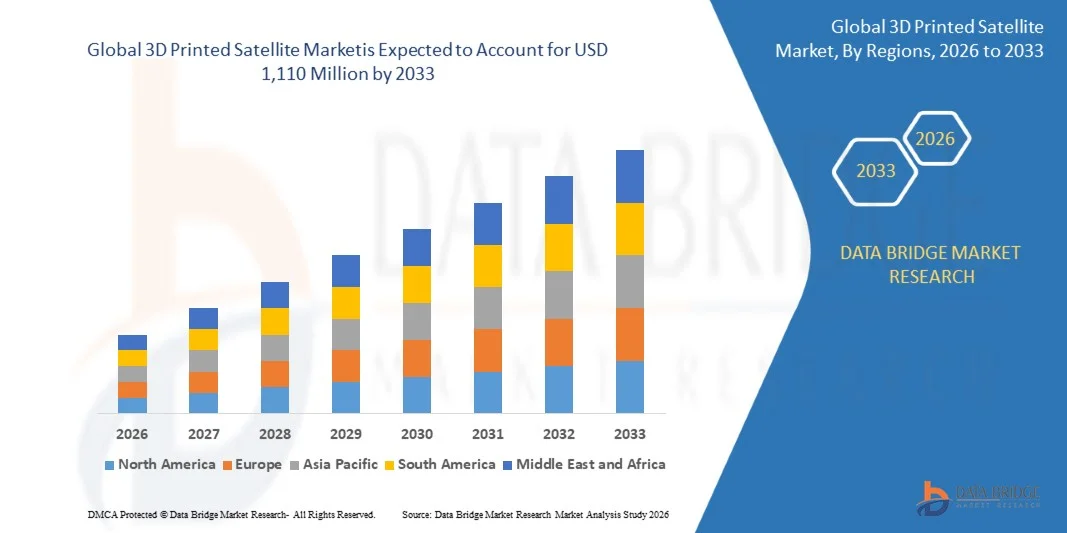
- As per Data Bridge Market Research analysis, the 3D printed satellite market was valued at USD 169.80 million in 2025 and is projected to reach USD 1.11 billion by 2033, growing at a CAGR of 26.5% from 2026 to 2033.
- The market is experiencing rapid growth driven by rising demand for lightweight satellite structures, shorter manufacturing lead times, and expanding small-satellite constellations across communication, Earth observation, navigation, and defense missions.
- Growing adoption of metal and polymer printing, rising launch cadence, and increasing government investment in sovereign space capabilities are supporting market adoption. Additive manufacturing is being applied across antennas, brackets, propulsion components, and thermal hardware, while nanosatellite and microsatellite platforms and communication satellite programs are using printed parts to reduce mass, part count, and cost.
Market Size & Forecast
- Global Market Value (2025): USD 169.80 Million
- Expected Market Value (2033): USD 1.11 billion
- Forecast CAGR (2026–2033): 26.5%
- Leading Region in 2025: North America
- Fastest Growing Region: Asia Pacific
What are the Major Takeaways of the 3D Printed Satellite Market?
- North America dominated the 3D printed satellite market with the largest revenue share of 41.62% in 2025, supported by a strong commercial space base, large defense satellite programs, and early adoption of additive manufacturing in flight hardware.
- Asia-Pacific is expected to be the fastest-growing region at a CAGR of 29.81% from 2026 to 2033, fueled by expanding national space programs, rising small-satellite launches, and growing additive manufacturing capacity.
- The structural components segment led the market with a 38.76% share in 2025, driven by increasing use of printed brackets, housings, and bus structures to reduce satellite mass and part count.
- Antennas & RF components are the fastest-growing component type, projected to register a CAGR of 30.28%, reflecting the surge in demand for lightweight, integrated antenna and waveguide hardware.
- The metals segment dominated the material category with a 54.35% revenue share in 2025, led by extensive use of titanium, aluminum, and copper alloys in flight-qualified components.
- Communication accounted for 46.83% of the market share in 2025, preferred by increasing deployment of satellite constellations and geostationary platforms that rely on printed RF and structural parts.
- The Earth observation segment is the fastest-growing application category, with a CAGR of 28.94%, driven by increasing demand for compact, rapidly manufactured imaging and remote-sensing satellites.
Report Scope and 3D Printed Satellite Market Segmentation
|
Attributes |
3D Printed Satellite Key Market Insights |
|
Segments Covered |
|
|
Countries Covered |
North America
Europe
Asia-Pacific
Middle East and Africa
South America
|
|
Key Market Players |
|
|
Market Opportunities |
|
|
Value Added Data Infosets |
In addition to the market insights such as market value, growth rate, market segments, geographical coverage, market players, and market scenario, the market report curated by the Data Bridge Market Research team includes in-depth expert analysis, import/export analysis, pricing analysis, production consumption analysis, and pestle analysis. |
What is the Key Trend in the 3D Printed Satellite Market?
- 3D printed satellites are increasingly evolving from prototype and bracket-level applications into serial production of flight hardware, combining metal and polymer additive manufacturing, topology optimization, and digital design to deliver lighter, more integrated satellite structures and RF payloads.
- For instance, in July 2026, according to Vestbee, SWISSto12 reported more than 2,000 of its 3D-printing-enabled satellite payload solutions in orbit, USD 140 million in 2025 revenue, and a 110% compound annual growth rate since 2022, highlighting the shift of printed satellite hardware into commercial-scale production.
- Printed lattice structures, integrated waveguides, and consolidated multi-part assemblies are enabling satellite makers to cut mass, assembly steps, and lead times without compromising structural or thermal performance.
- In-space and on-orbit manufacturing is emerging as an important extension of the technology, as agencies and manufacturers test metal and polymer printing in microgravity to support repairs, large structures, and future exploration missions.
- For instance, in August 2024, according to Airbus, astronauts retrieved the first sample printed by the first metal 3D printer on the International Space Station, developed by an Airbus-led consortium for ESA, so that microgravity-printed stainless steel could be compared with the same part produced in Toulouse, demonstrating progress in in-space metal manufacturing.
- As lightweight materials, qualification standards, and constellation economics continue to advance, 3D printed satellites are expected to expand beyond antennas and brackets into propulsion, thermal management, and full satellite buses across commercial, defense, and scientific missions.
What are the Key Drivers of the 3D Printed Satellite Market?
- Rising demand for lighter satellites and lower launch costs is increasing the use of additive manufacturing, which allows complex, topology-optimized parts to replace multi-piece assemblies while reducing mass and fastener count.
- For instance, in July 2021, according to Applied Sciences (MDPI), researchers redesigned a titanium TC4 aerospace bracket using multi-load-case topology optimization and 3D printing, achieving a 37% mass reduction versus the original structure while validating fatigue performance through simulation and testing, supporting printed lightweight structures for spacecraft.
- Growing small-satellite launches, proliferating constellations, and government demand for sovereign space capabilities are pushing manufacturers to shorten production cycles and adopt on-demand manufacturing of customized satellite components.
- For instance, in December 2022, according to TCT Magazine, a 3D printed satellite test container launched aboard the Zeus-1 satellite weighed 362 g, over 50% lighter than an estimated 800 g aluminum 6061 equivalent, and was produced in two to three days compared with at least three weeks for a machined part.
- With manufacturers increasingly integrating printing into satellite production lines, 3D printing can support faster delivery, design flexibility, and lower part counts for communication, Earth observation, and defense satellite programs.
What Factors Are Challenging the Growth of the 3D Printed Satellite Market?
- 3D printed satellite components require qualified powders, controlled build processes, post-processing, and extensive inspection to meet spaceflight standards, increasing development effort compared with conventional machined hardware.
- For instance, in May 2026, according to the NASA Technical Reports Server (NTRS), specialists from NASA Marshall Space Flight Center and the Jet Propulsion Laboratory presented lessons learned from applying NASA-STD-6030, citing challenges in tailoring requirements, documentation burden, and conservative mechanical-property approaches during certification of additively manufactured spaceflight hardware.
- These requirements can raise development costs and create challenges related to part inspectability, repeatability across machines, material allowables, and certification timelines, particularly for critical components with complex internal geometries.
- Printer build volumes, throughput limits, and the high cost of metal additive systems also restrict the size and quantity of parts that can be produced, particularly for large structures and high-volume constellation programs.
- For instance, in January 2024, according to Airbus, ESA's metal 3D printer for the International Space Station was designed to print only four stainless steel specimens, each about 9 x 5 cm and requiring roughly 40 hours to print, highlighting the throughput and size constraints that still limit printing of larger satellite hardware.
- The combination of qualification complexity, high equipment and material costs, and limited build volumes can constrain adoption among cost-sensitive operators and programs, particularly where conventional machining and casting already meet performance, schedule, and reliability requirements.
How is the 3D Printed Satellite Market Segmented?
The 3D printed satellite market is segmented on the basis of component, material, application, and end user.
- By Component
On the basis of component, the 3D printed satellite market is segmented into structural components, antennas & RF components, propulsion components, thermal management components, and others. The structural components segment dominated the market with 38.76% share in 2025, supported by increasing use of printed brackets, housings, panels, and bus structures that reduce satellite mass and part count. Additive manufacturing allows complex lattice and hollow geometries that are difficult to machine, while consolidating multiple parts into a single component. Structural parts also have established qualification pathways, as many are easier to inspect than propulsion hardware. Rising demand for lightweight small-satellite platforms and faster production cycles is further strengthening adoption.
The antennas & RF components segment is projected to register the fastest growth at a CAGR of 30.28% from 2026 to 2033, driven by increasing demand for lightweight, integrated antennas, waveguides, feeds, and phased-array hardware. Additive manufacturing enables complex internal channels and monolithic designs that improve RF performance while reducing assembly steps. Their applications include communication payloads, direct-to-device connectivity, and secure government communications. Rising satellite constellations and the shift toward electronically steered antennas are creating additional demand. Improvements in plating, copper alloy printing, and surface finishing are enhancing performance, while partnerships between satellite manufacturers and specialized RF suppliers are improving production readiness.
- By Material
On the basis of material, the 3D printed satellite market is segmented into metals, polymers, ceramics, and composites. The metals segment dominated the market with 54.35% share in 2025, supported by extensive use of titanium, aluminum, stainless steel, and copper alloys in flight-qualified structures, propulsion hardware, and RF components. Metal powder bed fusion and directed energy deposition provide high strength-to-weight ratios and thermal stability under launch loads and orbital conditions. Established material allowables and growing qualification experience help satellite makers adopt metal parts with lower technical risk. Increasing demand from defense and geostationary programs is also supporting the segment.
The composites segment is projected to register the fastest growth at a CAGR of 31.40% from 2026 to 2033, supported by increasing adoption of carbon fiber-reinforced polymers for lightweight satellite buses and structures. Continuous fiber printing allows low-mass parts with high stiffness, reducing screws, fasteners, and assembly time. Flame-retardant and low-outgassing formulations are expanding use in small satellites and rapid-response missions. Composite printing also supports short production runs and design iterations at lower cost than machined metals. Growing launches of nano and microsatellites are creating additional opportunities, while ongoing radiation, thermal cycling, and vacuum testing is strengthening developer confidence.
- By Application
On the basis of application, the 3D printed satellite market is segmented into communication, Earth observation, navigation, technology demonstration, and others. The communication segment dominated the application category with 46.83% share in 2025, supported by increasing deployment of satellite constellations and geostationary platforms that rely on printed RF, structural, and thermal components. Operators are seeking lighter payloads and faster manufacturing to lower launch and production costs. Additive manufacturing enables integrated antenna designs and compact payload structures. Growing demand for broadband connectivity, direct-to-device services, and secure government communications is further strengthening adoption across commercial and sovereign programs.
The Earth observation segment is projected to register the fastest growth at a CAGR of 28.94% from 2026 to 2033, driven by increasing demand for compact, rapidly manufactured imaging and remote-sensing satellites. Printed structures can reduce mass and accelerate production of multi-satellite constellations that improve revisit rates. Integration of onboard artificial intelligence, multi-sensor payloads, and custom mounting structures is increasing the need for flexible design. Applications include agriculture, maritime monitoring, disaster response, and defense intelligence. Falling launch costs through rideshare missions are creating additional demand, while shorter build times help operators respond quickly to evolving customer data needs.
- By End User
On the basis of end user, the 3D printed satellite market is segmented into commercial, government & defense, and academic & research. The commercial segment dominated the end-user category with 52.44% share in 2025, supported by increasing investment in satellite constellations, in-orbit services, and data-driven space businesses. Commercial operators prioritize low cost, fast delivery, and scalable production, which align with additive manufacturing capabilities. Printed components help reduce mass, assembly time, and launch expenses. Growing participation of private manufacturers and rideshare launches is increasing the number of missions that adopt printed parts, while established supplier ecosystems are improving access to flight-ready components.
The government & defense segment is projected to register the fastest growth at a CAGR of 29.15% from 2026 to 2033, driven by increasing investment in sovereign space capabilities, secure communications, and rapid-response satellite programs. Defense agencies value additive manufacturing for faster production, supply chain resilience, and customized payloads. Printed antennas and structural parts are being qualified for military communication and surveillance missions. Growing government funding for national space infrastructure is creating additional opportunities, while qualification standards and security requirements remain important considerations for deployment across mission-critical programs.
Which Region Holds the Largest Share of the 3D Printed Satellite Market?
- North America dominated the 3D printed satellite market with the largest revenue share of 41.62% in 2025, supported by a strong commercial space base, large defense satellite programs, and early adoption of additive manufacturing in flight hardware.
- The region also benefits from the presence of established satellite manufacturers, additive manufacturing suppliers, and government space agencies, along with strong demand for lightweight communication and Earth observation satellites. Increasing use of printed components in constellations, defense programs, and in-space manufacturing demonstrations continues to strengthen North America’s position in the global market.
U.S. 3D Printed Satellite Market Insight
The U.S. 3D printed satellite market is witnessing strong growth due to rising satellite constellation deployments, defense modernization programs, and rapid adoption of additive manufacturing across commercial space companies. The country’s mature aerospace ecosystem, along with increasing integration of printed structures, antennas, and propulsion parts into flight hardware, is driving demand for lightweight and rapidly produced satellites. In addition, growing emphasis on NASA qualification standards, rideshare launch access, and domestic supply chain resilience is accelerating adoption of 3D printed components across government and commercial missions.
Asia-Pacific 3D Printed Satellite Market Insight
The Asia-Pacific 3D printed satellite market is expected to witness rapid growth, driven by expanding national space programs, rising small-satellite launches, and increasing investments in additive manufacturing across countries such as China, India, and Japan. Growing demand for low-cost satellite production, indigenous launch and satellite capabilities, and government-backed space startups is supporting regional market expansion. In addition, the region’s strong manufacturing base and increasing collaboration between satellite developers and additive manufacturing providers are accelerating demand for printed satellite components.
Japan 3D Printed Satellite Market Insight
The Japan 3D printed satellite market is witnessing consistent growth due to rising investments in secure satellite communications, small-satellite development, and advanced manufacturing technologies. Space agencies, defense organizations, and electronics manufacturers are increasingly adopting printed antennas and lightweight structures for precision payloads. Moreover, strong demand for reliability, compact design, and domestic supply chain capability, including international partnerships for phased array antenna development, is further contributing to market growth in Japan.
China 3D Printed Satellite Market Insight
The China 3D printed satellite market is growing rapidly, driven by expanding national constellations, large-scale aerospace manufacturing, and increasing adoption of additive manufacturing for lightweight satellite structures. Growing use of metal printing in research institutes, state-owned space enterprises, and commercial satellite startups is significantly boosting market demand. In addition, strong domestic printer and materials manufacturing, increasing launch frequency, and rapid development of low Earth orbit satellite programs are positioning China as a key growth market for printed satellite solutions across Asia-Pacific.
U.K. 3D Printed Satellite Market Insight
The U.K. 3D printed satellite market is experiencing steady growth, supported by increasing investment in small-satellite manufacturing, space start-ups, and advanced engineering capabilities. Research institutions, defense organizations, and commercial satellite developers are increasingly utilizing additive manufacturing to shorten development cycles and reduce component mass. Furthermore, growing participation in European Space Agency programs, domestic launch initiatives, and precision manufacturing partnerships is supporting wider adoption of 3D printed satellite components in the U.K.
Germany 3D Printed Satellite Market Insight
The Germany 3D printed satellite market is expanding steadily due to the country’s strong industrial base, advanced additive manufacturing ecosystem, and active participation in European space programs. Satellite manufacturers, machine builders, and research institutes are increasingly utilizing printed metal parts for structures, propulsion, and thermal systems. Continuous advancements in powder bed fusion technology, materials engineering, and quality assurance, along with Germany’s focus on precision and certification, are further driving market growth in the country.
Which are the Top Companies in 3D Printed Satellite Market?
The 3D printed satellite industry is primarily led by well-established companies, including:
- SWISSto12 SA (Switzerland)
- Thales Alenia Space (France)
- Airbus SE (Netherlands)
- Lockheed Martin Corporation (U.S.)
- Sidus Space, Inc. (U.S.)
- Northrop Grumman Corporation (U.S.)
- The Boeing Company (U.S.)
- Sierra Space Corporation (U.S.)
- Redwire Corporation (U.S.)
- Mitsubishi Electric Corporation (Japan)
- OHB SE (Germany)
- Beyond Gravity (Switzerland)
- MDA Space Ltd. (Canada)
- EOS GmbH (Germany)
- Nikon SLM Solutions AG (Germany)
- Stratasys Ltd. (Israel)
- 3D Systems, Inc. (U.S.)
- Velo3D, Inc. (U.S.)
- Oerlikon AG (Switzerland)
- Colibrium Additive (U.S.)
What are Latest Developments in 3D Printed Satellite Market?
- In September 2026, SWISSto12 announced a strategic partnership with Mitsubishi Electric Corporation, including a contract to develop advanced phased array antenna products for the Japanese Government’s GEO secure satellite communications programme. The agreement builds on growing adoption of SWISSto12’s 3D-printing-based HummingLink payload technology and its small geostationary HummingSat platform, supporting the continued development of additively manufactured satellite payloads.
- In July 2026, SWISSto12 raised USD 70 million in a Series C funding round to expand manufacturing and integration capacity for its HummingSat geostationary satellite platform and HummingLink antenna and payload range. The company reported seven HummingSat contracts with operators, including SES and Viasat, and more than 2,000 of its solutions in orbit, supporting the scale-up of 3D printed satellite production.
- In January 2026, SWISSto12 received approximately EUR 73 million (about USD 84.8 million) in funding from European Space Agency member states to accelerate development and industrialization of its HummingSat platform, scale manufacturing capacity, and advance phased-array antenna technologies for low, medium, and geostationary orbit payloads, strengthening Europe’s capabilities in additively manufactured satellite hardware.
- In March 2025, Sidus Space announced the successful launch, deployment, and operation of LizzieSat-3 into low Earth orbit on SpaceX’s Transporter-13 rideshare mission. The satellite joined LizzieSat-1 and LizzieSat-2, which have been in orbit since March 2024 and December 2024, respectively, expanding a multi-mission constellation built on a hybrid 3D printed satellite bus with onboard artificial intelligence data processing.
- In January 2024, the European Space Agency launched the first metal 3D printer to the International Space Station aboard the Cygnus NG-20 resupply mission. Developed by an Airbus Defence and Space-led consortium, the 180 kg printer uses stainless steel wire and a high-power laser and was designed to produce four specimens to characterize how microgravity affects metal printing, supporting in-space manufacturing development.

- Interactive Data Analysis Dashboard
- Company Analysis Dashboard for high growth potential opportunities
- Research Analyst Access for customization & queries
- Competitor Analysis with Interactive dashboard
- Latest News, Updates & Trend analysis
- Harness the Power of Benchmark Analysis for Comprehensive Competitor Tracking
Data collection and base year analysis are done using data collection modules with large sample sizes. The stage includes obtaining market information or related data through various sources and strategies. It includes examining and planning all the data acquired from the past in advance. It likewise envelops the examination of information inconsistencies seen across different information sources. The market data is analysed and estimated using market statistical and coherent models. Also, market share analysis and key trend analysis are the major success factors in the market report. To know more, please request an analyst call or drop down your inquiry.
The key research methodology used by DBMR research team is data triangulation which involves data mining, analysis of the impact of data variables on the market and primary (industry expert) validation. Data models include Vendor Positioning Grid, Market Time Line Analysis, Market Overview and Guide, Company Positioning Grid, Patent Analysis, Pricing Analysis, Company Market Share Analysis, Standards of Measurement, Global versus Regional and Vendor Share Analysis. To know more about the research methodology, drop in an inquiry to speak to our industry experts.
Data Bridge Market Research is a leader in advanced formative research. We take pride in servicing our existing and new customers with data and analysis that match and suits their goal. The report can be customized to include price trend analysis of target brands understanding the market for additional countries (ask for the list of countries), clinical trial results data, literature review, refurbished market and product base analysis. Market analysis of target competitors can be analyzed from technology-based analysis to market portfolio strategies. We can add as many competitors that you require data about in the format and data style you are looking for. Our team of analysts can also provide you data in crude raw excel files pivot tables (Fact book) or can assist you in creating presentations from the data sets available in the report.