


What is the Global 5G in Automotive and Smart Transportation Market Size and Growth Rate?
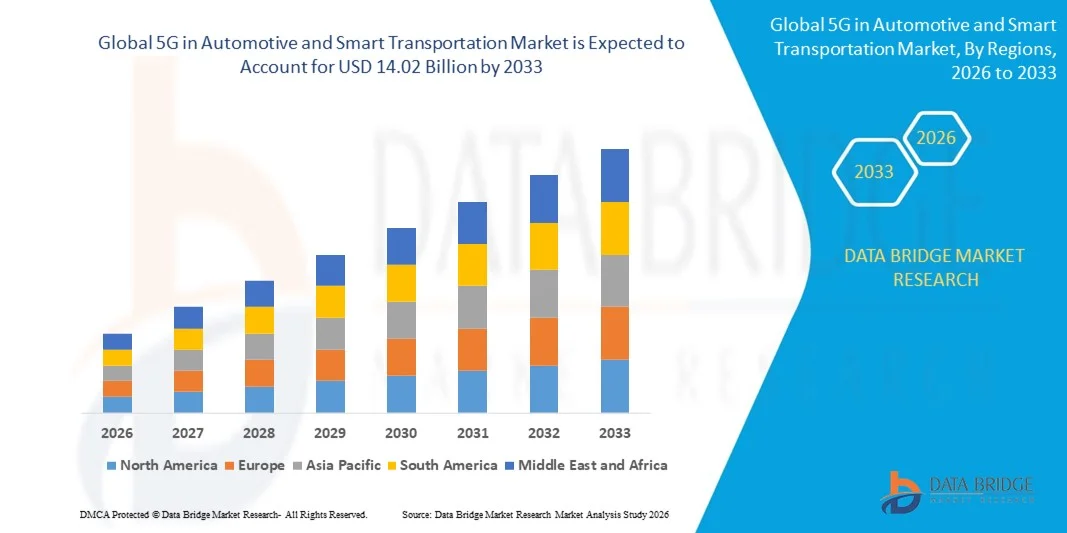
- The global 5G in Automotive and Smart Transportation market size was valued at USD 2.30 billion in 2025 and is expected to reach USD 14.02 billion by 2033, at a CAGR of25.30% during the forecast period
- The increase in demand for electric vehicles and smart vehicles is expected to influence the growth of 5G in automotive and smart transportation market
- Also, the high disposable income and rise in the demand for NextGen technology in automobiles are also anticipated to flourish the growth of the5G in automotive and smart transportation market
What are the Major Takeaways of 5G in Automotive and Smart Transportation Market?
- The rise in the penetration of advanced technologies, such as 5G and IoT in the automotive and transportation sectors are also such asly to positively impact the growth of the market
- Moreover, the increase in spending on R&D and high adoption of communication technology are also expected create a huge demand for 5G in automotive and smart transportation as well as lifting the growth of the 5G in automotive and smart transportation market
- North America dominated the 5G in automotive and smart transportation market with a 41.02% revenue share in 2025, driven by rapid 5G network rollout, strong presence of leading telecom operators, and early adoption of connected and autonomous vehicle technologies across the U.S. and Canada
- Asia-Pacific is projected to register the fastest CAGR of 7.59% from 2026 to 2033, driven by large-scale 5G deployment, strong automotive manufacturing ecosystems, and rising smart city investments across China, Japan, India, South Korea, and Southeast Asia
- The Hardware Components segment dominated the market with a 44.8% share in 2025, driven by high demand for 5G chipsets, antennas, onboard units (OBUs), roadside units (RSUs), and telematics control units integrated into connected vehicles and smart infrastructure
Report Scope and 5G in Automotive and Smart Transportation Market Segmentation
|
Attributes |
5G in Automotive and Smart Transportation Key Market Insights |
|
Segments Covered |
|
|
Countries Covered |
North America
Europe
Asia-Pacific
Middle East and Africa
South America
|
|
Key Market Players |
|
|
Market Opportunities |
|
|
Value Added Data Infosets |
In addition to the insights on market scenarios such as market value, growth rate, segmentation, geographical coverage, and major players, the market reports curated by the Data Bridge Market Research also include in-depth expert analysis, pricing analysis, brand share analysis, consumer survey, demography analysis, supply chain analysis, value chain analysis, raw material/consumables overview, vendor selection criteria, PESTLE Analysis, Porter Analysis, and regulatory framework. |
What is the Key Trend in the 5G in Automotive and Smart Transportation Market?
Increasing Shift Toward Ultra-Low Latency, Edge-Enabled, and Vehicle-to-Everything (V2X) Connectivity
- The 5G in automotive and smart transportation market is witnessing strong adoption of ultra-low latency and high-bandwidth 5G networks designed to support connected vehicles, autonomous driving systems, and real-time traffic management platforms
- Automotive manufacturers and telecom providers are introducing edge-enabled 5G architectures that support Vehicle-to-Vehicle (V2V), Vehicle-to-Infrastructure (V2I), and Vehicle-to-Cloud (V2C) communication for enhanced road safety and operational efficiency
- Growing demand for intelligent transport systems (ITS), smart traffic signals, predictive maintenance, and over-the-air (OTA) vehicle updates is accelerating 5G integration across mobility ecosystems
- For instance, companies such as Qualcomm Technologies Inc., Ericsson, Nokia, and Huawei Technologies Co., Ltd. are expanding 5G automotive chipsets, network infrastructure, and C-V2X solutions to strengthen connected mobility capabilities
- Increasing development of autonomous vehicles, AI-powered traffic analytics, and smart city infrastructure is accelerating deployment of private and public 5G networks
- As transportation systems become more digital and data-driven, 5G will remain critical for enabling real-time communication, enhanced passenger safety, and next-generation smart mobility solutions
What are the Key Drivers of 5G in Automotive and Smart Transportation Market?
- Rising adoption of connected and autonomous vehicles is significantly boosting demand for high-speed, reliable 5G communication networks
- For instance, in 2025, leading companies such as Verizon, AT&T Intellectual Property, and Continental AG expanded their 5G-enabled automotive platforms and edge computing collaborations to support smart transportation deployments
- Growing smart city initiatives across the U.S., Europe, and Asia-Pacific are driving investments in intelligent traffic management and digital road infrastructure
- Advancements in C-V2X technology, network slicing, and mobile edge computing are strengthening performance, scalability, and security of automotive communication systems
- Increasing demand for real-time navigation, remote diagnostics, infotainment streaming, and fleet management solutions is accelerating 5G integration
- Supported by continuous telecom infrastructure expansion and automotive digitization strategies, the 5G in Automotive and Smart Transportation market is expected to witness strong long-term growth
Which Factor is Challenging the Growth of the 5G in Automotive and Smart Transportation Market?
- High infrastructure deployment costs associated with 5G base stations, fiber backhaul networks, and edge data centers limit rapid large-scale implementation
- For instance, during 2024–2025, fluctuations in semiconductor supply chains and rising costs of 5G chipsets and network equipment impacted deployment timelines in several regions
- Complexity in integrating 5G modules with existing vehicle electronic control units (ECUs) and legacy transport infrastructure increases system development challenges
- Cybersecurity risks related to connected vehicles, data privacy concerns, and potential network vulnerabilities slow adoption
- Regulatory fragmentation across regions and spectrum allocation challenges create interoperability and compliance barriers
- To address these issues, companies are focusing on collaborative ecosystem partnerships, secure network architectures, phased infrastructure rollout strategies, and cost-optimized 5G module development to accelerate global adoption of 5G in Automotive and Smart Transportation solutions
How is the 5G in Automotive and Smart Transportation Market Segmented?
The market is segmented on the basis of component, application, and end user.
- By Component
On the basis of component, the 5G in automotive and smart transportation market is segmented into Hardware Components, Software Solutions, and Services. The Hardware Components segment dominated the market with a 44.8% share in 2025, driven by high demand for 5G chipsets, antennas, onboard units (OBUs), roadside units (RSUs), and telematics control units integrated into connected vehicles and smart infrastructure. Automotive OEMs and telecom operators are heavily investing in 5G modems, edge computing devices, and C-V2X communication modules to enable ultra-low latency connectivity. Rapid deployment of 5G base stations and network equipment further strengthens hardware demand across smart mobility ecosystems.
The Software Solutions segment is projected to grow at the fastest CAGR from 2026 to 2033, fueled by rising need for real-time data analytics, network management platforms, cybersecurity frameworks, and AI-driven traffic optimization systems supporting connected and autonomous vehicles.
- By Application
On the basis of application, the market is segmented into Vehicle-to-Everything (V2X), Infotainment and Telematics, and Fleet Management. The Vehicle-to-Everything (V2X) segment dominated the market with a 46.2% share in 2025, supported by increasing deployment of Vehicle-to-Vehicle (V2V), Vehicle-to-Infrastructure (V2I), and Vehicle-to-Cloud (V2C) communication systems. Governments and automotive manufacturers are prioritizing V2X technologies to improve road safety, reduce traffic congestion, and enable autonomous driving capabilities. Growing smart city initiatives and regulatory mandates for connected vehicle safety features further accelerate V2X integration.
The Fleet Management segment is expected to grow at the fastest CAGR from 2026 to 2033, driven by rising adoption of real-time vehicle tracking, predictive maintenance, fuel optimization, and logistics monitoring solutions across commercial transportation networks.
- By End User
On the basis of end user, the 5G in automotive and smart transportation market is segmented into Automotive, Defense, Transportation Infrastructure, Warehousing and Logistics, Public Safety, and Others. The Automotive segment dominated the market with a 52.7% share in 2025, as OEMs increasingly integrate 5G connectivity into passenger cars, EVs, and autonomous vehicle platforms. Rising consumer demand for connected infotainment, OTA updates, advanced driver-assistance systems (ADAS), and real-time navigation significantly strengthens adoption.
The Transportation Infrastructure segment is projected to grow at the fastest CAGR from 2026 to 2033, propelled by expansion of smart highways, intelligent traffic management systems, connected intersections, and digital tolling solutions. Growing government investments in smart mobility and urban digitization programs continue to accelerate adoption across public infrastructure networks.
Which Region Holds the Largest Share of the 5G in Automotive and Smart Transportation Market?
- North America dominated the 5G in automotive and smart transportation market with a 41.02% revenue share in 2025, driven by rapid 5G network rollout, strong presence of leading telecom operators, and early adoption of connected and autonomous vehicle technologies across the U.S. and Canada. Increasing deployment of C-V2X infrastructure, smart traffic management systems, and edge computing platforms continues to fuel regional demand
- Leading companies in North America are investing in private 5G networks, mobile edge computing (MEC), and automotive-grade 5G chipsets to enable ultra-low latency communication for ADAS, autonomous driving, and real-time fleet monitoring. Continuous collaboration between automotive OEMs and telecom providers strengthens the region’s technological leadership
- High R&D spending, strong innovation ecosystems, advanced semiconductor capabilities, and supportive regulatory frameworks further reinforce North America’s dominant market position
U.S. 5G in Automotive and Smart Transportation Market Insight
The U.S. is the largest contributor within North America, supported by aggressive 5G infrastructure expansion and strong investment in smart mobility programs. Major telecom operators and automotive OEMs are collaborating to deploy V2X corridors, connected highways, and AI-powered traffic analytics platforms. Rising production of EVs, autonomous vehicles, and connected commercial fleets significantly increases demand for high-speed, low-latency 5G connectivity solutions across urban and interstate transportation networks.
Canada 5G in Automotive and Smart Transportation Market Insight
Canada contributes steadily to regional growth through expanding 5G coverage and increasing government-backed smart city initiatives. Growing deployment of intelligent traffic systems, connected public transit networks, and remote fleet monitoring solutions supports adoption. Investments in digital infrastructure and cross-border mobility innovation programs further accelerate market penetration.
Asia-Pacific 5G in Automotive and Smart Transportation Market
Asia-Pacific is projected to register the fastest CAGR of 7.59% from 2026 to 2033, driven by large-scale 5G deployment, strong automotive manufacturing ecosystems, and rising smart city investments across China, Japan, India, South Korea, and Southeast Asia. Rapid expansion of EV production and connected vehicle platforms significantly boosts demand for advanced 5G-enabled transportation systems. Increasing digitalization of highways, logistics corridors, and urban transit networks further accelerates growth.
China 5G in Automotive and Smart Transportation Market Insight
China represents the largest contributor within Asia-Pacific due to extensive 5G base station deployment and strong government support for intelligent transportation systems. Rapid adoption of connected vehicles, autonomous driving trials, and smart highway projects drives large-scale integration of 5G-enabled V2X technologies.
Japan 5G in Automotive and Smart Transportation Market Insight
Japan shows steady growth supported by advanced telecom infrastructure and strong automotive OEM presence. Increasing focus on autonomous mobility, robotics, and high-precision traffic management systems strengthens demand for ultra-reliable low-latency communication (URLLC) solutions in transportation networks.
India 5G in Automotive and Smart Transportation Market Insight
India is emerging as a high-growth market driven by expanding 5G rollout, rising EV adoption, and government-led smart mobility initiatives. Development of connected public transport systems and digital tolling infrastructure accelerates 5G integration across transportation ecosystems.
South Korea 5G in Automotive and Smart Transportation Market Insight
South Korea contributes significantly due to advanced 5G penetration, strong semiconductor manufacturing, and rapid innovation in connected vehicle technologies. Deployment of smart highways, AI-driven traffic systems, and high-performance automotive communication modules supports sustained long-term market growth.
Which are the Top Companies in 5G in Automotive and Smart Transportation Market?
The 5G in automotive and smart transportation industry is primarily led by well-established companies, including:
- AUDI AG (Germany)
- BMW Group (Germany)
- Robert Bosch GmbH (Germany)
- Deutsche Telekom AG (Germany)
- Telefonaktiebolaget LM Ericsson (Sweden)
- Huawei Technologies Co., Ltd. (China)
- Daimler AG (Germany)
- Nokia (Finland)
- Qualcomm Technologies Inc. (U.S.)
- Telefonica S.A. (Spain)
- Verizon (U.S.)
- Vodafone Group (U.K.)
- AT&T Intellectual Property (U.S.)
- Ford Motor Company (U.S.)
- Volkswagen (Germany)
- SAMSUNG (South Korea)
- Thales Group (France)
- Continental AG (Germany)
What are the Recent Developments in Global 5G in Automotive and Smart Transportation Market?
- In September 2024, Verizon Business partnered with Vay Technology to deliver scalable 5G connectivity solutions for remotely operated electric vehicles, enabling seamless teleoperation, real-time vehicle data transmission, and enhanced software-defined mobility services across the U.S. market, strengthening the foundation for next-generation smart transportation systems
- In September 2024, Robert Bosch GmbH collaborated with Pirelli to advance intelligent tire technology by integrating sensor-enabled tires with Bosch’s automotive software platforms, enabling real-time tire data monitoring to enhance vehicle stability, safety, and driving performance, thereby accelerating the development of connected and autonomous mobility solutions
- In July 2024, Nokia Corporation completed the acquisition of Infinera to strengthen its optical networking portfolio and expand its presence in the webscale market, strategically reinforcing its 5G ecosystem to support smart transportation infrastructure, autonomous vehicles, and AI-driven digital transformation initiatives
- In April 2024, Qualcomm Incorporated announced the launch of its next-generation 5G automotive platform, the Snapdragon Ride Vision System, combining advanced 5G connectivity, high-performance computing, and computer vision technologies to enable autonomous driving, ADAS functionalities, and immersive in-vehicle infotainment, thereby enhancing innovation in connected automotive ecosystems

- Interactive Data Analysis Dashboard
- Company Analysis Dashboard for high growth potential opportunities
- Research Analyst Access for customization & queries
- Competitor Analysis with Interactive dashboard
- Latest News, Updates & Trend analysis
- Harness the Power of Benchmark Analysis for Comprehensive Competitor Tracking
Global 5g In Automotive And Smart Transportation Market, Supply Chain Analysis and Ecosystem Framework
To support market growth and help clients navigate the impact of geopolitical shifts, DBMR has integrated in-depth supply chain analysis into its Global 5g In Automotive And Smart Transportation Market research reports. This addition empowers clients to respond effectively to global changes affecting their industries. The supply chain analysis section includes detailed insights such as Global 5g In Automotive And Smart Transportation Market consumption and production by country, price trend analysis, the impact of tariffs and geopolitical developments, and import and export trends by country and HSN code. It also highlights major suppliers with data on production capacity and company profiles, as well as key importers and exporters. In addition to research, DBMR offers specialized supply chain consulting services backed by over a decade of experience, providing solutions like supplier discovery, supplier risk assessment, price trend analysis, impact evaluation of inflation and trade route changes, and comprehensive market trend analysis.
Data collection and base year analysis are done using data collection modules with large sample sizes. The stage includes obtaining market information or related data through various sources and strategies. It includes examining and planning all the data acquired from the past in advance. It likewise envelops the examination of information inconsistencies seen across different information sources. The market data is analysed and estimated using market statistical and coherent models. Also, market share analysis and key trend analysis are the major success factors in the market report. To know more, please request an analyst call or drop down your inquiry.
The key research methodology used by DBMR research team is data triangulation which involves data mining, analysis of the impact of data variables on the market and primary (industry expert) validation. Data models include Vendor Positioning Grid, Market Time Line Analysis, Market Overview and Guide, Company Positioning Grid, Patent Analysis, Pricing Analysis, Company Market Share Analysis, Standards of Measurement, Global versus Regional and Vendor Share Analysis. To know more about the research methodology, drop in an inquiry to speak to our industry experts.
Data Bridge Market Research is a leader in advanced formative research. We take pride in servicing our existing and new customers with data and analysis that match and suits their goal. The report can be customized to include price trend analysis of target brands understanding the market for additional countries (ask for the list of countries), clinical trial results data, literature review, refurbished market and product base analysis. Market analysis of target competitors can be analyzed from technology-based analysis to market portfolio strategies. We can add as many competitors that you require data about in the format and data style you are looking for. Our team of analysts can also provide you data in crude raw excel files pivot tables (Fact book) or can assist you in creating presentations from the data sets available in the report.













