


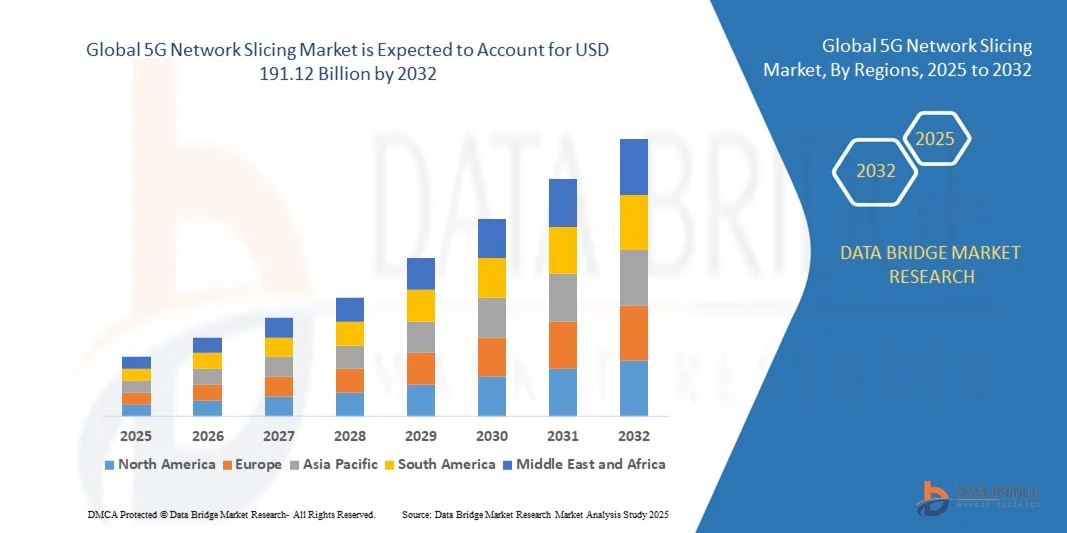
What is the Global 5G Network Slicing Market Size and Growth Rate?
- The global 5G network slicing market size was valued at USD 17.32 billion in 2024 and is expected to reach USD 191.12 billion by 2032, at a CAGR of 35.00% during the forecast period
- Surge in the evolution of cellular network technology which has offered higher data speeds and lower latency, growing need to manage and analyse organizational data effectively and efficiently and high adoption rate for 5G networks and associated technologies especially in the developing economies are the major factors attributable to the growth of the network slicing market
What are the Major Takeaways of 5G Network Slicing Market?
- Rising deployment of technologies and solutions that reduce the operational and production costs and availability of unlicensed and shared spectrum around the globe will emerge as the major market growth driving factor
- Surge in the commercialization of 5G network, growing number of small and medium scale enterprises especially in the developing economies and surge in the awareness about the benefits of 5G network slicing such as high data speed, improved latency, quality, security, and others will further aggravate the growth of the market
- Growing adoption of industrial and enterprise solutions and applications and increased collaboration among system integrators, vendors, and carriers are some other factors bolstering the growth of the market
- North America dominated the 5G network slicing market with the largest revenue share of 36.65% in 2024, driven by rapid deployment of 5G infrastructure, increasing enterprise adoption, and a strong focus on digital transformation across industries
- The Asia-Pacific 5G network slicing market is poised to grow at the fastest CAGR of 8.84% during 2025–2032, driven by rapid urbanization, rising industrial digitalization, and government initiatives supporting 5G adoption in countries such as China, Japan, and India
- The Technologies segment dominated the market with a market revenue share of 62.5% in 2024, driven by the increasing deployment of advanced 5G infrastructure, network virtualization tools, and AI-enabled orchestration platforms
Report Scope and 5G Network Slicing Market Segmentation
|
Attributes |
5G Network Slicing Key Market Insights |
|
Segments Covered |
|
|
Countries Covered |
North America
Europe
Asia-Pacific
Middle East and Africa
South America
|
|
Key Market Players |
|
|
Market Opportunities |
|
|
Value Added Data Infosets |
In addition to the insights on market scenarios such as market value, growth rate, segmentation, geographical coverage, and major players, the market reports curated by the Data Bridge Market Research also include in-depth expert analysis, pricing analysis, brand share analysis, consumer survey, demography analysis, supply chain analysis, value chain analysis, raw material/consumables overview, vendor selection criteria, PESTLE Analysis, Porter Analysis, and regulatory framework. |
What is the Key Trend in the 5G Network Slicing Market?
AI-Driven Automation and Intelligent Network Management
- A major and accelerating trend in the global 5G network slicing market is the integration of artificial intelligence (AI) and machine learning (ML) to optimize network performance, improve traffic management, and enable dynamic resource allocation. This trend is enhancing efficiency, reducing latency, and ensuring reliability across multiple services
- For instance, Ericsson’s AI-enabled slicing platform monitors network conditions in real time and dynamically adjusts slice configurations to meet diverse requirements, improving quality of service for critical applications. Similarly, Nokia’s AirGile solution leverages AI to automate slice orchestration, enhancing operational efficiency
- AI in network slicing enables predictive analytics, anomaly detection, and automated load balancing, ensuring high availability and optimal performance for enterprise, industrial, and consumer applications
- Seamless integration of AI-driven network slices with orchestration platforms allows operators to centrally manage multiple slices, configure QoS, and scale resources dynamically, supporting diverse applications such as IoT, AR/VR, and autonomous systems
- This trend toward intelligent, self-optimizing, and adaptive network slices is reshaping service delivery expectations. Companies such as Huawei and Cisco are deploying AI-enhanced network slicing solutions that automatically adjust bandwidth, latency, and priority based on user and application requirements
- The adoption of AI-enabled 5G Network Slicing is increasing rapidly across telecom operators and enterprises, driven by the demand for network agility, efficiency, and optimized resource utilization
What are the Key Drivers of 5G Network Slicing Market?
- Rising demand for efficient network utilization, ultra-low latency applications, and differentiated services is driving the adoption of 5G Network Slicing across telecom, industrial, and enterprise sectors
- For instance, in March 2024, NTT DOCOMO deployed AI-driven slicing solutions to support autonomous vehicle communications, enabling highly reliable, low-latency connections for connected mobility services
- Growing requirements for private networks, IoT applications, and critical communications (e.g., healthcare, smart factories) are creating high demand for customizable, isolated network slices
- Increasing digital transformation initiatives and cloud-based service adoption are promoting slice deployment for secure, scalable, and flexible connectivity solutions
- The ability to deliver tailored network experiences for enterprises, remote workers, and high-bandwidth users, along with reduced CAPEX through resource optimization, is fueling widespread adoption. Advanced orchestration platforms and user-friendly management interfaces further accelerate deployment
Which Factor is Challenging the Growth of the 5G Network Slicing Market?
- Security and privacy concerns associated with multi-tenant, software-defined networks are a key barrier. Network slices, if misconfigured, can create vulnerabilities for data breaches or service interruptions
- For instance, reports of vulnerabilities in early network slicing implementations have caused some enterprises to delay adoption due to potential cybersecurity risks
- Addressing these concerns requires robust encryption, strict authentication protocols, continuous monitoring, and automated compliance checks. Vendors such as Huawei and Cisco emphasize their advanced security features to reassure clients
- High deployment complexity, integration costs, and the need for skilled personnel can limit adoption, particularly for smaller operators or in emerging markets. While modular solutions reduce complexity, premium offerings still command higher investments
- Overcoming these challenges through enhanced security, standardized frameworks, and cost-effective slicing solutions is essential to sustain market growth and ensure reliable service delivery
How is the 5G Network Slicing Market Segmented?
The market is segmented on the basis of component, application area, and industry vertical.
- By Component
On the basis of component, the 5G network slicing market is segmented into Technologies and Services. The Technologies segment dominated the market with a market revenue share of 62.5% in 2024, driven by the increasing deployment of advanced 5G infrastructure, network virtualization tools, and AI-enabled orchestration platforms. Technologies such as network function virtualization (NFV), software-defined networking (SDN), and AI/ML-driven slicing management are central to the efficient creation and operation of network slices. Enterprises and telecom operators prioritize investments in these technological solutions to ensure scalability, low latency, and enhanced QoS across diverse applications. The Services segment is expected to witness the fastest CAGR of 22.1% from 2025 to 2032, fueled by rising demand for managed network slicing services, consulting, integration, and maintenance. Companies are increasingly outsourcing network slice deployment and management to reduce operational complexity and accelerate time-to-market, particularly for industrial and enterprise clients.
- By Application Area
On the basis of application area, the 5G network slicing market is segmented into Remote Monitoring, Real-Time Surveillance, Supply Chain Management, Asset Management, Real-Time Streaming, Network Monitoring, Network Function Virtualization, and Multimedia. The Network Monitoring segment dominated the market with a market revenue share of 38.7% in 2024, driven by the critical need to ensure network reliability, optimize resource allocation, and maintain QoS across multiple slices. Network operators rely on real-time monitoring tools and AI-driven analytics to prevent congestion, detect anomalies, and guarantee service-level agreements (SLAs). The Real-Time Streaming segment is projected to witness the fastest CAGR of 23.5% from 2025 to 2032, due to the surge in demand for high-bandwidth applications such as AR/VR, cloud gaming, and remote conferencing. Enhanced user experiences, low latency, and dynamic bandwidth allocation are key factors propelling the adoption of network slices for real-time streaming applications.
- By Industry Vertical
On the basis of industry vertical, the 5G network slicing market is segmented into Manufacturing, Automotive, Energy and Utilities, Healthcare, Media and Entertainment, BFSI, Public Safety, Agriculture, and Others. The Automotive segment dominated the market with a market revenue share of 42.1% in 2024, driven by the adoption of autonomous vehicles, connected car platforms, and vehicle-to-everything (V2X) communication. 5G Network Slicing enables dedicated low-latency, high-reliability slices to support autonomous navigation, telematics, and smart traffic management systems. The Healthcare segment is expected to witness the fastest CAGR of 24.3% from 2025 to 2032, fueled by telemedicine, remote surgery, and real-time patient monitoring applications. Hospitals and healthcare providers are increasingly leveraging network slicing to ensure secure, reliable, and private connections for sensitive medical data and latency-sensitive applications.
Which Region Holds the Largest Share of the 5G Network Slicing Market?
- North America dominated the 5G network slicing market with the largest revenue share of 36.65% in 2024, driven by rapid deployment of 5G infrastructure, increasing enterprise adoption, and a strong focus on digital transformation across industries
- Businesses and consumers in the region highly value low-latency, secure, and customizable network slices that enable optimized connectivity for smart factories, IoT applications, and critical enterprise operations
- The widespread adoption is further supported by high technological readiness, strong government initiatives promoting 5G, and an advanced telecom ecosystem, establishing North America as the leading market for 5G Network Slicing solutions
U.S. 5G Network Slicing Market Insight
The U.S. 5G network slicing market captured the largest revenue share of 81% in 2024 within North America, fueled by early adoption of 5G technologies, extensive enterprise connectivity projects, and smart city initiatives. Telecom operators are increasingly deploying customized network slices for enterprise, industrial, and healthcare applications. Government support and public-private partnerships accelerate deployments, while growing awareness of private 5G networks enhances adoption across commercial and industrial sectors. Furthermore, the integration of AI, cloud-native infrastructure, and edge computing solutions contributes to the market’s expansion, making the U.S. a key hub for advanced 5G Network Slicing applications.
Europe 5G Network Slicing Market Insight
The Europe 5G network slicing market is expected to expand at a robust CAGR during the forecast period, driven by stringent regulatory frameworks, increasing digitalization, and growing adoption of Industry 4.0 initiatives. Countries such as Germany, France, and the U.K. are deploying advanced 5G networks to support industrial automation, healthcare, and connected mobility. Rising investments in private 5G networks and government-backed smart city projects further bolster market growth. European enterprises are leveraging network slicing to ensure low-latency communications, enhanced reliability, and better security across multiple industrial and commercial applications, supporting the region’s steady adoption of 5G Network Slicing solutions.
U.K. 5G Network Slicing Market Insight
The U.K. 5G network slicing market is projected to grow at a notable CAGR during the forecast period, driven by rising enterprise demand for dedicated network slices and enhanced connectivity for critical operations. Government initiatives supporting 5G deployment, alongside strong telecom infrastructure, encourage adoption among businesses, especially in manufacturing, finance, and healthcare sectors. The U.K.’s thriving digital economy, coupled with high awareness of private 5G networks and secure connectivity solutions, is expected to accelerate market expansion and adoption of advanced 5G Network Slicing services.
Germany 5G Network Slicing Market Insight
The Germany 5G network slicing market is anticipated to expand at a significant CAGR during the forecast period, fueled by the country’s strong industrial base and focus on digitalization. Growing demand for secure, low-latency communication in smart factories, autonomous transport systems, and industrial IoT applications drives adoption. Germany’s robust telecom ecosystem, emphasis on innovation, and government-backed initiatives for 5G deployment promote the integration of network slicing solutions. Increasing enterprise reliance on private 5G networks ensures a growing market for specialized slicing services, positioning Germany as a key European adopter.
Which Region is the Fastest Growing Region in the 5G Network Slicing Market?
The Asia-Pacific 5G network slicing market is poised to grow at the fastest CAGR of 8.84% during 2025–2032, driven by rapid urbanization, rising industrial digitalization, and government initiatives supporting 5G adoption in countries such as China, Japan, and India. The region’s increasing focus on smart cities, IoT integration, and industrial automation is accelerating network slicing adoption. In addition, APAC is emerging as a manufacturing hub for 5G infrastructure and components, improving affordability and accessibility of network slicing solutions across multiple sectors.
Japan 5G Network Slicing Market Insight
The Japan 5G network slicing market is growing due to the country’s advanced technological infrastructure, high demand for industrial automation, and focus on smart city initiatives. Enterprises are adopting network slicing to enable secure, low-latency communications for industrial IoT, healthcare, and automotive applications. The integration of edge computing and AI-driven slicing solutions further supports growth, ensuring reliable and optimized connectivity for critical operations across sectors.
China 5G Network Slicing Market Insight
The China 5G network slicing market accounted for the largest market revenue share in Asia-Pacific in 2024, driven by rapid urbanization, industrial digitization, and government support for 5G deployments. China is a leading adopter of smart city and smart manufacturing solutions, where network slicing ensures high-performance connectivity, low latency, and efficient resource allocation. The presence of domestic telecom providers and component manufacturers enhances affordability and accessibility, further boosting market growth across residential, commercial, and industrial applications.
Which are the Top Companies in 5G Network Slicing Market?
The 5G network slicing industry is primarily led by well-established companies, including:
- Cisco Systems, Inc. (U.S.)
- Huawei Technologies Co., Ltd. (China)
- Nokia (Finland)
- Telefonaktiebolaget LM Ericsson (Sweden)
- NTT DOCOMO (Japan)
- ZTE Corporation (China)
- SK TELECOM CO., LTD. (South Korea)
- Intel Corporation (U.S.)
- Mavenir (U.S.)
- Affirmed Networks (U.S.)
- ARGELA (Turkey)
- Aria Networks (U.S.)
- BT (U.K.)
- NEC Corporation (Japan)
- Deutsche Telekom AG (Germany)
- Telefónica S.A. (Spain)
- SAMSUNG (South Korea)
- Blue Planet Geomatics (Canada)
- Parallel Wireless (U.S.)
- Tambora Systems Pte. Ltd (Singapore)
What are the Recent Developments in Global 5G Network Slicing Market?
- In February 2024, Ericsson, BT Bunch, and Qualcomm Advances, Inc. successfully demonstrated end-to-end enterprise and consumer 5G network slicing, leveraging Ericsson’s 5G Center and Radio Access Network technology to drive innovation within the U.K., highlighting the growing capabilities of fully integrated 5G solutions
- In August 2023, T-Mobile launched a 5G network slicing beta for engineers, enabling enhanced video calling performance with improved network conditions, consistent uplink and downlink speeds, lower latency, and higher reliability through its 5G SA (Standalone) deployment, showcasing the practical benefits of slicing for next-generation applications
- In June 2023, Nokia announced successful trials of an innovative industrial solution allowing Android smartphone users to purchase and activate network slices on-demand from their operators, available to Android 14 users, enhancing experiences across gaming, streaming, and social media applications, and demonstrating user-centric slicing adoption
- In July 2022, Ericsson collaborated with Telefonica to showcase end-to-end automated network slicing in 5G standalone in Madrid, emphasizing operational efficiency, automation, and improved network management for enterprise applications
- In June 2022, Amdocs and A1 Telekom Austria Group achieved a 5G network slicing proof of concept, validating Amdocs’ ability to manage, deploy, and monetize 5G slices for enterprises and consumers, underlining the potential for on-demand connectivity and next-generation services

- Interactive Data Analysis Dashboard
- Company Analysis Dashboard for high growth potential opportunities
- Research Analyst Access for customization & queries
- Competitor Analysis with Interactive dashboard
- Latest News, Updates & Trend analysis
- Harness the Power of Benchmark Analysis for Comprehensive Competitor Tracking
Data collection and base year analysis are done using data collection modules with large sample sizes. The stage includes obtaining market information or related data through various sources and strategies. It includes examining and planning all the data acquired from the past in advance. It likewise envelops the examination of information inconsistencies seen across different information sources. The market data is analysed and estimated using market statistical and coherent models. Also, market share analysis and key trend analysis are the major success factors in the market report. To know more, please request an analyst call or drop down your inquiry.
The key research methodology used by DBMR research team is data triangulation which involves data mining, analysis of the impact of data variables on the market and primary (industry expert) validation. Data models include Vendor Positioning Grid, Market Time Line Analysis, Market Overview and Guide, Company Positioning Grid, Patent Analysis, Pricing Analysis, Company Market Share Analysis, Standards of Measurement, Global versus Regional and Vendor Share Analysis. To know more about the research methodology, drop in an inquiry to speak to our industry experts.
Data Bridge Market Research is a leader in advanced formative research. We take pride in servicing our existing and new customers with data and analysis that match and suits their goal. The report can be customized to include price trend analysis of target brands understanding the market for additional countries (ask for the list of countries), clinical trial results data, literature review, refurbished market and product base analysis. Market analysis of target competitors can be analyzed from technology-based analysis to market portfolio strategies. We can add as many competitors that you require data about in the format and data style you are looking for. Our team of analysts can also provide you data in crude raw excel files pivot tables (Fact book) or can assist you in creating presentations from the data sets available in the report.













