


What is the A2 Dairy Products Market Size and Overview?
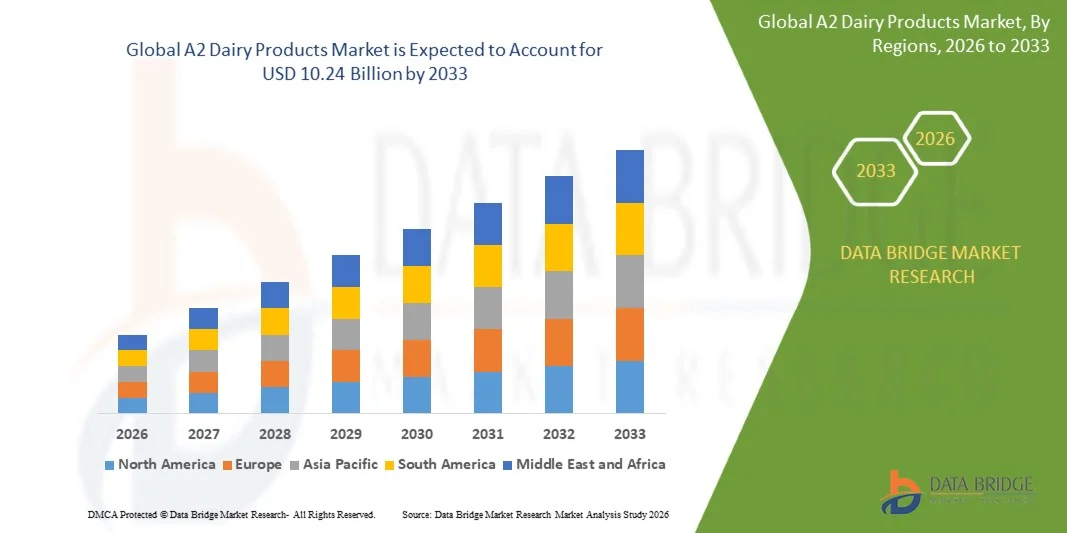
As per Data Bridge Market Research analysis, the A2 dairy products market was valued at USD 4.85 billion in 2025 and is projected to reach USD 10.24 billion by 2033, growing at a CAGR of 9.80% from 2026 to 2033. The market is experiencing consistent growth driven by increasing consumer awareness regarding the potential digestive benefits associated with A2 beta-casein milk, rising demand for premium and functional dairy products, and growing preference for naturally sourced and health-focused food products. The market is expanding due to increasing adoption of A2 milk-based products, including liquid milk, milk powder, yogurt, butter, cheese, and other value-added dairy products across household and commercial applications.
The growing focus on digestive wellness, clean-label nutrition, and personalized dietary choices is encouraging dairy manufacturers to expand their A2 product portfolios. Rising disposable income, increasing demand for organic and specialty dairy products, and advancements in dairy processing and breeding technologies for A2 milk-producing cattle are further supporting market growth. The availability of A2 dairy products through supermarkets, specialty stores, and online retail channels is also contributing to wider consumer accessibility globally.
Market Size & Forecast
- Global Market Value (2025): USD 4.85 Billion
- Expected Market Value (2033): USD 10.24 Billion
- Forecast CAGR (2026–2033): 9.80%
- Leading Region in 2025: Asia Pacific
- Fastest Growing Region: North America
What are the Major Takeaways of A2 Dairy Products Market?
- Asia-Pacific dominated the A2 dairy products market with the largest revenue share of 45.6% in 2025, supported by strong dairy consumption patterns, increasing awareness regarding A2 beta-casein milk, and growing adoption of premium dairy products across India, China, and Australia
- The liquid A2 milk segment led the market with a 55% share in 2025, driven by increasing consumer awareness regarding A2 beta-casein milk, rising preference for premium fresh dairy products, and growing availability through organized retail channels
- North America is expected to be the fastest-growing region with a CAGR of 10.1% during the forecast period, fueled by increasing demand for clean-label dairy products, rising focus on digestive wellness, and growing consumer acceptance of specialty milk products
- A2 milk powder are the fastest-growing product type, projected to register a CAGR of 10.2%, reflecting the surge in demand for shelf-stable dairy products, expanding infant nutrition applications, and rising consumption of powdered milk products in emerging markets
- The liquid segment dominated the form category with a 70% revenue share in 2025, led by high consumer preference for fresh milk products and increasing availability of liquid A2 milk through retail and online distribution channels
- Cartons accounted for 35.40% of the market, preferred by increasing adoption of convenient and sustainable packaging formats for liquid dairy products
- The infant formula segment is the fastest-growing application category, with a CAGR of 12%, driven by increasing demand for premium early-life nutrition products and specialized infant formulas
Report Scope and A2 Dairy Products Market Segmentation
|
Attributes |
A2 Dairy Products Key Market Insights |
|
Segments Covered |
|
|
Countries Covered |
North America
Europe
Asia-Pacific
Middle East and Africa
South America
|
|
Key Market Players |
|
|
Market Opportunities |
|
|
okValue Added Data Infosets |
In addition to the insights on market scenarios such as market value, growth rate, segmentation, geographical coverage, and major players, the market reports curated by the Data Bridge Market Research also include in-depth expert analysis, pricing analysis, brand share analysis, consumer survey, demography analysis, supply chain analysis, value chain analysis, raw material/consumables overview, vendor selection criteria, PESTLE Analysis, Porter Analysis, and regulatory framework. |
What is the Key Trend in the A2 Dairy Products Market?
Trend: Growth in Premium & Functional Dairy Consumption
Consumers are increasingly adopting premium and functional dairy products due to rising awareness of digestive wellness, clean-label nutrition, and specialty food alternatives. A2 dairy products are gaining traction as consumers seek milk options associated with improved digestibility and enhanced nutritional value. Dairy companies are expanding A2 milk-based portfolios, including liquid milk, milk powder, yogurt, cheese, and other value-added products, while retail and e-commerce expansion is improving product accessibility across developed and emerging markets. For instance, in October 2024, the a2 Milk Company expanded its presence in Vietnam by launching six A2 protein dairy products, including a2 Platinum junior milk drink, maternal nutrition products, milk powders, and UHT full-cream milk, targeting the country’s growing demand for premium nutrition products. This market expansion highlights the increasing commercialization of A2 dairy products and the growing adoption of differentiated dairy solutions across emerging markets
Expansion into new international markets with diversified A2 dairy product offerings demonstrates the growing opportunity for A2 dairy brands to capture demand for premium and functional nutrition products globally.
A2 Dairy Products Market Dynamics
Key Market Driver: Rising Consumer Awareness of A2 Beta-Casein Milk Benefits
The increasing focus on digestive health and personalized nutrition is driving demand for A2 dairy products globally. Consumers are becoming more aware of A2 beta-casein milk as a specialty dairy option, encouraging dairy producers to expand A2-certified milk production and introduce innovative products. The growing availability of A2 milk through supermarkets, specialty stores, and online platforms is further supporting market penetration and strengthening consumer acceptance across key regions. For instance, in October 2023, a review article published in Nutrients evaluated A2 milk consumption and its potential health benefits, highlighting consumer interest in A2 beta-casein milk due to reported differences in digestion and gastrointestinal comfort compared with conventional A1/A2 milk. The study reflects increasing scientific attention toward A2 dairy products as functional nutrition solutions.
Growing awareness of A2 beta-casein milk characteristics and increasing demand for digestive-friendly dairy options are key factors accelerating the adoption of A2 dairy products worldwide.
Key Restraint/Challenge: Limited Supply of A2 Milk and Higher Production Costs
A significant challenge in the A2 dairy products market is the limited availability of A2-certified milk compared with conventional milk production. Identifying A2 beta-casein-producing cattle requires specialized genetic testing, breeding programs, and supply chain management, increasing production complexity and operational costs. Higher production expenses often result in premium pricing, which may restrict adoption among price-sensitive consumers and create challenges for large-scale market expansion. For instance, in July 2022, research published in Animals (MDPI) analyzed global research trends on milk containing only A2 beta-casein and highlighted the increasing importance of A2 milk production, genetic selection, and dairy sector development. The study emphasized that identifying and managing A2 beta-casein-producing cattle requires genetic characterization and breeding strategies to support the expansion of A2 milk supply chains.
Supply limitations, specialized breeding requirements, and higher production costs remain key barriers that manufacturers must address to achieve broader commercialization of A2 dairy products.
Key Market Opportunity: Expansion of A2 Dairy Applications in Infant Nutrition and Specialty Products
The growing demand for premium infant nutrition, functional beverages, and specialty dairy products presents significant opportunities for A2 dairy manufacturers. Increasing consumer preference for clean-label and high-quality nutritional products is encouraging the use of A2 milk ingredients in infant formula, dairy beverages, and other value-added applications. Expanding e-commerce platforms and rising premium dairy consumption in emerging markets are further creating opportunities for companies to improve product availability and reach new consumer segments. For instance, in June 2023, the a2 Milk Company received approval for the re-registration of its China-label infant milk formula products under China’s new GB standards, enabling continued supply of its A2 protein-based infant nutrition products in the Chinese market. This development demonstrates the expanding application potential of A2 dairy ingredients beyond conventional milk consumption and the growing demand for premium early-life nutrition solutions.
Increasing applications in infant nutrition, functional foods, and premium dairy categories are expected to create new growth opportunities for A2 dairy products by expanding their role in specialized nutrition markets.
How is the A2 Dairy Products Market Segmented?
The A2 dairy products market is segmented on the basis of product type, form, packaging, application, and distribution channel.
- By Product Type
On the basis of product type, the A2 dairy products market is segmented into liquid A2 milk, A2 milk powder, A2 butter, A2 cheese, A2 yogurt, A2 ghee, A2 ice cream, and other A2 dairy products. The liquid A2 milk segment dominated the market with an estimated share of 55% in 2025, owing to increasing consumer awareness regarding A2 beta-casein milk, rising preference for premium fresh dairy products, and growing availability through organized retail channels. Liquid A2 milk remains the most widely consumed A2 dairy product due to its similarity with conventional milk consumption patterns. Increasing demand for functional dairy beverages and digestive-friendly milk alternatives is supporting segment growth. Dairy companies are expanding fresh A2 milk offerings across supermarkets, specialty stores, and online platforms. Rising consumer interest in clean-label and naturally sourced dairy products is further strengthening adoption. The segment continues to maintain its leading position due to strong consumer familiarity and broader product availability.
The A2 milk powder segment is projected to register the fastest growth at a CAGR of 10.2% during the forecast period, driven by increasing demand for shelf-stable dairy products, expanding infant nutrition applications, and rising consumption of powdered milk products in emerging markets. A2 milk powder provides longer shelf life and easier transportation compared with liquid milk products. Growing adoption of premium infant formula and nutritional dairy formulations is creating new opportunities for manufacturers. Increasing penetration across Asia-Pacific markets is supporting product expansion. Manufacturers are investing in advanced processing technologies to improve product quality and availability. Rising demand for convenient and functional dairy nutrition products is expected to accelerate segment growth.
- By Form
On the basis of form, the A2 dairy products market is segmented into liquid and powder. The Liquid segment dominated the market with an estimated share of 70% in 2025, supported by high consumer preference for fresh milk products and increasing availability of liquid A2 milk through retail and online distribution channels. Liquid A2 milk represents the primary consumption format due to its direct replacement potential for conventional milk. Growing awareness regarding A2 beta-casein milk is encouraging consumers to shift toward premium liquid dairy products. Dairy companies are expanding their liquid product portfolios across supermarkets, convenience stores, and direct-to-consumer platforms. Increasing demand for fresh and minimally processed dairy products is supporting segment growth. The segment continues to benefit from established consumer purchasing habits and widespread availability.
The powder segment is expected to witness the fastest growth at a CAGR of 11% during the forecast period, driven by rising demand for convenient dairy formats, infant nutrition products, and long-life dairy ingredients. Powdered A2 dairy products offer advantages related to storage, transportation, and international distribution. Increasing adoption of powdered milk products in developing economies is supporting market expansion. The segment is benefiting from growing applications in nutritional formulations and food processing industries. Manufacturers are focusing on improving processing efficiency and expanding product accessibility. Rising demand for convenient premium dairy solutions is expected to support strong growth of this segment.
- By Packaging
On the basis of packaging, the A2 dairy products market is segmented into cartons, bottles, plastic bottles & pouches, glass bottles, cans, and others. The cartons segment dominated the packaging category with an estimated share of 35.40% in 2025, supported by increasing adoption of convenient and sustainable packaging formats for liquid dairy products. Cartons are widely used for A2 milk due to their durability, portability, and ability to maintain product quality. Growing demand for packaged premium milk products is encouraging manufacturers to adopt advanced carton packaging solutions. Retail expansion and increasing availability of packaged dairy products are further supporting segment growth. Carton packaging also provides extended shelf-life advantages for certain A2 dairy products. The segment continues to benefit from strong adoption across supermarkets and online grocery platforms.
The plastic bottles & pouches segment is expected to register the fastest growth at a CAGR of 8.10%, driven by consumer preference for lightweight, convenient, and cost-effective packaging solutions. These packaging formats are widely used for ready-to-consume dairy products due to ease of handling and transportation. Growing demand for single-serve and convenient dairy packaging is supporting adoption. Manufacturers are increasingly focusing on flexible packaging solutions to improve distribution efficiency. Expansion of retail and e-commerce channels is further creating demand for practical packaging formats. Increasing focus on packaging innovation is expected to support future growth.
- By Application
On the basis of application, the A2 dairy products market is segmented into infant formula, dairy products, milk-based beverages, and bakery & confectionery. The dairy products segment dominated the application category with an estimated share of 60% in 2025, driven by increasing consumer demand for A2 milk-based products such as milk, yogurt, cheese, butter, and other specialty dairy products. Growing awareness of premium dairy nutrition is encouraging consumers to adopt A2-based alternatives. Manufacturers are expanding product portfolios to include multiple value-added dairy categories. Rising demand for clean-label and functional dairy products is supporting segment expansion. Retail availability and brand development strategies are further improving consumer access. The segment remains dominant due to broad applications and high consumer acceptance.
The infant formula segment is expected to be the fastest-growing application segment at a CAGR of 12% during the forecast period, supported by increasing demand for premium early-life nutrition products and specialized infant formulas. A2 milk ingredients are gaining attention in infant nutrition due to consumer preference for high-quality and easily digestible formulations. Growing premiumization of baby food products is creating opportunities for manufacturers. Expansion of infant nutrition markets in Asia-Pacific is further supporting adoption. Companies are investing in A2-based nutritional formulations to meet evolving consumer preferences. Increasing demand for specialized nutrition products is expected to accelerate segment growth.
- By Distribution Channel
On the basis of distribution channel, the A2 dairy products market is segmented into hypermarkets & supermarkets, convenience stores, specialty stores, online retail, and others. The hypermarkets & supermarkets segment dominated the distribution channel with an estimated share of 40% in 2025, owing to strong consumer preference for purchasing dairy products through established retail networks. These channels provide wider product visibility, availability of multiple brands, and convenient access to premium dairy products. Increasing expansion of organized retail is supporting A2 dairy product penetration. Supermarkets also enable manufacturers to reach a larger consumer base through dedicated dairy sections. Growing demand for branded and packaged dairy products is strengthening this channel. The segment remains dominant due to its accessibility and established purchasing behavior.
The online retail segment is expected to witness the fastest growth at a CAGR of 12.4% during the forecast period, driven by increasing e-commerce penetration, direct-to-consumer dairy brands, and rising consumer preference for convenient purchasing options. Online platforms allow consumers to access specialty dairy products that may not be widely available in physical stores. Increasing digital adoption and improved cold-chain logistics are supporting online dairy sales. Manufacturers are leveraging e-commerce channels to expand market reach. Rising demand for premium and functional food products is further encouraging online purchases. The segment is expected to gain momentum as digital grocery platforms continue expanding globally.
Which Region Holds the Largest Share of the A2 Dairy Products Market?
Asia-Pacific dominated the A2 dairy products market with the largest revenue share of 45.6% in 2025, supported by strong dairy consumption patterns, increasing awareness regarding A2 beta-casein milk, and growing adoption of premium dairy products across India, China, and Australia. The region also benefits from the strong presence of major A2 dairy producers, expanding organized retail networks, and rising adoption of specialty nutrition products across countries such as India, China, Australia, and New Zealand. Growing investments in A2 milk production, cattle breeding programs, and advanced dairy processing technologies are accelerating market development. Increasing demand for infant nutrition products, clean-label dairy solutions, and health-focused food products continues to strengthen Asia-Pacific’s leading position in the global A2 dairy products market.
U.S. A2 Dairy Products Market Insight
The U.S. A2 dairy products market is witnessing steady growth due to increasing consumer demand for premium dairy products, rising awareness regarding digestive wellness, and growing adoption of functional nutrition solutions. The country’s developed dairy industry, strong presence of specialty food retailers, and increasing availability of A2 milk-based products through supermarkets and online platforms are driving market expansion. In addition, growing consumer interest in clean-label and differentiated dairy products is accelerating adoption across household and nutritional applications. The a2 Milk Company has expanded its A2 protein-based milk portfolio in the U.S. market, supporting the growing availability of premium dairy nutrition products for health-conscious consumers.
Europe A2 Dairy Products Market Insight
The Europe A2 dairy products market remains an emerging contributor to global revenue, driven by increasing demand for specialty dairy products, growing consumer focus on digestive health, and rising interest in functional nutrition. The region benefits from established dairy production capabilities, advanced food processing infrastructure, and increasing availability of premium milk products through retail channels. Growing adoption of clean-label dairy solutions and innovation in value-added dairy categories are supporting market development across European countries. Research on A2 beta-casein milk has increased scientific attention toward digestive tolerance and nutritional characteristics, supporting the growing interest in specialty dairy products across European markets.
U.K. A2 Dairy Products Market Insight
The U.K. A2 dairy products market is experiencing gradual growth, supported by increasing demand for premium milk products, rising awareness of functional dairy solutions, and growing consumer preference for high-quality nutritional foods. Expansion of specialty dairy brands and increasing availability through online grocery platforms are contributing to market penetration. Furthermore, increasing interest in differentiated dairy production and clean-label food products is encouraging innovation within the U.K. dairy industry. The availability of A2 protein milk products through international dairy brands and specialty retail channels reflects increasing consumer access to premium dairy nutrition solutions in the U.K. market.
Germany A2 Dairy Products Market Insight
The Germany A2 dairy products market is expanding steadily due to the country’s strong dairy processing industry, high consumer demand for premium food products, and increasing adoption of functional nutrition solutions. Dairy manufacturers and retailers are increasingly focusing on specialty milk products that address evolving consumer preferences toward clean-label and health-oriented foods. Continuous innovation in dairy processing, packaging, and product diversification is further supporting market growth in Germany. Scientific research on A2 beta-casein milk production emphasizes the importance of cattle genetic selection and breeding strategies, supporting the development of reliable A2 milk supply chains in advanced dairy-producing countries.
North America A2 Dairy Products Market Insight
The North America A2 dairy products market is witnessing steady growth due to increasing consumer awareness regarding digestive wellness, rising demand for premium and functional dairy products, and growing preference for clean-label nutritional solutions. The region benefits from a developed dairy industry, strong retail infrastructure, and increasing availability of specialty dairy products through supermarkets, health-focused retailers, and online platforms. Growing interest in alternative dairy solutions and personalized nutrition is encouraging manufacturers to expand A2 milk-based product offerings across liquid milk, milk powder, and infant nutrition categories. The a2 Milk Company has introduced A2 protein-based milk products in the North American market, supporting increasing consumer access to premium dairy nutrition products focused on differentiated milk proteins.
Japan A2 Dairy Products Market Insight
The Japan A2 dairy products market is witnessing consistent growth due to increasing consumer interest in premium dairy nutrition, rising focus on digestive wellness, and growing demand for high-quality specialty dairy products. Food innovation, advanced retail infrastructure, and strong consumer acceptance of functional foods are supporting market development. Moreover, increasing availability of A2 milk products through online and specialty retail channels is improving consumer access. The expansion of premium A2 dairy product portfolios across Asian markets highlights growing consumer acceptance of differentiated dairy solutions in developed economies such as Japan.
China A2 Dairy Products Market Insight
The China A2 dairy products market is growing rapidly, driven by increasing demand for premium infant nutrition products, rising disposable income, and strong consumer preference for high-quality dairy solutions. The country represents one of the largest markets for A2 milk-based infant formula and specialty dairy products due to expanding middle-class consumption and increasing focus on early-life nutrition. In addition, regulatory approvals for A2-based infant formula products and expansion of premium dairy brands are strengthening market growth. The a2 Milk Company has received regulatory approval for its China-label infant formula products, supporting continued availability of A2 protein-based infant nutrition products in the Chinese market.
Which are the Top Companies in A2 Dairy Products Market?
The A2 dairy products industry is primarily led by well-established companies, including:
- The a2 Milk Company Limited (New Zealand)
- Fonterra Co-operative Group Limited (New Zealand)
- Nestlé (Switzerland)
- Danone (France)
- Alexandre Family Farm, LLC (U.S.)
- Groupe Lactalis (France)
- Saputo Inc. (Canada)
- Dairy Farmers of America, Inc. (U.S.)
- Yili Group (China)
- China Mengniu Dairy Company Limited (China)
- Mother Dairy Fruit & Vegetable Pvt. Ltd. (India)
- Amul (India)
- Dodla Dairy Limited (India)
- Parag Milk Foods Limited (India)
- Milma (India)
- Aavin (India)
- HAP (India)
- Origin Milk LLC (U.S.)
- Lewis Road Creamery Limited (New Zealand)
- Bellamy’s Organic (Australia)
What are Latest Developments in A2 Dairy Products Market?
- In October 2024, the a2 Milk Company launched its A2 protein-based dairy products in Vietnam, introducing six products including a2 Platinum junior milk drink, maternal nutrition products, milk powders, and UHT full-cream milk. The launch expanded the company’s presence in Southeast Asia and strengthened its focus on premium dairy nutrition products, reflecting growing demand for specialized dairy solutions in emerging markets
- In September 2023, the a2 Milk Company launched a2 Platinum® Premium Infant Formula in the United States, introducing an infant nutrition product made with fresh a2 Milk as the first ingredient and containing only A2-type protein. The launch expanded the company’s presence in the U.S. infant nutrition market and addressed increasing consumer demand for premium early-life nutrition products
- In April 2023, the a2 Milk Company launched new a2 Milk Grassfed Whole Milk and a2 Milk® Grassfed 2% Reduced Fat Milk products in the U.S. market, combining A2 protein milk with the growing consumer preference for grass-fed dairy products. The launch expanded the company’s premium milk portfolio and targeted increasing demand for natural, high-quality, and differentiated dairy products among U.S. consumers
- In August 2022, the a2 Milk Company launched a new a2 Milk Lactose Free product in Australia, expanding its existing A2 protein-based dairy portfolio to address consumer demand for milk products with improved digestive suitability. The launch combined lactose-free dairy with A2 beta-casein milk, creating a differentiated offering within the functional dairy category and expanding the company’s product range beyond conventional milk products
- In July 2021, the a2 Milk Company launched a2 Milk Half and Half in the United States, introducing a premium dairy product made with a2 Milk and cream. The product launch expanded the company’s U.S. dairy portfolio beyond traditional milk categories and targeted consumers seeking premium dairy options featuring A2 protein

- Interactive Data Analysis Dashboard
- Company Analysis Dashboard for high growth potential opportunities
- Research Analyst Access for customization & queries
- Competitor Analysis with Interactive dashboard
- Latest News, Updates & Trend analysis
- Harness the Power of Benchmark Analysis for Comprehensive Competitor Tracking
Global A2 Dairy Products Market, Supply Chain Analysis and Ecosystem Framework
To support market growth and help clients navigate the impact of geopolitical shifts, DBMR has integrated in-depth supply chain analysis into its Global A2 Dairy Products Market research reports. This addition empowers clients to respond effectively to global changes affecting their industries. The supply chain analysis section includes detailed insights such as Global A2 Dairy Products Market consumption and production by country, price trend analysis, the impact of tariffs and geopolitical developments, and import and export trends by country and HSN code. It also highlights major suppliers with data on production capacity and company profiles, as well as key importers and exporters. In addition to research, DBMR offers specialized supply chain consulting services backed by over a decade of experience, providing solutions like supplier discovery, supplier risk assessment, price trend analysis, impact evaluation of inflation and trade route changes, and comprehensive market trend analysis.
Data collection and base year analysis are done using data collection modules with large sample sizes. The stage includes obtaining market information or related data through various sources and strategies. It includes examining and planning all the data acquired from the past in advance. It likewise envelops the examination of information inconsistencies seen across different information sources. The market data is analysed and estimated using market statistical and coherent models. Also, market share analysis and key trend analysis are the major success factors in the market report. To know more, please request an analyst call or drop down your inquiry.
The key research methodology used by DBMR research team is data triangulation which involves data mining, analysis of the impact of data variables on the market and primary (industry expert) validation. Data models include Vendor Positioning Grid, Market Time Line Analysis, Market Overview and Guide, Company Positioning Grid, Patent Analysis, Pricing Analysis, Company Market Share Analysis, Standards of Measurement, Global versus Regional and Vendor Share Analysis. To know more about the research methodology, drop in an inquiry to speak to our industry experts.
Data Bridge Market Research is a leader in advanced formative research. We take pride in servicing our existing and new customers with data and analysis that match and suits their goal. The report can be customized to include price trend analysis of target brands understanding the market for additional countries (ask for the list of countries), clinical trial results data, literature review, refurbished market and product base analysis. Market analysis of target competitors can be analyzed from technology-based analysis to market portfolio strategies. We can add as many competitors that you require data about in the format and data style you are looking for. Our team of analysts can also provide you data in crude raw excel files pivot tables (Fact book) or can assist you in creating presentations from the data sets available in the report.













