


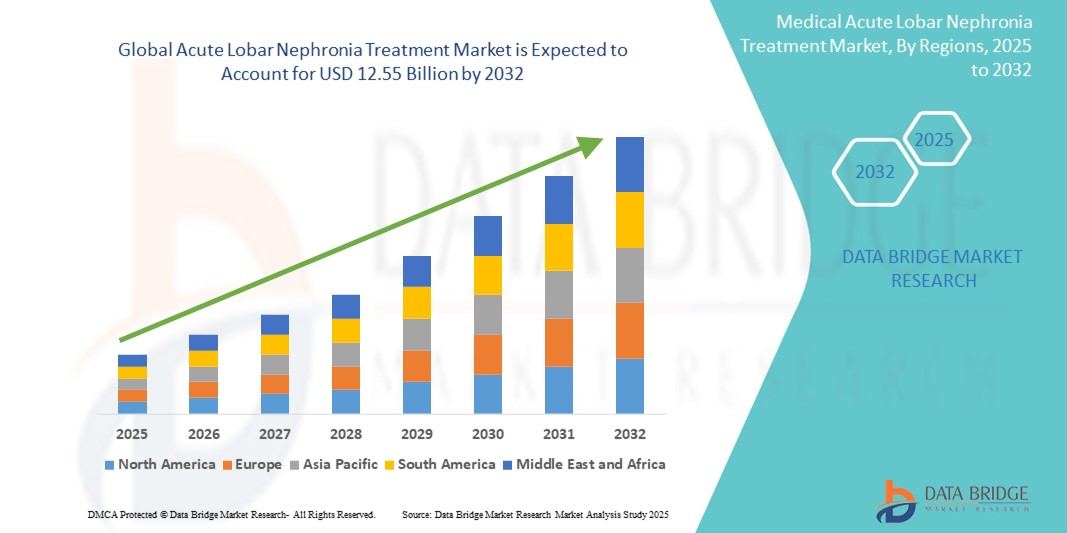
Acute Lobar Nephronia Treatment Market Size
- The global acute lobar nephronia treatment market size was valued at USD 9.53 billion in 2024 and is expected to reach USD 12.55 billion by 2032, at a CAGR of 3.50% during the forecast period
- The market growth is largely fueled by the increasing incidence of complicated urinary tract infections (UTIs), coupled with a growing awareness and improved diagnostic capabilities for early-stage kidney infections such as acute lobar nephronia (ALN). Technological progress in imaging modalities, especially ultrasound and contrast-enhanced CT scans, is aiding faster and more accurate diagnosis, enabling timely treatment initiation
- Furthermore, rising demand for effective, targeted antibiotic regimens and supportive hospital-based therapies is accelerating the uptake of acute lobar nephronia treatment solutions. The shift towards precision medicine, growing availability of broad-spectrum antibiotics, and ongoing clinical advancements in infection management are significantly boosting the industry’s growth
Acute Lobar Nephronia Treatment Market Analysis
- Acute lobar nephronia, a severe focal bacterial infection of the kidney, is increasingly recognized due to advancements in diagnostic imaging and heightened clinical awareness, making it a critical focus area within the broader urinary tract infection treatment landscape
- The growing demand for early, effective antimicrobial therapy, along with the need to prevent disease progression to renal abscesses, is fueling the demand for accurate diagnosis and targeted treatment strategies in both pediatric and adult populations.
- North America dominated the acute lobar nephronia treatment market with the largest revenue share of 42% in 2024, attributed to advanced healthcare infrastructure, early adoption of imaging diagnostics (such as CT and MRI), and a high prevalence of urinary tract infections requiring hospitalization. In particular, the U.S. contributes significantly to this growth, with increased awareness among healthcare providers and expanded access to broad-spectrum intravenous antibiotics
- Asia-Pacific is expected to witness the fastest growing region in the acute lobar nephronia treatment market during the forecast period, with a CAGR of 9.3%, driven by rising rates of UTIs, expanding hospital access in emerging economies, and government efforts to improve infectious disease management
- The parenteral segment dominated the acute lobar nephronia treatment market with a market share of 43.2% in 2024, driven by its critical role in managing moderate to severe infections that require hospitalization. Drugs such as third-generation cephalosporins and beta-lactamase inhibitors are commonly administered intravenously during the acute treatment phase, reinforcing the segment’s dominance due to their rapid efficacy, broad-spectrum activity, and clinical preference for inpatient care
Report Scope and Acute Lobar Nephronia Treatment Market Segmentation
|
Attributes |
Acute Lobar Nephronia Treatment Key Market Insights |
|
Segments Covered |
|
|
Countries Covered |
North America
Europe
Asia-Pacific
Middle East and Africa
South America
|
|
Key Market Players |
|
|
Market Opportunities |
|
|
Value Added Data Infosets |
In addition to the insights on market scenarios such as market value, growth rate, segmentation, geographical coverage, and major players, the market reports curated by the Data Bridge Market Research also include in-depth expert analysis, pricing analysis, brand share analysis, consumer survey, demography analysis, supply chain analysis, value chain analysis, raw material/consumables overview, vendor selection criteria, PESTLE Analysis, Porter Analysis, and regulatory framework. |
Acute Lobar Nephronia Treatment Market Trends
“Advancement Of Precision Diagnostics and The Use of Rapid Imaging Techniques”
- A significant and accelerating trend in the global acute lobar nephronia treatment market is the advancement of precision diagnostics and the use of rapid imaging techniques such as contrast-enhanced CT and ultrasound. These tools enable accurate localization of renal inflammation, which is crucial for timely intervention and prevention of complications such as renal abscess formation or sepsis
- For instance, hospitals and clinics globally are increasingly adopting point-of-care ultrasound (POCUS) to expedite the diagnosis of acute lobar nephronia in emergency settings. The rapid use of imaging at bedside reduces diagnostic delays and supports more efficient triage and antibiotic management protocols
- Pharmacological treatment is seeing steady innovation with the deployment of broad-spectrum intravenous antibiotics, such as third-generation cephalosporins and carbapenems, especially in resistant cases. Empirical therapy is typically refined based on urine and blood culture results, with treatment durations tailored to imaging resolution and patient response
- Pediatric applications are a critical focus, as acute lobar nephronia predominantly affects children. This has led to growing clinical research into optimized dosing protocols, renal-sparing antibiotic therapies, and early detection strategies to prevent chronic kidney damage
- With increasing antimicrobial resistance (AMR), there is a rising demand for molecular-based diagnostic tools such as PCR assays to rapidly identify causative organisms and resistance genes. These technologies allow clinicians to de-escalate antibiotics safely, minimizing unnecessary exposure
- Globally, healthcare systems are also emphasizing early intervention and outpatient care models through enhanced follow-up and remote monitoring strategies. This is especially evident in developed regions, where hospitals are integrating digital health records and imaging data to track patient recovery and avoid rehospitalization
- The demand for targeted, non-invasive, and child-friendly diagnostics and therapeutics is expected to drive further innovation in the acute lobar nephronia treatment market, with a growing emphasis on patient safety, early detection, and resistance-aware antibiotic stewardship
Acute Lobar Nephronia Treatment Market Dynamics
Driver
“Rising Incidence of Urinary Tract Infections (UTIs)”
- The rising incidence of urinary tract infections (UTIs), especially among pediatric and immunocompromised populations, is a significant driver for the increasing demand for effective acute lobar nephronia (ALN) treatment
- For instance, according to a 2024 report from the CDC, complicated UTIs leading to renal parenchymal infections like ALN have shown an upward trend due to delayed diagnosis and antibiotic resistance. This has prompted healthcare providers to adopt aggressive treatment protocols and early imaging diagnostics
- As awareness among clinicians improves regarding the differentiation of ALN from acute pyelonephritis, there is increased reliance on specific antibiotics and anti-inflammatory treatments. This growing diagnostic clarity is expanding the market for targeted therapies
- Furthermore, rising hospitalization rates due to renal infections, especially in children and older adults, are making ALN treatment options a focus for healthcare systems aiming to reduce complications and progression to renal abscess or chronic kidney disease
- The growing preference for early intervention, adoption of imaging-supported diagnosis (like contrast-enhanced CT and ultrasound), and the need for broad-spectrum empirical therapies are key factors propelling the Acute Lobar Nephronia Treatment market
Restraint/Challenge
“Limited Awareness and Diagnostic Challenges in Early Stages”
- Despite growing prevalence, a major barrier to market growth is the limited clinical awareness and underdiagnosis of acute lobar nephronia, particularly in rural and underserved healthcare settings
- For instance, the clinical presentation of ALN often mimics less severe UTIs, leading to delays in accurate diagnosis and appropriate treatment. This can result in prolonged morbidity and increased risk of renal scarring, reducing treatment efficacy
- Access to high-resolution imaging modalities such as contrast-enhanced CT scans and Doppler ultrasound—necessary for proper diagnosis—is limited in many low-income settings, which restricts early detection
- In addition, there is a reliance on empirical antibiotic treatments without confirmatory diagnostics, which not only affects the quality of care but also contributes to antibiotic resistance—a growing concern in nephrology and infectious disease management
- The relatively high treatment cost for hospitalization and parenteral antibiotics can also act as a barrier for economically constrained patients, especially in emerging markets where out-of-pocket expenditure is high
- Overcoming these challenges requires robust clinical training, improved diagnostic infrastructure, early screening protocols, and broader access to evidence-based guidelines for managing ALN, especially in pediatric and vulnerable adult populations
Acute Lobar Nephronia Treatment Market Scope
The market is segmented on the basis of type, drug, drug type, route of administration, population type, end users, and distribution channel.
• By Type
On the basis of type, the acute lobar nephronia treatment market is segmented into single lobe infection and multiple lobe infection. Single lobe infection held the largest revenue share of 61.4% in 2024, driven by its higher incidence and faster diagnosis.
Multiple lobe infection is expected to be the fastest-growing segment, with a CAGR of 18.2% from 2025 to 2032, due to increasing complications and hospitalization rates in late-detected cases.
• By Drug
On the basis of drug, the acute lobar nephronia treatment market is segmented into antibiotics, anti-inflammatory, and analgesics. Antibiotics segment dominated with a 72.6% market share in 2024, being the frontline treatment.
Anti-Inflammatory drugs are anticipated to grow at the fastest CAGR of 14.9% from 2025 to 2032, as supportive therapies gain traction in combination treatments.
• By Drug Type
On the basis of type, the acute lobar nephronia treatment market is segmented into branded and generics. Generics led the market in 2024 with a 65.3% share, attributed to affordability and access.
Branded drugs segment is expected to witness the fastest CAGR from 2025 to 2032, fueled by innovation and hospital-preferred therapies.
• By Route of Administration
On the basis of type, the acute lobar nephronia treatment market is segmented into oral and parenteral. Parenteral accounted for the largest share of 43.2% in 2024, due to the severity of the infection often requiring immediate and high-concentration antibiotic delivery, and the need for reliable absorption, especially in cases where oral intake might be compromised by nausea or vomiting.
Oral administration is expected to grow at the fastest CAGR of 13.5% from 2025 to 2032, supported by step-down therapy and outpatient treatment growth.
• By Population Type
On the basis of type, the acute lobar nephronia treatment market is segmented into children and adults. Children held the major share of 54.1% in 2024, due to higher prevalence and diagnostic sensitivity.
Adults are forecasted to grow at the fastest CAGR of 11.8% from 2025 to 2032, due to rising urinary tract complications in aging populations.
• By End Users
On the basis of type, the acute lobar nephronia treatment market is segmented into hospitals, specialty clinics, and others. Hospitals dominated with 69.5% market share in 2024, driven by acute inpatient care.
Specialty Clinics are projected to expand at the fastest CAGR of 14.2% from 2025 to 2032, owing to increasing outpatient diagnosis and treatment.
• By Distribution Channel
On the basis of type, the acute lobar nephronia treatment market is segmented into hospital pharmacy, retail pharmacy, online pharmacies, and others. Hospital Pharmacy led with a 48.3% share in 2024, tied to hospital-based care.
Online Pharmacies are expected to register the fastest growth, with a CAGR of 19.8% from 2025 to 2032, driven by rising e-health adoption and convenience.
Acute Lobar Nephronia Treatment Market Regional Analysis
- North America dominated the acute lobar nephronia treatment market with the largest revenue share of 42% in 2024, attributed to advanced healthcare infrastructure, early adoption of imaging diagnostics (such as CT and MRI), and a high prevalence of urinary tract infections requiring hospitalization.
- In particular, the U.S. contributes significantly to this growth, with increased awareness among healthcare providers and expanded access to broad-spectrum intravenous antibiotics
- The region benefits from early diagnostic interventions and widespread access to advanced antibiotics and imaging technologies
U.S. Acute Lobar Nephronia Treatment Market Insight
The U.S. acute lobar nephronia treatment market captured the largest revenue share of 60% within North America in 2024, driven by high prevalence of pediatric kidney infections, early use of parenteral antibiotic therapies, and the availability of specialized nephrology care. The integration of advanced imaging (e.g., ultrasound and CT) into emergency protocols and strong reimbursement systems further bolster growth.
Europe Acute Lobar Nephronia Treatment Market Insight
The Europe acute lobar nephronia treatment market is projected to expand at a substantial CAGR throughout the forecast period. Regional growth is supported by universal healthcare systems, adherence to clinical treatment guidelines, and increased hospitalization rates for complicated UTIs. Implementation of early diagnostic tools in primary care settings is further promoting treatment access.
U.K. Acute Lobar Nephronia Treatment Market Insight
The U.K. acute lobar nephronia treatment market is anticipated to grow at a noteworthy CAGR during the forecast period. Increasing public awareness of pediatric and adult renal complications, widespread NHS diagnostic protocols, and improved follow-up care in community health systems are primary contributors. The focus on early detection and national antimicrobial stewardship programs supports the growing demand.
Germany Acute Lobar Nephronia Treatment Market Insight
The Germany acute lobar nephronia treatment market is expected to expand at a considerable CAGR during the forecast period. A robust hospital network, emphasis on rapid diagnostic tools, and increased reliance on broad-spectrum antibiotics are key growth drivers. The country's commitment to clinical innovation and patient safety makes it a leading market in Europe.
Asia-Pacific Acute Lobar Nephronia Treatment Market Insight
The Asia-Pacific acute lobar nephronia treatment market is poised to grow at the fastest CAGR of 9.3% from 2025 to 2032. Urbanization, rising pediatric infection rates, improved access to diagnostic tools, and increasing healthcare investments in countries such as China, Japan, and India are accelerating market growth. Government initiatives to improve hospital infrastructure and infection control are contributing significantly.
Japan Acute Lobar Nephronia Treatment Market Insight
The Japan acute lobar nephronia treatment market accounted for 28.3% of the Asia-Pacific acute lobar nephronia treatment market in 2024. The country’s advanced healthcare ecosystem, growing elderly population (more susceptible to severe UTIs), and emphasis on imaging and intravenous antibiotic administration drive demand. Integration of national diagnostic standards supports consistent case detection.
China Acute Lobar Nephronia Treatment Market Insight
The China acute lobar nephronia treatment market led the Asia-Pacific market with a revenue share of 35.9% in 2024, driven by rapid urbanization, increased government spending on infectious disease management, and the presence of strong local manufacturers. Broad availability of generic antibiotics, rising hospitalization rates, and improvements in rural healthcare access are fueling market expansion.
Acute Lobar Nephronia Treatment Market Share
The acute lobar nephronia treatment industry is primarily led by well-established companies, including:
- Hikma Pharmaceuticals PLC (U.K.)
- Pfizer Inc. (U.S.)
- Bristol-Myers Squibb Company (U.S.)
- Novartis AG (Switzerland)
- Teva Pharmaceutical Industries Ltd (Israel)
- F. Hoffmann-La Roche Ltd (Switzerland)
- Fresenius Kabi AG (Germany)
- Accord Healthcare, Inc. (U.S.)
- GSK plc (U.K.)
- Lilly (U.S.)
- Abbott (U.S.)
- Sanofi (France)
- Bayer AG (Germany)
- Amgen Inc. (U.S.)
Latest Developments in Global Acute Lobar Nephronia Treatment Market
- In January 2024, a multi-center clinical review published in Frontiers in Pediatrics confirmed that intravenous antibiotics, followed by oral therapy for up to three weeks, significantly reduced relapse rates in children diagnosed with acute lobar nephronia. This aligns with the global push toward evidence-based, non-surgical management strategies, further standardizing treatment approaches across hospitals and specialty clinics
- In October 2023, researchers from Beijing Children's Hospital presented findings at the Chinese Pediatric Nephrology Conference showing that delayed diagnosis of acute lobar nephronia often led to unnecessary surgical interventions. Their report advocated for increased training on imaging interpretation and treatment duration standardization—steps expected to enhance clinical outcomes and support market growth
- In August 2023, a study from the U.S. CDC and NIH emphasized the role of rapid diagnostic tools like enhanced CT and renal MRI in distinguishing acute lobar nephronia from renal abscess or tumor. These findings are fueling investment in diagnostic innovation, contributing to early treatment initiation and better patient management outcomes, thereby supporting pharmaceutical sales in this segment
- In May 2023, Cipla Limited announced the development of a targeted antibiotic formulation optimized for pediatric acute kidney infections, including acute lobar nephronia. The formulation, pending regulatory review, aims to reduce nephrotoxicity and shorten hospital stays—demonstrating industry commitment to advancing safe and effective therapies in the global nephrology market

- Interactive Data Analysis Dashboard
- Company Analysis Dashboard for high growth potential opportunities
- Research Analyst Access for customization & queries
- Competitor Analysis with Interactive dashboard
- Latest News, Updates & Trend analysis
- Harness the Power of Benchmark Analysis for Comprehensive Competitor Tracking
Data collection and base year analysis are done using data collection modules with large sample sizes. The stage includes obtaining market information or related data through various sources and strategies. It includes examining and planning all the data acquired from the past in advance. It likewise envelops the examination of information inconsistencies seen across different information sources. The market data is analysed and estimated using market statistical and coherent models. Also, market share analysis and key trend analysis are the major success factors in the market report. To know more, please request an analyst call or drop down your inquiry.
The key research methodology used by DBMR research team is data triangulation which involves data mining, analysis of the impact of data variables on the market and primary (industry expert) validation. Data models include Vendor Positioning Grid, Market Time Line Analysis, Market Overview and Guide, Company Positioning Grid, Patent Analysis, Pricing Analysis, Company Market Share Analysis, Standards of Measurement, Global versus Regional and Vendor Share Analysis. To know more about the research methodology, drop in an inquiry to speak to our industry experts.
Data Bridge Market Research is a leader in advanced formative research. We take pride in servicing our existing and new customers with data and analysis that match and suits their goal. The report can be customized to include price trend analysis of target brands understanding the market for additional countries (ask for the list of countries), clinical trial results data, literature review, refurbished market and product base analysis. Market analysis of target competitors can be analyzed from technology-based analysis to market portfolio strategies. We can add as many competitors that you require data about in the format and data style you are looking for. Our team of analysts can also provide you data in crude raw excel files pivot tables (Fact book) or can assist you in creating presentations from the data sets available in the report.












