


Adaptive Brain Pacemaker Devices Market Size
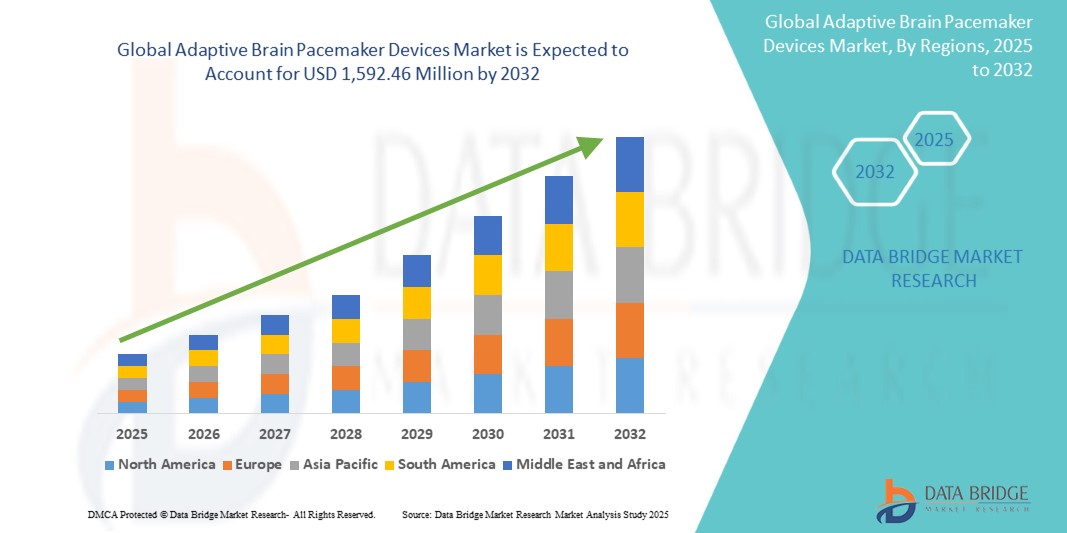
- The global adaptive brain pacemaker devices market size was valued at USD 396.00 million in 2024 and is expected to reach USD 1,592.46 million by 2032, at a CAGR of 19.00% during the forecast period
- The market growth is primarily driven by the rising prevalence of neurological disorders such as Parkinson’s disease, epilepsy, and dystonia, alongside continuous advancements in closed-loop neuromodulation technologies
- In addition, increasing demand for personalized, real-time brain stimulation therapies and favorable clinical outcomes are positioning adaptive brain pacemakers as a next-generation treatment solution. These converging dynamics are accelerating adoption across hospitals and specialized neurology centers, thereby fueling significant industry expansion
Adaptive Brain Pacemaker Devices Market Analysis
- Adaptive brain pacemakers, also known as closed-loop deep brain stimulation (DBS) systems, are increasingly vital in neurology as they provide real-time sensing and personalized stimulation for conditions such as Parkinson’s disease, epilepsy, and dystonia, owing to their precision and improved clinical outcomes
- The accelerating demand for adaptive brain pacemakers is primarily fueled by the rising prevalence of neurological disorders, growing clinical evidence for closed-loop neuromodulation, and continuous innovation in implantable pulse generators, electrodes, and AI-driven sensing algorithms
- North America dominated the adaptive brain pacemaker devices market with the largest revenue share of 51.1% in 2024, characterized by early neuromodulation adoption, favorable reimbursement policies, and the strong presence of leading medical device companies, with the U.S. experiencing substantial growth in DBS procedures supported by advanced R&D and regulatory approvals
- Asia-Pacific is expected to be the fastest growing region in the adaptive brain pacemaker devices market during the forecast period due to increasing awareness of advanced neurology treatments, rising healthcare investments, and expanding access to precision medicine
- Implantable pulse generators (IPGs) segment dominated the adaptive brain pacemaker devices market with a market share of 57.4% in 2024, driven by their essential role in delivering closed-loop stimulation and ongoing advancements in rechargeable, multi-channel, and sensing-enabled IPG systems
Report Scope and Adaptive Brain Pacemaker Devices Market Segmentation
|
Attributes |
Adaptive Brain Pacemaker Devices Key Market Insights |
|
Segments Covered |
|
|
Countries Covered |
North America
Europe
Asia-Pacific
Middle East and Africa
South America
|
|
Key Market Players |
|
|
Market Opportunities |
|
|
Value Added Data Infosets |
In addition to the insights on market scenarios such as market value, growth rate, segmentation, geographical coverage, and major players, the market reports curated by the Data Bridge Market Research also include in-depth expert analysis, pricing analysis, brand share analysis, consumer survey, demography analysis, supply chain analysis, value chain analysis, raw material/consumables overview, vendor selection criteria, PESTLE Analysis, Porter Analysis, and regulatory framework. |
Adaptive Brain Pacemaker Devices Market Trends
Personalized Neuromodulation Through AI and Real-Time Sensing
- A significant and accelerating trend in the global adaptive brain pacemaker devices market is the integration of real-time neural sensing with artificial intelligence (AI) algorithms, enabling dynamic adjustments of stimulation parameters to improve therapeutic precision and patient outcomes
- For instance, Medtronic’s Percept PC neurostimulator features BrainSense technology that records brain signals, allowing physicians to optimize therapy in real-time based on patient-specific neural activity patterns
- AI integration in adaptive brain pacemakers enables features such as predictive modeling of symptom fluctuations, detection of abnormal brain rhythms, and the potential for automated therapy adjustments, leading to more efficient and personalized treatment strategies
- Furthermore, the ability to record, analyze, and transmit brain activity data enhances clinical decision-making, supporting remote patient monitoring and reducing the need for frequent hospital visits
- The seamless integration of adaptive DBS systems with digital health platforms facilitates centralized management of neurological conditions, where physicians can track therapy performance and adjust treatment remotely through connected ecosystems
- This trend towards more intelligent, responsive, and data-driven neuromodulation therapies is reshaping expectations in neurology care. Consequently, companies such as Boston Scientific and Medtronic are investing heavily in AI-enabled closed-loop DBS systems with enhanced sensing and adaptive stimulation capabilities
- The demand for adaptive brain pacemaker devices offering seamless AI-driven personalization and remote connectivity is growing rapidly across both developed and emerging markets, as patients and clinicians increasingly prioritize improved efficacy, convenience, and long-term disease management
Adaptive Brain Pacemaker Devices Market Dynamics
Driver
Growing Need Due to Rising Neurological Disorder Prevalence and Therapy Advancements
- The increasing prevalence of neurological disorders such as Parkinson’s disease, epilepsy, and dystonia, combined with the growing adoption of advanced neuromodulation therapies, is a significant driver for the rising demand for adaptive brain pacemaker devices
- For instance, in May 2024, Medtronic announced updates to its Percept™ RC neurostimulator with enhanced sensing and rechargeable features, further advancing the adoption of adaptive DBS technology worldwide
- As patients and physicians seek more effective treatment options for managing complex neurological symptoms, adaptive brain pacemakers offer advantages such as improved symptom control, fewer side effects, and reduced need for frequent manual adjustments compared to conventional DBS systems
- Furthermore, the growing emphasis on personalized medicine and the rising investment in AI-driven neuromodulation are making adaptive pacemakers a cornerstone of next-generation therapies, offering transformative benefits for patient care
- The convenience of real-time data collection, improved therapy precision, and the ability to tailor stimulation to individual neural activity patterns are key factors propelling adoption across hospitals and neurology centers globally. The increasing number of clinical trials and favorable regulatory pathways are further contributing to market growth
Restraint/Challenge
High Costs and Regulatory Compliance Hurdle
- Concerns surrounding the high cost of adaptive brain pacemaker devices and the complex regulatory requirements associated with implantable neuromodulation systems pose significant challenges to broader market penetration
- For instance, the average cost of an adaptive DBS procedure remains substantially higher than that of conventional DBS, limiting accessibility in price-sensitive markets and straining reimbursement frameworks
- Addressing these challenges through improved reimbursement policies, government support programs, and cost-reduction strategies will be crucial to ensure equitable access to these advanced therapies across diverse healthcare settings
- In addition, the stringent regulatory approval processes required for adaptive devices, including clinical validation of AI algorithms and long-term safety monitoring, can delay market entry and increase development costs for manufacturers
- While innovations in device miniaturization, battery efficiency, and cloud integration continue to advance, the perceived premium pricing and complex approval landscape may still hinder widespread adoption, especially in emerging economies
- Overcoming these challenges through collaborative regulatory pathways, cost-effective innovation, and expanded clinical evidence will be vital for sustained global market growth
Adaptive Brain Pacemaker Devices Market Scope
The market is segmented on the basis of product type, channel, indication, and end user.
- By Product Type
On the basis of product type, the adaptive brain pacemaker devices market is segmented into implantable pulse generators (IPGs), leads & electrodes, extensions, chargers & accessories, and software / algorithms & sensing modules. Implantable Pulse Generators (IPGs) segment dominated the market with the largest revenue share of 57.4% in 2024, driven by their essential role as the “core” component of adaptive deep brain stimulation systems. IPGs provide the stimulation pulses and integrate sensing technology, making them indispensable for closed-loop neuromodulation. Continuous improvements in rechargeable batteries, miniaturization, and multi-channel configurations have further reinforced their leadership. Growing adoption across Parkinson’s disease and epilepsy treatments, supported by strong regulatory approvals, is fueling demand. Hospitals and neurology centers particularly prefer advanced IPGs due to their ability to capture brain signals in real time, enabling personalized therapies and improved clinical outcomes.
Software / Algorithms & Sensing Modules segment is anticipated to witness the fastest growth rate from 2025 to 2032, fueled by the increasing importance of real-time data processing and AI-enabled personalization in adaptive neuromodulation. These modules are essential in interpreting brain signals and automatically adjusting stimulation parameters, thus enhancing therapy precision. The rise of cloud connectivity and remote monitoring is also accelerating demand for advanced sensing algorithms. As companies invest in digital health integration and machine learning-driven decision support, this subsegment is expected to expand rapidly. Growing physician acceptance of data-driven treatment insights and patient preference for reduced hospital visits further contribute to its momentum.
- By Channel
On the basis of channel, the adaptive brain pacemaker devices market is segmented into single-channel systems and dual-channel (multi-channel) systems. Dual-channel (Multi-channel) Systems dominated the market with the largest revenue share in 2024, owing to their capability to provide bilateral stimulation required for managing symptoms of conditions such as Parkinson’s disease. These systems offer enhanced precision and flexibility compared to single-channel models, making them the preferred choice for complex neurological disorders. Hospitals and clinicians value the ability of dual-channel devices to address both hemispheres of the brain simultaneously, leading to improved symptom control and patient satisfaction. Increasing clinical evidence of better outcomes with bilateral stimulation has reinforced their widespread adoption in neurology practices globally.
Single-channel Systems are expected to witness the fastest growth from 2025 to 2032, supported by their cost-effectiveness and suitability for patients with localized or early-stage neurological disorders. These systems are particularly attractive in emerging markets where affordability is a key concern. Their simpler implantation procedures and reduced risk profile make them appealing to both patients and physicians. With ongoing technological improvements, single-channel devices are becoming more advanced while remaining affordable, positioning them as a growth driver in regions with expanding healthcare infrastructure.
- By Indication
On the basis of indication, the adaptive brain pacemaker devices market is segmented into Parkinson’s disease, essential tremor, epilepsy, dystonia, obsessive-compulsive disorder (OCD) / depression, pain management, and other neurological disorders. Parkinson’s Disease dominated the market with the largest revenue share in 2024, accounting for nearly two-thirds of all adaptive brain pacemaker implantations. The dominance is attributed to the high global prevalence of Parkinson’s and the strong clinical validation of DBS therapy in reducing motor fluctuations and improving quality of life. Adaptive pacemakers with real-time sensing are particularly effective in managing symptom variability, which makes them the gold standard therapy in advanced cases. Reimbursement support and extensive physician familiarity with DBS in Parkinson’s care further reinforce this segment’s leadership.
Epilepsy is expected to witness the fastest growth during the forecast period during forecast period, driven by the rising number of patients resistant to drug therapy and the growing recognition of adaptive neuromodulation as a viable treatment alternative. Adaptive pacemakers can detect abnormal brain rhythms and deliver stimulation to prevent seizures, significantly improving patient outcomes. Increasing clinical trials and regulatory approvals for epilepsy-targeted adaptive DBS devices are fueling adoption. Furthermore, growing awareness among neurologists and patient advocacy groups is creating momentum for epilepsy-focused DBS, positioning it as the fastest-growing indication.
- By End User
On the basis of end user, the adaptive brain pacemaker devices market is segmented into hospitals & neurology centers, ambulatory surgical centers (ASCs), specialized neurology / movement-disorder clinics, and home-based monitoring & remote follow-up. Hospitals & Neurology Centers dominated the market with the largest revenue share in 2024, reflecting their central role in performing complex neurosurgical implantations and managing advanced neurological conditions. These centers are equipped with the infrastructure, neurosurgeons, and specialists required for adaptive DBS procedures. Patients rely heavily on hospital-based care for post-surgical monitoring, device programming, and therapy optimization. The presence of multidisciplinary teams and access to cutting-edge technologies further strengthens hospitals’ dominance as the primary end user.
Home-based Monitoring & Remote Follow-up segment is anticipated to witness the fastest growth from 2025 to 2032, driven by the increasing adoption of digital health technologies and the rising need for continuous patient management outside hospital settings. Cloud connectivity, wearable integrations, and AI-driven platforms are enabling physicians to track brain activity remotely and adjust therapy settings virtually. This reduces hospital visits, improves convenience for patients, and enhances therapy adherence. As healthcare systems prioritize cost-efficiency and patient-centric care, home-based monitoring is becoming a critical growth avenue for adaptive brain pacemaker adoption.
Adaptive Brain Pacemaker Devices Market Regional Analysis
- North America dominated the adaptive brain pacemaker devices market with the largest revenue share of 51.1% in 2024, characterized by early neuromodulation adoption, favorable reimbursement policies, and the strong presence of leading medical device companies, with the U.S. experiencing substantial growth in DBS procedures supported by advanced R&D and regulatory approvals
- Patients and clinicians in the region highly value the precision, real-time sensing, and improved therapeutic outcomes offered by adaptive brain pacemakers compared to conventional deep brain stimulation systems
- This widespread adoption is further supported by strong reimbursement frameworks, a technologically advanced healthcare ecosystem, and continuous R&D investments from leading medical device manufacturers
U.S. Adaptive Brain Pacemaker Devices Market Insight
The U.S. adaptive brain pacemaker devices market captured the largest revenue share of 83% in North America in 2024, fueled by the swift adoption of advanced neuromodulation technologies and the growing prevalence of neurological disorders such as Parkinson’s disease and epilepsy. Patients and clinicians are increasingly prioritizing intelligent, closed-loop brain pacemakers for their ability to optimize stimulation in real time. Strong demand for AI-driven programming, remote monitoring, and mobile health integration further accelerates adoption. Moreover, the U.S. benefits from favorable reimbursement policies, high healthcare expenditure, and the strong presence of MedTech leaders, all of which significantly contribute to market expansion.
Europe Adaptive Brain Pacemaker Devices Market Insight
The Europe adaptive brain pacemaker devices market is projected to expand at a substantial CAGR throughout the forecast period, primarily driven by stringent clinical guidelines, an aging population, and the rising demand for advanced treatment options in neurological care. The region is experiencing accelerated adoption in both public and private healthcare systems, with hospitals and neurology centers prioritizing next-generation neuromodulation solutions. European consumers and healthcare providers are drawn to the therapeutic benefits and cost-effectiveness of adaptive pacemakers, particularly in chronic conditions such as Parkinson’s and dystonia. Increasing investment in digital health and cross-border research initiatives is also boosting growth.
U.K. Adaptive Brain Pacemaker Devices Market Insight
The U.K. adaptive brain pacemaker devices market is anticipated to grow at a noteworthy CAGR during the forecast period, driven by the increasing prevalence of movement disorders and a strong emphasis on digital healthcare innovation. Heightened awareness of early diagnosis, combined with government support for advanced neurology treatment, is fostering adoption. The U.K.’s strong clinical trial ecosystem and partnerships between the NHS and MedTech innovators further promote market penetration. Rising demand for home-based remote follow-up and keyless device adjustments is also expected to support market growth in the coming years.
Germany Adaptive Brain Pacemaker Devices Market Insight
The Germany adaptive brain pacemaker devices market is expected to expand at a considerable CAGR during the forecast period, fueled by the country’s advanced healthcare infrastructure and emphasis on cutting-edge neurological therapies. Germany’s strong research base and collaboration between universities, hospitals, and MedTech firms are fostering innovation in adaptive stimulation and sensing technologies. Consumer and patient preferences lean toward highly secure, clinically validated solutions with strong data privacy protections. Moreover, Germany’s focus on integrating AI and digital health tools into neurology care is expected to accelerate adoption of adaptive pacemaker systems.
Asia-Pacific Adaptive Brain Pacemaker Devices Market Insight
The Asia-Pacific adaptive brain pacemaker devices market is poised to grow at the fastest CAGR of 25% during the forecast period of 2025 to 2032, driven by increasing urbanization, rising healthcare investment, and expanding access to advanced neurology care in countries such as China, Japan, and India. Government initiatives promoting digital health, coupled with a rising burden of neurological disorders, are driving adoption of adaptive neuromodulation devices. As APAC emerges as both a high-demand healthcare region and a manufacturing hub for medical devices, affordability and accessibility are expected to expand, accelerating uptake among hospitals and specialized neurology centers.
Japan Adaptive Brain Pacemaker Devices Market Insight
The Japan adaptive brain pacemaker devices market is gaining momentum due to the country’s high-tech medical culture, aging population, and strong demand for precision-driven neurological therapies. Japan places a significant emphasis on safety and innovation, fueling adoption of adaptive pacemakers that integrate with other digital health tools such as wearable monitoring devices and AI-based diagnostic platforms. The integration of brain pacemakers into smart hospital ecosystems is further driving growth. Moreover, Japan’s leadership in robotics and minimally invasive technologies positions it as a key market for next-generation brain modulation systems.
India Adaptive Brain Pacemaker Devices Market Insight
The India adaptive brain pacemaker devices market accounted for the largest revenue share in Asia-Pacific in 2024, attributed to the country’s growing middle-class population, increased healthcare expenditure, and rapid adoption of advanced MedTech solutions. India is witnessing a surge in neurological cases, making adaptive pacemakers increasingly relevant in both private and public healthcare institutions. The government’s push toward digital health initiatives and smart hospitals, along with the presence of cost-effective domestic device manufacturers, is driving adoption. Strong demand from urban hospitals and specialized neurology clinics, combined with affordability improvements, is further fueling market growth.
Adaptive Brain Pacemaker Devices Market Share
The adaptive brain pacemaker devices industry is primarily led by well-established companies, including:
- NeuroPace, Inc. (U.S.)
- Medtronic (Ireland)
- Boston Scientific Corporation (U.S.)
- Abbott (U.S.)
- Renishaw plc (U.K.)
- SceneRay Co., Ltd. (China)
- ALEVA NEUROTHERAPEUTICS (Switzerland)
- Newronika S.p.A. (Italy)
- Beijing Pinchi Medical Equipment Co., Ltd. (China)
- LivaNova PLC (U.K.)
- Alpha Omega (Israel)
- Blackrock Neurotech (U.S.)
- NEVRO CORP. (U.S.)
- Soterix Medical (U.S.)
- Cala Health, Inc. (U.S.)
- Bioness Medical, Inc. (U.S.)
- Synapse Biomedical Inc. (U.S.)
- Saluda Medical Pty Ltd (Australia)
- Infusyn Therapeutics (U.S.)
What are the Recent Developments in Adaptive Brain Pacemaker Devices Market?
- In February 2025, Medtronic announced that it earned U.S. FDA approval for BrainSense Adaptive DBS, describing it as the first approved adaptive (closed-loop) DBS feature that personalizes stimulation in real time for people with Parkinson’s disease a milestone Medtronic says enables automated therapy adjustments based on patients’ brain activity and paves the way for broader commercial rollout of adaptive DBS
- In January 2024, Medtronic announced U.S. FDA approval of the Percept RC rechargeable neurostimulator with BrainSense technology, adding a rechargeable device to the Percept family that captures brain signals and supports sensing-enabled therapy and advanced programming
- In December 2023, NeuroPace announced the early completion of patient enrollment in its NAUTILUS pivotal study (evaluating responsive neurostimulation for idiopathic generalized epilepsy), marking a key clinical milestone toward potential regulatory filings and expanded indications for responsive (adaptive) neurostimulation
- In October 2023, NeuroPace disclosed a set of RNS® System enhancements designed to streamline clinical care including upgrades to clinician software (nSight), simplified programming transfers, and an FDA-cleared remote monitoring tablet intended to improve data review, programming efficiency, and remote patient management
- In January 2021, Medtronic launched the ADAPT-PD global adaptive DBS clinical trial (ADAPT-PD), a first-of-its-kind study to evaluate safety and efficacy of automated, brain-signal-responsive DBS in Parkinson’s disease patients a foundational program that later supported adaptive DBS regulatory submissions and clinical evidence generation

- Interactive Data Analysis Dashboard
- Company Analysis Dashboard for high growth potential opportunities
- Research Analyst Access for customization & queries
- Competitor Analysis with Interactive dashboard
- Latest News, Updates & Trend analysis
- Harness the Power of Benchmark Analysis for Comprehensive Competitor Tracking
Data collection and base year analysis are done using data collection modules with large sample sizes. The stage includes obtaining market information or related data through various sources and strategies. It includes examining and planning all the data acquired from the past in advance. It likewise envelops the examination of information inconsistencies seen across different information sources. The market data is analysed and estimated using market statistical and coherent models. Also, market share analysis and key trend analysis are the major success factors in the market report. To know more, please request an analyst call or drop down your inquiry.
The key research methodology used by DBMR research team is data triangulation which involves data mining, analysis of the impact of data variables on the market and primary (industry expert) validation. Data models include Vendor Positioning Grid, Market Time Line Analysis, Market Overview and Guide, Company Positioning Grid, Patent Analysis, Pricing Analysis, Company Market Share Analysis, Standards of Measurement, Global versus Regional and Vendor Share Analysis. To know more about the research methodology, drop in an inquiry to speak to our industry experts.
Data Bridge Market Research is a leader in advanced formative research. We take pride in servicing our existing and new customers with data and analysis that match and suits their goal. The report can be customized to include price trend analysis of target brands understanding the market for additional countries (ask for the list of countries), clinical trial results data, literature review, refurbished market and product base analysis. Market analysis of target competitors can be analyzed from technology-based analysis to market portfolio strategies. We can add as many competitors that you require data about in the format and data style you are looking for. Our team of analysts can also provide you data in crude raw excel files pivot tables (Fact book) or can assist you in creating presentations from the data sets available in the report.













