What is the Agar Containing Seaweed Market Size and Growth Rate?
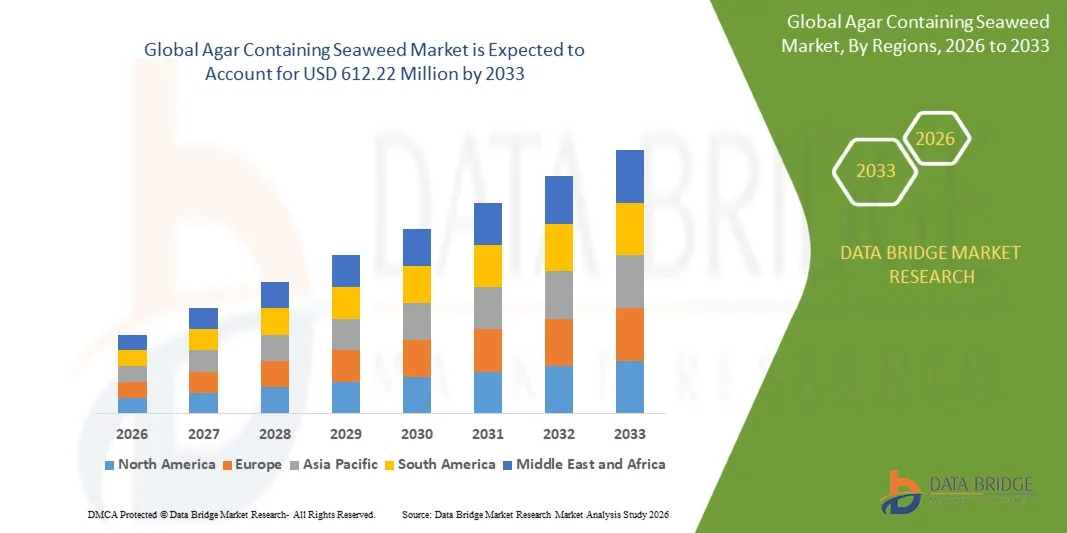
- As per Data Bridge Market Research analysis, the agar containing seaweed market was valued at USD 265.66 million in 2025 and is projected to reach USD 612.22 million by 2033, growing at a CAGR of 11.00% from 2026 to 2033.
- The market is experiencing consistent growth driven by rising demand for agar as a natural hydrocolloid, increasing consumption of seaweed-based products, and expanding applications across food and beverages, dietary supplements, agriculture, animal feed, and other industrial sectors.
- The increasing consumer preference for natural ingredients, combined with growing production of commercial seaweed and technological developments in seaweed cultivation and processing, is encouraging manufacturers to expand agar-containing seaweed applications. The rising use of agar in food products, dietary supplements, fertilizers, and animal feed is further supporting market expansion.
Market Size & Forecast
- Global Market Value (2025): USD 265.66 Million
- Expected Market Value (2033): USD 612.22 Million
- Forecast CAGR (2026–2033): 11.00%
- Leading Region in 2025: North America
- Fastest Growing Region: Asia Pacific
What are the Major Takeaways of the Agar Containing Seaweed Market?
- North America dominated the agar containing seaweed market with the largest revenue share of 34.2% in 2025, supported by advanced pharmaceutical and biotechnology infrastructure, strong research institutions, rising food-industry applications, and increased awareness of the functional properties of seaweed.
- Asia-Pacific is expected to be the fastest-growing region at a CAGR of 11.2% from 2026 to 2033, fueled by increased consumption and production of commercial seaweed and expanding aquaculture activities across China, India, Japan, and Southeast Asia.
- The red seaweed segment led the market with a 47.0% share in 2025, driven by its position as the primary source of agar and other commercially valuable hydrocolloids.
- Brown seaweed are the fastest-growing type, projected to register a CAGR of 9.5%, reflecting the surge in utilization of brown algae in food, agriculture, nutraceutical, and industrial applications.
- The wild harvesting segment dominated the method of application category with a 80.4% revenue share in 2025, led by the long-established collection of naturally occurring seaweed for agar production
- Food accounted for 58.0% of the market share in 2025, preferred by widespread utilization of agar as a gelling agent, thickener, stabilizer, and texture modifier
- The liquid segment is the fastest-growing form category, with a CAGR of 10.1%, driven by increasing demand for easily dispersible seaweed extracts and liquid formulations.
Report Scope and Agar Containing Seaweed Market Segmentation
|
Attributes |
Agar Containing Seaweed Key Market Insights |
|
Segments Covered |
|
|
Countries Covered |
North America
Europe
Asia-Pacific
Middle East and Africa
South America
|
|
Key Market Players |
|
|
Market Opportunities |
|
|
Value Added Data Infosets |
In addition to the insights on market scenarios such as market value, growth rate, segmentation, geographical coverage, and major players, the market reports curated by the Data Bridge Market Research also include in-depth expert analysis, pricing analysis, brand share analysis, consumer survey, demography analysis, supply chain analysis, value chain analysis, raw material/consumables overview, vendor selection criteria, PESTLE Analysis, Porter Analysis, and regulatory framework. |
What is the Key Trend in the Agar Containing Seaweed Market?
- Growing demand for plant-based, clean-label, and vegan ingredients is increasing the use of agar-containing seaweed as a natural gelling, thickening, and stabilizing ingredient across food and beverage formulations.
- For instance, in April 2025, Marine Biologics launched its “Super Crude” seaweed-derived ingredient, designed for emulsification and texture applications in functional foods, demonstrating the growing use of seaweed-derived ingredients beyond traditional applications.
- The shift toward animal-free formulations is particularly supporting agar adoption in confectionery, dairy alternatives, desserts, bakery products, and specialty foods where manufacturers seek alternatives to animal-derived gelatin.
- Agar-containing seaweed is also gaining traction in functional and wellness products, as manufacturers increasingly combine seaweed-derived ingredients with nutritional, digestive-health, and low-calorie positioning in consumer products.
- Expanding seaweed cultivation and improved processing technologies are supporting greater availability of agar-producing species, particularly Gracilaria, while reducing dependence on inconsistent wild-harvested raw-material supplies.
- For instance, in September 2025, BioMara’s Seafibrex seaweed-based powder won the European heat of the Global Food Tech Awards 2025, highlighting growing industry interest in seaweed ingredients for texture, nutrition, and sustainable food formulations
- As food manufacturers increasingly prioritize natural texturizers, vegan formulations, and functional ingredients, agar-containing seaweed is expected to gain broader adoption across food, nutraceutical, pharmaceutical, and biotechnology applications globally.
What are the Key Drivers of the Agar Containing Seaweed Market?
- The increasing adoption of plant-based and vegetarian food products is significantly driving demand for agar-containing seaweed as a natural, animal-free alternative to gelatin and synthetic texturizing ingredients.
- For instance, in January 2024, India’s Ministry of Fisheries, Animal Husbandry & Dairying held the first National Conference on Promotion of Seaweed Cultivation and highlighted nationwide expansion of seaweed farming, including the Kori Creek pilot project in Gujarat.
- Food manufacturers are incorporating agar into desserts, confectionery, dairy alternatives, sauces, and other processed foods because of its gelling, stabilizing, and thickening properties, supporting wider commercial consumption of agar-containing seaweed.
- Expanding seaweed cultivation is strengthening raw-material availability, particularly across Asia-Pacific, where government programs and aquaculture investments are supporting commercial production of agar-producing species and improving supply-chain infrastructure.
- For instance, in November 2025, ICAR-CMFRI reported the first-ever seaweed harvest from a farming project in Puducherry, recording 3.5-fold growth and demonstrating the potential for expanding commercial seaweed cultivation.
- The growing utilization of seaweed-derived ingredients in food, pharmaceuticals, nutraceuticals, cosmetics, agriculture, and animal feed is diversifying end-use applications and creating additional demand for agar-containing seaweed products.
What Factors are Challenging the Growth of the Agar Containing Seaweed Market?
- Dependence on consistent seaweed raw-material supply remains a major challenge because agar production relies heavily on specific red seaweed species whose availability can fluctuate due to environmental and cultivation conditions.
- For instance, in June 2024, the Philippine News Agency reported that rising seawater temperatures triggered ice-ice disease across seaweed farms in Northern Samar, causing widespread crop losses and forcing several farmers to stop harvesting; the province had 115 hectares of seaweed farms involving 657 farmers.
- Climate change is increasing risks for seaweed cultivation through rising ocean temperatures, changing seasonal conditions, marine heatwaves, storms, and disease, potentially reducing biomass yields and affecting agar production consistency.
- The concentration of global seaweed production in Asia also exposes agar-containing seaweed supply chains to disruptions involving harvesting conditions, processing capacity, trade flows, transportation, and changes in regional production.
- For instance, in October 2024, India’s Ministry of Fisheries, Animal Husbandry & Dairying reported that seaweed enterprises were facing insufficient availability and quality degradation of seed material, particularly for Kappaphycus, prompting the government to introduce guidelines for importing high-quality live seaweed seed stock.
- Limited processing infrastructure and inconsistent access to advanced cultivation technologies can constrain productivity in emerging seaweed-producing regions, making it difficult for producers to achieve consistent quality and commercial-scale output.
How is the Agar Containing Seaweed Market Segmented?
The agar containing seaweed market is segmented on the basis of type, method of harvesting, application, and form.
- By Type
On the basis of type, the agar containing seaweed market is segmented into red seaweed, brown seaweed, green seaweed, and others. The red seaweed segment dominated the market with 47.0% share in 2025, owing to its position as the primary source of agar and other commercially valuable hydrocolloids. Red seaweed is extensively used across food, pharmaceutical, biotechnology, and nutraceutical applications. Species such as Gelidium and Gracilaria are particularly important for commercial agar extraction. Established cultivation and processing infrastructure across major seaweed-producing regions further supports the segment. Rising demand for natural and plant-based hydrocolloids is strengthening the use of red seaweed. Its broad industrial applicability continues to make it the leading type in the market.
The brown seaweed segment is projected to register the fastest growth at CAGR of 9.5% during forecast period, driven by increasing utilization of brown algae in food, agriculture, nutraceutical, and industrial applications. Brown seaweed contains valuable bioactive compounds and polysaccharides that are attracting increasing commercial interest. Growing demand for marine-derived ingredients is encouraging manufacturers to diversify beyond traditional red-seaweed applications. Advances in extraction technologies are also enabling greater utilization of functional compounds from brown seaweed. Increasing use of seaweed-derived agricultural biostimulants is creating additional demand for brown seaweed products. Expanding research into health, nutrition, and sustainable bio-based applications is expected to further accelerate the segment's growth.
- By Method of Harvesting
On the basis of method of harvesting, the agar containing seaweed market is segmented into wild harvesting and aquaculture. The wild harvesting segment dominated the market with 80.4% share in 2025, supported by the long-established collection of naturally occurring seaweed for agar production. Wild harvesting provides access to established natural resources in coastal areas with suitable seaweed populations. Traditional collection practices remain important in regions where commercial cultivation infrastructure is still developing. Natural harvesting also supports local coastal communities and small-scale seaweed collectors. The availability of agar-producing red seaweed in natural marine environments continues to support this method. However, environmental variability and resource depletion concerns can affect the consistency of wild-harvested supplies.
The aquaculture segment is projected to register the fastest growth at CAGR of 9.1% during forecast period, driven by increasing investment in controlled seaweed cultivation and the need for consistent raw-material supplies. Aquaculture enables producers to improve production predictability and cultivate seaweed under managed conditions. Growing commercial demand for seaweed-derived hydrocolloids is encouraging expansion of dedicated cultivation activities. Government initiatives supporting sustainable marine farming are also strengthening aquaculture infrastructure. Improved cultivation techniques and better-quality seed material are increasing productivity in commercial farms. The growing emphasis on traceable and sustainable raw-material sourcing is further encouraging the transition toward cultivated seaweed.
- By Application
On the basis of application, the agar containing seaweed market is segmented into food, dietary supplements, agriculture, animal feed, textiles, paper, fertilizers, and other applications. The food segment dominated the market with 58.0% share in 2025, driven by widespread utilization of agar as a gelling agent, thickener, stabilizer, and texture modifier. Agar is extensively used in confectionery, desserts, bakery products, dairy alternatives, jellies, and other processed foods. Its ability to provide stable gels without animal-derived ingredients supports its adoption in vegetarian and vegan formulations. Growing consumer preference for natural and clean-label ingredients is further increasing incorporation of seaweed-derived hydrocolloids. Food manufacturers also benefit from agar's functional performance across different processing conditions. These factors continue to position food as the leading application segment.
The animal feed segment is projected to register the fastest growth at CAGR of 9.7% during forecast period, supported by increasing recognition of seaweed as a source of minerals, vitamins, and bioactive compounds for animal nutrition. Seaweed-based feed ingredients are increasingly being investigated for their potential effects on animal health, digestion, and productivity. Growing interest in sustainable feed resources is encouraging manufacturers to explore marine-derived ingredients. Demand for functional feed additives is also increasing as livestock producers seek alternatives to conventional nutritional inputs. Research into seaweed-based feed solutions is expanding the commercial application base. Increasing attention to sustainable livestock production and environmental performance is expected to further support this segment's growth.
- By Form
On the basis of form, the agar containing seaweed market is segmented into powder, liquid, and flakes. The powder segment dominated the market with 67.0% share in 2025, owing to its ease of handling, storage stability, and broad compatibility with commercial formulations. Powdered agar can be readily incorporated into food, pharmaceutical, laboratory, dietary supplement, and industrial applications. Its consistent dispersion characteristics make it suitable for formulations requiring controlled concentrations and predictable gel performance. Powder also offers transportation and storage advantages because of its reduced moisture content. Increasing demand for standardized agar ingredients is further supporting this format. Its versatility across multiple end-use industries continues to make powder the leading form.
The liquid segment is projected to register the fastest growth at CAGR of 10.1% during forecast period, driven by increasing demand for easily dispersible seaweed extracts and liquid formulations. Liquid seaweed products are increasingly used in agricultural biostimulants, functional beverages, nutritional products, and specialized formulations. Their convenient application characteristics make them attractive for agricultural and food-processing uses. Growing demand for ready-to-use marine-derived ingredients is creating additional opportunities for liquid formats. Advances in extraction and stabilization technologies are improving the consistency and shelf stability of liquid seaweed products. Increasing adoption of functional liquid ingredients is expected to support continued expansion of this segment.
Which Region Holds the Largest Share of the Agar Containing Seaweed Market?
- North America dominated the agar containing seaweed market with the largest revenue share of 34.2% in 2025, supported by advanced pharmaceutical and biotechnology infrastructure, strong research institutions, rising food-industry applications, and increased awareness of the functional properties of seaweed.
- The region also benefits from strong demand for agar in food processing, pharmaceutical culture media, biotechnology research, and plant-based formulations, while the United States leads regional consumption. Growing applications of high-quality agar in life-science research and food manufacturing continue to strengthen North America's leadership position in the global market.
U.S. Agar Containing Seaweed Market Insight
The U.S. agar containing seaweed market is witnessing strong growth due to rising demand for natural food ingredients, pharmaceutical-grade agar, and biotechnology applications. The country’s advanced food processing, pharmaceutical, and life-science ecosystem, along with continued use of agar as a stabilizer, thickener, texturizer, and culture-medium ingredient, is supporting market expansion. In addition, increasing research activity and development of domestic seaweed aquaculture are strengthening the supply base for seaweed-derived ingredients. Growing interest in sustainable marine biomass and plant-based formulations is further accelerating adoption of agar-containing seaweed across food, biotechnology, pharmaceutical, and other specialized applications.
Asia-Pacific Agar Containing Seaweed Market Insight
The Asia-Pacific agar containing seaweed market is expected to witness rapid growth, driven by strong seaweed cultivation capacity, expanding food processing industries, and increasing use of agar in food, pharmaceutical, and biotechnology applications. Countries such as China, Indonesia, India, Japan, and the Philippines provide a significant raw-material base for agar-producing seaweeds, supporting regional processing and consumption. Growing demand for plant-based and functional food ingredients, together with established seaweed harvesting and aquaculture activities, is supporting market expansion. In addition, increasing commercialization of seaweed-derived products and broader applications of agar in food, laboratory, pharmaceutical, and industrial formulations are strengthening the region’s growth prospects.
Japan Agar Containing Seaweed Market Insight
The Japan agar containing seaweed market is witnessing consistent growth due to the country’s long-established consumption of agar, strong food culture, and advanced pharmaceutical and life-science industries. Agar, commonly known as kanten, is widely used in traditional Japanese foods and desserts, while its functional properties also support applications in food formulation and specialized technical uses. In addition, Japan’s established seaweed processing capabilities and aquaculture infrastructure are supporting reliable access to marine biomass. Growing consumer interest in functional foods, alongside continued demand for high-quality ingredients with consistent performance and traceability, is further contributing to market development across food, biotechnology, and pharmaceutical applications.
China Agar Containing Seaweed Market Insight
The China agar containing seaweed market is growing rapidly, driven by its large seaweed cultivation base, expanding food processing sector, and established production of seaweed-derived hydrocolloids. China cultivates several commercially important seaweed species, including Gracilaria and other agar-producing red seaweeds, creating strong raw-material availability for agar extraction and processing. Growing applications across food products, industrial formulations, and biotechnology are supporting domestic demand, while continued development of seaweed farming and processing capabilities is strengthening the value chain. In addition, the country’s expanding use of seaweed biomass for higher-value products and increasing commercialization of marine resources are positioning China as a key market for agar-containing seaweed globally.
U.K. Agar Containing Seaweed Market Insight
The U.K. agar containing seaweed market is experiencing steady growth, supported by increasing interest in seaweed-based food ingredients, sustainable marine biomass, and innovative bio-based applications. Growing adoption of seaweed in food formulations and interest in natural functional ingredients are contributing to demand for seaweed-derived hydrocolloids such as agar. In addition, development of seaweed cultivation projects is helping strengthen the domestic marine biomass ecosystem and stimulate commercial interest in the sector. Increasing focus on sustainable food systems, product innovation, and the development of scalable seaweed supply chains is further supporting market growth, positioning the U.K. as an important emerging market for seaweed-based ingredients and applications.
Germany Agar Containing Seaweed Market Insight
The Germany agar containing seaweed market is expanding steadily due to growing consumption of algae-based foods, increasing use of seaweed-derived hydrocolloids, and strong emphasis on food safety and ingredient quality. Agar-agar is used as a gelling and thickening agent in food products, while broader interest in seaweed ingredients is supporting innovation across food and dietary applications. In addition, Germany’s advanced food research environment and structured regulatory framework are encouraging companies to evaluate seaweed ingredients for scalable product development. Growing attention to sustainable food ingredients, traceability, and safe algae consumption is further contributing to market expansion, strengthening Germany’s role in the European seaweed-based ingredients landscape.
Which are the Top Companies in Agar Containing Seaweed Market?
The agar containing seaweed industry is primarily led by well-established companies, including:
- Hispanagar (Spain)
- INDUSTRIAS ROKO, S.A. (Spain)
- B&V srl (Italy)
- PT. Agarindo Bogatama (Indonesia)
- Cargill, Incorporated (U.S.)
- Seaweed & Co. (U.K.)
- Green Rise Agro Industries (India)
- ALGAplus (Portugal)
- NACALAI TESQUE, INC. (Japan)
- Bio-Rad Laboratories, Inc. (U.S.)
- Thermo Fisher Scientific Inc. (U.S.)
- HiMedia Laboratories (India)
- LobaChemie Pvt. Ltd. (India)
- CONDALAB (Spain)
- Java Biocolloid (Indonesia)
- PT Murni Agar Jaya (Indonesia)
- Hyar (India)
- GoldBio (U.S.)
- Zenia Co. Pvt Ltd (India)
What are Latest Developments in Agar Containing Seaweed Market?
- In August 2025, Vantage Specialty Chemicals introduced Perma-Frost No Boil, an agar-based icing stabilizer designed for commercial donuts and other frosted baked goods. The new ingredient eliminates the need for boiling water during icing preparation while improving processing efficiency, stability, product quality, and operational safety. The launch demonstrates the expansion of agar-based functional ingredients into industrial bakery applications
- In April 2025, Oddball launched its plant-based ready-to-eat jiggly fruit snacks, formulated with agar and carob as alternatives to traditional animal-derived gelatin. The new products were introduced in flavors including mango, grape, double berry, and pink grapefruit and were positioned as a clean-label fruit snack inspired by agar-based desserts popular in Asia. This launch highlights the use of agar in innovative plant-based confectionery formats.
- In August 2024, Biotium launched Precast GelRed® Agarose Gels, ready-to-use agarose gels designed to simplify DNA electrophoresis and provide a safer alternative to traditional ethidium-bromide-stained gels. The product combines precast 1% agarose gels with GelRed® staining technology, reducing preparation time and supporting laboratory, educational, and research applications. The launch expands the use of agar-derived gel materials in biotechnology and life-science workflows.
- In October 2023, Living Jin announced the launch of its Agar Agar Powder, a plant-based gelling, thickening, stabilizing, and emulsifying ingredient derived from natural red seaweed. The product was introduced as a vegan alternative to gelatin for applications including jellies, gummy products, yogurt, vegan cheese, custards, confectionery, and other food formulations. The launch highlights continuing commercialization of red-seaweed-derived agar for plant-based food applications.
- In April 2021, SmartyPants Vitamins launched its Healthy Sleep and Healthy Kids Sleep formulas, with the children's product formulated as agar-based gummies. The new gummies used plant-based gelling technology alongside ingredients such as L-Theanine, saffron extract, magnesium, chamomile, and lemon balm, providing an alternative to conventional gelatin-based gummy formats. This launch illustrates the use of agar in functional and nutraceutical gummy applications.
- Interactive Data Analysis Dashboard
- Company Analysis Dashboard for high growth potential opportunities
- Research Analyst Access for customization & queries
- Competitor Analysis with Interactive dashboard
- Latest News, Updates & Trend analysis
- Harness the Power of Benchmark Analysis for Comprehensive Competitor Tracking
Global Agar Containing Seaweed Market, Supply Chain Analysis and Ecosystem Framework
To support market growth and help clients navigate the impact of geopolitical shifts, DBMR has integrated in-depth supply chain analysis into its Global Agar Containing Seaweed Market research reports. This addition empowers clients to respond effectively to global changes affecting their industries. The supply chain analysis section includes detailed insights such as Global Agar Containing Seaweed Market consumption and production by country, price trend analysis, the impact of tariffs and geopolitical developments, and import and export trends by country and HSN code. It also highlights major suppliers with data on production capacity and company profiles, as well as key importers and exporters. In addition to research, DBMR offers specialized supply chain consulting services backed by over a decade of experience, providing solutions like supplier discovery, supplier risk assessment, price trend analysis, impact evaluation of inflation and trade route changes, and comprehensive market trend analysis.
Data collection and base year analysis are done using data collection modules with large sample sizes. The stage includes obtaining market information or related data through various sources and strategies. It includes examining and planning all the data acquired from the past in advance. It likewise envelops the examination of information inconsistencies seen across different information sources. The market data is analysed and estimated using market statistical and coherent models. Also, market share analysis and key trend analysis are the major success factors in the market report. To know more, please request an analyst call or drop down your inquiry.
The key research methodology used by DBMR research team is data triangulation which involves data mining, analysis of the impact of data variables on the market and primary (industry expert) validation. Data models include Vendor Positioning Grid, Market Time Line Analysis, Market Overview and Guide, Company Positioning Grid, Patent Analysis, Pricing Analysis, Company Market Share Analysis, Standards of Measurement, Global versus Regional and Vendor Share Analysis. To know more about the research methodology, drop in an inquiry to speak to our industry experts.
Data Bridge Market Research is a leader in advanced formative research. We take pride in servicing our existing and new customers with data and analysis that match and suits their goal. The report can be customized to include price trend analysis of target brands understanding the market for additional countries (ask for the list of countries), clinical trial results data, literature review, refurbished market and product base analysis. Market analysis of target competitors can be analyzed from technology-based analysis to market portfolio strategies. We can add as many competitors that you require data about in the format and data style you are looking for. Our team of analysts can also provide you data in crude raw excel files pivot tables (Fact book) or can assist you in creating presentations from the data sets available in the report.