What is the Agricultural Biologicals Testing Market Size and Growth Rate?
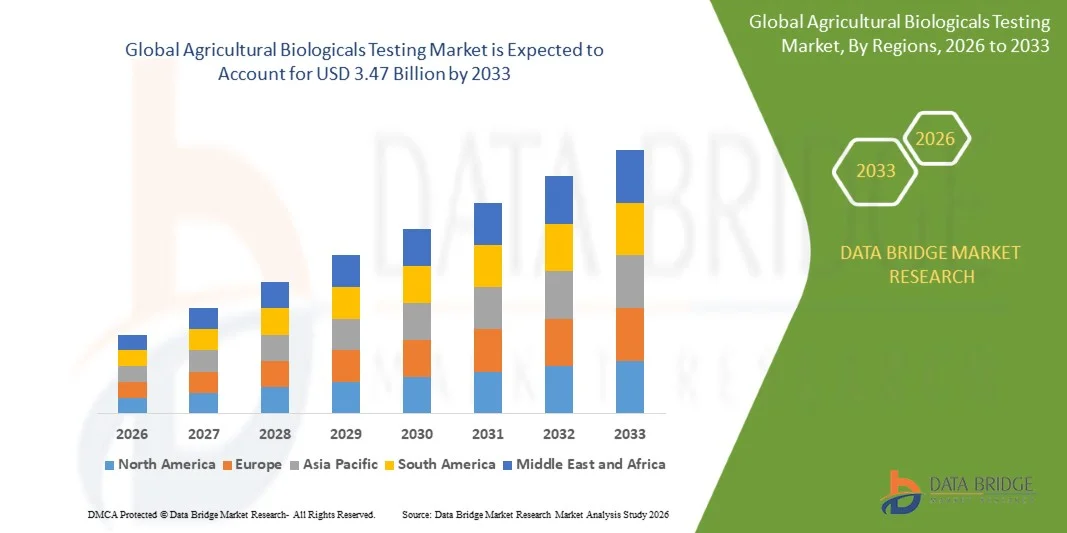
- As per Data Bridge Market Research analysis, the agricultural biologicals testing market was valued at USD 2.90 billion in 2025 and is projected to reach USD 3.47 billion by 2033, growing at a CAGR of 2.30% from 2026 to 2033.
- The market is experiencing consistent growth driven by rising adoption of sustainable agricultural practices, increasing development of biological crop inputs, and growing demand for reliable testing of biopesticides, biofertilizers, and biostimulants to validate their safety, efficacy, and quality.
- The increasing shift toward biological alternatives to synthetic agricultural chemicals, combined with stringent regulatory requirements for product safety, efficacy, and environmental impact, is compelling biological product manufacturers, government agencies, plant breeders, and research organizations to adopt advanced testing services. Analytical, regulatory, and field-support testing is increasingly being used to validate biological products before commercialization and support compliance with agricultural standards.
Market Size & Forecast
- Global Market Value (2025): USD 2.90 Billion
- Expected Market Value (2033): USD 3.47 Billion
- Forecast CAGR (2026–2033): 2.30%
- Leading Region in 2025: North America
- Fastest Growing Region: Asia Pacific
What are the Major Takeaways of the Agricultural Biologicals Testing Market?
- North America dominated the agricultural biologicals testing market with the largest revenue share of 35.8% in 2025, supported by strong regulatory frameworks, advanced agricultural biotechnology infrastructure, and the presence of established testing service providers.
- Asia-Pacific is expected to be the fastest-growing region at a CAGR of 7.5% from 2026 to 2033, fueled by increasing adoption of agricultural biologicals, growing interest in sustainable and organic farming, expanding agricultural technology capabilities, and rising demand for biological product testing
- The biopesticides segment led the market with a 43.2% share in 2025, driven by increasing demand for environmentally friendly pest-control solutions and stringent requirements for validating biological alternatives to conventional pesticides.
- Biostimulants are the fastest-growing type, projected to register a CAGR of 9.0%, reflecting the surge in emphasis on soil health, crop resilience, nutrient-use efficiency, and sustainable agricultural productivity.
- The analytical segment dominated the product type category with a 46.7% revenue share in 2025, led by the increasing need for laboratory assessment of microbial identity, potency, formulation stability, and product composition.
- Biological efficacy testing accounted for 42% of the market share in 2025, preferred by the need to demonstrate that biological products deliver their intended agricultural benefits.
- The regulatory compliance testing segment is the fastest-growing test type category, with a CAGR of 10.0%, driven by increasingly stringent requirements governing biological product registration and commercialization.
Report Scope and Agricultural Biologicals Testing Market Segmentation
|
Attributes |
Agricultural Biologicals Testing Key Market Insights |
|
Segments Covered |
|
|
Countries Covered |
North America
Europe
Asia-Pacific
Middle East and Africa
South America
|
|
Key Market Players |
|
|
Market Opportunities |
|
|
Value Added Data Infosets |
In addition to the insights on market scenarios such as market value, growth rate, segmentation, geographical coverage, and major players, the market reports curated by the Data Bridge Market Research also include import export analysis, production capacity overview, production consumption analysis, price trend analysis, climate change scenario, supply chain analysis, value chain analysis, raw material/consumables overview, vendor selection criteria, PESTLE Analysis, Porter Analysis, and regulatory framework. |
What is the Key Trend in the Agricultural Biologicals Testing Market?
- Agricultural biologicals manufacturers are increasingly adopting field-based and multi-environment testing to validate the real-world efficacy of microbial products, biostimulants, and biofertilizers across different crops, soils, and climatic conditions.
- For instance, in May 2025, Mosaic Biosciences continued its Frontier Fields program with six farmers conducting on-farm trials of BioPath and PowerCoat across corn farms in six U.S. states. Mosaic stated that its biologicals undergo rigorous in-lab and on-farm testing to evaluate how soil type, moisture, and growing conditions affect product performance.
- Advanced laboratory, greenhouse, and field testing is increasingly being combined to assess biological products across efficacy, stability, crop response, and environmental-performance parameters before commercialization.
- Biologicals developers are increasingly relying on specialized testing methodologies because microbial and biological products can respond differently to environmental conditions than conventional chemical agricultural inputs.
- For instance, in September 2025, WinField United expanded its BioVerified designation to 12 biological products after evaluation by its agronomy and research teams using field trials and controlled-environment testing. The company reported that its assessment draws on the Answer Plot field-testing system and 3D imaging at its Innovation Center to evaluate biological product impacts.
- As biological product pipelines expand and manufacturers seek stronger evidence of product efficacy, safety, and consistency across agricultural environments, demand for integrated laboratory, greenhouse, and field testing services is expected to increase, reinforcing testing as a critical stage in biological product development
What are the Key Drivers of the Agricultural Biologicals Testing Market?
- The rapid expansion of biopesticides, biofertilizers, and biostimulants has significantly increased demand for testing services capable of validating product efficacy, quality, safety, and consistency before commercialization.
- For instance, in October 2025, the European and Mediterranean Plant Protection Organization (EPPO) updated its efficacy-testing standards, adding new and revised standards for evaluating plant protection products under field conditions. The database contained more than 300 efficacy-evaluation standards, reinforcing the need for standardized testing to support product registration and performance validation
- Increasing regulatory requirements for efficacy, environmental safety, product chemistry, residues, and effects on non-target organisms are encouraging manufacturers to undertake comprehensive testing programs before registering biological agricultural products.
- For instance, in October 2024, researchers at the University of Florida evaluated three biological products Howler, Theia, and Double Nickel LC in field trials for controlling Rhizoctonia diseases in snap beans. Howler reduced disease incidence and achieved up to 95.4% disease reduction, demonstrating the need for field efficacy testing to establish biological product performance.
- With agricultural producers and biologicals manufacturers seeking reliable evidence of product performance while regulators demand scientifically supported safety and efficacy data, testing services will remain indispensable for product registration, commercialization, and market expansion.
What Factors are Challenging the Growth of the Agricultural Biologicals Testing Market?
- Agricultural biologicals testing requires specialized laboratories, controlled field trials, trained scientific personnel, and validated analytical methodologies, increasing testing costs and creating barriers for smaller biological product developers.
- For instance, in May 2025, a study published in Biologicals identified high reagent costs, import complexities, limited suppliers, and financial and supply-chain challenges as significant barriers to biologicals testing, particularly in low-income countries. These constraints can increase testing expenses and delay access to essential testing materials.
- These requirements can limit testing capabilities among small manufacturers, start-ups, and laboratories in developing markets, particularly when biological products require repeated testing across multiple crops, locations, and environmental conditions.
- The complexity of biological products can also increase testing requirements because microbial identity, genetic stability, contaminants, environmental effects, and product performance may require different analytical and field-based assessments.
- For instance, in July 2024, Agmatix reported that rising field-trial costs and stricter regulatory requirements were increasing the expense of developing new crop-protection products, including biological products. The article noted that traditional field-trial management also creates data-integrity and processing challenges, which can increase the time and resources required for testing.
- The combination of high testing costs, specialized infrastructure requirements, limited availability of critical materials, and complex regulatory data requirements can lengthen product-development timelines and constrain testing adoption among smaller agricultural biologicals companies.
How is the Agricultural Biologicals Testing Market Segmented?
The agricultural biologicals testing market is segmented on the basis of type, product, test type, crop type, and end user.
- By Type
On the basis of type, the agricultural biologicals testing market is segmented into biopesticides, biofertilizers, and biostimulants. The biopesticides segment dominated the market with a 43.2% share in 2025, owing to increasing demand for environmentally friendly pest-control solutions and stringent requirements for validating biological alternatives to conventional pesticides. Biopesticides require comprehensive testing to establish efficacy, safety, environmental compatibility, and product consistency. Testing also helps verify microbial strains, formulation stability, and performance under different agricultural conditions. Growing development of microbial, botanical, and biochemical pest-control products is expanding the need for specialized testing services. Increasing regulatory attention toward pesticide safety is further supporting testing requirements for biological pest-control products.
The biostimulants segment is projected to register the fastest growth at a CAGR of 9.0% from 2026 to 2033, driven by increasing emphasis on soil health, crop resilience, nutrient-use efficiency, and sustainable agricultural productivity. Biostimulant products require testing to validate their effects on plant growth and crop performance. Increasing commercialization of microbial and non-microbial biostimulant formulations is creating additional testing requirements. Testing also helps manufacturers establish consistency and demonstrate product performance across different crops and environmental conditions. Growing farmer interest in biological approaches to improve crop resilience is further supporting product development. Regulatory attention toward biological agricultural inputs is increasing the importance of reliable performance and quality data.
- By Product
On the basis of product, the agricultural biologicals testing market is segmented into field support, analytical, and regulatory. The analytical segment dominated the market with a 46.7% share in 2025, owing to the increasing need for laboratory assessment of microbial identity, potency, formulation stability, and product composition. Analytical testing provides manufacturers with essential information for evaluating biological product quality and consistency. Advanced laboratory techniques are increasingly used to characterize complex microbial and biological formulations. These services also generate supporting information for efficacy, safety, and regulatory assessments. Increasing complexity in biological product development is creating greater demand for specialized analytical capabilities. Manufacturers are increasingly using laboratory testing throughout product development and commercialization.
The regulatory segment is projected to register the fastest growth at a CAGR of 10.0% from 2026 to 2033, driven by increasing regulatory requirements for the registration and commercialization of agricultural biological products. Regulatory testing generates scientific evidence related to product safety, efficacy, environmental compatibility, and compliance. Manufacturers increasingly require specialized testing support to prepare submissions for different regulatory jurisdictions. The growing number of biological products entering commercial development is increasing demand for regulatory data. Differences in national requirements also encourage manufacturers to use specialized testing providers with regulatory expertise. Increasing scrutiny of microbial and biochemical products is further expanding compliance requirements.
- By Test Type
On the basis of test type, the agricultural biologicals testing market is segmented into biological efficacy testing, quality testing, safety testing, and regulatory compliance testing. Biological efficacy testing dominated the test type category with a share of 42% in 2025, supported by the need to demonstrate that biological products deliver their intended agricultural benefits. Efficacy trials evaluate the ability of biopesticides, biofertilizers, and biostimulants to perform under practical agricultural conditions. Testing can be conducted across different crops, soil conditions, climates, and application methods. Manufacturers use efficacy data to substantiate product claims and support commercialization. Regulatory authorities also require reliable performance evidence when evaluating biological agricultural products. Growing development of biological alternatives to conventional agricultural inputs is increasing the need for scientifically validated efficacy data.
The regulatory compliance testing segment is expected to register the fastest growth at a CAGR of 10.0% from 2026 to 2033, driven by increasingly stringent requirements governing biological product registration and commercialization. Compliance testing helps manufacturers demonstrate conformity with requirements related to safety, efficacy, environmental effects, residues, and non-target organisms. Increasing international commercialization of biological products is creating demand for testing against different national regulatory frameworks. Manufacturers also require comprehensive documentation to support regulatory submissions and minimize approval delays. Growing regulatory scrutiny of microbial and biochemical products is increasing the depth of supporting data required. Specialized laboratories are therefore becoming increasingly important to biological product developers seeking regulatory approval.
- By Crop Type
On the basis of crop type, the agricultural biologicals testing market is segmented into cereals & grains, oilseeds & pulses, fruits & vegetables, and other crop types. The cereals & grains segment dominated the crop type category with a market share of 41.55% in 2025, supported by the extensive cultivation of major crops such as corn, wheat, rice, and barley and the growing use of biological inputs in their production. Biological products used in cereal cultivation require efficacy and performance validation under different agricultural conditions. Large cultivated areas create significant demand for field testing and crop-specific performance assessments. Increasing pressure to improve productivity while reducing dependence on conventional agricultural chemicals is supporting biological product adoption. Manufacturers also require crop-specific evidence before expanding product claims across cereal varieties. Testing helps establish product consistency across different soils, climates, and cultivation systems.
The fruits & vegetables segment is projected to register the fastest growth at a CAGR of 9.5% from 2026 to 2033, driven by increasing adoption of biological crop-protection and plant-health solutions in high-value horticultural production. Fruits and vegetables have stringent quality and residue requirements, increasing the importance of biological product validation. Testing is used to assess pest control, disease management, crop growth, nutrient efficiency, and product compatibility. Different varieties and growing environments also require localized testing to establish consistent performance. Increasing consumer preference for produce cultivated with reduced chemical inputs is encouraging the development of biological solutions. Manufacturers are expanding biological product portfolios for horticultural applications, creating additional testing requirements.
- By End User
On the basis of end user, the agricultural biologicals testing market is segmented into biological product manufacturers, government agencies, and others. The biological product manufacturers segment dominated the market with a 52.4% share in 2025, as manufacturers require extensive testing to validate the efficacy, quality, safety, and regulatory compliance of products before commercialization. Biological product developers rely on laboratory and field testing throughout the product-development process. Testing helps manufacturers substantiate product claims and demonstrate consistent performance across crops and environments. The expanding development of biopesticides, biofertilizers, and biostimulants is increasing the volume of testing required by manufacturers. Outsourcing testing activities also enables manufacturers to access specialized laboratories and field-testing capabilities.
The government agencies segment is projected to register the fastest growth at a CAGR of 8.5% from 2026 to 2033, driven by increasing regulatory oversight and government initiatives supporting sustainable agriculture. Government agencies use biological testing to evaluate product safety, efficacy, quality, and environmental compatibility. Growing adoption of biological agricultural inputs is increasing the need for reliable regulatory monitoring and verification. Government laboratories are also strengthening testing capabilities to support registration and quality-control programs. Increasing emphasis on sustainable agriculture is encouraging public-sector investment in biological product assessment. Regulatory agencies require scientifically validated data to maintain product integrity and protect agricultural ecosystems.
Which Region Holds the Largest Share of the Agricultural Biologicals Testing Market?
- North America dominated the agricultural biologicals testing market with the largest revenue share of 35.8% in 2025, supported by strong regulatory frameworks, advanced agricultural biotechnology infrastructure, and the presence of established testing service providers.
- The region also benefits from stringent requirements for efficacy, safety, and regulatory testing of biological inputs, high research and development investments, and growing demand for sustainable agricultural solutions. Increasing adoption of advanced laboratory technologies and collaboration between testing facilities, universities, and biological product manufacturers continues to strengthen North America’s leadership position in the global market.
U.S. Agricultural Biologicals Testing Market Insight
The U.S. U.S. agricultural biologicals testing market is witnessing strong growth due to its large agricultural sector, established testing infrastructure, and stringent regulatory requirements for biological products. The country’s extensive corn, soybean, cotton, and specialty-crop production, along with established EPA and state-level review processes, is driving demand for efficacy, safety, analytical, and regulatory testing services. In addition, growing adoption of biological crop inputs and increasing requirements for scientific validation and product registration are accelerating testing activity across manufacturers, research organizations, and agricultural stakeholders.
Asia-Pacific Agricultural Biologicals Testing Market Insight
The Asia-Pacific agricultural biologicals testing market is expected to witness rapid growth, driven by expanding agricultural production, rising adoption of biological inputs, and increasing food-security requirements across countries such as China, India, and Japan. Growing demand for sustainable crop protection, stricter product-registration requirements, and increasing investments in agricultural biotechnology are supporting regional market expansion. In addition, the presence of diverse cropping systems and increasing need for localized efficacy and safety testing are accelerating testing demand across commercial and research applications.
Japan Agricultural Biologicals Testing Market Insight
The Japan agricultural biologicals testing market is witnessing consistent growth due to increasing adoption of sustainable farming practices, advanced agricultural technologies, and stringent requirements for biological product validation. Manufacturers and research organizations are increasingly utilizing testing services to evaluate product efficacy, quality, safety, and performance across cereals, horticultural crops, and specialty agricultural applications. Moreover, the country’s focus on precision agriculture, environmentally sustainable inputs, and advanced research capabilities is further contributing to market growth in Japan.
China Agricultural Biologicals Testing Market Insight
The China agricultural biologicals testing market is growing rapidly, driven by the country’s large agricultural base, increasing adoption of biological crop inputs, and rising focus on sustainable agricultural production. Growing requirements for localized product evaluation, efficacy assessment, and regulatory compliance are significantly boosting demand for agricultural biologicals testing services. In addition, expanding domestic biological-input manufacturing, government emphasis on food security, and technological advancements in agricultural research are supporting China’s position as a major market for agricultural biologicals testing in Asia-Pacific.
U.K. Agricultural Biologicals Testing Market Insight
The U.K. agricultural biologicals testing market is experiencing steady growth, supported by stringent regulatory expectations, increasing adoption of sustainable agricultural inputs, and growing demand for scientifically validated biological products. Testing laboratories and research organizations are increasingly involved in efficacy, analytical, safety, and regulatory studies to support product development and commercialization. Furthermore, increasing emphasis on reduced-risk crop protection, environmental sustainability, and documented agronomic performance is contributing to continued testing demand in the U.K.
Germany Agricultural Biologicals Testing Market Insight
The Germany agricultural biologicals testing market is expanding steadily due to the country’s strong agricultural research capabilities, stringent regulatory environment, and increasing adoption of biological crop protection and plant-health products. Manufacturers, research institutions, and testing laboratories are increasingly conducting scientific assessments to establish product efficacy, quality, safety, and regulatory compliance. Continuous advancements in agricultural biotechnology, sustainability-focused farming practices, and European regulatory requirements are further driving demand for specialized biologicals testing services in Germany.
Which are the Top Companies in Agricultural Biologicals Testing Market?
The agricultural biologicals testing industry is primarily led by well-established companies, including:
- SGS SA (Switzerland)
- Eurofins Scientific SE (Luxembourg)
- Bureau Veritas SA (France)
- Intertek Group plc (U.K.)
- ALS Limited (Australia)
- Bionema (U.K.)
- BASF SE (Germany)
- Bayer AG (Germany)
- Corteva (U.S.)
- FMC Corporation (U.S.)
- UPL Limited (India)
- Certis USA L.L.C. (U.S.)
- Staphyt S.A. (France)
- R J Hill Laboratories Limited (New Zealand)
- Valent BioSciences LLC (U.S.)
- SUSTÅNE NATURAL FERTILIZER, INC. (U.S.)
- i2LResearch (U.K.)
- Andermatt Group AG (Switzerland)
- BioTecnologie B.T. Srl (Italy)
- Bionema Limited (U.K.)
What are Latest Developments in Agricultural Biologicals Testing Market?
- In April 2025, Jord BioScience announced results from two years of field trials evaluating its microbial solutions across 16 locations in the U.S. Midwest. The trials used advanced analytics and a large microbial-isolate bank to assess product performance under varying weather conditions, providing field-efficacy data for biological crop solutions and demonstrating the increasing use of multi-location testing to validate biological performance.
- In April 2025, DPH Biologicals announced mode-of-action findings for its TerraTrove AmplAphex biofertilizer following a multi-year field trial program. The company conducted testing with Eurofins Bio Diagnostics to identify the product’s mode of action, combining laboratory analysis with field-trial results to evaluate its performance under abiotic stresses and support further development of biological agricultural inputs.
- In March 2024, Certis Biologicals and SDS Biotech announced a collaboration to develop and commercialize agricultural biological products. The partnership combined research, development, and production capabilities to accelerate the development of biological crop-protection solutions, supporting additional product evaluation and testing activities before commercialization.
- In May 2023, Biotalys reported results from its global field-testing program for the Evoca biological fungicide. The company conducted more than 160 field trials during 2022 across multiple crops and locations, including trials in California, New York, and Oregon, to evaluate efficacy and reliability against fungal diseases and generate data supporting regulatory and commercial development.
- In August 2021, Farmers Business Network expanded its On-Farm R&D Trial Program to provide large-scale real-world testing for agricultural innovations, including biologicals. The expanded program enabled manufacturers to test biostimulants, biofertilizers, and biopesticides across farms in the U.S., Canada, and Australia, while introducing a trial dashboard for monitoring agronomic, weather, and performance data.

- Interactive Data Analysis Dashboard
- Company Analysis Dashboard for high growth potential opportunities
- Research Analyst Access for customization & queries
- Competitor Analysis with Interactive dashboard
- Latest News, Updates & Trend analysis
- Harness the Power of Benchmark Analysis for Comprehensive Competitor Tracking
Data collection and base year analysis are done using data collection modules with large sample sizes. The stage includes obtaining market information or related data through various sources and strategies. It includes examining and planning all the data acquired from the past in advance. It likewise envelops the examination of information inconsistencies seen across different information sources. The market data is analysed and estimated using market statistical and coherent models. Also, market share analysis and key trend analysis are the major success factors in the market report. To know more, please request an analyst call or drop down your inquiry.
The key research methodology used by DBMR research team is data triangulation which involves data mining, analysis of the impact of data variables on the market and primary (industry expert) validation. Data models include Vendor Positioning Grid, Market Time Line Analysis, Market Overview and Guide, Company Positioning Grid, Patent Analysis, Pricing Analysis, Company Market Share Analysis, Standards of Measurement, Global versus Regional and Vendor Share Analysis. To know more about the research methodology, drop in an inquiry to speak to our industry experts.
Data Bridge Market Research is a leader in advanced formative research. We take pride in servicing our existing and new customers with data and analysis that match and suits their goal. The report can be customized to include price trend analysis of target brands understanding the market for additional countries (ask for the list of countries), clinical trial results data, literature review, refurbished market and product base analysis. Market analysis of target competitors can be analyzed from technology-based analysis to market portfolio strategies. We can add as many competitors that you require data about in the format and data style you are looking for. Our team of analysts can also provide you data in crude raw excel files pivot tables (Fact book) or can assist you in creating presentations from the data sets available in the report.