What is the Agricultural Drone Spraying Services Market Size and Growth Rate?
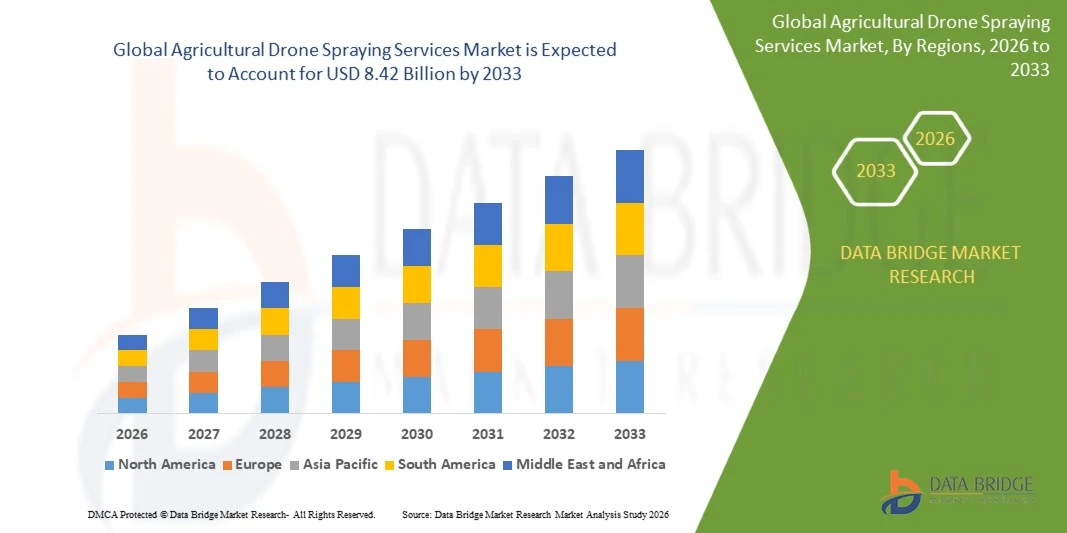
- As per Data Bridge Market Research analysis, the agricultural drone spraying services market was valued at USD 4.20 billion in 2025 and is projected to reach USD 8.42 billion by 2033, growing at a CAGR of 11.6% from 2026 to 2033.
- The market is experiencing consistent growth driven by rising agricultural labor shortages, increasing demand for precise and timely crop protection, and expanding adoption of drone-as-a-service models across cereals, horticulture, plantation, and specialty crop farming.
- The increasing shift toward precision application, reduced chemical and water use, and rental-based access to equipment, combined with growing government support for drone adoption, is supporting market adoption. Drone spraying services are being applied across crop protection, nutrient management, weed control, and seeding, offering farmers greater speed and flexibility while integrating with precision agriculture, agriculture drones, and crop scouting workflows.
Market Size & Forecast
- Global Market Value (2025): USD 4.20 Billion
- Expected Market Value (2033): USD 8.42 Billion
- Forecast CAGR (2026–2033): 11.6%
- Leading Region in 2025: Asia Pacific
- Fastest Growing Region: North America
What are the Major Takeaways of the Agricultural Drone Spraying Services Market?
- Asia-Pacific dominated the agricultural drone spraying services market with the largest revenue share of 46.18% in 2025, supported by large smallholder acreage, strong domestic drone manufacturing, and government-backed drone programs across China and India.
- North America is expected to be the fastest-growing region at a CAGR of 14.60% from 2026 to 2033, fueled by a rising number of certified spray operators, extensive row-crop acreage, and persistent labor constraints.
- The liquid spraying segment led the market with a 74.26% share in 2025, driven by widespread use of drones for pesticide, herbicide, fungicide, and foliar nutrient application.
- Granular spreading & seeding is the fastest-growing service type, projected to register a CAGR of 14.80%, reflecting rising demand for drone-based fertilizer broadcasting and cover-crop and rice seeding.
- The multi-rotor segment dominated the drone type category with an 81.30% revenue share in 2025, led by its ability to hover, take off vertically, and operate in small and irregular fields.
- Cereals & grains accounted for 43.18% of the market share in 2025, preferred by large planted areas that require repeated crop protection and nutrient applications within narrow timing windows.
- The fruits & vegetables segment is the fastest-growing crop category, with a CAGR of 13.10%, driven by demand for precise and timely treatment of high-value crops grown on slopes and in irregular orchards.
Report Scope and Agricultural Drone Spraying Services Market Segmentation
|
Attributes |
Agricultural Drone Spraying Services Key Market Insights |
|
Segments Covered |
|
|
Countries Covered |
North America
Europe
Asia-Pacific
Middle East and Africa
South America
|
|
Key Market Players |
|
|
Market Opportunities |
|
|
Value Added Data Infosets |
In addition to the insights on market scenarios such as market value, growth rate, segmentation, geographical coverage, and major players, the market reports curated by the Data Bridge Market Research also include import export analysis, production capacity overview, production consumption analysis, price trend analysis, climate change scenario, supply chain analysis, value chain analysis, raw material/consumables overview, vendor selection criteria, PESTLE Analysis, Porter Analysis, and regulatory framework. |
What is the Key Trend in the Agricultural Drone Spraying Services Market?
- Agricultural drone spraying services are increasingly evolving from basic aerial application into data-driven precision treatment platforms, combining autonomous flight planning, RTK positioning, obstacle sensing, and variable-rate nozzles to deliver targeted crop protection with minimal operator intervention.
- For instance, in July 2026, according to DJI Agriculture, the company launched the Agras T55 and the Agras T100 Dual Battery Spraying System globally, with the T55 offering a 50 L payload and added safety systems, highlighting the shift toward larger-capacity, higher-productivity spray platforms for commercial service operators and large-acreage farms.
- Precision spot-spraying and improved nozzle technologies are enabling service providers to reduce chemical usage while maintaining deposition quality across different crops, canopy structures, and field conditions.
- Standardized training, certification, and digital job-management platforms are professionalizing the sector, enabling farmers to hire licensed operators on demand rather than purchasing and maintaining their own aircraft.
- For instance, in June 2025, according to Drones (MDPI), researchers evaluating unmanned aerial application systems found that flight speed, droplet size, and application volume significantly influenced spray deposition, with a 4 m/s flight speed and 28.10 L/ha application volume increasing coverage, supporting data-driven parameter optimization by service operators.
- As larger payloads, autonomous flight, precision nozzles, and digital compliance tools continue to advance, drone spraying services are expected to expand beyond conventional crop protection into nutrient management, seeding, vegetation management, and integrated precision farming programs.
What are the Key Drivers of the Agricultural Drone Spraying Services Market?
- Persistent agricultural labor shortages and the need for timely crop protection are accelerating the shift from manual and tractor-based spraying to drone-based application services that can cover large areas quickly with fewer workers.
- For instance, in October 2026, according to Farm Progress, drone spraying in the U.S. expanded from practically nothing to 16.4 million acres in 2025, while more than 1,700 operators held the FAA agricultural aircraft operator certificate, demonstrating rapid commercial uptake of drone spraying services.
- Farmers, cooperatives, and agribusinesses are increasingly outsourcing application work to service providers to avoid high capital costs, reduce chemical exposure for workers, and access trained pilots and compliant operations.
- For instance, in November 2024, according to the Press Information Bureau of India, the Namo Drone Didi scheme aims to provide drones to 15,000 women self-help groups during 2024-25 and 2025-26, with financial assistance covering 80% of drone and accessory costs, supporting rental-based drone spraying services for farmers.
- Rising emphasis on reducing pesticide and water use, together with the growing availability of larger-capacity and lower-cost spray drones, is strengthening the economic case for professional drone spraying services across crop types.
What Factors Are Challenging the Growth of the Agricultural Drone Spraying Services Market?
- Drone spraying services operate under evolving aviation, pesticide, and data regulations, requiring operators to hold multiple certifications and maintain compliance across jurisdictions, which increases administrative burden and entry barriers.
- For instance, in August 2026, according to Farm Progress, the FAA proposed a record civil penalty of nearly USD 290,000 against a Washington-based operator for allegedly conducting 15 fertilizer application flights without an agricultural aircraft operator certificate, underscoring the compliance risks facing service providers.
- Spray drift, uneven deposition in dense canopies, and weather sensitivity can limit the effectiveness of drone application, while battery life, payload limits, and charging logistics can reduce daily productivity and increase operating costs.
- Trade restrictions affecting foreign-made drones and components can create uncertainty in equipment availability, pricing, and after-sales support, particularly in markets that depend on a small number of dominant manufacturers.
- For instance, in February 2026, according to AgBull, DJI, which by its own 2024 estimate supplied about four of every five agricultural spray drones in the United States, filed suit against the Federal Communications Commission to overturn the decision preventing new Chinese models from entering the U.S. market, illustrating the supply uncertainty facing spray service providers.
- The combination of regulatory complexity, technical limitations, and equipment supply uncertainty can constrain adoption among small operators and cost-sensitive farmers, particularly where conventional ground sprayers or manual application already meet basic crop protection needs.
How is the Agricultural Drone Spraying Services Market Segmented?
The agricultural drone spraying services market is segmented on the basis of service type, drone type, crop type, and end user.
- By Service Type
On the basis of service type, the agricultural drone spraying services market is segmented into liquid spraying and granular spreading & seeding. The liquid spraying segment dominated the market with 74.26% share in 2025, supported by widespread use of drones for pesticide, herbicide, fungicide, and foliar nutrient application. Liquid application benefits from mature nozzle technologies, established tank-mix practices, and a broad range of approved crop protection products. Drones allow timely treatment of fields that are wet, steep, or difficult to access with ground rigs. Service providers can also reduce water usage and operator exposure to chemicals. Growing availability of high-capacity tanks is further strengthening the segment's cost competitiveness.
The granular spreading & seeding segment is projected to register the fastest growth at a CAGR of 14.80% from 2026 to 2033, driven by increasing use of drones for broadcasting fertilizer, cover-crop seed, rice seed, and other dry inputs. Drone-mounted spreaders allow operators to apply inputs without entering fields, which is valuable in standing crops, flooded paddies, and terraced land. Interest in cover cropping and regenerative practices is creating additional demand for flexible seeding services. Improvements in spreader accuracy, payload capacity, and flight-planning software are widening the range of workable applications. Service providers also gain additional revenue by offering multiple application types with the same aircraft across seasons.
- By Drone Type
On the basis of drone type, the agricultural drone spraying services market is segmented into multi-rotor, fixed-wing, and hybrid. The multi-rotor segment dominated the market with 81.30% share in 2025, supported by its ability to hover, take off vertically, and operate in small and irregular fields. Multi-rotor platforms offer straightforward operation, relatively low acquisition costs, and wide availability of service and spare parts. They can follow terrain contours and apply precise swaths close to the crop canopy. Large tank capacities and fast battery swapping have increased hourly coverage. A broad base of trained pilots and established dealer networks further reinforces the segment's leadership.
The hybrid segment is projected to register the fastest growth at a CAGR of 14.20% from 2026 to 2033, driven by demand for longer flight endurance and greater coverage per sortie in large-scale farming operations. Hybrid designs combine vertical take-off with efficient forward flight, enabling operators to treat extensive acreage between charging or refueling stops. They are particularly relevant for plantations, broadacre cropping, and remote regions where field transitions are time-consuming. Advances in battery chemistry, lightweight materials, and autonomous flight control are improving reliability. Regulatory progress on beyond-visual-line-of-sight operations may further expand their usefulness for commercial service providers.
- By Crop Type
On the basis of crop type, the agricultural drone spraying services market is segmented into cereals & grains, fruits & vegetables, oilseeds & pulses, and others. The cereals & grains segment dominated the crop category with 43.18% share in 2025, supported by large planted areas of rice, wheat, and corn that require repeated fungicide, insecticide, and nutrient applications within narrow timing windows. Drones help operators treat fields quickly after rainfall, when ground machinery may damage crops or compact soil. Standing tall crops such as corn can be treated late in the season without wheel damage. Government support in major rice-growing countries is also encouraging adoption among grain farmers.
The fruits & vegetables segment is projected to register the fastest growth at a CAGR of 13.10% from 2026 to 2033, driven by demand for precise, timely treatment of high-value crops grown on slopes, terraces, and in irregular orchards. Drone services can reduce labor requirements for repeated protection sprays and limit soil compaction in wet conditions. Growers are increasingly interested in canopy-specific application, although research on deposition and drift in tree crops continues to shape recommended flight parameters. Improved nozzles, lower flight heights, and tuned operating speeds are improving performance. Rising demand for consistent produce quality is supporting wider use of professional spraying services.
- By End User
On the basis of end user, the agricultural drone spraying services market is segmented into smallholder farmers, large commercial farms, agricultural cooperatives, agribusiness & plantation companies, government & research institutions, and others. The smallholder farmers segment dominated the end-user category with 38.45% share in 2025, supported by fragmented landholdings where purchasing a drone is uneconomical and rental-based services offer immediate access to the technology. Service providers can aggregate demand across many small plots and spread equipment costs over large areas. Drone application reduces the physical strain and chemical exposure associated with backpack spraying. Local operators and village-level entrepreneurs are also creating new rural employment.
The agricultural cooperatives segment is projected to register the fastest growth at a CAGR of 13.90% from 2026 to 2033, driven by group-based ownership and shared-service models that make drone technology affordable for members. Cooperatives and self-help groups can purchase aircraft collectively, train local pilots, and schedule applications across many farms. Government schemes that subsidize drone purchases and training for community groups are strengthening this model. Cooperatives also negotiate bulk input purchases and coordinate application timing, improving efficiency. Compliance support, insurance, and maintenance services remain important considerations for scaling shared drone fleets.
Which Region Holds the Largest Share of the Agricultural Drone Spraying Services Market?
- Asia-Pacific dominated the agricultural drone spraying services market with the largest revenue share of 46.18% in 2025, supported by large smallholder acreage, strong domestic drone manufacturing, and government-backed drone programs across China and India.
- The region also benefits from rapid mechanization of rice, wheat, and plantation farming, rural labor migration, and the presence of established drone manufacturers and service networks. Increasing use of drones for pesticide, fertilizer, and seed application, supported by training and subsidy programs, continues to strengthen Asia-Pacific's position in the global market.
China Agricultural Drone Spraying Services Market Insight
The China agricultural drone spraying services market is growing rapidly, driven by large-scale rice, wheat, and corn cultivation, shortages of rural labor, and the strong domestic base of agricultural drone manufacturers. Farmers and service cooperatives increasingly rely on drones for pesticide and fertilizer application across plains, terraces, and orchards. In addition, supportive agricultural mechanization policies, widely available operator training, and competitive equipment pricing are positioning China as a key growth market for professional drone spraying services in Asia-Pacific.
North America Agricultural Drone Spraying Services Market Insight
The North America agricultural drone spraying services market is expected to witness rapid growth, driven by expanding use of drones for fungicide, insecticide, and fertilizer application across row crops, specialty crops, and pastureland. Growing numbers of certified operators, rising labor costs, and interest in reducing soil compaction are supporting adoption. In addition, clearer regulatory pathways for agricultural aircraft operations and greater availability of service marketplaces connecting farmers with licensed pilots are accelerating demand for drone spraying services across the region.
U.S. Agricultural Drone Spraying Services Market Insight
The U.S. agricultural drone spraying services market is witnessing strong growth due to rising adoption of drones for crop protection, cover-crop seeding, and nutrient application across corn, soybean, cotton, and specialty crop operations. The country's large farm sizes, established custom application industry, and increasing number of certificated operators are driving demand. In addition, regulatory enforcement, evolving rules for beyond-visual-line-of-sight flights, and uncertainty over foreign-made equipment are shaping how service providers invest in fleets and compliance.
Canada Agricultural Drone Spraying Services Market Insight
The Canada agricultural drone spraying services market is experiencing steady growth, supported by large-scale grain and oilseed production, short application windows, and interest in precision input management. Drones are increasingly considered for spot treatments, hard-to-reach areas, and wet fields where ground equipment is restricted. Furthermore, growing availability of trained pilots, collaboration between agronomy retailers and drone operators, and attention to regulatory compliance and pesticide application standards are supporting wider adoption of drone spraying services among Canadian farmers.
India Agricultural Drone Spraying Services Market Insight
The India agricultural drone spraying services market is expanding rapidly, supported by government schemes that promote drone adoption among women-led self-help groups, growing use of nano fertilizers, and persistent shortages of farm labor. Fragmented landholdings make rental-based services particularly suitable for small farmers. Moreover, domestic drone manufacturing, expanding pilot training programs, and increasing awareness of efficiency and safety benefits are encouraging farmers to adopt drone spraying for paddy, cotton, sugarcane, and horticultural crops.
Brazil Agricultural Drone Spraying Services Market Insight
The Brazil agricultural drone spraying services market is witnessing consistent growth due to extensive soybean, corn, sugarcane, and coffee cultivation and the need for rapid application across large and sometimes difficult terrains. Service providers and agribusiness companies are increasingly using drones to complement tractors and aircraft, particularly when soils are wet or fields are small. In addition, growing availability of local operators, supportive agricultural technology ecosystems, and interest in reducing input costs are supporting adoption across the country.
Which are the Top Companies in Agricultural Drone Spraying Services Market?
The agricultural drone spraying services industry is primarily led by well-established companies, including:
- SZ DJI Technology Co., Ltd. (China)
- XAG Co., Ltd. (China)
- Hylio, Inc. (U.S.)
- Rantizo, Inc. (U.S.)
- Yamaha Motor Co., Ltd. (Japan)
- TopXGun Robotics (China)
- Central UAS Technologies (U.S.)
- AgEagle Aerial Systems, Inc. (U.S.)
- Pyka Inc. (U.S.)
- Precision AI Inc. (Canada)
- Garuda Aerospace Pvt. Ltd. (India)
- Marut Drones Pvt. Ltd. (India)
- ideaForge Technology Ltd. (India)
- Throttle Aerospace Systems Pvt. Ltd. (India)
- Nileworks Inc. (Japan)
- Terra Drone Corporation (Japan)
- Syngenta Group (Switzerland)
- Bayer AG (Germany)
- AGCO Corporation (U.S.)
- Kubota Corporation (Japan)
What are Latest Developments in Agricultural Drone Spraying Services Market?
- In July 2026, DJI Agriculture announced the global launch of the Agras T55 and the Agras T100 Dual Battery Spraying System. The T55 offers a 50 L payload capacity with added safety systems, while the T100 is designed to improve efficiency in large-scale field operations, with sales availability varying by country and region, supporting continued development of high-capacity spraying platforms.
- In April 2026, Florida-based Central UAS Technologies was featured at CattleCon 2026 for designing aircraft specifically for application work, with liquid and granular payload options. The company's drones were presented as tools for hard-to-reach terrain, reflecting growing interest among ranchers and farmers in purpose-built spray platforms rather than adapted camera drones.
- In February 2026, New Zealand's Ministry for Regulation published recommendations to better enable agricultural drone use, including targeted changes to Parts 101 and 102 to allow heavier drones to undertake low-risk spraying on an operator's own land, and broader reform of Part 137 to create a dedicated and durable framework for agricultural drone operations.
- In January 2025, Hylio introduced the AG-210 Enterprise Kit, a fully autonomous four-rotor spray platform with a 2.6-gallon tank, TeeJet nozzles, and electronic flowmeters. The compact drone, designed for one-person operation, stores flight and treatment data in the operator's account and targets vegetation management applications, including weed treatment at solar project sites.
- In December 2024, XAG released its P150 spray drone, featuring rotary atomization technology, which Rantizo subsequently added to its equipment portfolio ahead of the 2025 spraying season. Rantizo said the aircraft would be offered to its network of spray drone operators and flown at its own regional hub locations to help operators cover more ground in less time.

- Interactive Data Analysis Dashboard
- Company Analysis Dashboard for high growth potential opportunities
- Research Analyst Access for customization & queries
- Competitor Analysis with Interactive dashboard
- Latest News, Updates & Trend analysis
- Harness the Power of Benchmark Analysis for Comprehensive Competitor Tracking
Data collection and base year analysis are done using data collection modules with large sample sizes. The stage includes obtaining market information or related data through various sources and strategies. It includes examining and planning all the data acquired from the past in advance. It likewise envelops the examination of information inconsistencies seen across different information sources. The market data is analysed and estimated using market statistical and coherent models. Also, market share analysis and key trend analysis are the major success factors in the market report. To know more, please request an analyst call or drop down your inquiry.
The key research methodology used by DBMR research team is data triangulation which involves data mining, analysis of the impact of data variables on the market and primary (industry expert) validation. Data models include Vendor Positioning Grid, Market Time Line Analysis, Market Overview and Guide, Company Positioning Grid, Patent Analysis, Pricing Analysis, Company Market Share Analysis, Standards of Measurement, Global versus Regional and Vendor Share Analysis. To know more about the research methodology, drop in an inquiry to speak to our industry experts.
Data Bridge Market Research is a leader in advanced formative research. We take pride in servicing our existing and new customers with data and analysis that match and suits their goal. The report can be customized to include price trend analysis of target brands understanding the market for additional countries (ask for the list of countries), clinical trial results data, literature review, refurbished market and product base analysis. Market analysis of target competitors can be analyzed from technology-based analysis to market portfolio strategies. We can add as many competitors that you require data about in the format and data style you are looking for. Our team of analysts can also provide you data in crude raw excel files pivot tables (Fact book) or can assist you in creating presentations from the data sets available in the report.