What is the Agricultural Pump Market Size and Growth Rate?
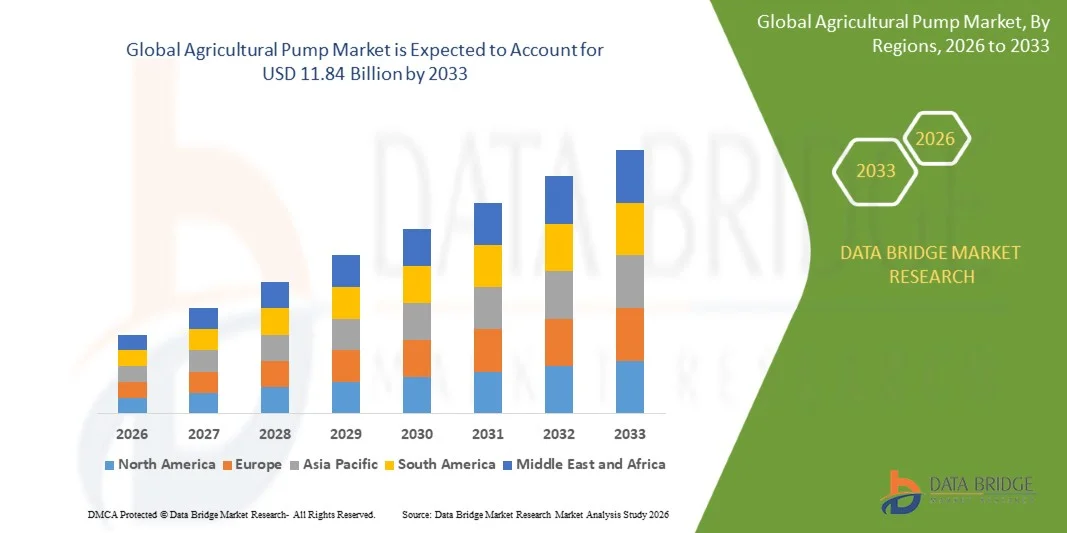
- As per Data Bridge Market Research analysis, the agricultural pump market was valued at USD 6.26 billion in 2025 and is projected to reach USD 11.84 billion by 2033, growing at a CAGR of 8.30% from 2026 to 2033.
- The market is experiencing consistent growth driven by rising demand for efficient irrigation and crop protection solutions, increasing adoption of solar-powered pump and energy-efficient pumps, and expanding agricultural mechanization across developing economies.
- The increasing need for reliable and efficient irrigation, combined with inadequate electricity supply in developing and underdeveloped economies, is compelling farmers to adopt advanced pumping solutions. Submersible, centrifugal, and solar-powered pumps are increasingly being used to support large-scale farming, improve water management, and enhance crop productivity, particularly across emerging agricultural markets.
Market Size & Forecast
- Global Market Value (2025): USD 6.26 Billion
- Expected Market Value (2033): USD 11.84 Billion
- Forecast CAGR (2026–2033): 8.30%
- Leading Region in 2025: North America
- Fastest Growing Region: Asia Pacific
What are the Major Takeaways of the Agricultural Pump Market?
- North America dominated the agricultural pump market with the largest revenue share of 34% in 2025, supported by advanced agricultural infrastructure, widespread mechanized farming, and increasing adoption of efficient irrigation technologies.
- Asia-Pacific is expected to be the fastest-growing region at a CAGR of 9.0% from 2026 to 2033, fueled by expanding agricultural activities, rising irrigation requirements, and increasing investments in modern farming infrastructure.
- The centrifugal pumps segment led the market with a 60.2% share in 2025, driven by their extensive use in irrigation and high-volume water-transfer applications
- Displacement pumps are the fastest-growing product type, projected to register a CAGR of 7.2%, reflecting the surge in demand for controlled and consistent fluid delivery.
- The irrigation segment dominated the application category with a 67.9% revenue share in 2025, led by the essential role of pumps in supplying water to agricultural fields.
- Electric pumps accounted for 52.0% of the market share in 2025, preferred by their energy efficiency, reliable operation, and broad use in established irrigation infrastructure.
- The solar-powered pumps segment is the fastest-growing power source category, with a CAGR of 8.1%, driven by the increasing demand for renewable and off-grid irrigation solutions.
Report Scope and Agricultural Pump Market Segmentation
|
Attributes |
Agricultural Pump Key Market Insights |
|
Segments Covered |
|
|
Countries Covered |
North America
Europe
Asia-Pacific
Middle East and Africa
South America
|
|
Key Market Players |
|
|
Market Opportunities |
|
|
Value Added Data Infosets |
In addition to the insights on market scenarios such as market value, growth rate, segmentation, geographical coverage, and major players, the market reports curated by the Data Bridge Market Research also include import export analysis, production capacity overview, production consumption analysis, price trend analysis, climate change scenario, supply chain analysis, value chain analysis, raw material/consumables overview, vendor selection criteria, PESTLE Analysis, Porter Analysis, and regulatory framework. |
What is the Key Trend in the Agricultural Pump Market?
- Farmers are increasingly adopting solar-powered agricultural pumps to reduce dependence on grid electricity and diesel, lower irrigation costs, and improve access to reliable water pumping in remote areas where conventional energy infrastructure remains limited.
- For instance, in September 2024, an article published in Results in Engineering on an IoT-based solar photovoltaic pumping system for agricultural applications, integrating soil-moisture-based control to automatically manage irrigation across different climatic conditions in India.
- Smart pump technologies are increasingly enabling farmers to remotely monitor operating conditions, control irrigation schedules, and optimize water delivery through connected sensors, digital controllers, and cloud-based platforms, supporting more precise and resource-efficient agricultural water management.
- For instance, in May 2025, Agricultural Engineering Today reported on a variable-speed control device developed for conventional centrifugal irrigation pumps, demonstrating approximately 36.66% energy savings by adjusting pump speed and water application rates according to irrigation requirements.
- Energy-efficient pumping systems are gaining attention as farmers and irrigation operators seek to reduce electricity consumption, operating costs, and inefficiencies associated with conventional agricultural pumping equipment while maintaining reliable water delivery for intensive crop production worldwide.
What are the Key Drivers of the Agricultural Pump Market?
- The rising irrigation requirements and increasing dependence on groundwater are driving demand for agricultural pumps as farmers seek reliable water supplies to maintain crop productivity amid changing rainfall patterns, drought conditions, and expanding agricultural production across major farming regions.
- For instance, in June 2024, Frontiers in Environmental Science reported that India had approximately 32 million irrigation pumps operating on diesel, electric, and solar power, with irrigation remaining an important tool for addressing climate-related impacts on agricultural production. The study also noted that increasing diesel costs and expanding electrification have contributed to the shift toward electric irrigation pumps.
- Government programs supporting renewable-energy-based irrigation are encouraging farmers to replace diesel pumps with solar-powered alternatives, particularly in off-grid areas where reliable electricity access remains limited and operating expenses associated with conventional pumping systems can be substantial.
- For instance, in January 2024, the World Bank reported that solar-powered groundwater irrigation was growing rapidly across low- and middle-income countries, with more than 500,000 small standalone solar pumps installed in South Asia over the preceding decade. The expansion was linked to increasing energy needs for irrigation and the potential of solar pumps to support food production, food security, and farmer livelihoods.
- Growing groundwater dependence is increasing demand for pumping equipment, while concerns over groundwater depletion are simultaneously encouraging more efficient irrigation technologies and improved pump controls that can reduce unnecessary water extraction and support better agricultural resource management.
What Factors are Challenging the Growth of the Agricultural Pump Market?
- Advanced agricultural pumps can require substantial upfront expenditure for equipment, installation, controllers, solar components, borewells, and supporting infrastructure, creating affordability challenges for smallholder farmers and limiting adoption where access to agricultural finance remains constrained.
- For instance, in June 2024, Frontiers in Environmental Science reported that the rapid adoption of electric irrigation pumps in India had contributed to excessive groundwater withdrawal in several states, including Punjab, Haryana, Rajasthan, Andhra Pradesh, and Uttar Pradesh. The study noted that regulators had stopped electric-pump subsidies in several states to discourage further groundwater overextraction.
- Maintenance, installation, and infrastructure requirements can further increase the total cost of agricultural pumping systems, particularly for submersible and solar installations that may require borewells, specialized components, skilled servicing, and periodic replacement of equipment.
- For instance, in October 2024, Nature Communications reported that groundwater depletion in India is increasing the cost of cultivation because deeper groundwater tables require additional well deepening and pumping infrastructure. The study also highlighted that declining groundwater availability threatens agricultural production and farmer livelihoods, creating a constraint for groundwater-dependent irrigation systems.
- The combination of high equipment costs, installation requirements, maintenance needs, and limited financing availability can restrict adoption among small and marginal farmers, particularly in price-sensitive markets where conventional diesel or electric pumps remain established.
How is the Agricultural Pump Market Segmented?
The agricultural pump market is segmented on the basis of product, application, power source, business type, and type of pumps.
- By Product
On the basis of product, the agricultural pump market is segmented into centrifugal pumps, displacement pumps, and vortex pump set. The centrifugal pumps segment dominated the market with an estimated 60.2% share in 2025, owing to their extensive use in irrigation and high-volume water-transfer applications. These pumps are widely preferred because of their simple construction and ease of maintenance. Their ability to provide continuous water flow makes them suitable for farmland irrigation systems. Centrifugal pumps can also be integrated with electric, diesel, and solar power sources. Their broad operating range allows them to serve different farm sizes and irrigation requirements. Strong adoption across surface-water and irrigation applications continues to support their leading position in the market.
The displacement pumps segment is projected to register the fastest growth at an estimated CAGR of 7.2% from 2026 to 2033, driven by increasing demand for controlled and consistent fluid delivery. These pumps are suitable for applications requiring accurate flow management and pressure control. Their operating characteristics make them useful for specialized agricultural pumping requirements. Increasing adoption of precision irrigation is creating additional demand for pumps capable of delivering controlled water volumes. Displacement pumps are also suitable for applications involving fertilizers, chemicals, and other agricultural fluids. Improvements in pump efficiency and durability are supporting wider adoption. Growing emphasis on efficient water and agricultural-input management is expected to further contribute to segment growth.
- By Application
On the basis of application, the agricultural pump market is segmented into irrigation, spray, and supply. The irrigation segment dominated the market with an estimated 67.9% share in 2025, supported by the essential role of pumps in supplying water to agricultural fields. Irrigation pumps are extensively used in drip, sprinkler, and conventional irrigation systems. Increasing agricultural production and the need for dependable water availability are supporting demand for irrigation pumping equipment. Water scarcity and irregular rainfall are also encouraging farmers to adopt controlled irrigation systems. Agricultural modernization is further increasing the use of mechanized pumping solutions. The expansion of irrigated farmland and investment in water-management infrastructure continue to reinforce irrigation as the leading application.
The spray segment is expected to witness the fastest growth at an estimated CAGR of 6.1% from 2026 to 2033, driven by increasing mechanization of agricultural spraying operations. Pumps are essential components in systems used to distribute pesticides, fertilizers, herbicides, and other crop-treatment products. Increasing adoption of precision agriculture is encouraging more controlled application of agricultural inputs. Modern spraying equipment requires pumps capable of maintaining consistent pressure and flow. Demand for improved crop protection and efficient use of farm inputs is supporting the adoption of advanced spraying systems. Technological improvements in agricultural sprayers are further strengthening pump integration. Growing commercial farming and increasing focus on productivity are expected to support continued expansion of this application segment.
- By Power Source
On the basis of power source, the agricultural pump market is segmented into electric pumps, diesel pumps, and solar-powered pumps. The electric pumps segment dominated the market with an estimated 52.0% share in 2025, owing to their energy efficiency, reliable operation, and broad use in established irrigation infrastructure. Electric pumps are widely used where grid electricity or other electrical power sources are available. They generally require less routine mechanical maintenance than fuel-powered alternatives. Their compatibility with automation and variable-speed technologies also supports efficient water management. Increasing rural electrification is expanding their potential agricultural applications. Farmers are increasingly adopting electrically powered equipment as agricultural operations become more mechanized. These factors continue to support the leading position of electric pumps.
The solar-powered pumps segment is projected to register the fastest growth at an estimated CAGR of 8.1% from 2026 to 2033, driven by increasing demand for renewable and off-grid irrigation solutions. Solar pumps can provide water access in agricultural areas where grid electricity is unavailable or unreliable. Their use can reduce dependence on diesel fuel and associated operating expenses. Government-supported renewable-energy initiatives are also encouraging deployment among farmers. Solar pumping systems are particularly relevant for remote agricultural areas and water-stressed regions. Improvements in photovoltaic technology and pump efficiency are making these systems increasingly practical. Growing interest in sustainable farming and renewable energy is expected to accelerate adoption of solar-powered agricultural pumps.
- By Business Type
On the basis of business type, the agricultural pump market is segmented into manufacturer, wholesaler, distributor, supplier, and retailer. The manufacturer segment dominated the market with an estimated 35.0% share in 2025, supported by the direct role of manufacturers in pump production, technological development, and product innovation. Manufacturers develop pumping solutions for different agricultural water-management requirements. They increasingly focus on energy-efficient designs and improved hydraulic performance. Manufacturers also provide customized products for different irrigation configurations and farm operating conditions. Direct technical expertise allows manufacturers to introduce advanced pumping technologies more rapidly. Expanding agricultural mechanization is creating additional demand for specialized pump equipment. The continuing development of efficient and application-specific products supports the leading position of manufacturers.
The distributor segment is projected to register the fastest growth at an estimated CAGR of 6.0% from 2026 to 2033, driven by the increasing need for efficient distribution and localized availability of agricultural pumping equipment. Distributors connect pump manufacturers with farmers across geographically dispersed agricultural markets. Their local presence helps farmers access equipment, replacement components, and technical assistance. Distributors also support installation and after-sales services in many agricultural regions. Growing adoption of modern irrigation technologies is increasing demand for specialized distribution networks. Expansion of agricultural equipment markets in developing economies is creating additional opportunities for distributors. The increasing importance of localized technical support is expected to contribute to continued segment growth.
- By Type of Pumps
On the basis of type of pumps, the agricultural pump market is segmented into rotary lobe pump, progressing cavity pump, rotary gear pump, piston pump, diaphragm pump, screw pump, gear pump, and vane pump. The piston pump segment dominated the market with an estimated 25.0% share in 2025, owing to its ability to generate high pressure and provide controlled fluid delivery. Piston pumps are used in agricultural spraying and other applications requiring consistent pressure. Their robust construction enables operation under demanding agricultural conditions. They can support applications involving water, fertilizers, and crop-protection fluids. Increasing mechanization of agricultural spraying is supporting demand for high-pressure pumping systems. Improvements in pump materials and component durability are also strengthening their operational reliability. Their established use across pressure-intensive agricultural applications supports their leading position.
The diaphragm pump segment is expected to witness the fastest growth at an estimated CAGR of 6.7% from 2026 to 2033, driven by increasing demand for controlled pumping of agricultural chemicals and crop-treatment fluids. Diaphragm pumps can handle a broad range of agricultural fluids while providing consistent flow. Their design makes them suitable for spraying and chemical-transfer applications. Increasing precision in the application of pesticides and fertilizers is supporting demand for controlled pumping technologies. These pumps can also provide reliable performance in applications where fluid compatibility is important. Improvements in diaphragm materials are enhancing durability and resistance to demanding operating conditions. Rising adoption of precision spraying and modern crop-protection equipment is expected to support continued growth of the segment.
Which Region Holds the Largest Share of the Agricultural Pump Market?
- North America dominated the agricultural pump market with the largest revenue share of 34% in 2025, supported by advanced agricultural infrastructure, widespread mechanized farming, and increasing adoption of efficient irrigation technologies.
- The region also benefits from increasing investment in efficient irrigation infrastructure, precision agriculture, and modern pumping technologies. Growing concerns regarding water conservation, declining water availability in some agricultural areas, and the need to improve irrigation efficiency are encouraging farmers to adopt advanced agricultural pumps. The increasing integration of energy-efficient and solar-powered pumping systems is further supporting regional market growth.
U.S. Agricultural Pump Market Insight
The U.S. agricultural pump market is witnessing steady growth due to extensive irrigated agriculture, increasing investment in modern irrigation infrastructure, and rising adoption of efficient water-management technologies. The country’s large-scale farming sector, along with increasing use of precision irrigation and automated pumping systems, is driving demand across crop production and agricultural water-supply applications. In addition, growing emphasis on water conservation, energy efficiency, and reliable irrigation is accelerating adoption of advanced agricultural pumps across farming operations.
Asia-Pacific Agricultural Pump Market Insight
The Asia-Pacific agricultural pump market is expected to witness rapid growth, driven by expanding agricultural production, increasing irrigation requirements, and rising investments in water-management infrastructure across countries such as China, India, and Japan. Growing concerns regarding water availability, increasing adoption of mechanized farming, and rising demand for efficient irrigation solutions are supporting regional market expansion. In addition, government initiatives promoting irrigation development and increasing adoption of solar-powered and energy-efficient pumps are accelerating agricultural pump deployment across the region.
Japan Agricultural Pump Market Insight
The Japan agricultural pump market is witnessing consistent growth due to rising investments in efficient irrigation technologies, agricultural modernization, and water-management infrastructure. Farmers and agricultural organizations are increasingly adopting advanced pumping systems for irrigation, crop production, and water-supply applications. Moreover, increasing integration of energy-efficient technologies and growing focus on water conservation are further contributing to market growth.
China Agricultural Pump Market Insight
The China agricultural pump market is growing rapidly, driven by extensive agricultural activity, expanding irrigation infrastructure, and rising demand for efficient water-management solutions. Growing adoption of electric, solar-powered, and technologically advanced pumping systems across agricultural applications is significantly boosting market demand. In addition, increasing investments in agricultural modernization, water conservation, and mechanized farming are supporting the expansion of agricultural pump adoption across the country.
U.K. Agricultural Pump Market Insight
The U.K. agricultural pump market is experiencing steady growth, supported by increasing adoption of efficient irrigation systems, modern agricultural equipment, and advanced water-management technologies. Growing investments in agricultural productivity and demand for reliable water-supply solutions are contributing to market growth. Furthermore, increasing focus on energy efficiency, water conservation, and sustainable farming practices is encouraging the adoption of modern agricultural pumping systems across the country.
Germany Agricultural Pump Market Insight
The Germany agricultural pump market is expanding steadily due to the country’s advanced agricultural sector, increasing adoption of efficient irrigation technologies, and strong focus on sustainable water management. Farmers and agricultural enterprises are increasingly utilizing modern pumps for irrigation, water supply, and precision farming applications. Continuous advancements in energy-efficient pumping technologies, along with growing emphasis on resource conservation and agricultural modernization, are further driving market growth in Germany.
Which are the Top Companies in Agricultural Pump Market?
The agricultural pump industry is primarily led by well-established companies, including:
- Grundfos Holding A/S (Denmark)
- Xylem Inc. (U.S.)
- Flowserve Corporation (U.S.)
- EBARA CORPORATION (Japan)
- KSB SE & Co. KGaA (Germany)
- Kirloskar Brothers Limited (India)
- Shakti Pumps (India) Ltd. (India)
- Franklin Electric Co., Inc. (U.S.)
- Pedrollo S.p.A (Italy)
- WILO SE (Germany)
- Tsurumi Manufacturing Co., Ltd. (Japan)
- Torishima Pump Mfg. Co., Ltd. (Japan)
- Calpeda S.p.A. (Italy)
- Sulzer Ltd (Switzerland)
- Pentair plc (U.S.)
- SAER Elettropompe S.p.A. (Italy)
- C.R.I. Pumps Private Limited (India)
- LEO GROUP CO., LTD. (China)
- SHIMGE PUMP INDUSTRY GROUP CO., LTD. (China)
- Rovatti A. & Figli S.p.A. (Italy)
What are Latest Developments in Agricultural Pump Market?
- In March 2025, Kirloskar Brothers Limited (KBL) launched its KU7P and LEHR advanced borewell submersible pumps for agricultural and domestic applications. The KU7P features oil-filled technology, low power consumption, and solar compatibility, while the LEHR incorporates Flexi Drive Motor Technology for operation across a wide voltage range. The launch highlights the industry's focus on energy-efficient, durable, and solar-compatible pumping solutions for agricultural water supply.
- In November 2024, Saatvik Green Energy partnered with Maharashtra State Electricity Distribution Co. Ltd. (MSEDCL) to supply solar submersible pumps at 250 sites across Maharashtra. The 3 HP to 7.5 HP pumps are designed for applications including irrigation and are equipped with high-efficiency motors and controllers. The development demonstrates increasing deployment of solar-powered pumping systems to provide reliable irrigation in areas with limited access to conventional electricity.
- In October 2023, Kirloskar Brothers Limited unveiled its ANNIKA-I and ANISA-I 1 HP mini-series pumps for domestic, agricultural, and industrial applications. The pumps feature CED coating for corrosion resistance, wide-voltage operation, thermal overload protection, and compact designs. Their agricultural applications include irrigation, demonstrating continued development of compact and efficient pumping solutions for farming requirements.
- In September 2022, Kirloskar Brothers Limited introduced the Pamba Puzha 0.5 HP monobloc pump, designed for small irrigation farms, lawn sprinklers, gardening, and water-supply applications. The compact and lightweight pump incorporates an energy-saving design, thermal overload protection, and dynamically balanced components to support reliable operation. The development reflects continued innovation in compact pumping equipment for smaller agricultural irrigation applications.
- In July 2021, Kirloskar Brothers Limited launched its SP Coupled Pumpset with an IE5 motor, focusing on improved energy efficiency for pumping applications. The pumpset was developed with an ultra-premium-efficiency motor and incorporated features such as a non-clog impeller, corrosion-resistant CED coating, and self-priming capability. The development reflects the industry's increasing focus on reducing energy consumption while maintaining reliable pump performance under varied operating conditions.
- Interactive Data Analysis Dashboard
- Company Analysis Dashboard for high growth potential opportunities
- Research Analyst Access for customization & queries
- Competitor Analysis with Interactive dashboard
- Latest News, Updates & Trend analysis
- Harness the Power of Benchmark Analysis for Comprehensive Competitor Tracking
Data collection and base year analysis are done using data collection modules with large sample sizes. The stage includes obtaining market information or related data through various sources and strategies. It includes examining and planning all the data acquired from the past in advance. It likewise envelops the examination of information inconsistencies seen across different information sources. The market data is analysed and estimated using market statistical and coherent models. Also, market share analysis and key trend analysis are the major success factors in the market report. To know more, please request an analyst call or drop down your inquiry.
The key research methodology used by DBMR research team is data triangulation which involves data mining, analysis of the impact of data variables on the market and primary (industry expert) validation. Data models include Vendor Positioning Grid, Market Time Line Analysis, Market Overview and Guide, Company Positioning Grid, Patent Analysis, Pricing Analysis, Company Market Share Analysis, Standards of Measurement, Global versus Regional and Vendor Share Analysis. To know more about the research methodology, drop in an inquiry to speak to our industry experts.
Data Bridge Market Research is a leader in advanced formative research. We take pride in servicing our existing and new customers with data and analysis that match and suits their goal. The report can be customized to include price trend analysis of target brands understanding the market for additional countries (ask for the list of countries), clinical trial results data, literature review, refurbished market and product base analysis. Market analysis of target competitors can be analyzed from technology-based analysis to market portfolio strategies. We can add as many competitors that you require data about in the format and data style you are looking for. Our team of analysts can also provide you data in crude raw excel files pivot tables (Fact book) or can assist you in creating presentations from the data sets available in the report.