What is the Agriculture Biotechnology Market Size and Growth Rate?
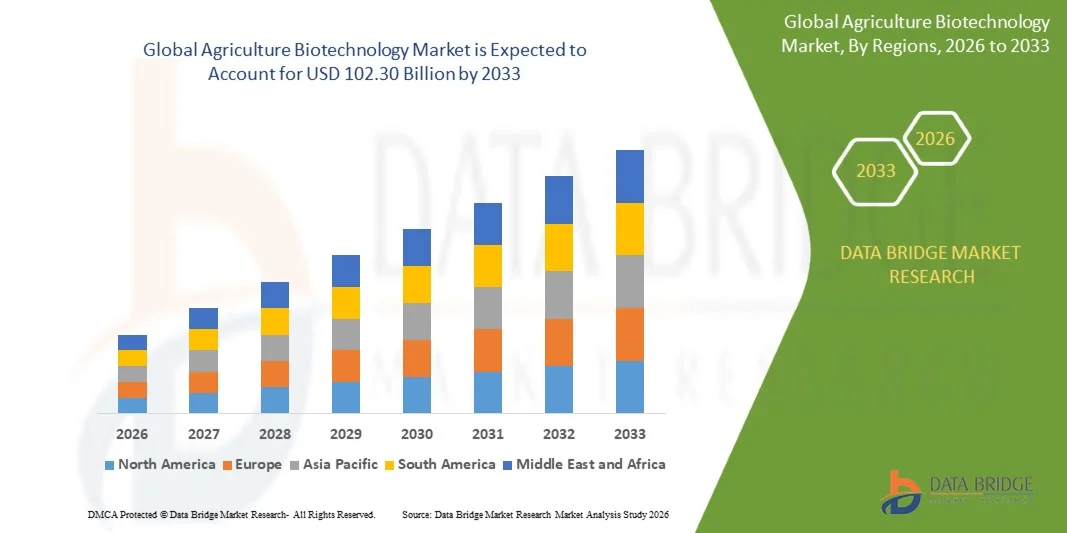
- As per Data Bridge Market Research analysis, the agriculture biotechnology market was valued at USD 92.19 billion in 2025 and is projected to reach USD 102.30 billion by 2033, growing at a CAGR of 10.20% from 2026 to 2033.
- The market is experiencing consistent growth driven by rising demand for higher-yielding and stress-tolerant crops, growing adoption of genome editing and biological crop inputs, and supportive regulatory changes in several major agricultural economies.
- The increasing shift toward precision breeding, trait stacking, and biological alternatives to chemical inputs, combined with growing investment in AI-assisted crop research, is supporting market adoption. Agriculture biotechnology is being applied across biopesticides for pest control, genome editing for crop improvement, and seed treatment solutions, offering growers higher productivity, climate resilience, and reduced dependence on synthetic inputs.
Market Size & Forecast
- Global Market Value (2025): USD 92.19 Billion
- Expected Market Value (2033): USD 102.30 Billion
- Forecast CAGR (2026–2033): 10.20%
- Leading Region in 2025: North America
- Fastest Growing Region: Asia-Pacific
What are the Major Takeaways of the Agriculture Biotechnology Market?
- North America dominated the agriculture biotechnology market with the largest revenue share of 38.15% in 2025, supported by near-universal adoption of biotech traits, strong research capability, and the presence of leading seed and trait developers.
- Asia-Pacific is expected to be the fastest-growing region at a CAGR of 12.35% from 2026 to 2033, fueled by rising food demand, government support for genome-edited crops, and expanding use of biological inputs.
- The genetic engineering segment led the market with a 47.60% share in 2025, driven by large-scale cultivation of herbicide-tolerant and insect-resistant crops.
- Genome editing is the fastest-growing technology, projected to register a CAGR of 14.70%, reflecting faster, more precise trait development and easing regulation in several countries.
- The transgenic seeds & crops segment dominated the product category with a 54.30% revenue share in 2025, led by widespread use of biotech corn, soybean, and cotton seeds.
- Crop improvement accounted for 51.20% of the market share in 2025, supported by demand for yield, stress tolerance, and quality traits across major field crops.
- The crop protection segment is the fastest-growing application category, with a CAGR of 11.90%, driven by growing adoption of biopesticides and pest-resistance traits.
Report Scope and Agriculture Biotechnology Market Segmentation
|
Attributes |
Agriculture Biotechnology Market Key Market Insights |
|
Segments Covered |
|
|
Countries Covered |
North America
Europe
Asia-Pacific
Middle East and Africa
South America
|
|
Key Market Players |
|
|
Market Opportunities |
|
|
Value Added Data Infosets |
In addition to the insights on market scenarios such as market value, growth rate, segmentation, geographical coverage, and major players, the market reports curated by the Data Bridge Market Research also include import export analysis, production capacity overview, production consumption analysis, price trend analysis, climate change scenario, supply chain analysis, value chain analysis, raw material/consumables overview, vendor selection criteria, PESTLE Analysis, Porter Analysis, and regulatory framework. |
What is the Key Trend in the Agriculture Biotechnology Market?
- Agriculture biotechnology is moving from first-generation transgenic traits toward precision breeding and genome editing, which allow targeted changes to existing genes and shorter development timelines for new crop varieties.
- For instance, in May 2025, according to India's Ministry of Agriculture and Farmers Welfare, the Indian Council of Agricultural Research launched two genome-edited rice varieties, DRR Dhan 100 (Kamala) and Pusa DST Rice 1, developed with CRISPR-Cas technology and aimed at higher yield and salinity tolerance.
- Governments are creating dedicated approval pathways for gene-edited plants that could have arisen through conventional breeding, reducing time and cost compared with traditional genetically modified crop approvals.
- Biological inputs such as biopesticides, biofertilizers, and biostimulants are being developed alongside biotech traits to reduce dependence on synthetic chemicals.
- For instance, in November 2025, according to the UK Government, the Genetic Technology (Precision Breeding) Regulations 2025 came into force on 13 November 2025, allowing developers to seek authorization to grow and sell precision-bred plants and food and feed derived from them in England.
- As regulation eases and AI-assisted discovery matures, agriculture biotechnology is expected to expand from major field crops into wheat, rice, vegetables, and specialty crops, with traits aimed at climate resilience and reduced input use.
What are the Key Drivers of the Agriculture Biotechnology Market?
- Rising global food demand, shrinking arable land per person, and increasing climate stress are driving demand for higher-yielding, pest-resistant, and stress-tolerant crop varieties developed through biotechnology.
- For instance, in July 2025, according to the U.S. Department of Agriculture Economic Research Service, adoption of genetically engineered seeds exceeded 90% for corn, upland cotton, and soybeans, with herbicide-tolerant soybeans at 96% and insect-resistant Bt corn at 87% of acreage in 2025.
- Growers are seeking tools that reduce chemical applications and production risk, which is increasing demand for insect-resistance traits, herbicide-tolerance stacks, and biological crop protection products.
- For instance, in November 2025, according to Corteva's third-quarter 2025 earnings call, hybrid wheat commercialization was on track for a 2027 launch with expected yield improvements of 10% to 15%, reflecting investment in new genetics for major food crops.
- Continuous investment by seed and agrochemical companies and public institutions in genomics, gene editing, and AI-enabled breeding is shortening development cycles and widening the pipeline of new products.
What Factors Are Challenging the Growth of the Agriculture Biotechnology Market?
- Developing and commercializing biotech and gene-edited crops requires long research timelines, significant capital, and navigation of varying approval systems across countries.
- For instance, in December 2025, according to the Council of the European Union, the provisional agreement on new genomic techniques keeps more complex NGT-2 plants under the existing GMO framework and allows member states to opt out of cultivating NGT-2 plants on their territory, showing continued regulatory fragmentation.
- Differences in labeling, traceability, and import rules between countries can restrict trade in biotech crops and make it harder for developers to launch products globally.
- Public acceptance concerns, patent and seed-access debates, and opposition from some farming and consumer groups can slow adoption in certain regions.
- For instance, in December 2025, according to law firm Finnegan, England's new precision breeding regulations diverge from Scotland, where precision breeding rules are not enforced and alignment with the EU is maintained, meaning that precision-bred crops authorized in England cannot automatically be marketed in Scotland.
- The combination of high development cost, divergent regulation across regions, and public acceptance concerns can constrain adoption and slow commercial launches, particularly for smaller developers and in markets with strict approval requirements.
How is the Agriculture Biotechnology Market Segmented?
The agriculture biotechnology market is segmented on the basis of technology, product, application, and end user.
- By Technology
On the basis of technology, the agriculture biotechnology market is segmented into genetic engineering, genome editing, tissue culture, molecular diagnostics, and others. The genetic engineering segment dominated the market with 47.60% share in 2025, supported by large-scale cultivation of herbicide-tolerant and insect-resistant crops. Established trait platforms are deployed across corn, soybean, cotton, and canola in major producing countries. Stacked traits allow growers to manage several weed and pest challenges in a single seed. Mature regulatory pathways in leading markets support continued commercial launches. Long-term investment by seed companies also sustains this segment.
The genome editing segment is projected to register the fastest growth at a CAGR of 14.70% from 2026 to 2033, driven by faster development cycles and greater precision than conventional breeding. Techniques such as CRISPR-Cas allow changes to existing genes without introducing foreign DNA. Several countries are creating simpler approval routes for gene-edited plants that could have arisen naturally. Applications include yield, disease resistance, stress tolerance, and quality traits. Public institutions and start-ups are also expanding the range of edited crops under development.
- By Product
On the basis of product, the agriculture biotechnology market is segmented into transgenic seeds & crops, biopesticides, biofertilizers, biostimulants, and others. The transgenic seeds & crops segment dominated the product category with 54.30% share in 2025, supported by high adoption of biotech corn, soybean, and cotton seeds. Adoption rates in major producing countries are already very high, giving the segment a large revenue base. Growers value built-in weed and insect control that lowers application costs. Seed companies continue to introduce new trait combinations and higher-yielding genetics. Royalty and licensing structures support steady revenue.
The biopesticides segment is projected to register the fastest growth at a CAGR of 13.40% from 2026 to 2033, driven by regulatory pressure on synthetic pesticides and demand for residue-free produce. Biological products based on microbes, natural compounds, and pheromones are being integrated into crop protection programs. Faster registration pathways in several countries are encouraging new launches. Growers are also using biologicals to manage resistance to conventional chemistries. Investment by large crop protection companies is widening distribution.
- By Application
On the basis of application, the agriculture biotechnology market is segmented into crop improvement, crop protection, animal genetics & health, and others. The crop improvement segment dominated the application category with 51.20% share in 2025, supported by demand for yield, stress tolerance, and quality traits across major field crops. Breeders use biotechnology to develop varieties suited to drought, salinity, heat, and disease pressure. Hybrid and trait development programs rely on molecular tools to shorten breeding cycles. Rising food demand and climate variability are increasing the value of improved genetics. Public and private research funding continues to support this segment.
The crop protection segment is projected to register the fastest growth at a CAGR of 11.90% from 2026 to 2033, driven by growing adoption of biopesticides, pest-resistance traits, and biological seed treatments. Integrated pest management strategies are combining biological and chemical tools to slow resistance. Regulatory limits on certain synthetic actives are encouraging alternatives. New traits that work together with novel herbicides and insecticides are under development. Growers also see biological products as a way to meet buyer sustainability requirements.
- By End User
On the basis of end user, the agriculture biotechnology market is segmented into seed & agrochemical companies, farmers & growers, research & academic institutes, and others. The seed & agrochemical companies segment dominated the end-user category with 49.50% share in 2025, supported by large research budgets and ownership of major trait and germplasm portfolios. These companies develop, license, and commercialize biotech traits and biological products. Strategic restructuring and partnerships are focusing resources on seed genetics and crop protection innovation. Patent portfolios give them strong positions in trait licensing. Global distribution networks help scale new products.
The farmers & growers segment is projected to register the fastest growth at a CAGR of 11.60% from 2026 to 2033, driven by rising direct adoption of biological inputs and improved seed technologies. Growers are seeking tools that raise yield stability while lowering chemical use. Digital advisory services help them select suitable traits and biologicals. Public extension programs and demonstration plots are increasing awareness. Greater availability of locally adapted genome-edited and biotech varieties is expanding the user base.
Which Region Holds the Largest Share of the Agriculture Biotechnology Market?
- North America dominated the agriculture biotechnology market with the largest revenue share of 38.15% in 2025, supported by near-universal adoption of biotech traits, strong research capability, and the presence of leading seed and trait developers.
- The region also benefits from well-established regulatory pathways, high private investment in plant genetics and gene editing, and strong grower familiarity with trait-based crop protection. Increasing development of genome-edited crops, biologicals, and AI-assisted breeding programs continues to strengthen North America's position in the global market.
U.S. Agriculture Biotechnology Market Insight
The U.S. agriculture biotechnology market is witnessing strong growth due to very high adoption of biotech traits, large field-crop acreage, and strong private research investment. Seed and crop protection companies are developing new herbicide-tolerance stacks, disease-resistant hybrids, and gene-edited traits. In addition, growing interest in biologicals and sustainable inputs is accelerating adoption across commercial farms.
Asia-Pacific Agriculture Biotechnology Market Insight
The Asia-Pacific agriculture biotechnology market is expected to witness rapid growth, driven by rising food demand, growing government investment in crop research, and policy support for genome-edited varieties across countries such as India, China, and Japan. Expanding use of biological inputs and improved seeds is supporting productivity goals. In addition, strong public research institutions are developing locally adapted crops.
India Agriculture Biotechnology Market Insight
The India agriculture biotechnology market is growing rapidly, supported by public research programs, regulatory frameworks for genome-edited crops, and rising demand for climate-resilient varieties. Research institutions are developing improved rice and other staple crops with higher yield and stress tolerance. Moreover, growing adoption of biofertilizers and biopesticides is encouraging wider use of biological solutions among farmers.
China Agriculture Biotechnology Market Insight
The China agriculture biotechnology market is witnessing consistent growth, driven by strong government emphasis on seed industry revitalization and food security. Domestic institutions and companies are investing in biotech traits, gene editing, and molecular breeding. In addition, expanding production and use of biological fertilizers and pesticides is supporting the broader adoption of agricultural biotechnology across the country.
U.K. Agriculture Biotechnology Market Insight
The U.K. agriculture biotechnology market is experiencing steady growth, supported by the introduction of a dedicated regulatory pathway for precision-bred plants in England. Universities, research institutes, and breeders are developing gene-edited crops with improved disease resistance and nutritional traits. Furthermore, strong life-science research capability is attracting investment into plant biotechnology.
Germany Agriculture Biotechnology Market Insight
The Germany agriculture biotechnology market is expanding steadily due to the country's strong plant science and seed research base and growing interest in gene-edited crops following changes to European rules. Breeders and research institutes are advancing resilient varieties and biological crop protection solutions. Continuous progress in sequencing, breeding technologies, and sustainable agriculture programs is further supporting market growth in the country.
Which are the Top Companies in Agriculture Biotechnology Market?
The agriculture biotechnology market is primarily led by well-established companies, including:
- Bayer AG (Germany)
- Corteva, Inc. (U.S.)
- Syngenta Group (Switzerland)
- BASF SE (Germany)
- KWS SAAT SE & Co. KGaA (Germany)
- Limagrain (France)
- FMC Corporation (U.S.)
- UPL Limited (India)
- Sumitomo Chemical Co., Ltd. (Japan)
- Nufarm Limited (Australia)
- Novonesis (Denmark)
- Koppert Biological Systems (Netherlands)
- Bioceres Crop Solutions Corp. (Argentina)
- Rovensa Group (Spain)
- Cibus, Inc. (U.S.)
- Pairwise (U.S.)
- Inari Agriculture, Inc. (U.S.)
- Evogene Ltd. (Israel)
- Arcadia Biosciences, Inc. (U.S.)
- Certis Biologicals (U.S.)
What are Latest Developments in Agriculture Biotechnology Market?
- In September 2026, Bayer announced a genome-edited standable soybean and the development of a herbicide-tolerance trait to correspond with its new herbicide Icafolin. The company also said Vyconic, the first soybean trait stack with tolerance to five herbicides, begins commercial launch in Argentina this year as part of its plan to bring 10 blockbusters to market.
- In May 2026, Corteva renamed its seed and genetics business Vylor ahead of the planned separation from its crop protection business, which was announced in October 2025. The company said Vylor holds more than 4,000 germplasm patents and more than 2,000 biotechnology patents spanning hybrid wheat, gene editing, and multi-disease resistant corn.
- In March 2026, BASF reiterated at Commodity Classic that its transgenic Nemasphere trait for soybean cyst nematode remains on track for commercial launch in 2028, pending regulatory approval. The company also said it has 28 soybean varieties in development ranging from maturity Group 0 to Group 4.5.
- In October 2025, Corteva announced plans to separate into two independent publicly traded companies, a crop protection business and a seed genetics business, with completion targeted for the second half of 2026. Management said the seed business would pursue opportunities in out-licensing, hybrid wheat, biofuels, and gene editing.
- In June 2025, BASF unveiled InVigor Gold, a new innovation in canola seed, as part of an updated trait and seed pipeline presented to growers. The launch reflects continued investment by major seed companies in new traits and genetics for oilseed crops.

- Interactive Data Analysis Dashboard
- Company Analysis Dashboard for high growth potential opportunities
- Research Analyst Access for customization & queries
- Competitor Analysis with Interactive dashboard
- Latest News, Updates & Trend analysis
- Harness the Power of Benchmark Analysis for Comprehensive Competitor Tracking
Data collection and base year analysis are done using data collection modules with large sample sizes. The stage includes obtaining market information or related data through various sources and strategies. It includes examining and planning all the data acquired from the past in advance. It likewise envelops the examination of information inconsistencies seen across different information sources. The market data is analysed and estimated using market statistical and coherent models. Also, market share analysis and key trend analysis are the major success factors in the market report. To know more, please request an analyst call or drop down your inquiry.
The key research methodology used by DBMR research team is data triangulation which involves data mining, analysis of the impact of data variables on the market and primary (industry expert) validation. Data models include Vendor Positioning Grid, Market Time Line Analysis, Market Overview and Guide, Company Positioning Grid, Patent Analysis, Pricing Analysis, Company Market Share Analysis, Standards of Measurement, Global versus Regional and Vendor Share Analysis. To know more about the research methodology, drop in an inquiry to speak to our industry experts.
Data Bridge Market Research is a leader in advanced formative research. We take pride in servicing our existing and new customers with data and analysis that match and suits their goal. The report can be customized to include price trend analysis of target brands understanding the market for additional countries (ask for the list of countries), clinical trial results data, literature review, refurbished market and product base analysis. Market analysis of target competitors can be analyzed from technology-based analysis to market portfolio strategies. We can add as many competitors that you require data about in the format and data style you are looking for. Our team of analysts can also provide you data in crude raw excel files pivot tables (Fact book) or can assist you in creating presentations from the data sets available in the report.