What is the Seed Treatment Market Size and Growth Rate?
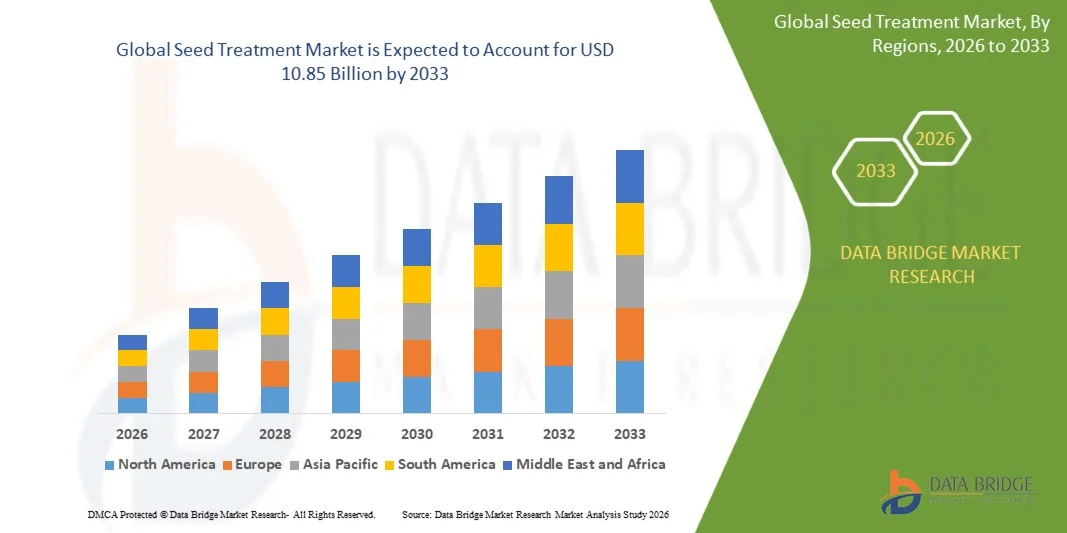
As per Data Bridge Market Research analysis, the seed treatment market was valued at USD 5.57 billion in 2025 and is projected to reach USD 10.85 billion by 2033, growing at a CAGR of 8.7% from 2026 to 2033. The market is experiencing consistent growth driven by the increasing need for higher crop yields, rising pest and disease pressure, and continuous advancements in seed treatment formulations and delivery technologies.
The growing adoption of high-value hybrid and genetically modified seeds, combined with the global shift toward sustainable agriculture, is encouraging farmers to implement advanced seed treatment solutions before planting. Biological seed treatments, innovative coating technologies, and integrated crop protection strategies are increasingly replacing conventional approaches by providing enhanced seed protection, improved germination, and higher crop productivity while reducing environmental impact.
Market Size & Forecast
- Global Market Value (2025): USD 5.57 Billion
- Expected Market Value (2033): USD 10.85 Billion
- Forecast CAGR (2026–2033): 8.7%
- Leading Region in 2025: North America
- Fastest Growing Region: Asia Pacific
What are the Major Takeaways of Seed Treatment Market?
- North America dominated the seed treatment market with the largest revenue share of 31.10% in 2025, supported by high adoption of treated seeds, advanced farming practices, and strong demand for crop protection technologies
- The fungicide segment led the market with a 43.8% share in 2025, driven by its critical role in protecting seeds and young seedlings from soil-borne and seed-borne fungal diseases that can significantly reduce crop yields
- Asia-Pacific is expected to be the fastest-growing regional market, projected to register a CAGR of 8.3% during the forecast period, fueled by increasing use of hybrid seeds, expanding commercial agriculture, and rising investments in modern crop protection practices across China and India
- Bio-control are the fastest-growing product type, projected to register a CAGR of 11.2%, reflecting the surge in demand for sustainable agricultural practices and environmentally friendly crop protection solutions
- The seed coating segment dominated the treatment method category with a 46.5% revenue share in 2025, led by its ability to deliver precise quantities of active ingredients directly onto seed surfaces
- Cereals & grains accounted for 48.6% of the market, preferred by the extensive global cultivation of crops such as corn, wheat, rice, and barley
- The non-chemical seed treatment segment is the fastest-growing type category, with a CAGR of 10.7%, driven by increasing environmental concerns and growing demand for sustainable crop protection solutions
Report Scope and Seed Treatment Market Segmentation
|
Attributes |
Seed Treatment Key Market Insights |
|
Segments Covered |
|
|
Countries Covered |
North America
Europe
Asia-Pacific
Middle East and Africa
South America
|
|
Key Market Players |
|
|
Market Opportunities |
|
|
Value Added Data Infosets |
In addition to the insights on market scenarios such as market value, growth rate, segmentation, geographical coverage, and major players, the market reports curated by the Data Bridge Market Research also include import export analysis, production capacity overview, production consumption analysis, price trend analysis, climate change scenario, supply chain analysis, value chain analysis, raw material/consumables overview, vendor selection criteria, PESTLE Analysis, Porter Analysis, and regulatory framework. |
What is the Key Trend in the Seed Treatment Market ?
Trend: Growing Adoption of Biological and Sustainable Seed Treatment Solutions
Farmers are increasingly adopting biological seed treatments to improve seed vigor, enhance crop resilience, and reduce dependence on conventional chemical pesticides while meeting evolving sustainability goals and regulatory requirements. The integration of microbial inoculants, biofungicides, and advanced seed coating technologies is enabling improved germination and early plant establishment. Seed companies are also expanding biological product portfolios to support regenerative agriculture and integrated crop management practices, while innovations in formulation technologies continue to improve product efficacy across diverse crop systems. For instance, in June 2024, Reuters reported that Brazil's bioinputs market, including biological seed treatment products, was growing at nearly four times the global average rate, driven by increasing adoption of sustainable agricultural inputs.
This trend is expected to accelerate the transition toward environmentally responsible and high-performance seed treatment technologies.
Seed Treatment Market Dynamics
Key Market Driver: Rising Demand for High-Yield Crops and Protection Against Seed- and Soil-Borne Diseases
The increasing need to maximize agricultural productivity and protect high-value hybrid seeds is driving demand for advanced seed treatment technologies that safeguard crops during the critical germination stage. Seed treatments provide early-season protection against fungal pathogens, insects, and nematodes while improving stand establishment and reducing the need for multiple foliar pesticide applications. Agricultural input companies are investing in innovative biological and chemical formulations that enhance crop performance, improve resource efficiency, and support sustainable farming systems. For instance, in March 2024, Syngenta announced the expansion of its Seed Health Laboratory in Hyderabad, India, to strengthen seed testing, disease detection, and seed quality assurance capabilities for global agriculture.
This driver is expected to sustain long-term market growth as global food demand and crop protection requirements continue to increase.
Key Restraint/Challenge: Stringent Regulatory Requirements for Chemical Seed Treatment Products
A significant challenge for the seed treatment market is the tightening regulatory framework governing the approval and use of chemical active ingredients, particularly across Europe and other environmentally regulated regions. Manufacturers must invest heavily in product registration, environmental safety studies, and regulatory compliance while responding to growing concerns regarding pollinator health, environmental toxicity, and pesticide residues. These requirements increase product development costs, extend commercialization timelines, and encourage reformulation toward lower-risk alternatives. For instance, in September 2023, Reuters reported that the European Union's restrictions on neonicotinoid seed treatments, led to reduced sugar beet cultivation and lower yields in several EU countries, highlighting the regulatory challenges facing chemical seed treatment products. This instance demonstrates how stringent pesticide regulations are increasing pressure on manufacturers to develop alternative seed treatment solutions.
This challenge is expected to increase compliance costs while accelerating innovation in sustainable seed treatment technologies.
Key Market Opportunity: Expansion of Biological Seed Treatments and Regenerative Agriculture Practices
The rapid expansion of regenerative agriculture and sustainable farming systems is creating significant opportunities for biological seed treatment products that enhance nutrient uptake, improve soil health, and strengthen crop resilience while reducing dependence on synthetic crop protection chemicals. Growing regulatory support for environmentally friendly agricultural inputs, combined with increasing adoption of microbial inoculants and bio-based seed coatings, is encouraging manufacturers to expand biological product portfolios across major crop categories. Seed companies are also investing in next-generation biological formulations that improve efficacy, shelf life, and compatibility with precision agriculture systems. For instance, in October 2022, Bayer and Ginkgo Bioworks finalized a multi-year strategic partnership to accelerate the development of next-generation agricultural biologicals, including microbial crop protection, nitrogen optimization, and carbon sequestration technologies that support biological seed treatment innovation. This collaboration highlights the growing industry investment in advanced biological platforms for sustainable crop protection
This opportunity is expected to accelerate market expansion as growers seek higher productivity with lower environmental impact.
How is the Seed Treatment Market Segmented?
The seed treatment market is segmented on the basis of product, treatment method, crop type, type, and application.
- By Product
On the basis of product, the seed treatment market is segmented into insecticide, fungicide, bio-control, and others. The fungicide segment dominated the market with an estimated 43.8% share in 2025, owing to its critical role in protecting seeds and young seedlings from soil-borne and seed-borne fungal diseases that can significantly reduce crop yields. Fungicidal seed treatments are extensively used across cereals, grains, oilseeds, and pulses to improve germination rates and ensure uniform crop establishment. Their ability to provide early-stage disease protection while reducing the need for multiple foliar fungicide applications has increased adoption among commercial growers. Continuous development of broad-spectrum fungicide formulations is further enhancing treatment effectiveness. Strong demand for high-quality crop production and improved farm productivity continues to support segment growth. Widespread acceptance among large-scale agricultural producers reinforces its market leadership.
The bio-control segment is projected to register the fastest growth at a CAGR of 11.2% from 2026 to 2033, driven by increasing demand for sustainable agricultural practices and environmentally friendly crop protection solutions. Biological seed treatments utilize beneficial microorganisms and naturally derived compounds to improve seed health and crop performance. Growing regulatory restrictions on chemical pesticides are encouraging farmers to adopt biological alternatives. Advancements in microbial technology and formulation science are improving product efficacy and commercial viability. Rising investments by agricultural biotechnology companies are accelerating innovation within this segment. Increasing adoption of regenerative agriculture practices is expected to further strengthen long-term growth prospects.
- By Treatment Method
On the basis of treatment method, the seed treatment market is segmented into seed coating, seed dressing, and seed pelleting. The seed coating segment accounted for the largest market share of 46.5% in 2025 owing to its ability to deliver precise quantities of active ingredients directly onto seed surfaces. This method enhances seed protection, improves handling characteristics, and enables uniform application of pesticides, biological agents, and nutrients. Seed coating technologies support better germination and early plant development while minimizing product wastage. The increasing use of high-value hybrid and genetically modified seeds has further accelerated adoption. Technological advancements in polymer coatings and controlled-release formulations are strengthening market demand. Its compatibility with precision agriculture practices continues to support widespread deployment.
The seed pelleting segment is anticipated to register the fastest growth at a CAGR of 9.8% from 2026 to 2033 due to increasing demand for precision planting and improved seed placement accuracy. Pelleting enhances seed size, shape, and weight, making seeds easier to handle during mechanized sowing operations. This technology is particularly beneficial for small and irregularly shaped seeds commonly used in vegetable and specialty crop cultivation. Rising adoption of automated farming equipment is driving demand for pelletized seeds. Manufacturers are increasingly incorporating nutrients and biological agents into pellet formulations to improve crop performance. Growing focus on maximizing planting efficiency and reducing seed wastage is expected to further accelerate growth.
- By Crop Type
On the basis of crop type, the seed treatment market is segmented into cereals & grains, oilseeds & pulses, and other crop types. The cereals & grains segment dominated the market with a 48.6% share in 2025 due to the extensive global cultivation of crops such as corn, wheat, rice, and barley. These crops represent a substantial share of global agricultural output and require effective seed protection to ensure optimal yields. Seed treatment helps minimize losses caused by fungal diseases, insect infestations, and adverse soil conditions during early growth stages. Increasing demand for food security and higher crop productivity continues to support adoption. Farmers are increasingly investing in treated seeds to improve germination rates and crop establishment. Large-scale commercial farming activities further reinforce segment dominance.
The oilseeds & pulses segment is expected to witness the fastest growth at a CAGR of 8.9% from 2026 to 2033, driven by rising global demand for plant-based proteins, edible oils, and animal feed ingredients. Crops such as soybean, canola, sunflower, and pulses are increasingly benefiting from advanced seed treatment technologies. Growing awareness regarding seed-borne disease management is encouraging wider adoption among growers. Expansion of soybean cultivation across emerging economies is supporting market growth. Increasing use of biological seed treatments in oilseed production is creating additional opportunities. Rising investments in sustainable agriculture are expected to further strengthen segment expansion.
- By Type
On the basis of type, the seed treatment market is segmented into chemical seed treatment and non-chemical seed treatment. The chemical seed treatment segment held the largest market share of 71.4% in 2025 owing to its proven effectiveness in controlling a broad range of insects, fungi, and pathogens. Chemical treatments provide reliable and cost-effective protection during the critical early stages of crop development. Their widespread availability and extensive adoption across major agricultural regions continue to drive market leadership. Farmers prefer chemical seed treatments due to their consistent performance and ease of integration into existing farming practices. Ongoing innovation in active ingredient formulations is improving efficacy while reducing environmental impact. Strong demand from large-scale commercial agriculture remains a key growth contributor.
The non-chemical seed treatment segment is projected to register the fastest growth at a CAGR of 10.7% from 2026 to 2033, supported by increasing environmental concerns and growing demand for sustainable crop protection solutions. Biological inoculants, microbial treatments, and natural seed enhancement products are gaining popularity among farmers seeking alternatives to synthetic chemicals. Regulatory agencies are encouraging adoption through favorable policies and sustainability initiatives. Advances in biotechnology are significantly improving the effectiveness of non-chemical treatment products. Rising consumer preference for organic and residue-free food production is further stimulating demand. Continued investment in agricultural biologicals is expected to accelerate market penetration globally.
- By Application
On the basis of application, the seed treatment market is segmented into seed protection and seed enhancement. The seed protection segment dominated the market with a 67.9% share in 2025 due to its essential role in safeguarding seeds from insects, fungal infections, nematodes, and adverse environmental conditions. Protecting seeds during the germination phase significantly improves crop establishment and overall agricultural productivity. Farmers increasingly rely on seed protection solutions to reduce crop losses and minimize the need for post-emergence pesticide applications. The segment benefits from strong demand across cereals, grains, oilseeds, and specialty crops. Continuous innovation in crop protection technologies is further improving treatment efficiency. Its direct impact on yield optimization continues to support market leadership.
The seed enhancement segment is anticipated to register the fastest growth at a CAGR of 9.6% from 2026 to 2033, driven by increasing focus on improving germination rates, seed vigor, and plant performance. Seed enhancement technologies include nutrient coatings, growth stimulants, biological inoculants, and stress tolerance agents that improve crop establishment under challenging environmental conditions. Growing climate variability is encouraging farmers to adopt solutions that improve seed resilience and productivity. Advances in biological technologies are expanding the effectiveness of enhancement products. Rising adoption of precision agriculture practices is further supporting demand. Increasing emphasis on maximizing crop output from limited arable land is expected to drive substantial growth in this segment
Which Region Holds the Largest Share of the Seed Treatment Market?
North America dominated the seed treatment market with the largest revenue share of 31.10% in 2025, supported by high adoption of treated seeds, advanced farming practices, and strong demand for crop protection technologies. The region also benefits from advanced farming practices, strong investment in agricultural biotechnology, and extensive use of hybrid and genetically modified seeds. Growing adoption of biological seed treatment products, precision agriculture technologies, and integrated pest management programs is accelerating market development. Increasing focus on improving crop productivity, reducing yield losses from seed- and soil-borne diseases, and enhancing farm profitability continues to strengthen North America's leadership position in the global market.
U.S. Seed Treatment Market Insight
The U.S. seed treatment market is witnessing strong growth due to rising adoption of high-value hybrid seeds, increasing focus on crop protection, and growing investments in sustainable agricultural technologies. The country’s large-scale corn and soybean production, along with widespread use of treated seeds, is driving demand across major farming regions. In addition, increasing adoption of biological seed treatments, precision agriculture systems, and integrated pest management practices is accelerating market expansion. According to the USDA's Prospective Plantings Report 2024, U.S. farmers intended to plant approximately 95.3 million acres of corn in 2024, demonstrating the extensive scale of row-crop cultivation and the corresponding demand for seed treatment technologies that protect seed performance and maximize crop establishment.
Europe Seed Treatment Market Insight
The Europe seed treatment market remains a major contributor to global revenue, driven by advanced agricultural practices, strong seed technology adoption, and increasing emphasis on sustainable crop production. The widespread use of certified seeds and growing investments in biological seed treatment solutions are supporting market expansion across the region. Increasing focus on reducing environmental impact while maintaining crop productivity continues to drive innovation within the sector. According to the European Seed Association, more than 7,000 seed companies operate across Europe, supporting one of the world's most advanced seed industries and driving continued demand for seed treatment technologies.
U.K. Seed Treatment Market Insight
The U.K. seed treatment market is experiencing steady growth, supported by increasing demand for sustainable farming practices, improved crop productivity, and enhanced seed health management. Growing investments in agricultural research and precision farming technologies are contributing to market expansion. Furthermore, increasing adoption of biological seed treatment products and integrated crop management solutions is supporting long-term growth. According to DEFRA’s Agriculture in the United Kingdom 2023 report, cereal crops accounted for 68% of the U.K. cropped area, with wheat and barley representing the dominant cereal crops, supporting continued demand for seed treatment products that enhance crop establishment and protect against seed- and soil-borne diseases.
Germany Seed Treatment Market Insight
The Germany seed treatment market is expanding steadily due to the country’s strong agricultural sector, advanced crop protection industry, and increasing adoption of sustainable farming technologies. Agricultural producers are increasingly utilizing treated seeds to improve germination, disease resistance, and overall crop performance. Continuous advancements in biological seed treatment solutions and precision agriculture technologies are further supporting market growth. According to the Federal Statistical Office of Germany (Destatis), cereals remain among the country's most widely cultivated crops, supporting continuous demand for advanced seed protection and enhancement product
Asia-Pacific Seed Treatment Market Insight
The Asia-Pacific seed treatment market is expected to witness rapid growth, driven by increasing food demand, expanding commercial agriculture, and rising adoption of hybrid seeds across countries such as China, India, and Japan. Growing awareness regarding crop protection, increasing investments in agricultural modernization, and rising demand for higher crop yields are supporting regional market expansion. In addition, government initiatives promoting sustainable farming and precision agriculture are accelerating seed treatment adoption. According to the Food and Agriculture Organization (FAO), Asia accounts for more than 50% of global agricultural production, creating significant opportunities for seed treatment technologies to improve crop productivity and food security.
Japan Seed Treatment Market Insight
The Japan seed treatment market is witnessing consistent growth due to increasing adoption of advanced agricultural technologies, rising demand for high-quality crop production, and strong emphasis on food security. Agricultural producers are increasingly utilizing seed treatment products to improve crop establishment and reduce disease-related losses. Moreover, growing investment in biological crop protection and precision farming technologies is further contributing to market growth. According to Japan's Ministry of Agriculture, Forestry and Fisheries (MAFF), the government continues to promote smart agriculture technologies to improve productivity and sustainability, supporting demand for advanced seed treatment solutions.
China Seed Treatment Market Insight
The China seed treatment market is growing rapidly, driven by increasing agricultural modernization, expanding hybrid seed adoption, and rising government focus on food security and crop productivity. Growing use of biological and chemical seed treatment products across major crop categories is significantly boosting market demand. In addition, rising investments in agricultural biotechnology and precision farming are supporting long-term market growth. According to China's Ministry of Agriculture and Rural Affairs, the country continues to prioritize seed industry development under its national seed revitalization strategy, strengthening demand for advanced seed treatment technologies and high-performance seed products.
Which are the Top Companies in Seed Treatment Market?
The seed treatment industry is primarily led by well-established companies, including:
- Bayer AG (Germany)
- Syngenta Crop Protection AG (Switzerland)
- BASF SE (Germany)
- Corteva (U.S.)
- Sumitomo Chemical Co., Ltd. (Japan)
- FMC Corporation (U.S.)
- UPL LTD (India)
- Nufarm (Australia)
- Mitsui Chemicals Crop & Life Solutions, Inc. (Japan)
- Bioceres Crop Solutions (Argentina)
- Valent BioSciences LLC (U.S.)
- Novozymes A/S (Denmark)
- Koppert (Netherlands)
- Certis Belchim B.V. (Netherlands)
- Verdesian Life Sciences (U.S.)
- Precision Laboratories, LLC (U.S.)
- Croda International Plc. (Netherlands)
- Germains Seed Technology (U.K.)
- Plant Health Care plc (U.K.)
What are Latest Developments in Seed Treatment Market?
- In November 2025, Syngenta announced the launch of Victrato seed treatment, a new Seedcare innovation designed to provide broad-spectrum protection against plant-parasitic nematodes and diseases in soybean and cotton crops. The product received registration from the U.S. Environmental Protection Agency and is expected to support growers by improving early-season crop protection and yield potential. Victrato uses Syngenta’s TYMIRIUM® technology to deliver advanced nematode management and disease suppression through a single seed treatment solution, strengthening Syngenta’s portfolio of next-generation crop protection technologies
- In November 2025, BASF announced the registration of Integral Pro fungicide seed treatment for sunflower cultivation in France, expanding access to its biological seed treatment solutions across Europe. The product is part of BASF’s BioSolutions portfolio and is designed to protect sunflower seeds against seed- and soil-borne fungal diseases while supporting crop resilience. Integral Pro represents BASF’s continued investment in sustainable biological technologies that combine crop protection with improved agricultural performance
- In August 2025, Bayer introduced Yoalo, a biological biostimulant designed to enhance plant performance and improve nutrient availability through seed treatment combinations. The product was developed as part of Bayer’s expanding biological solutions portfolio and is intended to support growers by improving crop vigor and stress tolerance. Yoalo is being integrated into Bayer’s Acceleron seed treatment combinations for Dekalb® seeds, highlighting the company’s focus on combining biological technologies with conventional seed treatment platforms. This development reflects the increasing industry shift toward sustainable and integrated seed enhancement solutions
- In March 2023, Syngenta Crop Protection partnered with Aphea.Bio to accelerate the development and commercialization of a novel biological seed treatment solution for wheat crops across Europe. The collaboration focused on ACTIV by Aphea.Bio, a microbial-based biostimulant seed treatment designed to improve wheat yield performance while reducing fertilizer requirements. The partnership highlights increasing investment in biological seed treatment technologies that support sustainable agriculture and improved resource efficiency. This development demonstrates the growing importance of microbial solutions within the global seed treatment industry
- In September 2022, Syngenta Seedcare and Bioceres Crop Solutions announced a strategic collaboration to bring innovative biological seed treatment solutions to growers globally. The partnership focused on combining Syngenta’s global seed treatment commercialization capabilities with Bioceres’ biological inoculant technologies, including microbial solutions that improve crop nutrition and plant growth. The companies planned joint research and development activities to accelerate registration and commercialization of biological seed treatments across key agricultural markets, including Brazil and China

- Interactive Data Analysis Dashboard
- Company Analysis Dashboard for high growth potential opportunities
- Research Analyst Access for customization & queries
- Competitor Analysis with Interactive dashboard
- Latest News, Updates & Trend analysis
- Harness the Power of Benchmark Analysis for Comprehensive Competitor Tracking
Data collection and base year analysis are done using data collection modules with large sample sizes. The stage includes obtaining market information or related data through various sources and strategies. It includes examining and planning all the data acquired from the past in advance. It likewise envelops the examination of information inconsistencies seen across different information sources. The market data is analysed and estimated using market statistical and coherent models. Also, market share analysis and key trend analysis are the major success factors in the market report. To know more, please request an analyst call or drop down your inquiry.
The key research methodology used by DBMR research team is data triangulation which involves data mining, analysis of the impact of data variables on the market and primary (industry expert) validation. Data models include Vendor Positioning Grid, Market Time Line Analysis, Market Overview and Guide, Company Positioning Grid, Patent Analysis, Pricing Analysis, Company Market Share Analysis, Standards of Measurement, Global versus Regional and Vendor Share Analysis. To know more about the research methodology, drop in an inquiry to speak to our industry experts.
Data Bridge Market Research is a leader in advanced formative research. We take pride in servicing our existing and new customers with data and analysis that match and suits their goal. The report can be customized to include price trend analysis of target brands understanding the market for additional countries (ask for the list of countries), clinical trial results data, literature review, refurbished market and product base analysis. Market analysis of target competitors can be analyzed from technology-based analysis to market portfolio strategies. We can add as many competitors that you require data about in the format and data style you are looking for. Our team of analysts can also provide you data in crude raw excel files pivot tables (Fact book) or can assist you in creating presentations from the data sets available in the report.