


AI-Based Flu Tracking Service Market Size
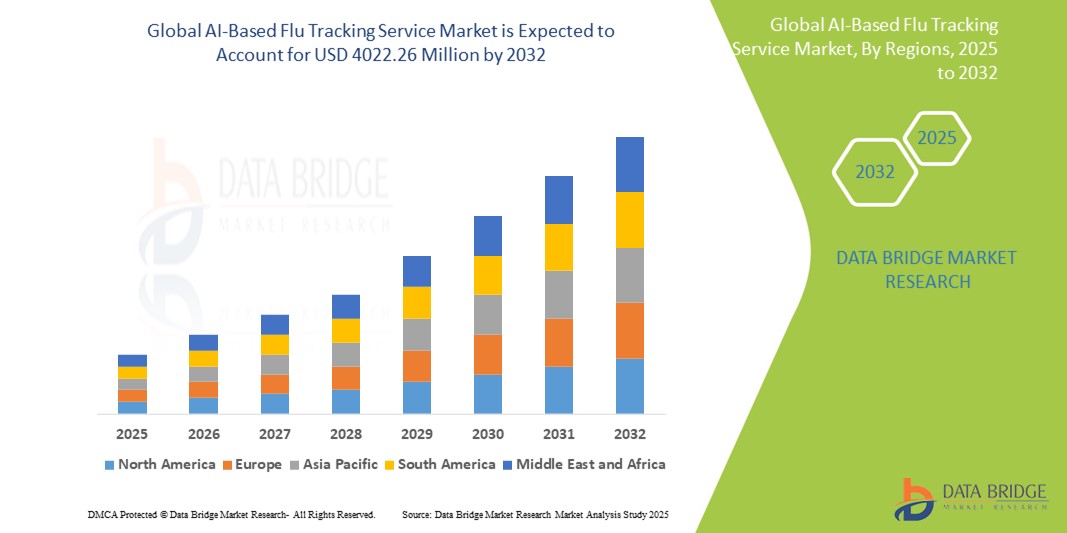
- The global AI-based flu tracking service market size was valued at USD 643.7 million in 2024 and is expected to reach USD 4,022.26 Million by 2032, at a CAGR of 25.70% during the forecast period
- The market growth is largely fueled by the increasing focus on early identification and effective management of influenza outbreaks, particularly with the heightened awareness of infectious disease spread following recent global health crises
- Furthermore, rising demand from public health agencies for robust surveillance tools, healthcare providers for informed decision-making, and pharmaceutical companies for vaccine development, coupled with continuous advancements in machine learning algorithms and data analytics, is establishing AI-based solutions as critical components of modern infectious disease control
AI-Based Flu Tracking Service Market Analysis
- AI-based flu tracking services, leveraging advanced algorithms to analyze diverse data sources, are increasingly vital components of modern public health surveillance and infectious disease management systems in both governmental and private healthcare settings. Their enhanced capabilities for early detection, predictive analytics, and real-time insights make them indispensable for informed decision-making and proactive interventions
- The escalating demand for AI-based flu tracking is primarily fueled by the intensified global focus on pandemic preparedness and rapid response following recent health crises, a growing recognition of the limitations of traditional surveillance methods, and the widespread availability of large, diverse datasets
- North America dominates the AI-based flu tracking service market with the largest revenue share of 47.5% in 2024, characterized by its advanced healthcare infrastructure, high investment in public health technologies, and a strong presence of key AI and healthcare technology innovators
- Asia-Pacific is expected to be the fastest growing region in the AI-based flu tracking service market during the forecast period due to increasing urbanization, rising healthcare expenditure, a large and dense population base prone to rapid disease spread, and a growing emphasis on adopting advanced digital health solutions for public health management
- Non-traditional data analytics segment dominates the AI-based flu tracking service market with a market share of 46.5% in 2024, driven by its capability to provide real-time, wide-ranging insights from diverse digital sources such as social media, search queries, and wearables, enabling earlier and more comprehensive detection of flu trends than traditional methods
Report Scope and AI-Based Flu Tracking Service Market Segmentation
|
Attributes |
AI-Based Flu Tracking Service Key Market Insights |
|
Segments Covered |
|
|
Countries Covered |
North America
Europe
Asia-Pacific
Middle East and Africa
South America
|
|
Key Market Players |
|
|
Market Opportunities |
|
|
Value Added Data Infosets |
In addition to the insights on market scenarios such as market value, growth rate, segmentation, geographical coverage, and major players, the market reports curated by the Data Bridge Market Research also include in-depth expert analysis, pricing analysis, brand share analysis, consumer survey, demography analysis, supply chain analysis, value chain analysis, raw material/consumables overview, vendor selection criteria, PESTLE Analysis, Porter Analysis, and regulatory framework. |
AI-Based Flu Tracking Service Market Trends
“Proactive Preparedness Through Real-time Data and Predictive AI”
- A significant and accelerating trend in the global AI-based flu tracking services market is the profound shift towards proactive preparedness through the sophisticated integration of real-time, diverse data sources and advanced predictive AI capabilities. This fusion is dramatically enhancing the accuracy and speed with which flu outbreaks can be detected, monitored, and forecasted
- For instance, cutting-edge platforms are leveraging Natural Language Processing (NLP) to analyze vast quantities of online discourse, social media trends, and news reports for early indicators of flu-like symptoms or community spread. Similarly, the analysis of aggregated, anonymized data from wearable devices provides a unique, real-time physiological layer of surveillance. This is further complemented by geospatial AI that integrates environmental, climatic, and demographic data to identify and predict localized high-risk areas
- AI's integration in flu tracking enables features such as dynamic learning from evolving flu patterns to forecast future waves with superior precision, and delivering more intelligent, context-aware alerts based on real-time epidemiological shifts. For instance, advanced AI models are continuously refining their predictive capabilities by incorporating feedback loops from actual reported flu cases and vaccine efficacy data, leading to more robust and adaptive forecasts. Furthermore, the ability to seamlessly integrate disparate data types offers public health officials comprehensive, multi-faceted insights crucial for strategic planning
- The seamless integration of AI-based flu tracking solutions with broader public health dashboards and national/international epidemiological models is facilitating centralized, cohesive control over various aspects of disease surveillance and response
- This trend towards more intelligent, intuitive, and interconnected flu tracking systems is fundamentally reshaping global expectations for infectious disease preparedness and response. Consequently, public health bodies, research institutions, and private developers are aggressively investing in AI-enabled platforms featuring automated anomaly detection, dynamic risk mapping, and integrated communication functionalities for efficient public alerts and guidance
AI-Based Flu Tracking Service Market Dynamics
Driver
“Increasing Imperative for Proactive Public Health Surveillance and Pandemic Preparedness”
- The escalating demand for AI-based flu tracking services is primarily fueled by the intensified global focus on robust public health surveillance and swift pandemic preparedness, profoundly amplified by the lessons learned from recent global health crises. This has created an urgent need for more agile and precise tools to monitor and predict infectious disease outbreaks
- For instance, government initiatives worldwide are increasingly funding projects that integrate AI into public health infrastructure, recognizing its capacity to provide real-time insights and predictive warnings that surpass traditional epidemiological methods. This strategic shift by key public health bodies is expected to significantly drive the AI-based flu tracking industry's growth in the forecast period
- As healthcare authorities and policymakers become acutely aware of the devastating economic and human costs of uncontained outbreaks, AI-based flu tracking offers advanced capabilities such as early anomaly detection, granular geographic trend analysis, and sophisticated forecasting, providing a compelling upgrade over manual or siloed data collection
- Furthermore, the growing availability of diverse data sources – from clinical records and laboratory results to anonymized digital footprints from social media, search engines, and even wearable health devices and the desire for interconnected public health ecosystems are making AI-powered flu tracking an integral component of modern disease control systems. These solutions offer seamless integration with existing health information platforms and broader public health initiatives
- The critical need for timely resource allocation (for instance, vaccines, antivirals, hospital beds), rapid policy adjustments, and effective public communication during flu seasons are key factors propelling the adoption of AI-based flu tracking services across governmental, healthcare, and pharmaceutical sectors. The trend towards data-driven decision-making and the increasing sophistication of AI models further contributes to market expansion
Restraint/Challenge
“Addressing Data Privacy, Interoperability, and High Implementation Costs”
- Concerns surrounding data privacy, the complex ethical implications of using sensitive health data, and significant interoperability challenges pose substantial hurdles to the widespread adoption and scaling of AI-based flu tracking services. As these systems rely on aggregating vast, often personal, health and behavioral datasets, anxieties among both individuals and public health bodies about data security and potential misuse are significant
- For instance, highly publicized data breaches in healthcare and the inherent 'black box' nature of some advanced AI models create hesitation regarding the transparency and accountability of these systems. Furthermore, integrating AI solutions with disparate legacy health IT systems and ensuring seamless data exchange across different platforms and jurisdictions presents a major interoperability barrier, hindering comprehensive real-time surveillance
- Addressing these complex challenges requires robust cybersecurity frameworks, strict adherence to data protection regulations transparent AI governance, and the development of standardized data exchange protocols. Companies and public health organizations are increasingly investing in privacy-preserving AI techniques and emphasizing clear data usage policies to build trust. In addition, the relatively high initial investment in AI infrastructure, specialized talent, and ongoing maintenance can be a significant barrier for budget-constrained public health departments or smaller healthcare providers, particularly in developing regions. While some basic AI solutions are emerging, the full potential of advanced predictive analytics often comes with a substantial price tag
- While the long-term benefits of AI in public health are clear, the perceived high upfront costs and the complexities of ensuring data security and ethical use can still hinder widespread adoption, especially for organizations that lack the immediate resources or technical expertise for large-scale AI implementation
AI-Based Flu Tracking Service Market Scope
The market is segmented on the basis of technology, service type, and end-user
- By Technology
On the basis of technology, the AI-based flu tracking services market is segmented into traditional data integration, non-traditional data analytics, genomic and proteomic analysis, and image and audio recognition. The non-traditional data analytics segment dominated the largest market share of in 46.5% in 2024, driven by its unparalleled ability to process vast, real-time data from sources such as social media, search queries, and wearables, offering rapid and broad insights into flu activity
The genomic and proteomic analysis segment is anticipated to witness significant growth during the forecast period, fueled by increasing investment in understanding viral evolution and predicting strain changes crucial for vaccine development, leveraging AI to analyze complex biological data
- By Service Type
On the basis of service type, the AI-based flu tracking services market is segmented into prediction & forecasting services, real-time surveillance & monitoring, outbreak management & response support, vaccine efficacy & strain prediction, and personalized risk assessment. The prediction & forecasting services segment is estimated to hold the largest market share in 2024, driven by the critical need for proactive strategies by public health agencies and pharmaceutical companies to prepare for flu seasons and allocate resources effectively.
The real-time surveillance & monitoring segment is expected to witness substantial growth during the forecast period, favored for its ability to provide immediate insights into current flu activity and identify emerging hotspots, essential for rapid response and validation of predictive models
- By End User
On the basis of end-user, the AI-based flu tracking services market is segmented into public health agencies, hospitals & healthcare providers, pharmaceutical & biotechnology companies, research & academic institutions, consumers, and businesses. The public health agencies segment is estimated to hold the largest market share in 2024, driven by their primary mandate and significant funding for comprehensive population-level disease surveillance, preparedness, and response.
The pharmaceutical & biotechnology companies segment is expected to witness significant growth during the forecast period, fueled by their increasing reliance on AI-driven insights for vaccine development, drug research, and market forecasting related to influenza, directly impacting their strategic decisions.
AI-Based Flu Tracking Service Market Regional Analysis
- North America dominates the AI-based flu tracking service market with the largest revenue share of 47.5% in 2024, driven by its advanced healthcare infrastructure, high investment in public health technologies, and a strong presence of key AI and healthcare technology innovators
- Consumers and public health bodies in the region highly value the proactive insights, predictive accuracy, and real-time surveillance capabilities offered by AI-based solutions, which seamlessly integrate with existing digital health ecosystems and facilitate rapid response to outbreaks
- This widespread adoption is further supported by high disposable incomes, a technologically sophisticated population eager to adopt advanced health solutions, and a strong regulatory and funding environment that prioritizes infectious disease preparedness and leverages innovative data-driven approaches
U.S. AI-Based Flu Tracking Service Market Insight
The U.S. AI-based flu tracking services market captured a significant revenue share within North America in 2024, propelled by its advanced healthcare infrastructure, substantial government and private sector investment in AI technologies, and widespread adoption of digital health solutions. Public health agencies and healthcare providers are increasingly prioritizing the enhancement of disease surveillance through intelligent, data-driven predictive systems. The growing emphasis on real-time epidemiological insights, combined with robust demand for AI-powered analytical tools and seamless integration with existing health IT systems, further propels the AI-based flu tracking industry.
Europe AI-Based Flu Tracking Service Market Insight
The Europe AI-based flu tracking services market is projected to expand at a substantial CAGR throughout the forecast period, primarily driven by rising incidence of seasonal influenza outbreaks, an aging population, and increased awareness surrounding flu prevention and treatment across the region. The increase in digitalization of healthcare systems, coupled with the demand for sophisticated public health tools, is fostering the adoption of AI-based solutions. European public health bodies are also drawn to the efficiency and accuracy these AI systems offer in predicting and managing flu seasons. The region is experiencing significant growth across public health, hospital, and research applications, with AI-based flu tracking being incorporated into both national surveillance programs and local health initiatives
U.K. AI-Based Flu Tracking Service Market Insight
The U.K. AI-based flu tracking services market is anticipated to grow at a noteworthy CAGR during the forecast period, driven by the escalating trend of digital transformation in public health and a desire for heightened preparedness against infectious diseases. In addition, concerns regarding flu outbreaks and public health resilience are encouraging both government agencies and healthcare providers to choose AI-driven predictive and surveillance solutions. The UK’s embrace of advanced analytics and its robust health data infrastructure, alongside its strong research and academic ecosystem, is expected to continue to stimulate market growth
Germany AI-Based Flu Tracking Service Market Insight
The Germany AI-based flu tracking services market is expected to expand at a considerable CAGR during the forecast period, fueled by increasing awareness of digital health security and the demand for technologically advanced, efficient public health solutions. Germany’s well-developed healthcare infrastructure, combined with its emphasis on innovation and data-driven decision-making, promotes the adoption of AI-based flu tracking, particularly within public health agencies and large hospital networks. The integration of AI solutions with national health information systems is also becoming increasingly prevalent, with a strong preference for secure, privacy-focused solutions aligning with local regulatory expectations
Asia-Pacific AI-Based Flu Tracking Service Market Insight
The Asia-Pacific AI-based flu tracking services market is poised to grow at the fastest CAGR during the forecast period, driven by increasing urbanization, rising healthcare expenditure, and rapid technological advancements in countries such as China, Japan, and India. The region's growing inclination towards digital health, supported by government initiatives promoting digitalization and disease surveillance, is driving the adoption of AI-based flu tracking. Furthermore, as APAC becomes a significant hub for AI development and application, the accessibility and affordability of AI-powered health solutions are expanding to a wider public health and healthcare provider base
Japan AI-Based Flu Tracking Service Market Insight
The Japan AI-based flu tracking services market is gaining momentum due to the country’s high-tech culture, rapid urbanization, and strong emphasis on public health preparedness. The Japanese market places a significant emphasis on data-driven health insights, and the adoption of AI-based flu tracking is driven by the increasing number of smart hospitals and connected healthcare systems. The integration of AI solutions with other health IoT devices, such as remote patient monitoring and environmental sensors, is fueling growth. Moreover, Japan's aging population is such asly to spur demand for more efficient, proactive disease surveillance solutions in both public health and clinical sectors
India AI-Based Flu Tracking Service Market Insight
The India AI-based flu tracking services market is expected to account for a substantial market revenue share within Asia Pacific in 2024 and is expected to have the highest CAGR during the forecast period, attributed to the country's expanding digital health initiatives, rapid urbanization, and high rates of technological adoption in healthcare. India is increasingly prioritizing AI in public health, and AI-based flu tracking is becoming increasingly popular in government surveillance programs and large hospital networks. The push towards smart cities and robust public health infrastructure, alongside the availability of domestic AI development capabilities, are key factors propelling the market in India
AI-Based Flu Tracking Service Market Share
The AI-Based Flu tracking service industry is primarily led by well-established companies, including:
- Microsoft (U.S.)
- Merative (U.S.)
- Komodo Health, Inc. (U.S.)
- Clarivate (U.S.)
- Qure.ai (India)
- Hitachi, Ltd. (Japan)
- SAS Institute Inc. (U.S.)
- Tempus AI, Inc. (U.S.)
- Bayer AG (Germany)
- Epic Systems Corporation (U.S.)
- eClinicalWorks (U.S.)
- Koninklijke Philips N.V., (Netherlands)
- Insilico Medicine (U.S.)
- Recursion (U.S.)
- AI Superior GmbH (Germany)
- Poolbeg Pharma (U. K.)
Latest Developments in Global AI-Based Market
- In April 2025, the AI-powered BEACON platform was launched by Boston University's Center on Emerging Infectious Diseases, in partnership with the Hariri Institute for Computing and Data Sciences and HealthMap at Boston Children's Hospital. This open-source global surveillance platform leverages advanced AI and large language models (LLMs) to rapidly collect, analyze, and disseminate information on emerging infectious diseases, including influenza, for early public health response
- In March 2025, the World Health Organization (WHO) published updated guidance on implementing an integrated surveillance system for influenza and other respiratory viruses. This initiative aims to expand the Global Influenza Surveillance and Response System (GISRS) to include other viruses with epidemic or pandemic potential, highlighting the increasing need for comprehensive and robust data collection, which AI can significantly enhance
- In February 2025, an article in StateTech Magazine highlighted how the Centers for Disease Control and Prevention (CDC) has been using AI to track infectious diseases, including COVID-19 since 2023, and emphasized AI's role in predicting flu outbreaks and aiding vaccine development. This highlights a strategic partnership between government agencies and technological advancements to enhance public health capabilities, facilitating more efficient and secure disease management
- In September 2021, Hitachi has developed an influenza forecasting service that uses AI (machine learning) to produce four-weeks-ahead forecasts of the number of influenza sufferers in each region of Japan and publishes the results as an index indicating the degree of prevalence
- In March 2021, University of Massachusetts Amherst researchers have invented a portable surveillance device powered by machine learning – called FluSense – which can detect coughing and crowd size in real time, then analyze the data to directly monitor flu-such as illnesses and influenza trends

- Interactive Data Analysis Dashboard
- Company Analysis Dashboard for high growth potential opportunities
- Research Analyst Access for customization & queries
- Competitor Analysis with Interactive dashboard
- Latest News, Updates & Trend analysis
- Harness the Power of Benchmark Analysis for Comprehensive Competitor Tracking
Data collection and base year analysis are done using data collection modules with large sample sizes. The stage includes obtaining market information or related data through various sources and strategies. It includes examining and planning all the data acquired from the past in advance. It likewise envelops the examination of information inconsistencies seen across different information sources. The market data is analysed and estimated using market statistical and coherent models. Also, market share analysis and key trend analysis are the major success factors in the market report. To know more, please request an analyst call or drop down your inquiry.
The key research methodology used by DBMR research team is data triangulation which involves data mining, analysis of the impact of data variables on the market and primary (industry expert) validation. Data models include Vendor Positioning Grid, Market Time Line Analysis, Market Overview and Guide, Company Positioning Grid, Patent Analysis, Pricing Analysis, Company Market Share Analysis, Standards of Measurement, Global versus Regional and Vendor Share Analysis. To know more about the research methodology, drop in an inquiry to speak to our industry experts.
Data Bridge Market Research is a leader in advanced formative research. We take pride in servicing our existing and new customers with data and analysis that match and suits their goal. The report can be customized to include price trend analysis of target brands understanding the market for additional countries (ask for the list of countries), clinical trial results data, literature review, refurbished market and product base analysis. Market analysis of target competitors can be analyzed from technology-based analysis to market portfolio strategies. We can add as many competitors that you require data about in the format and data style you are looking for. Our team of analysts can also provide you data in crude raw excel files pivot tables (Fact book) or can assist you in creating presentations from the data sets available in the report.













