


AI-Driven Care Navigation Services Market Size
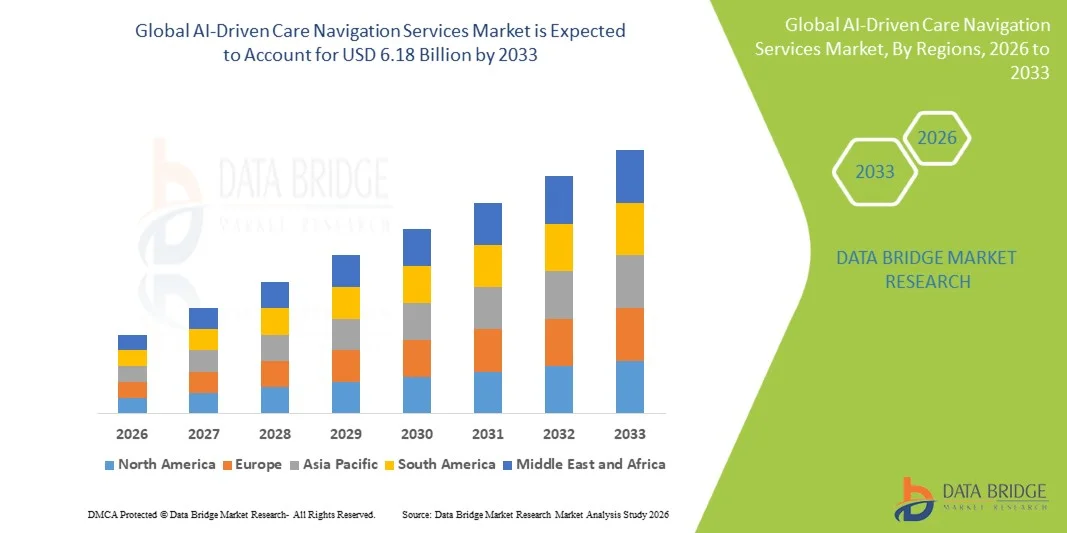
- The global AI-Driven care navigation services market size was valued at USD 1.22 billion in 2025 and is expected to reach USD 6.18 billion by 2033, at a CAGR of 22.50% during the forecast period
- The market growth is largely fueled by the accelerating adoption of artificial intelligence and data‑driven technologies in healthcare delivery, enabling seamless coordination of patient care, benefit navigation, cost transparency, referral management, and predictive analytics across care pathways
- Furthermore, increasing emphasis on patient‑centric care models, the rising demand for digital health solutions that streamline healthcare access, and the need to reduce administrative burden in both providers and payers are driving rapid implementation of AI‑enabled care navigation services
AI-Driven Care Navigation Services Market Analysis
- AI-driven care navigation services, which leverage artificial intelligence to guide patients through healthcare systems, optimize care pathways, and streamline administrative processes, are becoming essential components of modern healthcare delivery due to their ability to enhance patient outcomes, reduce costs, and improve overall system efficiency across providers and payers
- The escalating demand for AI-driven care navigation services is primarily fueled by the growing adoption of digital health technologies, increasing complexity of healthcare systems, rising need for cost containment, and a strong shift toward patient-centric and value-based care models
- North America dominated the AI-driven care navigation services market with the largest revenue share of 42.5% in 2025, characterized by advanced healthcare infrastructure, high adoption of AI technologies, and strong presence of key market players, with the U.S. witnessing significant growth driven by increased investment in digital health platforms and employer-sponsored navigation solutions
- Asia-Pacific is expected to be the fastest growing region in the AI-driven care navigation services market during the forecast period due to expanding healthcare infrastructure, increasing digitalization, and rising demand for accessible and efficient healthcare services across emerging economies
- Cloud-based segment dominated the market with a share of 48.7% in 2025, driven by its scalability, cost-effectiveness, and ability to support real-time data integration and remote access across diverse healthcare systems
Report Scope and AI-Driven Care Navigation Services Market Segmentation
|
Attributes |
AI-Driven Care Navigation Services Key Market Insights |
|
Segments Covered |
|
|
Countries Covered |
North America
Europe
Asia-Pacific
Middle East and Africa
South America
|
|
Key Market Players |
|
|
Market Opportunities |
|
|
Value Added Data Infosets |
In addition to the insights on market scenarios such as market value, growth rate, segmentation, geographical coverage, and major players, the market reports curated by the Data Bridge Market Research also include in-depth expert analysis, patient epidemiology, pipeline analysis, pricing analysis, and regulatory framework |
AI-Driven Care Navigation Services Market Trends
“Enhanced Patient Experience Through AI and Digital Integration”
- A significant and accelerating trend in the global AI-driven care navigation services market is the deepening integration with artificial intelligence (AI) and advanced digital health ecosystems such as telehealth platforms, electronic health records, and mobile health applications. This convergence of technologies is significantly enhancing patient experience and care coordination
- For instance, AI-driven navigation platforms such as those developed by companies such as Accolade and Included Health integrate with telehealth and benefits systems, enabling patients to receive personalized care guidance, appointment scheduling, and provider matching through a unified interface
- AI integration in care navigation services enables features such as predictive analytics for patient risk stratification, personalized care recommendations, and intelligent routing to appropriate providers based on clinical and cost factors. For instance, some platforms utilize AI algorithms to identify high-risk patients and proactively guide them toward preventive care while sending alerts for critical health interventions. Furthermore, digital interfaces offer users the ease of seamless access, allowing them to navigate healthcare services remotely using mobile or web-based applications
- The seamless integration of AI-driven navigation solutions with broader healthcare IT systems facilitates centralized management of patient journeys and administrative workflows. Through a single platform, providers and payers can coordinate care delivery, manage claims, and optimize resource allocation, creating a unified and efficient healthcare ecosystem
- This trend towards more intelligent, personalized, and interconnected care navigation systems is fundamentally reshaping patient expectations for healthcare access. Consequently, companies such as HealthJoy are developing AI-enabled navigation services with features such as real-time care guidance, automated benefit navigation, and integration with virtual care platforms
- The demand for AI-driven care navigation services that offer seamless digital integration and personalized guidance is growing rapidly across healthcare providers, payers, and employers, as stakeholders increasingly prioritize efficiency, cost reduction, and improved patient outcomes
- Growing focus on population health management and preventive care is driving the adoption of AI-powered navigation tools that can proactively engage patients, monitor health trends, and guide early interventions to reduce long-term healthcare costs
AI-Driven Care Navigation Services Market Dynamics
Driver
“Growing Need Due to Rising Healthcare Complexity and Demand for Patient-Centric Care”
- The increasing complexity of healthcare systems, coupled with the accelerating shift toward patient-centric and value-based care models, is a significant driver for the heightened demand for AI-driven care navigation services
- For instance, in March 2025, Accolade, Inc. expanded its AI-powered healthcare navigation platform to enhance personalized care delivery and improve patient engagement across employer-sponsored health programs. Such strategies by key companies are expected to drive the AI-driven care navigation services market growth in the forecast period
- As patients face challenges in accessing appropriate care, understanding benefits, and managing healthcare costs, AI-driven navigation services provide advanced capabilities such as real-time assistance, personalized recommendations, and streamlined care coordination, offering a compelling solution over traditional healthcare access methods
- Furthermore, the growing adoption of digital health technologies and the increasing need for integrated healthcare solutions are making AI-driven navigation platforms an essential component of modern healthcare systems, enabling seamless interaction between patients, providers, and payers
- The convenience of guided care pathways, improved access to in-network providers, and the ability to manage healthcare journeys through digital platforms are key factors propelling the adoption of AI-driven care navigation services across healthcare ecosystems. The expansion of employer-sponsored health programs and rising investments in digital health infrastructure further contribute to market growth
- Increasing pressure on healthcare systems to reduce operational costs and improve efficiency is encouraging providers and payers to adopt AI-driven navigation solutions that automate administrative tasks and optimize resource utilization
- Rising investments from venture capital firms and strategic partnerships between healthcare providers and technology companies are accelerating innovation and deployment of advanced AI-based care navigation platforms globally
Restraint/Challenge
“Data Privacy Concerns and Integration Complexity Hurdle”
- Concerns surrounding data privacy, security, and regulatory compliance associated with healthcare information systems pose a significant challenge to broader market penetration. As AI-driven care navigation services rely heavily on sensitive patient data, they are subject to strict regulations and potential risks of data breaches, raising concerns among stakeholders
- For instance, increasing scrutiny under healthcare data protection regulations such as HIPAA and GDPR has made some organizations cautious about adopting AI-based navigation solutions without robust compliance frameworks
- Addressing these concerns through secure data management practices, advanced encryption technologies, and transparent governance policies is crucial for building trust among users. Companies such as Included Health and Accolade emphasize their compliance capabilities and secure data handling practices to reassure clients. In addition, the complexity of integrating AI-driven navigation platforms with existing healthcare IT systems can act as a barrier for adoption, particularly for smaller providers with limited technological infrastructure
- While integration capabilities are improving, the need for interoperability with diverse healthcare systems and legacy platforms continues to pose implementation challenges, especially in fragmented healthcare environments
- Overcoming these challenges through enhanced data security measures, regulatory alignment, improved interoperability standards, and scalable deployment models will be vital for sustained market growth in AI-driven care navigation services
- Limited digital literacy among certain patient populations and healthcare providers may hinder the effective utilization of AI-driven navigation platforms, reducing their overall impact and adoption rates
- High initial implementation costs and ongoing maintenance requirements for advanced AI systems can act as a barrier, particularly for small and mid-sized healthcare organizations with constrained budgets
AI-Driven Care Navigation Services Market Scope
The market is segmented on the basis of component, deployment mode, technology, and application.
- By Component
On the basis of component, the AI-driven care navigation services market is segmented into solutions and services. The solutions segment dominated the market with the largest revenue share in 2025, driven by the increasing adoption of AI-powered platforms that enable patient navigation, care coordination, and workflow automation. These solutions provide integrated capabilities such as predictive analytics, provider matching, and real-time decision support, making them essential for healthcare providers and payers. The growing need for scalable and centralized digital health platforms further strengthens the demand for solution-based offerings. In addition, continuous advancements in AI algorithms and data analytics are enhancing the efficiency and accuracy of these platforms, contributing to their widespread adoption. The ability of solutions to deliver measurable outcomes such as cost reduction and improved patient engagement also supports their dominant position.
The services segment is anticipated to witness the fastest growth rate during the forecast period, fueled by the increasing need for implementation, consulting, and support services associated with AI platforms. As healthcare organizations adopt complex AI-driven systems, the demand for specialized services to ensure seamless integration and optimization is rising significantly. Service providers play a crucial role in customizing solutions according to organizational needs and regulatory requirements. In addition, ongoing maintenance, training, and upgrades are essential to ensure optimal performance of care navigation systems. The growing reliance on third-party expertise and managed services models is further accelerating segment growth.
- By Deployment Mode
On the basis of deployment mode, the market is segmented into cloud-based, on-premises, and hybrid. The cloud-based segment held the largest market revenue share of 48.7% in 2025, driven by its scalability, cost-effectiveness, and ease of deployment. Cloud platforms enable real-time data access and seamless integration across multiple healthcare systems, making them highly suitable for AI-driven navigation services. The increasing adoption of Software-as-a-Service (SaaS) models and remote healthcare solutions further supports the growth of this segment. In addition, cloud-based systems facilitate continuous updates and improvements without significant infrastructure investment. Their ability to support large-scale data analytics and interoperability enhances their dominance in the market.
The hybrid segment is expected to witness the fastest growth during the forecast period, driven by the need for a balanced approach combining data security and operational flexibility. Hybrid deployment allows healthcare organizations to store sensitive data on-premises while leveraging cloud capabilities for analytics and scalability. This model is particularly attractive for organizations dealing with strict regulatory requirements and data privacy concerns. It also enables gradual digital transformation without completely replacing existing infrastructure. The growing focus on secure yet flexible IT environments is contributing to the rapid adoption of hybrid solutions.
- By Technology
On the basis of technology, the market is segmented into artificial intelligence (AI), machine learning (ML), natural language processing (NLP), big data analytics, and others. The artificial intelligence (AI) segment dominated the market with the largest revenue share in 2025, driven by its core role in enabling intelligent care navigation and automation. AI technologies power critical functionalities such as predictive modeling, decision support, and personalized care recommendations. The increasing adoption of AI in healthcare for improving efficiency and reducing costs is a key factor driving segment growth. In addition, advancements in deep learning and neural networks are enhancing the capabilities of AI-driven platforms. The widespread use of AI across multiple healthcare applications further reinforces its leading position.
The natural language processing (NLP) segment is expected to witness the fastest growth rate during the forecast period, fueled by the rising demand for conversational interfaces and automated patient interactions. NLP enables systems to understand and process human language, facilitating chatbots, virtual assistants, and voice-enabled navigation tools. These capabilities significantly enhance patient engagement and accessibility to healthcare services. The increasing use of NLP in analyzing unstructured clinical data such as medical records and physician notes further supports its growth. In addition, advancements in generative AI and voice recognition technologies are accelerating the adoption of NLP-based solutions.
- By Application
On the basis of application, the market is segmented into clinical & care navigation, insurance & benefits navigation, telehealth & remote care integration, appointment scheduling & referral management, provider discovery & matching, cost transparency & claims support, population health management, and patient engagement & communication. The clinical & care navigation segment dominated the market with the largest revenue share in 2025, driven by the increasing need for efficient care coordination and improved patient outcomes. These solutions help patients navigate complex healthcare systems by guiding them to appropriate providers and treatment pathways. The rising prevalence of chronic diseases and the need for continuous care management are further driving demand. In addition, healthcare providers are increasingly adopting AI tools to optimize clinical workflows and reduce administrative burden. The ability to enhance patient satisfaction and treatment adherence strengthens the dominance of this segment.
The population health management segment is anticipated to witness the fastest growth during the forecast period, fueled by the growing focus on preventive care and value-based healthcare models. AI-driven tools enable healthcare organizations to analyze large datasets and identify at-risk populations for early intervention. This approach helps reduce hospitalizations and overall healthcare costs while improving long-term health outcomes. Governments and healthcare providers are increasingly investing in population health initiatives to address public health challenges. In addition, the integration of predictive analytics and real-time monitoring is accelerating the adoption of this segment.
AI-Driven Care Navigation Services Market Regional Analysis
- North America dominated the AI-driven care navigation services market with the largest revenue share of 42.5% in 2025, characterized by advanced healthcare infrastructure, high adoption of AI technologies, and strong presence of key market players
- Healthcare stakeholders in the region highly value the personalized care coordination, real-time guidance, and seamless integration offered by AI-driven navigation platforms with systems such as electronic health records and telehealth services
- This widespread adoption is further supported by high healthcare spending, advanced technological capabilities, and the strong presence of key market players, along with the growing emphasis on value-based care and patient engagement, establishing AI-driven care navigation services as a preferred solution for providers, payers, and employers
U.S. AI-Driven Care Navigation Services Market Insight
The U.S. AI-driven care navigation services market captured the largest revenue share of 79% in 2025 within North America, fueled by the rapid adoption of digital health platforms and the increasing complexity of healthcare systems. Healthcare stakeholders are increasingly prioritizing improved patient outcomes through personalized, AI-enabled care navigation solutions. The growing preference for employer-sponsored healthcare navigation programs, combined with strong demand for telehealth integration and real-time care coordination, further propels the market. Moreover, the increasing integration of AI technologies with electronic health records, virtual care platforms, and analytics tools is significantly contributing to the market's expansion.
Europe AI-Driven Care Navigation Services Market Insight
The Europe AI-driven care navigation services market is projected to expand at a substantial CAGR throughout the forecast period, primarily driven by stringent healthcare regulations and the escalating need for efficient patient management systems across public and private healthcare sectors. The increase in aging population, coupled with the demand for digital health solutions, is fostering the adoption of AI-driven navigation services. European stakeholders are also drawn to the efficiency and cost optimization these platforms offer. The region is experiencing notable growth across hospitals, insurance providers, and government healthcare systems, with AI navigation solutions being integrated into both existing infrastructure and new digital health initiatives.
U.K. AI-Driven Care Navigation Services Market Insight
The U.K. AI-driven care navigation services market is anticipated to grow at a noteworthy CAGR during the forecast period, driven by the increasing adoption of digital healthcare solutions and a strong focus on improving patient access and system efficiency. In addition, pressure on the National Health Service (NHS) to reduce waiting times and optimize resource utilization is encouraging the adoption of AI-powered navigation platforms. The UK’s strong digital infrastructure, alongside its growing investments in healthcare innovation, is expected to continue to stimulate market growth.
Germany AI-Driven Care Navigation Services Market Insight
The Germany AI-driven care navigation services market is expected to expand at a considerable CAGR during the forecast period, fueled by increasing emphasis on healthcare digitalization and the demand for advanced, data-driven solutions. Germany’s well-developed healthcare infrastructure, combined with its focus on innovation and data privacy, promotes the adoption of AI-driven navigation services across hospitals and insurance providers. The integration of these platforms with electronic health systems is becoming increasingly prevalent, with a strong preference for secure and compliant solutions aligning with regional regulatory standards.
Asia-Pacific AI-Driven Care Navigation Services Market Insight
The Asia-Pacific AI-driven care navigation services market is poised to grow at the fastest CAGR during the forecast period of 2026 to 2033, driven by expanding healthcare infrastructure, increasing digitalization, and rising healthcare awareness in countries such as China, Japan, and India. The region's growing adoption of digital health platforms, supported by government initiatives promoting healthcare access and efficiency, is driving the demand for AI-driven navigation services. Furthermore, as APAC emerges as a key hub for healthcare innovation and technology adoption, the accessibility and scalability of AI solutions are expanding across diverse populations.
Japan AI-Driven Care Navigation Services Market Insight
The Japan AI-driven care navigation services market is gaining momentum due to the country’s advanced healthcare system, aging population, and demand for efficient care delivery solutions. The Japanese market places significant emphasis on quality healthcare, and the adoption of AI navigation services is driven by the increasing need for coordinated care and chronic disease management. The integration of AI platforms with healthcare IT systems, such as electronic records and remote monitoring tools, is fueling growth. Moreover, Japan's aging demographic is likely to spur demand for intelligent, easy-to-use care navigation solutions across both public and private healthcare sectors.
India AI-Driven Care Navigation Services Market Insight
The India AI-driven care navigation services market accounted for a significant market share in Asia Pacific in 2025, attributed to the country’s expanding healthcare infrastructure, rapid digital transformation, and increasing adoption of telehealth services. India stands as one of the fastest emerging markets for digital health solutions, and AI-driven care navigation is gaining traction across hospitals, insurers, and corporate healthcare programs. The push towards digital health initiatives, such as Ayushman Bharat, and the growing presence of health-tech startups are key factors propelling the market in India.
AI-Driven Care Navigation Services Market Share
The AI-Driven Care Navigation Services industry is primarily led by well-established companies, including:
- Accolade, Inc. (U.S.)
- Included Health, Inc. (U.S.)
- Castlight Health, Inc. (U.S.)
- Quantum Health, Inc. (U.S.)
- Transcarent, Inc. (U.S.)
- HealthJoy, LLC (U.S.)
- Sharecare, Inc. (U.S.)
- Health Advocate, Inc. (U.S.)
- Rightway Healthcare, Inc. (U.S.)
- Wellframe, Inc. (U.S.)
- Alight Solutions LLC (U.S.)
- League Inc. (Canada)
- Virgin Pulse, Inc. (U.S.)
- Medecision, Inc. (U.S.)
- b.well Connected Health, Inc. (U.S.)
- Evive Health, LLC (U.S.)
- Compass Professional Health Services, Inc. (U.S.)
- NaviHealth, Inc. (U.S.)
- Optum, Inc. (U.S.)
- Ada Health GmbH (Germany)
What are the Recent Developments in Global AI-Driven Care Navigation Services Market?
- In January 2026, Included Health announced the expansion of its integrated AI-driven healthcare navigation model with a new primary care–centered approach, aimed at improving access to personalized, whole-person care. The platform leverages AI along with clinician oversight to guide patients across clinical, behavioral, and administrative pathways, enabling seamless navigation of coverage, care, and costs. This development highlights the growing shift toward AI-powered, end-to-end healthcare navigation solutions that enhance patient engagement and outcomes
- In October 2025, Transcarent scaled its AI-powered WayFinding platform, offering a unified interface for benefits navigation, clinical guidance, and care delivery. The platform uses large language models and clinical data to provide real-time, personalized healthcare recommendations while enabling users to schedule care and access services seamlessly. This advancement demonstrates the increasing adoption of generative AI to enhance care navigation efficiency and user experience
- In April 2025, Transcarent completed its USD 621 million acquisition of Accolade to strengthen its AI-powered healthcare navigation and benefits platform. The combined entity integrates Accolade’s advocacy and care services with Transcarent’s generative AI-based WayFinding system, creating a unified platform for personalized care guidance and cost optimization. This development reflects increasing consolidation in the digital health navigation space to deliver more comprehensive and AI-enabled care solutions
- In January 2025, Transcarent announced its agreement to acquire Accolade in a USD 621 million deal to expand its AI-driven health and care navigation capabilities. The integration of generative AI-powered navigation tools with clinical and benefits services aims to simplify healthcare access while reducing costs for employers and patients. This move underscores the growing role of AI in transforming healthcare navigation into a unified, consumer-centric experience
- In March 2021, Grand Rounds Health merged with Doctor On Demand to form Included Health, integrating virtual care services with healthcare navigation capabilities. This merger created a comprehensive platform combining telehealth, benefits navigation, and care coordination, marking a significant step toward unified, AI-enabled healthcare navigation ecosystems. The move laid the foundation for modern AI-driven navigation services by combining clinical care delivery with digital guidance tools

- Interactive Data Analysis Dashboard
- Company Analysis Dashboard for high growth potential opportunities
- Research Analyst Access for customization & queries
- Competitor Analysis with Interactive dashboard
- Latest News, Updates & Trend analysis
- Harness the Power of Benchmark Analysis for Comprehensive Competitor Tracking
Data collection and base year analysis are done using data collection modules with large sample sizes. The stage includes obtaining market information or related data through various sources and strategies. It includes examining and planning all the data acquired from the past in advance. It likewise envelops the examination of information inconsistencies seen across different information sources. The market data is analysed and estimated using market statistical and coherent models. Also, market share analysis and key trend analysis are the major success factors in the market report. To know more, please request an analyst call or drop down your inquiry.
The key research methodology used by DBMR research team is data triangulation which involves data mining, analysis of the impact of data variables on the market and primary (industry expert) validation. Data models include Vendor Positioning Grid, Market Time Line Analysis, Market Overview and Guide, Company Positioning Grid, Patent Analysis, Pricing Analysis, Company Market Share Analysis, Standards of Measurement, Global versus Regional and Vendor Share Analysis. To know more about the research methodology, drop in an inquiry to speak to our industry experts.
Data Bridge Market Research is a leader in advanced formative research. We take pride in servicing our existing and new customers with data and analysis that match and suits their goal. The report can be customized to include price trend analysis of target brands understanding the market for additional countries (ask for the list of countries), clinical trial results data, literature review, refurbished market and product base analysis. Market analysis of target competitors can be analyzed from technology-based analysis to market portfolio strategies. We can add as many competitors that you require data about in the format and data style you are looking for. Our team of analysts can also provide you data in crude raw excel files pivot tables (Fact book) or can assist you in creating presentations from the data sets available in the report.













