


AI-Driven Surgical Robotics Market Size
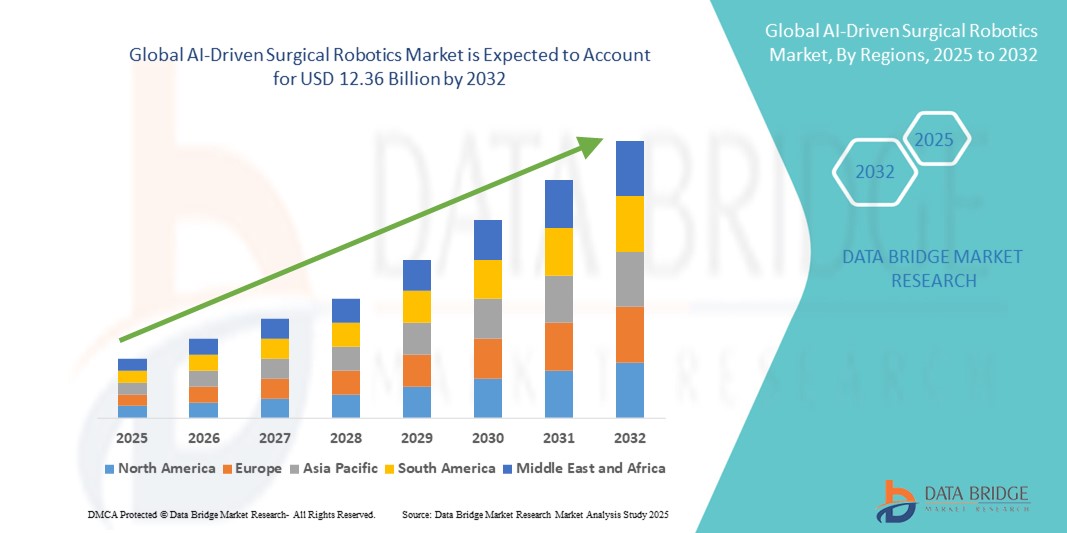
- The global AI-driven surgical robotics market size was valued at USD 3.96 billion in 2024 and is expected to reach USD 12.36 billion by 2032, at a CAGR of 15.30% during the forecast period
- The market growth is primarily driven by rapid advancements in artificial intelligence, robotics technology, and the increasing demand for precision and minimally invasive surgeries across healthcare settings worldwide
- In addition, rising investments in healthcare infrastructure, growing acceptance of robotic-assisted procedures, and a shift towards automated and remote surgical systems are fueling the widespread adoption of AI-driven surgical robots, significantly accelerating market expansion
AI-Driven Surgical Robotics Market Analysis
- AI-driven surgical robots, combining artificial intelligence with robotic precision, are becoming critical tools in modern surgical procedures across both hospital and ambulatory care settings, offering enhanced accuracy, reduced invasiveness, and improved patient outcomes
- The rising adoption of minimally invasive surgeries, increasing surgeon demand for enhanced dexterity and real-time decision support, and ongoing technological advancements in AI algorithms and robotic platforms are the primary drivers fueling market growth
- North America dominated the AI-driven surgical robotics market with the largest revenue share of 42.5% in 2024, driven by high healthcare expenditure, advanced infrastructure, and the presence of key industry leaders such as Intuitive Surgical and Medtronic, with the U.S. witnessing rapid adoption in specialties such as urology and general surgery
- Asia-Pacific is projected to be the fastest-growing region during in the AI-driven surgical robotics market during the forecast period, fueled by expanding healthcare infrastructure, growing awareness of robotic-assisted procedures, and increasing investments in AI technologies across emerging economies such as China and India
- The hardware segment dominated the AI-driven surgical robotics market with a share of 71.5% in 2024 due to the continuous rollout of innovative robotic systems and instruments that enhance surgical precision and procedural efficiency, establishing a strong foundation for future growth
Report Scope and AI-Driven Surgical Robotics Market Segmentation
|
Attributes |
AI-Driven Surgical Robotics Key Market Insights |
|
Segments Covered |
|
|
Countries Covered |
North America
Europe
Asia-Pacific
Middle East and Africa
South America
|
|
Key Market Players |
|
|
Market Opportunities |
|
|
Value Added Data Infosets |
In addition to the insights on market scenarios such as market value, growth rate, segmentation, geographical coverage, and major players, the market reports curated by the Data Bridge Market Research also include in-depth expert analysis, pricing analysis, brand share analysis, consumer survey, demography analysis, supply chain analysis, value chain analysis, raw material/consumables overview, vendor selection criteria, PESTLE Analysis, Porter Analysis, and regulatory framework. |
AI-Driven Surgical Robotics Market Trends
Advancements in AI and Autonomous Surgical Systems
- A significant and accelerating trend in the global AI-driven surgical robotics market is the integration of advanced artificial intelligence algorithms and autonomous capabilities to enhance surgical precision, reduce invasiveness, and improve patient outcomes across various specialties
- For instance, Intuitive Surgical’s da Vinci Xi system incorporates AI-driven imaging and motion scaling to provide surgeons with greater control during minimally invasive surgeries. Similarly, Medtronic’s Hugo platform leverages AI for optimized instrument movement and workflow efficiency
- AI integration enables real-time surgical navigation, predictive analytics, and continuous learning from procedural data, reducing human error and supporting better clinical decisions. Furthermore, autonomous robotic features assist surgeons in complex tasks, improving consistency and safety
- The seamless connection of surgical robots with hospital IT infrastructure and electronic health records allows for personalized surgery planning and improved post-operative care coordination
- This trend towards smarter, more autonomous surgical systems is reshaping surgeon expectations and accelerating adoption globally, as healthcare providers seek precision and efficiency in surgical care
AI-Driven Surgical Robotics Market Dynamics
Driver
Rising Demand for Minimally Invasive and Precision Surgeries
- The growing preference for minimally invasive procedures, due to benefits such as faster recovery and reduced complications, is a major driver of demand for AI-enabled surgical robots
- For instance, in 2024, key companies expanded the use of AI-driven robotic systems in urology, gynecology, and general surgery, reporting improved patient outcomes and higher satisfaction rates
- Increasing surgeon acceptance of AI-assisted dexterity, enhanced visualization, and intraoperative guidance tools is propelling market growth worldwide
- Rising investments in healthcare infrastructure and the focus on personalized medicine further boost adoption, as AI-enabled systems tailor surgical approaches to individual patients
- The expanding outpatient surgery and ambulatory care center markets are also contributing to demand for efficient AI-driven robotic solutions
- Growing collaboration between technology companies and healthcare providers is fostering innovation and accelerating the development of next-generation AI-driven surgical robots, expanding their capabilities and applications
- Increasing government funding and supportive policies for advanced healthcare technologies in developed and emerging economies are facilitating wider adoption of AI-enabled surgical robotics
Restraint/Challenge
High Costs and Regulatory Hurdles
- The high initial investment and ongoing maintenance costs of AI-driven surgical robotic systems remain significant barriers, particularly for smaller hospitals and healthcare providers in developing regions
- For instance, inconsistent reimbursement policies and unclear regulatory guidelines limit the adoption of AI-enabled surgical robots in some regions
- Regulatory approval processes for AI-enabled medical devices are complex and lengthy, requiring extensive clinical validation to ensure safety and efficacy, which may delay market entry
- Concerns over ethical issues and liability related to autonomous surgical functions generate caution among healthcare professionals and patients
- Addressing these challenges through cost reduction, clearer regulatory pathways, and education on AI surgical benefits is critical for accelerating global market growth
- Limited availability of skilled surgeons trained to operate complex AI-driven robotic systems restricts market growth, as training programs and certifications lag behind technological advancements
- Data privacy and cybersecurity concerns related to AI and connected surgical robots raise apprehensions among hospitals about potential breaches and misuse of sensitive patient information
AI-Driven Surgical Robotics Market Scope
The market is segmented on the basis of product type, level of automation, application, and end user.
- By Product Type
On the basis of product type, the AI-driven surgical robotics market is segmented into hardware and services. The hardware segment dominated the market with the largest revenue share of 71.5% in 2024. This dominance is attributed to continuous innovations in robotic surgical systems, instruments, and accessories that enhance surgical precision, reduce operation times, and improve patient outcomes. Hospitals and surgical centers prioritize investments in these tangible assets to upgrade their surgical capabilities.
The services segment is the fastest growing during forecast period, driven by the increasing need for specialized training programs for surgeons, regular maintenance of complex robotic systems, and timely software updates that enhance functionality and security. As AI-driven surgical robotics become more sophisticated, demand for these support services is expected to rise sharply.
- By Level of Automation
On the basis of level of automation, the AI-driven surgical robotics market is segmented into semi-autonomous systems, autonomous systems, and telerobotic systems. The semi-autonomous systems segment is dominant because it balances human surgeon control with robotic assistance, offering enhanced precision without fully relinquishing manual oversight. These systems are widely adopted in current clinical practice due to their proven reliability and safety.
The telerobotic systems segment is the fastest growing during forecast period, propelled by technological advancements in high-speed internet and telecommunication infrastructure, allowing surgeons to perform operations remotely. This capability is especially valuable in providing expert surgical care to patients in remote or underserved areas, thereby expanding market reach and addressing disparities in healthcare access.
- By Application
On the basis of application, the AI-driven surgical robotics market is segmented into general surgery, orthopedic surgery, neurological surgery, urological surgery, gynecological surgery, and other specialties such as cardiovascular and oncological surgeries. The general surgery segment dominated the market in 2024 due to its wide procedural variety, ranging from minimally invasive abdominal surgeries to complex reconstructive operations. The high volume of general surgeries performed globally sustains strong demand for AI-driven robotics in this field.
The orthopedic surgery segment is the fastest growing during forecast period, fueled by increasing prevalence of musculoskeletal conditions, aging populations, and a rising preference for precision robotic assistance in joint replacements, spinal surgeries, and trauma care. The ability of robotics to improve surgical accuracy and reduce post-operative complications drives this rapid growth.
- By End User
On the basis of end user, the AI-driven surgical robotics market is segmented into hospitals and ambulatory surgical centers. The hospitals segment dominated the market with 73% revenue share in 2024, reflecting the high surgical volumes, advanced infrastructure, and financial capacity required to acquire and operate AI-driven surgical robots. Large hospitals also benefit from diverse surgical specialties requiring robotic assistance.
The ambulatory surgical centers segment is the fastest growing during forecast period, as these centers increasingly adopt robotic technologies to perform outpatient procedures that offer quicker recovery and lower costs. The shift towards minimally invasive surgeries in ambulatory settings, supported by technological advancements and patient demand, is expected to drive strong adoption of AI-driven surgical robotics in this segment.
AI-Driven Surgical Robotics Market Regional Analysis
- North America dominated the AI-driven surgical robotics market with the largest revenue share of 42.5% in 2024, driven by high healthcare expenditure, advanced infrastructure, and the presence of key industry leaders such as Intuitive Surgical and Medtronic, with the U.S. witnessing rapid adoption in specialties such as urology and general surgery
- Surgeons and healthcare providers in the region value the enhanced precision, reduced invasiveness, and improved patient outcomes offered by AI-enabled robotic systems, fueling widespread integration across hospitals and surgical centers
- This dominance is further supported by strong government funding for healthcare innovation, the presence of leading industry players such as Intuitive Surgical and Medtronic, and a technologically advanced population that encourages rapid adoption of AI-driven surgical solutions in both routine and complex procedures
U.S. AI-Driven Surgical Robotics Market Insight
The U.S. AI-driven surgical robotics market captured the largest revenue share of 55% in 2024 within North America, propelled by widespread adoption of advanced robotic systems and high healthcare expenditure. The country leads in research and development of AI-enhanced surgical technologies, with hospitals rapidly integrating robotics in specialties such as urology, general surgery, and gynecology. Growing patient preference for minimally invasive surgeries and strong reimbursement policies further boost market expansion. In addition, collaboration between tech innovators and healthcare providers accelerates the commercialization of cutting-edge surgical robots.
Europe AI-Driven Surgical Robotics Market Insight
The Europe AI-driven surgical robotics market is projected to grow at a substantial CAGR during the forecast period, supported by increasing government investments in healthcare modernization and stringent surgical safety regulations. Countries such as Germany, the U.K., and France are witnessing rising adoption of AI robotic systems across both public and private hospitals. The push for precision surgeries, combined with growing awareness of robotic benefits among surgeons and patients, is driving market growth. Integration of AI robotics with existing hospital infrastructure remains a key focus in the region.
U.K. AI-Driven Surgical Robotics Market Insight
The U.K. AI-driven surgical robotics market is expected to grow notably, driven by the National Health Service’s (NHS) increasing focus on technology adoption and minimally invasive procedures. Surgeons’ growing trust in AI-assisted robotic systems for enhanced dexterity and reduced complications fuels adoption. Furthermore, ongoing investments in healthcare infrastructure and digital health initiatives contribute to market growth, especially in specialties such as colorectal and orthopedic surgeries.
Germany AI-Driven Surgical Robotics Market Insight
The Germany AI-driven surgical robotics market is forecasted to expand steadily due to the country’s advanced healthcare system and strong emphasis on innovation and quality care. The growing demand for precision surgeries, coupled with government support for medical technology development, promotes widespread adoption. Hospitals increasingly incorporate AI robotic systems for complex surgeries, including cardiovascular and neurological procedures. In addition, strong collaborations between universities and medical device manufacturers accelerate product advancements.
Asia-Pacific AI-Driven Surgical Robotics Market Insight
The Asia-Pacific AI-driven surgical robotics market is poised to record the fastest CAGR of 25% during the forecast period, driven by rapid healthcare infrastructure development and rising surgical volumes in countries such as China, Japan, and India. Government initiatives promoting digital health, growing patient awareness, and expanding insurance coverage support adoption. The region’s increasing focus on reducing surgical complications and improving recovery times fuels demand. Moreover, local manufacturing and cost-effective solutions enhance accessibility, boosting market penetration.
Japan AI-Driven Surgical Robotics Market Insight
The Japan market growth is propelled by a high standard of healthcare and a strong emphasis on robotic automation in surgery. The aging population intensifies demand for minimally invasive procedures to reduce hospitalization times and improve outcomes. Integration of AI with robotic platforms for neurological and orthopedic surgeries is a notable trend. Japan’s robust technological ecosystem supports continuous innovation and adoption of next-generation surgical robots.
India AI-Driven Surgical Robotics Market Insight
The India accounted for the largest market share in Asia-Pacific in 2024, driven by increasing healthcare investments, expanding hospital networks, and rising awareness of robotic-assisted surgeries. Rapid urbanization, coupled with the government’s focus on smart healthcare and telemedicine, supports growth. The availability of cost-effective AI-driven robotic solutions, combined with an increasing number of trained surgeons, is accelerating adoption across metropolitan and tier-2 cities, especially in general and urological surgeries.
AI-Driven Surgical Robotics Market Share
The AI-Driven surgical robotics industry is primarily led by well-established companies, including:
- Intuitive Surgical, Inc. (U.S.)
- Stryker (U.S.)
- Medtronic (Ireland)
- Johnson & Johnson and its affiliates (U.S.)
- Zimmer Biomet (U.S.)
- Smith + Nephew (U.K.)
- CMR Surgical Ltd. (U.K.)
- Asensus Surgical US, Inc. (U.S.)
- Renishaw plc (U.K.)
- THINK Surgical, Inc. (U.S.)
- Siemens Healthineers AG (Germany)
- Vicarious Surgical (U.S.)
- Robocath, Inc. (France)
- Medicaroid Corporation (Japan)
- Titan Medical Inc. (Canada)
- MicroPort Scientific Corporation (U.S.)
- Medical Microinstruments, Inc. (Italy)
- meerecompany Inc. (South Korea)
- Accuray Incorporated (U.S.)
What are the Recent Developments in Global AI-Driven Surgical Robotics Market?
- In June 2025, Johnson & Johnson launched the Polyphonic AI Fund for Surgery, an initiative aimed at accelerating promising artificial intelligence solutions that address challenges in surgery. The fund invites innovation to help advance data-driven healthcare, with partners such as NVIDIA and Amazon Web Services joining the committee to evaluate and select awardees
- In April 2025, Medtronic submitted its Hugo robotic surgery system to the U.S. Food and Drug Administration (FDA) after meeting safety and effectiveness goals. The system demonstrated a 98.5% surgical success rate in urologic studies, surpassing the 85% benchmark, positioning it as a strong competitor in the robotic surgery market
- In February 2025, NTT, together with NTT East, Hirosaki University Hospital, Medicaroid, and Kajima, successfully demonstrated telesurgical support using the hinotori Surgical Robot System across two distant hospitals via an ultra-fast IOWN All-Photonics Network (APN). This showcased a communication environment so responsive that it mimicked being in the same operating room—overcoming latency and stability challenges in remote robotic surgery
- In July 2023, Stryker unveiled the Ortho Q Guidance System, a fully autonomous surgical system designed to revolutionize orthopedic procedures. The system aims to augment surgical navigation's precision and efficiency without human intervention, representing a significant step forward in surgical robotics
- In April 2023, Medical MicroInstruments (MMI) received FDA clearance for the Symani Surgical System, making it the first FDA-approved robot for microsurgery. With wristed robotic arms offering seven degrees of flexibility, Symani effectively mitigates tremors during delicate procedures. Nearly 1,000 surgeries across 17 procedures in Europe have been completed using this system. MMI is now working toward an AI-augmented version capable of handling routine surgical tasks such as tying arteries

- Interactive Data Analysis Dashboard
- Company Analysis Dashboard for high growth potential opportunities
- Research Analyst Access for customization & queries
- Competitor Analysis with Interactive dashboard
- Latest News, Updates & Trend analysis
- Harness the Power of Benchmark Analysis for Comprehensive Competitor Tracking
Data collection and base year analysis are done using data collection modules with large sample sizes. The stage includes obtaining market information or related data through various sources and strategies. It includes examining and planning all the data acquired from the past in advance. It likewise envelops the examination of information inconsistencies seen across different information sources. The market data is analysed and estimated using market statistical and coherent models. Also, market share analysis and key trend analysis are the major success factors in the market report. To know more, please request an analyst call or drop down your inquiry.
The key research methodology used by DBMR research team is data triangulation which involves data mining, analysis of the impact of data variables on the market and primary (industry expert) validation. Data models include Vendor Positioning Grid, Market Time Line Analysis, Market Overview and Guide, Company Positioning Grid, Patent Analysis, Pricing Analysis, Company Market Share Analysis, Standards of Measurement, Global versus Regional and Vendor Share Analysis. To know more about the research methodology, drop in an inquiry to speak to our industry experts.
Data Bridge Market Research is a leader in advanced formative research. We take pride in servicing our existing and new customers with data and analysis that match and suits their goal. The report can be customized to include price trend analysis of target brands understanding the market for additional countries (ask for the list of countries), clinical trial results data, literature review, refurbished market and product base analysis. Market analysis of target competitors can be analyzed from technology-based analysis to market portfolio strategies. We can add as many competitors that you require data about in the format and data style you are looking for. Our team of analysts can also provide you data in crude raw excel files pivot tables (Fact book) or can assist you in creating presentations from the data sets available in the report.













