What is the AI in Industrial Automation Market Size and Growth Rate?
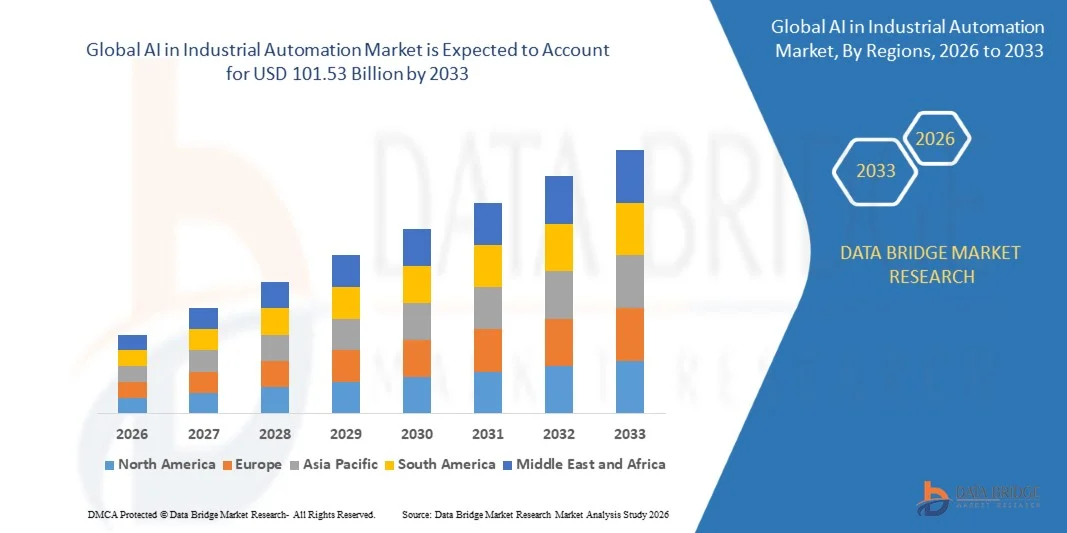
- As per Data Bridge Market Research analysis, the AI in industrial automation market was valued at USD 23.30 billion in 2025 and is projected to reach USD 101.53 billion by 2033, growing at a CAGR of 20.2% from 2026 to 2033.
- The market is experiencing strong growth driven by rising demand for predictive maintenance, automated quality inspection, and autonomous process optimization across automotive, electronics, pharmaceutical, food and beverage, and energy industries.
- The increasing integration of machine learning, computer vision, generative AI, and edge computing into controllers, robots, and plant software, combined with growing pressure to improve productivity and reduce unplanned downtime, is supporting market adoption. AI is being applied across predictive maintenance, machine vision-based inspection, and industrial robotics workflows, offering manufacturers faster decisions and greater operational resilience.
Market Size & Forecast
- Global Market Value (2025): USD 23.30 Billion
- Expected Market Value (2033): USD 101.53 Billion
- Forecast CAGR (2026–2033): 20.2%
- Leading Region in 2025: North America
- Fastest Growing Region: Asia Pacific
What are the Major Takeaways of the AI in Industrial Automation Market?
- North America dominated the AI in industrial automation market with the largest revenue share of 33.90% in 2025, supported by early adoption of industrial AI platforms, a strong presence of automation and cloud vendors, and large-scale smart factory investments.
- Asia-Pacific is expected to be the fastest-growing region at a CAGR of 23.41% from 2026 to 2033, fueled by rapid factory automation, large industrial robot installations, and expanding electronics and automotive manufacturing.
- The software segment led the market with a 44.79% share in 2025, driven by increasing adoption of AI platforms, analytics, digital twins, and engineering copilots across industrial operations.
- Services are the fastest-growing component type, projected to register a CAGR of 23.04%, reflecting the surge in demand for integration, data engineering, model maintenance, and managed AI operations.
- The machine learning segment dominated the technology category with a 43.6% revenue share in 2025, led by extensive deployment in predictive maintenance, process control, and anomaly detection.
- Predictive maintenance accounted for 31.94% of the market share in 2025, preferred by increasing need to reduce unplanned downtime and extend asset life across continuous and discrete manufacturing.
- The quality inspection & control segment is the fastest-growing application category, with a CAGR of 22.92%, driven by increasing use of computer vision for defect detection and traceability.
Report Scope and AI in Industrial Automation Market Segmentation
|
Attributes |
AI in Industrial Automation Key Market Insights |
|
Segments Covered |
|
|
Countries Covered |
North America
Europe
Asia-Pacific
Middle East and Africa
South America
|
|
Key Market Players |
|
|
Market Opportunities |
|
|
Value Added Data Infosets |
In addition to the market insights such as market value, growth rate, market segments, geographical coverage, market players, and market scenario, the market report curated by the Data Bridge Market Research team includes in-depth expert analysis, import/export analysis, pricing analysis, production consumption analysis, and pestle analysis. |
What is the Key Trend in the AI in Industrial Automation Market?
- AI in industrial automation is increasingly evolving from isolated analytics tools into integrated, agent-based systems that combine machine learning, generative AI, digital twins, and edge computing to engineer, operate, and maintain production systems with greater autonomy.
- For instance, in January 2024, according to arXiv, researchers behind LLM4PLC reported that their large language model pipeline for programmable logic controller programming improved code generation success from 47% to 72% and expert-rated code quality from 2.25 to 7.75 out of 10, highlighting the expansion of generative AI into industrial control engineering.
- Industrial AI vendors are embedding copilots and agents directly into engineering environments, controllers, and plant software, reducing the manual effort required for programming, configuration, documentation, and troubleshooting.
- Edge AI, industrial data platforms, and digital twin validation are also gaining importance, as manufacturers seek real-time inference, contextualized operational data, and safe testing of AI-generated control logic before deployment.
- For instance, in December 2025, according to arXiv, researchers reported that the LLM4SFC framework generated syntactically valid sequential function chart programs with a generation success of 75% to 94%, extending AI code generation from textual PLC languages to the graphical IEC 61131-3 languages used in automation engineering.
- As foundation models, edge computing, and industrial data platforms continue to mature, AI in industrial automation is expected to expand beyond maintenance and inspection into autonomous engineering, closed-loop process control, and fully orchestrated smart factory operations.
What are the Key Drivers of the AI in Industrial Automation Market?
- The rapid shift toward smart manufacturing and the need to reduce unplanned downtime, quality losses, and energy use have significantly increased demand for AI-enabled monitoring, prediction, and optimization across production assets.
- For instance, in November 2025, according to the International Journal of Industrial Engineering and Management, researchers deployed a hybrid CNN-LSTM predictive maintenance framework on 127 industrial machines across three facilities, achieving 94.3% accuracy in predicting failures 48 hours in advance, with a 37% reduction in unplanned downtime, 28% lower maintenance costs, and a 15% improvement in overall equipment effectiveness.
- Manufacturers facing labor shortages, rising quality requirements, and increasing product variety are integrating robots, machine vision, and AI-driven planning to improve throughput and consistency while preserving production flexibility.
- For instance, in September 2025, according to the International Federation of Robotics (IFR), 542,000 industrial robots were installed worldwide in 2024, while the global operational stock reached 4,664,000 units, up 9% from the previous year, expanding the installed base on which AI-enabled vision, control, and optimization software can be deployed.
- With manufacturers increasingly connecting machines, sensors, and enterprise systems, AI in industrial automation can support faster decisions, lower operating costs, and more resilient production across discrete and process industries.
What Factors Are Challenging the Growth of the AI in Industrial Automation Market?
- AI in industrial automation requires high-quality data, sensor retrofits, integration with legacy controllers and enterprise systems, and specialized skills, increasing project complexity compared with conventional automation upgrades.
- For instance, in December 2024, according to arXiv, researchers developing AutoPLC noted that vendors implement IEC 61131-3 Structured Text with proprietary extensions, and the system achieved a 78% formal verification pass rate on the 23-task Agents4PLC benchmark, indicating that LLM-generated control code still requires rigorous verification before deployment.
- These requirements can increase implementation costs and create challenges related to data labeling, model drift, interoperability, explainability, and maintaining reliable performance across different machines, plants, and operating conditions.
- Greater connectivity and autonomy also expand the cyber-attack surface of operational technology, while safety and liability concerns make operators cautious about allowing AI systems to control physical processes without human oversight.
- For instance, in February 2026, according to Dragos, the number of ransomware groups targeting industrial organizations rose to 119 in 2025 from 80 in 2024, collectively impacting 3,300 organizations, highlighting the cybersecurity risks that can constrain adoption of connected, AI-enabled industrial systems.
- The combination of data readiness gaps, integration complexity, cybersecurity exposure, and uncertain return on investment can constrain adoption among small and mid-sized manufacturers, particularly where existing automation already meets basic production requirements.
How is the AI in Industrial Automation Market Segmented?
The AI in industrial automation market is segmented on the basis of component, technology, application, and end user.
- By Component
On the basis of component, the AI in industrial automation market is segmented into hardware, software, and services. The software segment dominated the market with 44.79% share in 2025, supported by increasing adoption of AI platforms, analytics, digital twins, and engineering copilots across industrial operations. Software allows manufacturers to deploy models across multiple lines, integrate with controllers and manufacturing execution systems, and update capabilities without replacing equipment. Subscription-based licensing and cloud-edge architectures are improving accessibility for enterprises of different sizes. Vendors are also embedding generative AI assistants into engineering tools to reduce programming time, further strengthening the segment.
The services segment is projected to register the fastest growth at a CAGR of 23.04% from 2026 to 2033, driven by increasing demand for system integration, data engineering, model monitoring, training, and managed AI operations. Many manufacturers lack in-house data science and operational technology expertise, creating demand for specialized implementation partners. Services support sensor retrofits, data pipeline design, cybersecurity, and validation of AI models in production. Continuous model retraining and lifecycle management are creating recurring revenue opportunities. Growing adoption among mid-sized manufacturers is also supporting service demand.
- By Technology
On the basis of technology, the AI in industrial automation market is segmented into machine learning, computer vision, natural language processing, and others. The machine learning segment dominated the market with 43.62% share in 2025, supported by extensive use in predictive maintenance, process control, anomaly detection, and demand forecasting. Machine learning models can learn from vibration, temperature, current, and production data to anticipate failures and optimize setpoints. Mature algorithms, availability of industrial datasets, and compatibility with edge devices are increasing adoption. Integration with industrial internet of things platforms allows models to be deployed across multiple assets and facilities.
The natural language processing segment is projected to register the fastest growth at a CAGR of 24.81% from 2026 to 2033, driven by increasing use of large language models in engineering copilots, operator assistants, and maintenance knowledge systems. These tools can generate controller code, interpret manuals, summarize alarms, and answer troubleshooting questions in plain language. Their applications include automation programming, documentation, work-order creation, and training. Improvements in domain-specific models, verification tools, and secure on-premises deployment are improving trust, while integration with digital twins is expanding use cases.
- By Application
On the basis of application, the AI in industrial automation market is segmented into predictive maintenance, quality inspection & control, process optimization, supply chain & logistics, and others. The predictive maintenance segment dominated the application category with 31.94% share in 2025, supported by increasing need to reduce unplanned downtime, extend asset life, and lower maintenance costs. AI models can analyze sensor data to identify early signs of equipment degradation and schedule interventions before failures occur. Integration with maintenance management and enterprise resource planning systems improves work-order planning and spare-parts availability across process and discrete industries.
The quality inspection & control segment is projected to register the fastest growth at a CAGR of 22.92% from 2026 to 2033, driven by increasing use of computer vision for defect detection, dimensional measurement, and traceability. AI-based inspection can adapt to product variation and detect subtle defects that rule-based systems may miss. Its applications include electronics assembly, automotive components, packaging, and pharmaceutical production. Rising quality standards, zero-defect initiatives, and the need to reduce scrap and rework are creating additional demand. Improvements in cameras, edge processors, and synthetic training data are lowering deployment effort.
- By End User
On the basis of end user, the AI in industrial automation market is segmented into automotive, electronics & semiconductors, food & beverages, pharmaceuticals, energy & power, and others. The automotive segment dominated the end-user category with 28.44% share in 2025, supported by high levels of robotics, complex assembly lines, and strict quality requirements. Automakers are using AI for predictive maintenance, vision-based inspection, production scheduling, and battery manufacturing optimization. The industry’s large installed base of robots and programmable controllers provides a strong foundation for AI deployment, while rising electric vehicle production creates further opportunities.
The electronics & semiconductors segment is projected to register the fastest growth at CAGR of 23.50% from 2026 to 2033, driven by increasing complexity of chip fabrication, high yield sensitivity, and demand for microscopic defect detection. AI can optimize process parameters, classify wafer defects, and predict equipment drift in cleanrooms. Manufacturers are also using AI for printed circuit board inspection and automated test analysis. Rapid product cycles and capacity expansion in advanced packaging are encouraging investment, while data security and fab system interoperability remain important deployment considerations.
Which Region Holds the Largest Share of the AI in Industrial Automation Market?
- North America dominated the AI in industrial automation market with the largest revenue share of 33.90% in 2025, supported by early adoption of industrial AI platforms, a strong presence of automation and cloud vendors, and large-scale smart factory investments.
- The region also benefits from the presence of leading automation vendors, cloud and semiconductor providers, and a large base of advanced manufacturers, along with strong investment in smart factories and reshoring. Increasing use of AI for predictive maintenance, quality inspection, and engineering automation continues to strengthen North America’s position in the global market.
U.S. AI in Industrial Automation Market Insight
The U.S. AI in industrial automation market is witnessing strong growth due to rising adoption of smart factory technologies, reshoring of manufacturing, and large investments in AI infrastructure across automotive, aerospace, electronics, and energy industries. The country’s mature technology ecosystem, along with increasing integration of AI with programmable controllers, robots, and industrial cloud platforms, is driving demand for predictive and autonomous operations. In addition, growing emphasis on labor productivity, supply chain resilience, and operational technology cybersecurity is accelerating adoption of AI-enabled industrial automation.
Asia-Pacific AI in Industrial Automation Market Insight
The Asia-Pacific AI in industrial automation market is expected to witness rapid growth, driven by large-scale factory automation, expanding robot installations, and increasing investments in smart manufacturing across countries such as China, India, and Japan. Growing demand for higher productivity, quality consistency, and energy efficiency is supporting regional market expansion. In addition, the region’s strong electronics and automotive manufacturing ecosystems and government-backed digitalization programs are accelerating demand for AI-enabled industrial solutions.
Japan AI in Industrial Automation Market Insight
The Japan AI in industrial automation market is witnessing consistent growth due to rising investments in robotics, precision manufacturing, and labor-saving automation to address an aging workforce. Machine builders, electronics manufacturers, and automotive suppliers are increasingly adopting AI for inspection, robot control, and predictive maintenance. Moreover, strong demand for reliability, compact edge devices, and integration with established controller and robot platforms is further contributing to market growth in Japan.
China AI in Industrial Automation Market Insight
The China AI in industrial automation market is growing rapidly, driven by the world’s largest industrial robot base, expanding smart factory programs, and increasing adoption of AI across electronics, automotive, battery, and heavy industry. Growing use of machine vision, digital twins, and industrial platforms in large manufacturing clusters is significantly boosting market demand. In addition, strong domestic automation suppliers, supportive industrial policies, and rapid adoption of edge AI are positioning China as a key growth market for AI in industrial automation across Asia-Pacific.
U.K. AI in Industrial Automation Market Insight
The U.K. AI in industrial automation market is experiencing steady growth, supported by increasing adoption of smart manufacturing, digital twins, and data-driven maintenance across aerospace, automotive, pharmaceutical, and food production. Manufacturers, research centers, and technology providers are increasingly using AI to improve productivity and reduce energy consumption. Furthermore, growing government support for industrial digitalization and integration of AI with industrial software platforms is supporting wider adoption of intelligent automation in the U.K.
Germany AI in Industrial Automation Market Insight
The Germany AI in industrial automation market is expanding steadily due to the country’s strong industrial base, leadership in automation technology, and active development of industrial AI platforms. Automotive, machinery, chemical, and electronics manufacturers are increasingly utilizing AI for engineering automation, predictive maintenance, and quality control. Continuous advancements in digital twins, industrial edge computing, and generative AI copilots, along with Germany’s focus on reliability and data sovereignty, are further driving market growth in the country.
Which are the Top Companies in AI in Industrial Automation Market?
The AI in industrial automation industry is primarily led by well-established companies, including:
- Siemens AG (Germany)
- ABB Ltd (Switzerland)
- Rockwell Automation, Inc. (U.S.)
- Schneider Electric SE (France)
- Honeywell International Inc. (U.S.)
- Emerson Electric Co. (U.S.)
- Mitsubishi Electric Corporation (Japan)
- FANUC Corporation (Japan)
- Yokogawa Electric Corporation (Japan)
- NVIDIA Corporation (U.S.)
- Microsoft Corporation (U.S.)
- International Business Machines Corporation (U.S.)
- Google LLC (U.S.)
- Amazon Web Services, Inc. (U.S.)
- Intel Corporation (U.S.)
- Cognex Corporation (U.S.)
- OMRON Corporation (Japan)
- Hitachi, Ltd. (Japan)
- PTC Inc. (U.S.)
- C3.ai, Inc. (U.S.)
What are Latest Developments in AI in Industrial Automation Market?
- In June 2026, Schneider Electric announced a definitive agreement to acquire Cognite, an industrial data and AI software provider, in an all-cash transaction valued at USD 3.1 billion. Cognite will be integrated with AVEVA, strengthening Schneider Electric’s industrial AI capabilities with a unified industrial data foundation and agentic AI platform; Cognite reported 2025 revenue above USD 170 million and 36% growth in ARR bookings.
- In April 2026, Siemens launched the Eigen Engineering Agent at Hannover Messe, an AI agent for automation engineering integrated into the TIA Portal. The solution has been tested with more than 100 companies and is designed to accelerate programming, configuration, documentation, and troubleshooting workflows, marking a shift from copilots that assist engineers to agents that execute engineering tasks.
- In April 2026, Rockwell Automation announced it would demonstrate AI-orchestrated factory system design at Hannover Messe 2026, combining Emulate3D digital twin software, Copilot in Visual Studio Code, and FactoryTalk Design Studio. The workflow pairs autonomous AI agents with closed-loop digital twin validation so engineers can move from a validated model to a fully tested controller project before hardware is deployed.
- In January 2026, Siemens announced at CES an expanded partnership with NVIDIA to build an Industrial AI Operating System spanning design, engineering, manufacturing, operations, and supply chains. The company also introduced its Digital Twin Composer software and unveiled nine industrial copilots, extending AI across the industrial value chain and supporting wider adoption of intelligent automation.
- In October 2025, SoftBank Group agreed to acquire ABB’s robotics division for USD 5.375 billion, with closing expected in mid-to-late 2026 subject to regulatory approvals. The division generated USD 2.3 billion in revenue in 2024, and SoftBank positioned the deal as part of its push to combine artificial intelligence with industrial robotics under a physical AI strategy.

- Interactive Data Analysis Dashboard
- Company Analysis Dashboard for high growth potential opportunities
- Research Analyst Access for customization & queries
- Competitor Analysis with Interactive dashboard
- Latest News, Updates & Trend analysis
- Harness the Power of Benchmark Analysis for Comprehensive Competitor Tracking
Data collection and base year analysis are done using data collection modules with large sample sizes. The stage includes obtaining market information or related data through various sources and strategies. It includes examining and planning all the data acquired from the past in advance. It likewise envelops the examination of information inconsistencies seen across different information sources. The market data is analysed and estimated using market statistical and coherent models. Also, market share analysis and key trend analysis are the major success factors in the market report. To know more, please request an analyst call or drop down your inquiry.
The key research methodology used by DBMR research team is data triangulation which involves data mining, analysis of the impact of data variables on the market and primary (industry expert) validation. Data models include Vendor Positioning Grid, Market Time Line Analysis, Market Overview and Guide, Company Positioning Grid, Patent Analysis, Pricing Analysis, Company Market Share Analysis, Standards of Measurement, Global versus Regional and Vendor Share Analysis. To know more about the research methodology, drop in an inquiry to speak to our industry experts.
Data Bridge Market Research is a leader in advanced formative research. We take pride in servicing our existing and new customers with data and analysis that match and suits their goal. The report can be customized to include price trend analysis of target brands understanding the market for additional countries (ask for the list of countries), clinical trial results data, literature review, refurbished market and product base analysis. Market analysis of target competitors can be analyzed from technology-based analysis to market portfolio strategies. We can add as many competitors that you require data about in the format and data style you are looking for. Our team of analysts can also provide you data in crude raw excel files pivot tables (Fact book) or can assist you in creating presentations from the data sets available in the report.