


What is the AI-integrated Blood Analyzers Market Size and Growth Rate?
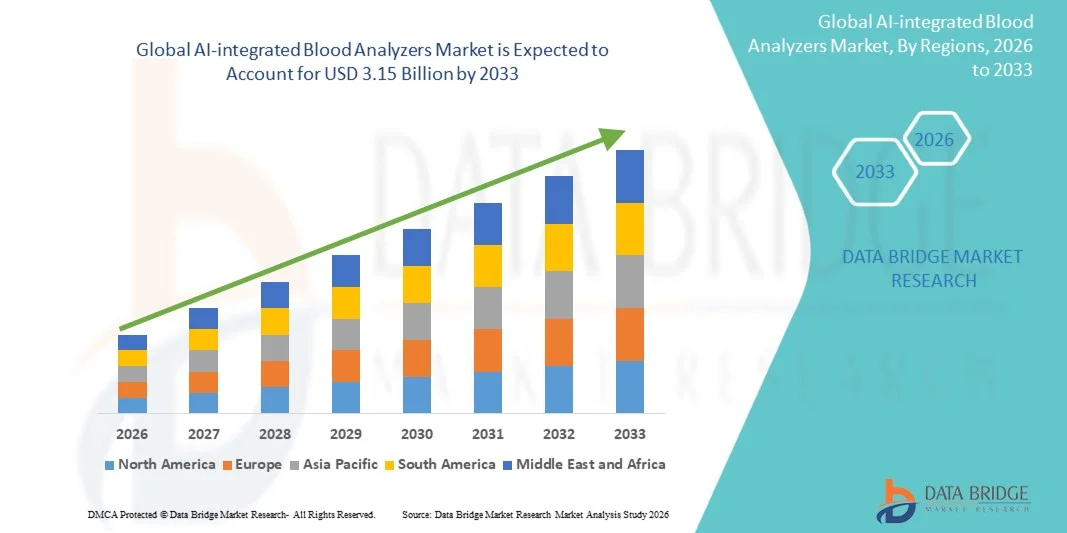
- As per Data Bridge Market Research analysis, the AI-integrated blood analyzers market was valued at USD 1.09 billion in 2025 and is projected to reach USD 3.15 billion by 2033, growing at a CAGR of 14.21% from 2026 to 2033.
- The market is experiencing consistent growth as artificial intelligence, machine learning, and automation are built into hematology and blood diagnostic systems, alongside a growing need for faster, more accurate disease detection. AI-enabled analyzers help providers interpret complex blood parameters, reduce manual errors, and raise laboratory productivity.
- Rising chronic disease prevalence, demand for early diagnosis, and adoption of automated diagnostic platforms are encouraging hospitals, diagnostic laboratories, and research institutions to adopt AI-integrated blood analyzers. These systems are displacing conventional testing workflows by offering automated sample processing, digital morphology analysis, predictive insights, and stronger clinical decision support.
Market Size & Forecast
- Global Market Value (2025): USD 1.09 Billion
- Expected Market Value (2033): USD 3.15 Billion
- Forecast CAGR (2026–2033): 14.21%
- Leading Region in 2025: North America
- Fastest Growing Region: Asia Pacific
What are the Major Takeaways of the AI-integrated Blood Analyzers Market?
- North America dominated the AI-integrated blood analyzers market with the largest revenue share of 42.36% in 2025, supported by a strong base of high-throughput reference laboratories, established healthcare infrastructure, and rising adoption of AI-enabled hematology diagnostics.
- Asia-Pacific is expected to be the fastest-growing region at a CAGR of 15.32% from 2026 to 2033, fueled by rising healthcare expenditure, expanding diagnostic laboratory infrastructure, growing use of automation, and demand for AI-powered diagnostics.
- The AI-assisted POC analyzers segment led the market with a 45.5% share in 2025, driven by demand for rapid, decentralized, real-time blood testing.
- AI-based diagnostic software is the fastest-growing product type, projected to register a CAGR of 16.8%, reflecting the surge in demand for advanced analytics, automated interpretation, and AI-driven decision support.
- The diagnostic laboratories segment dominated the technology category with a 40.5% revenue share in 2025, led by adoption of automated hematology systems, high-volume testing needs, and efficient laboratory workflows.
- Hematology accounted for 35.0% of the market share in 2025, preferred for AI-enabled complete blood count testing, blood cell classification, and detection of hematological abnormalities.
- The oncology segment is the fastest-growing application category, with a CAGR of 18.0%, driven by demand for early cancer detection and AI-assisted analysis of abnormal blood cell patterns.
Report Scope and AI-integrated Blood Analyzers Market Segmentation
|
Attributes |
AI-integrated Blood Analyzers Key Market Insights |
|
Segments Covered |
|
|
Countries Covered |
North America
Europe
Asia-Pacific
Middle East and Africa
South America
|
|
Key Market Players |
|
|
Market Opportunities |
|
|
Value Added Data Infosets |
In addition to the insights on market scenarios such as market value, growth rate, segmentation, geographical coverage, and major players, the market reports curated by the Data Bridge Market Research also include in-depth expert analysis, patient epidemiology, pipeline analysis, pricing analysis, and regulatory framework. |
What is the Key Trend in the AI-integrated Blood Analyzers Market?
- Healthcare laboratories are increasingly adopting AI-integrated blood analyzers to improve diagnostic accuracy, automate hematology workflows, and enhance blood cell analysis through AI, machine learning, and digital morphology.
- AI-powered analyzers enable automated blood cell classification, identification of abnormal cell patterns, and faster interpretation of complex hematological data, reducing manual review and improving efficiency.
- For instance, in August 2022, according to a study published in the International Journal of Laboratory Hematology, the Scopio X100 Full-Field Peripheral Blood Smear platform showed high agreement between its AI-assisted digital morphology and expert manual microscopy while improving workflow standardization and efficiency.
- Image recognition and deep learning let analyzers evaluate peripheral blood smears and return standardized, consistent diagnostic insights.
- For instance, in April 2025, according to an article in Frontiers in Oncology, the AI-assisted MC-100i digital morphology analyzer supported early screening of acute promyelocytic leukemia through automated blood smear analysis and AI-based cell recognition.
- As healthcare systems prioritize laboratory automation, precision diagnostics, and AI adoption, AI-integrated blood analyzers are expected to become a core part of next-generation diagnostic infrastructure and personalized healthcare.
What are the Key Drivers of the AI-integrated Blood Analyzers Market?
- Rising prevalence of hematological disorders, demand for early disease detection, and the need for faster diagnostic testing have significantly increased demand for AI-integrated blood analyzers in healthcare facilities worldwide.
- For instance, in March 2024, according to a multicenter study in Clinica Chimica Acta, Mindray’s MC-100i digital morphology analyzer was evaluated across 11 tertiary hospitals in China, where its convolutional neural network (CNN)-based technology improved automated blood cell classification accuracy, supporting faster and more standardized hematology testing.
- AI algorithms analyze large volumes of blood data, improve detection of abnormalities, support predictive diagnostics, and strengthen clinical decision-making.
- For instance, in March 2023, according to an article in BMC Medical Informatics and Decision Making, AI-assisted digital morphology analyzers improved peripheral blood leukocyte differentiation, raising classification accuracy and cutting the time needed for manual smear analysis.
- As providers increasingly turn to AI for automated diagnostics and precision medicine, AI-integrated blood analyzers will remain essential to better disease detection, laboratory efficiency, and patient outcomes.
What Factors Are Challenging the Growth of the AI-integrated Blood Analyzers Market?
- AI-integrated blood analyzers require significant upfront investment because they combine AI software, advanced imaging, automated processing, and complex laboratory data-management platforms.
- For instance, in September 2024, according to the World Health Organization and the International Telecommunication Union, more than 60% of countries have developed digital health strategies, yet integrating new technologies into existing health infrastructure and securing investment in digital health systems remain challenges.
- These costs limit adoption among smaller diagnostic laboratories, healthcare facilities, and providers in developing regions with restricted technology budgets.
- Implementation also demands skilled personnel, digital infrastructure, and laboratory integration capability, adding operational complexity for providers.
- For instance, in September 2025, according to the World Health Organization, adoption of digital health technologies still faces barriers in infrastructure, workforce training, time constraints, workload, ethics, and technical factors.
- High capital expenditure, maintenance requirements, and adoption barriers continue to restrict wider deployment, particularly among smaller laboratories and emerging healthcare markets, despite rising demand for automated diagnostics.
How is the AI-integrated Blood Analyzers Market Segmented?
The AI-integrated blood analyzers market is segmented on the basis of product type, technology, application, and end user.
- By Product Type
On the basis of product type, the AI-integrated blood analyzers market is segmented into AI-assisted POC analyzers, AI-based test report automation tools, and AI-based diagnostic software. The AI-assisted POC analyzers segment dominated the market with an estimated revenue share of 45.5% in 2025, owing to demand for rapid, decentralized, real-time blood testing. These analyzers let clinicians test closer to the patient, cutting turnaround time and improving access in emergency, outpatient, and remote settings. AI improves automated interpretation and speeds clinical decisions. Expanding use in critical care, infectious disease monitoring, and preventive healthcare further supports the segment.
The AI-based diagnostic software segment is projected to register the fastest growth at a CAGR of 16.8% from 2026 to 2033, driven by demand for advanced analytics, automated interpretation, and AI-powered decision support. These platforms analyze complex blood parameters, enable predictive diagnostics, and link laboratory data to healthcare information systems. Digital pathology and laboratory automation are accelerating demand. Continued progress in machine learning and cloud-based platforms is widening applications, while investment in precision medicine supports rapid growth.
- By Technology
On the basis of technology, the AI-integrated blood analyzers market is segmented into diagnostic laboratories, hospitals & clinics, point-of-care settings, academic & research institutes, corporate wellness providers, and others. The diagnostic laboratories segment dominated the market with an estimated revenue share of 40.5% in 2025, supported by adoption of automated hematology systems, high-volume testing, and demand for efficient workflows. Laboratories run large numbers of blood tests daily, creating strong demand for AI-enabled automation that improves accuracy, reduces manual workload, and shortens reporting cycles. Investment in laboratory digitalization and the need for standardized analysis in centralized laboratories reinforce the segment.
The point-of-care settings segment is expected to witness the fastest growth at a CAGR of 17.9% from 2026 to 2033, driven by demand for rapid diagnostics and decentralized care. AI-assisted POC analyzers reduce dependence on centralized laboratories by delivering results near the patient. Emergency care, remote facilities, and home-based diagnostics are growing adopters. Miniaturized devices and AI-driven interpretation are improving usability and accuracy, and telemedicine and remote monitoring create further opportunity.
- By Application
On the basis of application, the AI-integrated blood analyzers market is segmented into oncology, cardiovascular disease, infectious disease, hematology, metabolic & endocrine disorders, autoimmune & inflammatory conditions, neurological disorders, prenatal & neonatal testing, and wellness & preventive health. The hematology segment dominated the market with an estimated revenue share of 35.0% in 2025, owing to widespread use of AI-enabled analyzers for complete blood count testing, blood cell classification, and detection of hematological abnormalities. AI is increasingly built into hematology workflows to improve peripheral blood smear analysis. Rising anemia and leukemia prevalence and gains in laboratory efficiency from automated morphology analysis sustain the segment’s lead.
The oncology segment is expected to register the fastest growth at a CAGR of 18.0% from 2026 to 2033, driven by demand for early cancer detection and AI-assisted analysis of abnormal blood cell patterns. AI helps identify malignant cells and interpret complex diagnostic data faster. The global cancer burden and the focus on precision oncology are raising adoption, and growing research combining AI with cancer diagnostics adds momentum.
- By End User
On the basis of end user, the AI-integrated blood analyzers market is segmented into hospitals, diagnostic laboratories, blood banks and transfusion centers, ambulatory and urgent care centers, research and academic institutes, and others. The hospitals segment dominated the market with an estimated revenue share of 45.0% in 2025, supported by adoption of advanced diagnostic technologies, rising patient volumes, and demand for automated laboratory solutions. Hospitals use AI-enabled analyzers to improve diagnostic efficiency, shorten turnaround time, and support clinical decisions, especially in emergency departments and specialized care units. Healthcare infrastructure investment and digital transformation reinforce the segment.
The research and academic institutes segment is projected to experience the fastest growth at a CAGR of 17.9% from 2026 to 2033, driven by research on AI, machine learning, and advanced diagnostics. Academic institutions use AI-integrated analyzers to study biomarkers, blood cell behavior, and new diagnostic methods. Collaboration between technology companies and research bodies, together with biomedical and precision medicine funding, is accelerating adoption. These institutions also play a central role in validating new AI-based blood analysis technologies.
Which Region Holds the Largest Share of the AI-integrated Blood Analyzers Market?
- North America dominated the AI-integrated blood analyzers market with the largest revenue share of 42.36% in 2025, supported by a strong base of high-throughput reference laboratories, established healthcare infrastructure, and rising adoption of AI-enabled hematology diagnostics.
- The region also benefits from investment in healthcare automation, wide adoption of advanced hematology analyzers, and growing integration of AI-powered diagnostic platforms across hospitals and clinical laboratories. Demand for faster disease detection, precision diagnostics, and automated workflows continues to strengthen North America’s leadership.
U.S. AI-integrated Blood Analyzers Market Insight
The U.S. AI-integrated blood analyzers market is witnessing strong growth due to rising use of AI in clinical diagnostics, laboratory automation, and demand for faster, more accurate blood analysis. Advanced healthcare infrastructure, leading diagnostics companies, and investment in AI-driven healthcare innovation are driving adoption across hospitals, laboratories, and research institutions. In addition, the focus on precision medicine and early detection is accelerating integration of AI-enabled hematology and digital morphology platforms. The U.S. Food and Drug Administration (FDA) has continued to expand its oversight and clearance of AI-enabled medical devices.
Asia-Pacific AI-integrated Blood Analyzers Market Insight
The Asia-Pacific AI-integrated blood analyzers market is expected to witness rapid growth, driven by rising healthcare expenditure, expanding diagnostic infrastructure, and adoption of AI-based laboratory solutions in China, Japan, and India. Chronic disease prevalence, demand for early diagnosis, and government healthcare digitalization initiatives support regional expansion. In addition, investment in medical AI research and automation is accelerating use of AI-enabled blood analysis in hospitals and diagnostic centers. China’s National Health Commission has highlighted digital healthcare and AI applications as part of healthcare modernization.
Japan AI-integrated Blood Analyzers Market Insight
The Japan AI-integrated blood analyzers market is witnessing consistent growth due to investment in healthcare automation, advanced diagnostics, and AI applications in medical laboratories. Hospitals and research institutions are adopting AI-enabled platforms to improve laboratory efficiency, strengthen analysis accuracy, and meet the needs of an aging population. Moreover, Japan’s strong medical technology ecosystem and digital transformation focus contribute to growth. The Ministry of Health, Labour and Welfare has promoted digital technologies and AI in healthcare services to improve diagnostic efficiency.
China AI-integrated Blood Analyzers Market Insight
The China AI-integrated blood analyzers market is growing rapidly, driven by healthcare modernization, expanding laboratory automation, and government support for AI in medical diagnostics. Demand for high-throughput testing and investment in medical technology innovation boost adoption. In addition, rapid expansion of hospitals and diagnostic centers, along with the focus on early detection, positions China as one of the fastest-growing markets. National AI development initiatives encourage integration of AI into healthcare and medical innovation.
U.K. AI-integrated Blood Analyzers Market Insight
The U.K. AI-integrated blood analyzers market is experiencing steady growth, supported by adoption of AI in healthcare, investment in digital diagnostics, and demand for automated laboratory solutions. The National Health Service (NHS) infrastructure, strong research ecosystem, and focus on diagnostic efficiency contribute to AI adoption in hospitals and pathology laboratories. Furthermore, AI-based analytics and automation are improving workflow efficiency and speeding clinical decisions. NHS England has expanded initiatives to adopt AI to improve diagnostic pathways and efficiency.
Germany AI-integrated Blood Analyzers Market Insight
The Germany AI-integrated blood analyzers market is expanding steadily due to strong healthcare infrastructure, an advanced medical technology sector, and growing use of AI in laboratory diagnostics. Hospitals, laboratories, and research organizations are using AI-enabled systems to improve accuracy, automate workflows, and raise efficiency. Continued investment in healthcare digitalization, medical research, and precision diagnostics further drives growth. Germany’s Digital Act (Digital-Gesetz) supports expansion of digital healthcare infrastructure, including AI applications.
Which are the Top Companies in AI-integrated Blood Analyzers Market?
The AI-integrated blood analyzers industry is primarily led by well-established companies, including:
- Shenzhen Mindray Bio-Medical Electronics Co., Ltd. (China)
- Sysmex Corporation (Japan)
- F. Hoffmann-La Roche Ltd (Switzerland)
- Danaher (U.S.)
- Abbott (U.S.)
- Siemens Healthineers AG (Germany)
- HORIBA, Ltd. (Japan)
- NIHON KOHDEN CORPORATION (Japan)
- BD (U.S.)
- Thermo Fisher Scientific Inc. (U.S.)
- Bio-Rad Laboratories, Inc. (U.S.)
- Agilent Technologies, Inc. (U.S.)
- PerkinElmer, Inc. (U.S.)
- EKF Diagnostics Holdings plc (U.K.)
- QuidelOrtho Corporation (U.S.)
- Nova Biomedical Corporation (U.S.)
- Diatron (Hungary)
- Erba Mannheim (Germany)
- Scopio Labs Ltd. (Israel)
- CellaVision AB (Sweden)
What are Latest Developments in AI-integrated Blood Analyzers Market?
- In September 2024, Zoetis announced Vetscan OptiCell, a cartridge-based AI-powered hematology analyzer for point-of-care complete blood count (CBC) analysis in veterinary clinics. It delivers automated blood cell analysis with reference-laboratory-level accuracy while reducing testing time, maintenance, and workflow complexity, highlighting growing adoption of AI-powered hematology at the point of care.
- In February 2024, Sysmex Corporation announced a strategic alliance with CellaVision to advance hematology solutions, including next-generation cell morphology analyzers. The collaboration aims to improve efficiency, standardization, and precision of cell morphology classification by combining automated hematology with digital morphology.
- In May 2023, Siemens Healthineers launched the Atellica HEMA 570 and Atellica HEMA 580 hematology analyzers for high-volume testing, with advanced automation and workflow connectivity to help laboratories handle rising diagnostic demand.
- In June 2022, researchers published the development and evaluation of the Hilab system, an AI-supported point-of-care hematology analyzer that combines AI algorithms with Internet of Things (IoT) connectivity to automate hematological analysis for rapid near-patient testing outside conventional laboratories.
- In September 2021, Scopio Labs launched its Full-Field Peripheral Blood Smear (FF-PBS) application on the X100 platform, combining high-resolution full-field imaging with AI-based cell recognition and classification to digitize smear analysis and reduce reliance on manual microscopy.

- Interactive Data Analysis Dashboard
- Company Analysis Dashboard for high growth potential opportunities
- Research Analyst Access for customization & queries
- Competitor Analysis with Interactive dashboard
- Latest News, Updates & Trend analysis
- Harness the Power of Benchmark Analysis for Comprehensive Competitor Tracking
Data collection and base year analysis are done using data collection modules with large sample sizes. The stage includes obtaining market information or related data through various sources and strategies. It includes examining and planning all the data acquired from the past in advance. It likewise envelops the examination of information inconsistencies seen across different information sources. The market data is analysed and estimated using market statistical and coherent models. Also, market share analysis and key trend analysis are the major success factors in the market report. To know more, please request an analyst call or drop down your inquiry.
The key research methodology used by DBMR research team is data triangulation which involves data mining, analysis of the impact of data variables on the market and primary (industry expert) validation. Data models include Vendor Positioning Grid, Market Time Line Analysis, Market Overview and Guide, Company Positioning Grid, Patent Analysis, Pricing Analysis, Company Market Share Analysis, Standards of Measurement, Global versus Regional and Vendor Share Analysis. To know more about the research methodology, drop in an inquiry to speak to our industry experts.
Data Bridge Market Research is a leader in advanced formative research. We take pride in servicing our existing and new customers with data and analysis that match and suits their goal. The report can be customized to include price trend analysis of target brands understanding the market for additional countries (ask for the list of countries), clinical trial results data, literature review, refurbished market and product base analysis. Market analysis of target competitors can be analyzed from technology-based analysis to market portfolio strategies. We can add as many competitors that you require data about in the format and data style you are looking for. Our team of analysts can also provide you data in crude raw excel files pivot tables (Fact book) or can assist you in creating presentations from the data sets available in the report.













