


What is the AI-Integrated Surgical Navigation Systems Market Size and Overview?
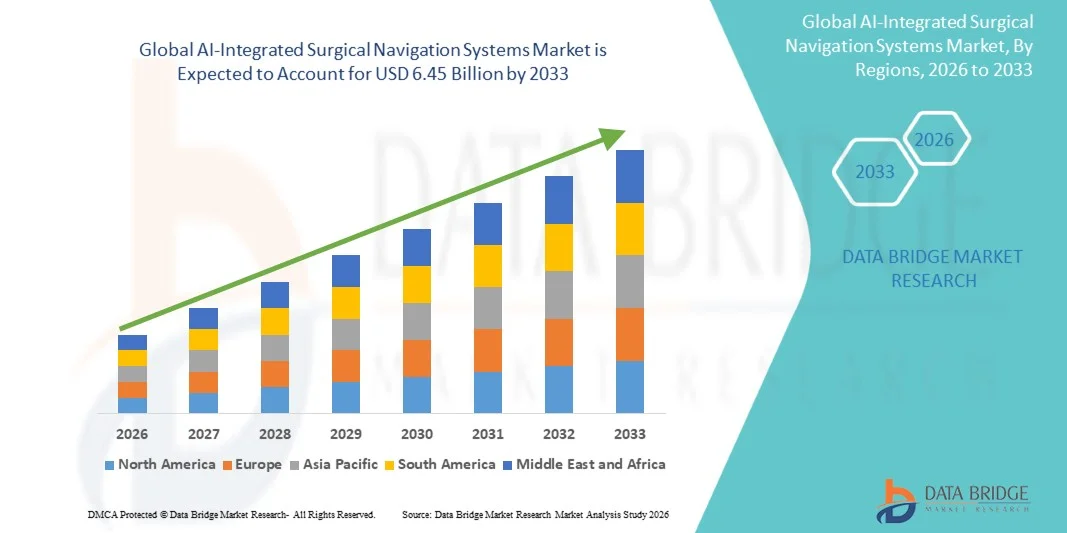
- As per Data Bridge Market Research Analysis the global AI-Integrated Surgical Navigation Systems market size was valued at USD 1.93 billion in 2025 and is expected to reach USD 6.45 billion by 2033, at a CAGR of 16.30% during the forecast period
- The market growth is largely fueled by the increasing adoption of advanced healthcare technologies and the integration of artificial intelligence in surgical procedures, leading to enhanced precision, improved outcomes, and greater efficiency in operating rooms across healthcare settings
- Furthermore, rising demand for minimally invasive surgeries, growing prevalence of complex surgical conditions, and increasing focus on patient safety and accuracy are establishing AI-integrated surgical navigation systems as essential tools in modern surgical practices. These converging factors are accelerating the uptake of AI-Integrated Surgical Navigation Systems solutions, thereby significantly boosting the industry's growth
Market Size & Forecast
- Global Market Value (2025): USD 1.93 billion
- Expected Market Value (2033): USD 6.45 billion
- Forecast CAGR (2026–2033): 16.30%
What are the Major Takeaways of AI-Integrated Surgical Navigation Systems Market?
- AI-integrated surgical navigation systems, enabling real-time imaging, precision guidance, and data-driven decision-making, are increasingly vital components of modern surgical procedures across hospitals and specialized surgical centers due to their ability to enhance accuracy and reduce surgical risks
- The escalating demand for AI-integrated surgical navigation systems is primarily fueled by the growing adoption of minimally invasive surgeries, rising prevalence of complex and chronic conditions, and increasing need for improved surgical outcomes and patient safety
- North America dominated the AI-integrated surgical navigation systems market with the largest revenue share of approximately 38.6% in 2025, characterized by advanced healthcare infrastructure, high adoption of cutting-edge medical technologies, and strong presence of key industry players, with the U.S. experiencing substantial growth driven by increasing investments in AI-based healthcare solutions and surgical innovations
- Asia-Pacific is expected to be the fastest growing region in the AI-Integrated Surgical Navigation Systems market during the forecast period, with a projected CAGR of around 9.4%, due to rising healthcare expenditure, increasing patient population, growing adoption of advanced surgical technologies, and improving healthcare infrastructure
- The optical navigation systems segment dominated the largest market revenue share of 42.7% in 2025, driven by its high accuracy and reliability in complex surgical procedures
Report Scope and AI-Integrated Surgical Navigation Systems Market Segmentation
|
Attributes |
AI-Integrated Surgical Navigation Systems Key Market Insights |
|
Segments Covered |
|
|
Countries Covered |
North America
Europe
Asia-Pacific
Middle East and Africa
South America
|
|
Key Market Players |
|
|
Market Opportunities |
|
|
Value Added Data Infosets |
In addition to the insights on market scenarios such as market value, growth rate, segmentation, geographical coverage, and major players, the market reports curated by the Data Bridge Market Research also include in-depth expert analysis, patient epidemiology, pipeline analysis, pricing analysis, and regulatory framework. |
What is the Key Trend in the AI-Integrated Surgical Navigation Systems Market?
“Advancements in Precision and Integration of Surgical Technologies”
- A significant and accelerating trend in the global AI-Integrated Surgical Navigation Systems market is the increasing adoption of advanced imaging, real-time data analytics, and integration with robotic-assisted surgical platforms. These technologies are enhancing surgical precision, improving clinical outcomes, and reducing intraoperative risks across complex procedures.
- Modern surgical navigation systems are increasingly being integrated with 3D imaging, augmented reality (AR), and real-time intraoperative guidance tools, enabling surgeons to achieve higher accuracy in procedures such as neurosurgery, orthopedic surgery, and spinal interventions
- The incorporation of artificial intelligence in these systems allows for improved preoperative planning, intraoperative decision support, and predictive analytics, helping surgeons identify optimal surgical pathways and minimize complications
- Furthermore, the growing compatibility of navigation systems with robotic surgical platforms is enabling seamless workflows in operating rooms, enhancing efficiency and reducing procedure times
- The trend toward minimally invasive surgeries is also driving the demand for advanced navigation systems, as these procedures require high levels of precision and visualization
- As healthcare providers increasingly focus on improving patient outcomes and reducing hospital stays, the demand for technologically advanced, integrated surgical navigation systems continues to rise globally
AI-Integrated Surgical Navigation Systems Market Dynamics
Driver
“Rising Demand for Minimally Invasive and High-Precision Surgeries”
- The increasing global preference for minimally invasive surgical procedures is a major driver for the growth of the AI-integrated surgical navigation systems market, as these procedures require enhanced accuracy and real-time guidance
- For instance, hospitals are increasingly adopting image-guided navigation platforms such as Medtronic StealthStation and Brainlab Curve Navigation System to support complex neurosurgery and spinal procedures, significantly improving surgical precision and reducing intraoperative risks
- The growing prevalence of chronic diseases, including orthopedic disorders, neurological conditions, and cardiovascular diseases, is leading to a higher volume of complex surgeries, thereby increasing the need for advanced navigation technologies
- Advancements in imaging modalities such as CT, MRI, and intraoperative imaging systems are further supporting the adoption of navigation systems by enabling precise visualization of anatomical structures during surgery
- The rising adoption of robotic-assisted surgeries in developed and emerging economies is also contributing significantly to market growth, as navigation systems play a critical role in ensuring procedural accuracy and safety
- Increasing healthcare expenditure and investments in advanced surgical infrastructure, particularly in hospitals and specialized surgical centers, are further accelerating the adoption of these systems
- In addition, the growing focus on reducing surgical errors, improving patient safety, and enhancing postoperative outcomes is encouraging healthcare providers to adopt AI-integrated navigation solutions
- Favorable government initiatives and funding for healthcare digitization and innovation are also supporting the expansion of this market
Restraint/Challenge
“High Costs and Technical Complexity of Advanced Systems”
- The high cost associated with AI-integrated surgical navigation systems, including installation, maintenance, and training, remains a significant barrier to adoption, particularly in developing regions
- For instance, the deployment of advanced systems such as Brainlab navigation platforms or Stryker NAV3i systems often requires substantial capital investment, which can be challenging for small and mid-sized hospitals in emerging economies
- The technical complexity of operating advanced navigation systems necessitates specialized training for surgeons and operating room staff, creating an additional challenge for healthcare providers
- Integration with existing hospital infrastructure and surgical workflows can also be complex and time-consuming, potentially slowing down adoption rates
- Concerns related to data privacy, system reliability, and potential technical failures during critical surgical procedures further add to the hesitation among end users
- Moreover, limited reimbursement policies in certain regions for advanced surgical technologies may restrict market growth
- Addressing these challenges through cost optimization, training programs, and improved system usability will be essential for broader adoption and long-term market expansion
AI-Integrated Surgical Navigation Systems Market Scope
The market is segmented on the basis of technology, and application .
• By Technology
On the basis of technology, the AI-Integrated Surgical Navigation Systems market is segmented into optical navigation systems, electromagnetic navigation systems, hybrid navigation systems, and AI-based image-guided systems. The optical navigation systems segment dominated the largest market revenue share of 42.7% in 2025, driven by its high accuracy and reliability in complex surgical procedures. These systems are widely used in neurosurgery and orthopedic procedures due to precise real-time tracking capabilities. Increasing demand for minimally invasive surgeries further supports adoption. Surgeons prefer optical systems due to better visualization and reduced surgical errors. Technological advancements in imaging and tracking enhance system efficiency. Growing integration with AI-based platforms improves surgical outcomes. Rising investments in advanced operating room infrastructure also boost adoption. Hospitals increasingly adopt these systems for precision-based procedures. Favorable reimbursement policies in developed regions support growth. Increasing number of complex surgeries globally strengthens demand. These factors collectively ensure the dominance of the optical navigation systems segment.
The AI-based image-guided systems segment is expected to witness the fastest CAGR of 11.8% from 2026 to 2033, driven by rapid advancements in artificial intelligence and machine learning technologies. These systems enable enhanced decision-making through real-time data analysis. Increasing adoption of AI in healthcare significantly boosts growth. Improved accuracy in tumor localization and surgical planning supports demand. Rising focus on personalized and precision medicine enhances adoption. Integration with big data and cloud platforms strengthens capabilities. Growing investments in digital healthcare infrastructure accelerate market expansion. Surgeons benefit from predictive analytics and automation features. Increasing clinical trials for AI-based solutions further support growth. Expanding use in multiple surgical specialties drives demand. These factors position AI-based image-guided systems as the fastest-growing segment.
• By Application
On the basis of application, the AI-Integrated Surgical Navigation Systems market is segmented into neurosurgery, orthopedic surgery, ENT surgery, spinal surgery, and others. The neurosurgery segment accounted for the largest market revenue share of 39.4% in 2025, driven by the critical need for precision in brain and nervous system procedures. Navigation systems help reduce risks associated with complex neurosurgical operations. Increasing prevalence of neurological disorders supports demand. Surgeons rely on navigation systems for accurate tumor removal and biopsy procedures. Technological advancements improve surgical outcomes and patient safety. Growing number of brain surgeries globally further boosts adoption. Hospitals increasingly invest in advanced neurosurgical infrastructure. Integration of AI enhances real-time guidance and decision-making. Rising awareness regarding minimally invasive neurosurgery supports growth. Favorable clinical outcomes encourage wider adoption. These factors collectively ensure dominance of the neurosurgery segment.
The orthopedic surgery segment is expected to witness the fastest CAGR of 10.9% from 2026 to 2033, driven by the increasing number of joint replacement and trauma cases worldwide. Growing aging population significantly contributes to demand. Rising incidence of musculoskeletal disorders supports market growth. Navigation systems improve implant positioning and surgical accuracy. Increasing adoption of robotic-assisted orthopedic procedures boosts demand. Surgeons prefer navigation systems for better alignment and reduced complications. Expansion of healthcare infrastructure in emerging markets accelerates growth. Technological advancements in orthopedic devices enhance compatibility. Increasing patient awareness regarding advanced surgical options supports adoption. Rising sports injuries and accidents further drive demand. These factors position orthopedic surgery as the fastest-growing segment.
AI-Integrated Surgical Navigation Systems Market Regional Analysis
- North America dominated the AI-integrated surgical navigation systems market with the largest revenue share of approximately 38.6% in 2025, characterized by advanced healthcare infrastructure, high adoption of cutting-edge medical technologies, and a strong presence of leading medical device companies
- The region benefits from increasing integration of AI-based surgical solutions in hospitals and specialty clinics, where real-time navigation, imaging precision, and robotic-assisted surgery support are becoming standard practices
- This dominance is further supported by high healthcare expenditure, strong regulatory frameworks, and continuous innovation in surgical technologies, making North America a key hub for advanced surgical navigation system adoption
U.S. AI-Integrated Surgical Navigation Systems Market Insight
The U.S. AI-integrated surgical navigation systems market captured the largest revenue share within North America in 2025, driven by rising investments in AI-based healthcare solutions, advanced surgical infrastructure, and a high volume of complex surgical procedures. The country is witnessing strong adoption of image-guided and robotic-assisted surgical systems, particularly in neurosurgery, orthopedic, and spinal procedures. In addition, increasing focus on precision medicine, growing healthcare digitization, and strong presence of major industry players are further accelerating market growth in the U.S.
Europe AI-Integrated Surgical Navigation Systems Market Insight
The Europe AI-integrated surgical navigation systems market is projected to expand at a substantial CAGR during the forecast period, driven by increasing demand for high-precision surgical procedures and strong regulatory emphasis on patient safety and clinical outcomes. The region is experiencing rising adoption of advanced operating room technologies across hospitals and surgical centers, supported by well-established healthcare systems and increasing investments in digital health infrastructure.
U.K. AI-Integrated Surgical Navigation Systems Market Insight
The U.K. AI-integrated surgical navigation systems market is anticipated to grow at a noteworthy CAGR during the forecast period, driven by increasing demand for minimally invasive surgeries and advanced hospital technologies. Rising healthcare modernization initiatives, along with growing investments in surgical innovation and digital healthcare transformation, are supporting the adoption of AI-based navigation systems across public and private healthcare facilities.
Germany AI-Integrated Surgical Navigation Systems Market Insight
The Germany AI-integrated surgical navigation systems market is expected to expand at a considerable CAGR during the forecast period, fueled by strong emphasis on healthcare innovation, precision engineering, and high-quality surgical care. Germany’s advanced hospital infrastructure and increasing adoption of digital operating room technologies are driving the integration of AI-based navigation systems in complex surgical procedures, particularly in orthopedics and neurosurgery.
Asia-Pacific AI-Integrated Surgical Navigation Systems Market Insight
The Asia-Pacific AI-integrated surgical navigation systems market is expected to be the fastest growing region during the forecast period, with a projected CAGR of around 9.4%, driven by rising healthcare expenditure, increasing patient population, and rapid adoption of advanced surgical technologies. The region is witnessing strong growth in hospital infrastructure development and expanding access to modern surgical care, particularly in emerging economies such as China and India. In addition, growing awareness of minimally invasive procedures and improving healthcare systems are supporting market expansion.
Japan AI-Integrated Surgical Navigation Systems Market Insight
The Japan AI-integrated surgical navigation systems market is gaining momentum due to its advanced healthcare ecosystem, aging population, and strong focus on precision-based medical care. The country’s increasing adoption of robotic-assisted surgeries and AI-driven imaging technologies is enhancing surgical accuracy and improving patient outcomes, particularly in orthopedic and neurological procedures.
China AI-Integrated Surgical Navigation Systems Market Insight
The China AI-integrated surgical navigation systems market accounted for the largest market revenue share in Asia-Pacific in 2025, attributed to rapid healthcare infrastructure expansion, strong government support for medical innovation, and increasing adoption of advanced surgical technologies. The country is witnessing significant growth in high-volume surgical procedures, supported by rising investments in hospital modernization and increasing integration of AI-enabled medical systems across healthcare facilities.
Which are the Top Companies in AI-Integrated Surgical Navigation Systems Market?
The AI-Integrated Surgical Navigation Systems industry is primarily led by well-established companies, including:
- Medtronic plc (Ireland)
- Stryker Corporation (U.S.)
- Brainlab AG (Germany)
- Siemens Healthineers AG (Germany)
- GE HealthCare Technologies Inc. (U.S.)
- Johnson & Johnson (DePuy Synthes) (U.S.)
- Zimmer Biomet Holdings, Inc. (U.S.)
- Philips Healthcare (Netherlands)
- Smith & Nephew plc (U.K.)
- Karl Storz SE & Co. KG (Germany)
- Zimmer MedizinSysteme GmbH (Germany)
- Orthofix Medical Inc. (U.S.)
- NuVasive, Inc. (U.S.)
- Scopis GmbH (Germany)
- ClaroNav Inc. (Canada)
- Surgical Theater (U.S.)
- Medacta International (Switzerland)
- B. Braun SE(Germany)
- Anke High-Tech Co., Ltd. (China)
- Renishaw plc (U.K.)
Latest Developments in Global AI-Integrated Surgical Navigation Systems Market
- In March 2021, Brainlab announced the acquisition of Mint Medical, a company specializing in imaging data analysis software, to strengthen its capabilities in AI-driven medical imaging and surgical navigation solutions. This development enhanced Brainlab’s position in integrating artificial intelligence into image-guided surgery workflows
- In May 2022, Brainlab acquired MedPhoton, a developer of robotic imaging systems, to advance intraoperative imaging and AI-enabled navigation technologies used in precision surgery. This strategic move supported the integration of robotics, imaging, and navigation in modern operating rooms
- In September 2024, Medtronic announced the expansion of its AiBLE spine surgery ecosystem, introducing AI-powered navigation, imaging, and predictive software tools, along with a partnership with Siemens Healthineers to enhance surgical imaging integration. These advancements improve surgical precision, workflow efficiency, and patient-specific planning in spine and cranial procedures
- In February 2025, Medtronic received U.S. FDA approval for its BrainSense Adaptive deep brain stimulation system, which uses real-time brain signal sensing and AI-driven algorithms to personalize neurosurgical therapy. This marks a significant advancement in AI-integrated surgical and navigation-related technologies
- In October 2025, Medtronic’s BrainSense Adaptive deep brain stimulation technology was recognized as one of TIME’s Best Inventions, highlighting its role in advancing AI-enabled surgical and neurological intervention systems. This recognition underscores the growing importance of intelligent, adaptive systems in modern surgical navigation
- In December 2025, Medtronic announced U.S. FDA clearance of its Hugo™ robotic-assisted surgery system, which integrates with AI-powered digital ecosystems for surgical planning, training, and post-operative analysis. This development supports the evolution of connected, AI-driven surgical navigation and robotic platforms

- Interactive Data Analysis Dashboard
- Company Analysis Dashboard for high growth potential opportunities
- Research Analyst Access for customization & queries
- Competitor Analysis with Interactive dashboard
- Latest News, Updates & Trend analysis
- Harness the Power of Benchmark Analysis for Comprehensive Competitor Tracking
Data collection and base year analysis are done using data collection modules with large sample sizes. The stage includes obtaining market information or related data through various sources and strategies. It includes examining and planning all the data acquired from the past in advance. It likewise envelops the examination of information inconsistencies seen across different information sources. The market data is analysed and estimated using market statistical and coherent models. Also, market share analysis and key trend analysis are the major success factors in the market report. To know more, please request an analyst call or drop down your inquiry.
The key research methodology used by DBMR research team is data triangulation which involves data mining, analysis of the impact of data variables on the market and primary (industry expert) validation. Data models include Vendor Positioning Grid, Market Time Line Analysis, Market Overview and Guide, Company Positioning Grid, Patent Analysis, Pricing Analysis, Company Market Share Analysis, Standards of Measurement, Global versus Regional and Vendor Share Analysis. To know more about the research methodology, drop in an inquiry to speak to our industry experts.
Data Bridge Market Research is a leader in advanced formative research. We take pride in servicing our existing and new customers with data and analysis that match and suits their goal. The report can be customized to include price trend analysis of target brands understanding the market for additional countries (ask for the list of countries), clinical trial results data, literature review, refurbished market and product base analysis. Market analysis of target competitors can be analyzed from technology-based analysis to market portfolio strategies. We can add as many competitors that you require data about in the format and data style you are looking for. Our team of analysts can also provide you data in crude raw excel files pivot tables (Fact book) or can assist you in creating presentations from the data sets available in the report.













