


AI-Powered Prosthetics Market Size
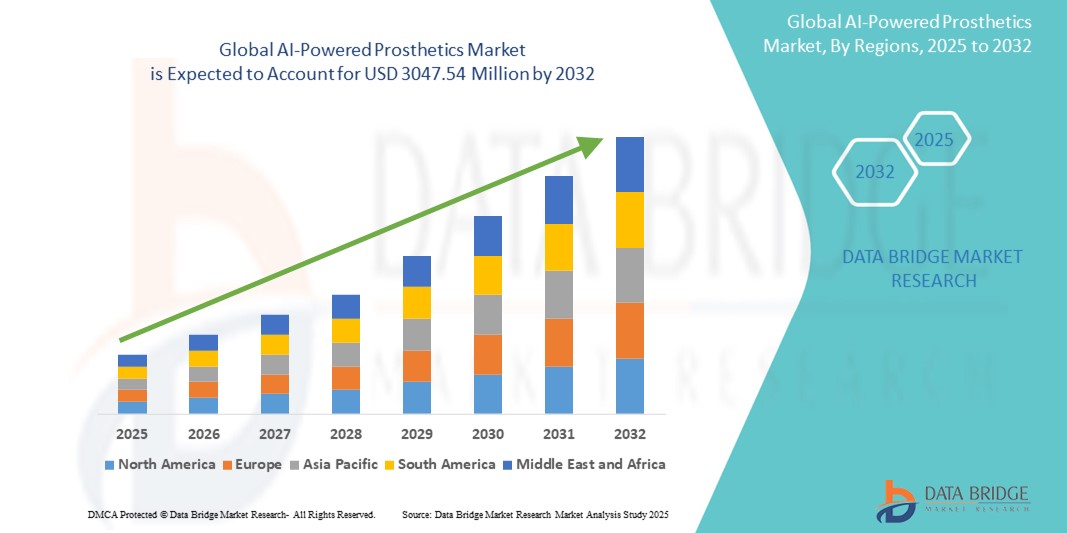
- The global AI-powered prosthetics market size was valued at USD 833.09 million in 2024 and is expected to reach USD 3,047.54 million by 2032, at a CAGR of 17.60% during the forecast period
- The market growth is largely driven by rapid advancements in artificial intelligence and sensor technology, enhancing the functionality, responsiveness, and adaptability of modern prosthetic devices
- Furthermore, rising incidence of limb loss due to chronic diseases, accidents, and aging populations is fueling demand for intelligent, user-centric prosthetic solutions. These combined factors are propelling the adoption of AI-powered prosthetics, significantly boosting global market expansion
AI-Powered Prosthetics Market Analysis
- AI-powered prosthetics, integrating advanced robotics, machine learning, and sensor-based technologies, are becoming essential in modern rehabilitation and assistive care due to their ability to replicate natural limb movement, adapt to user intent, and improve mobility outcomes for amputees in both clinical and home settings
- The accelerating demand for AI-powered prosthetics is primarily driven by increasing cases of limb loss from trauma, diabetes, and vascular diseases, alongside a growing need for personalized, high-functionality solutions that enhance user quality of life
- North America dominated the AI-powered prosthetics market with the largest revenue share of 42% in 2024, supported by strong R&D investments, favorable reimbursement policies, and early adoption of advanced prosthetic technologies, particularly in the U.S., where partnerships between med-tech firms and research institutions are fostering rapid innovation
- Asia-Pacific is expected to be the fastest growing region in the AI-powered prosthetics market during the forecast period due to rising healthcare expenditure, expanding patient awareness, and increasing access to advanced prosthetic care in countries such as China and India
- Non-implantable Prosthesis segment dominated the AI-powered prosthetics market with a market share of 85.5% in 2024, driven by its ease of use, non-surgical application, and widespread availability across both clinical and homecare settings
Report Scope and AI-Powered Prosthetics Market Segmentation
|
Attributes |
AI-Powered Prosthetics Key Market Insights |
|
Segments Covered |
|
|
Countries Covered |
North America
Europe
Asia-Pacific
Middle East and Africa
South America
|
|
Key Market Players |
|
|
Market Opportunities |
|
|
Value Added Data Infosets |
In addition to the insights on market scenarios such as market value, growth rate, segmentation, geographical coverage, and major players, the market reports curated by the Data Bridge Market Research also include in-depth expert analysis, pricing analysis, brand share analysis, consumer survey, demography analysis, supply chain analysis, value chain analysis, raw material/consumables overview, vendor selection criteria, PESTLE Analysis, Porter Analysis, and regulatory framework. |
AI-Powered Prosthetics Market Trends
“Personalized Mobility Through AI-Driven Adaptation and Neural Integration”
- A significant and emerging trend in the global AI-powered prosthetics market is the rapid advancement in AI algorithms and their integration with neuro-controlled and sensor-based systems, allowing prosthetic limbs to learn and adapt to individual users' movement patterns and behavioral cues. This level of customization is transforming user experiences by enhancing mobility, comfort, and functional independence
- For instance, Össur’s mind-controlled bionic leg and MIT’s brain-machine interface prototypes exemplify the fusion of AI and neural signals to enable intuitive limb control. Similarly, companies such as Mobius Bionics are leveraging adaptive AI to automatically adjust grip strength and joint movement based on object texture and weight
- AI-powered prosthetics are increasingly capable of real-time adjustments, learning from the user’s walking cadence, posture, and terrain, thus reducing falls and improving gait efficiency. Devices with embedded AI can also detect fatigue, predict user intent, and provide haptic feedback, mimicking near-natural limb behavior
- The convergence of prosthetics with cloud computing and machine learning further enables remote updates, performance tracking, and data-driven care improvements. Integrating AI with rehabilitation software also allows clinicians to fine-tune devices for optimal use.
- The demand for highly responsive and self-learning prosthetics is expanding rapidly, especially in high-income countries and specialized rehab centers, as patients seek advanced solutions that improve their daily functionality and quality of life
AI-Powered Prosthetics Market Dynamics
Driver
“Rising Amputation Cases and Technological Advancements in Smart Rehabilitation”
- The increasing global burden of limb loss due to traumatic injuries, diabetes, and vascular diseases, combined with growing advancements in robotics, neural interfaces, and smart materials, is a major driver for the adoption of AI-powered prosthetic devices
- For instance, in 2024, Coapt announced next-generation AI-powered pattern recognition systems that improve prosthetic arm control, expanding functionality for amputees. These innovations are accelerating the transition from passive to intelligent prosthetic systems.
- As patients demand more natural movement and higher control precision, AI enables features such as adaptive joint motion, predictive response to terrain, and gesture-based commands, offering superior alternatives to mechanical or manually controlled limbs.
- In addition, the global push for advanced rehabilitative care, especially in military and sports medicine, supports the rapid incorporation of AI into prosthetics. Patients benefit from quicker adaptation, remote monitoring, and reduced physiotherapy sessions
- The increasing acceptance of AI-based rehabilitation tools and smart limb solutions in hospitals and clinics, along with rising healthcare investments, is further propelling market growth
Restraint/Challenge
“High Costs and Limited Accessibility in Low-Income Regions”
- Despite their technological promise, the high cost of AI-powered prosthetics—often ranging from USD 20,000 to USD 100,000—remains a significant barrier to adoption, especially in low- and middle-income countries where access to healthcare and insurance coverage is limited
- For instance, while companies such as Open Bionics offer lower-cost alternatives using 3D printing, most advanced AI-integrated devices remain unaffordable for a large segment of the global amputee population
- Moreover, these devices require specialized fitting, calibration, and ongoing maintenance, which can be difficult in regions with limited clinical infrastructure or prosthetic technicians.
- Regulatory complexities, including stringent medical device approvals and the need for clinical validation, can also slow down commercialization and patient access
- Overcoming these challenges will depend on innovations in low-cost AI technology, scalable manufacturing, and public-private partnerships to expand access. Increased efforts toward insurance reimbursement and global NGO support for amputee rehabilitation will be key to unlocking broader market potential
AI-Powered Prosthetics Market Scope
The market is segmented on the basis of type, technology, application, and end user
- By Type
On the basis of type, the AI-powered prosthetics market is segmented into implantable prosthesis and non-implantable prosthesis. The non-implantable prosthesis segment dominated the market with the largest market revenue share of 85.5% in 2024, driven by its non-invasive nature, easier availability, and broader accessibility for both upper and lower limb amputees. Non-implantable devices are widely adopted due to their compatibility with external sensors and AI modules, making them ideal for both clinical and at-home rehabilitation settings.
The implantable prosthesis segment is expected to witness the fastest CAGR from 2025 to 2032, due to advances in osseointegration and brain-machine interfaces that enable more intuitive control and movement fidelity.
- By Technology
On the basis of technology, the AI-powered prosthetics market is segmented into microprocessor-controlled prosthetics, myoelectric prosthetics, robotic prosthetics, electric-powered prosthetics, and hybrid technologies. The microprocessor-controlled prosthetics segment held the largest market revenue share in 2024, driven by its ability to enhance gait stability, adapt in real-time to changing terrains, and improve user mobility with precision. These prosthetics are particularly dominant in lower limb applications due to their advanced sensors and dynamic joint control.
The myoelectric prosthetics segment is expected to witness the fastest CAGR from 2025 to 2032, fueled by the increasing adoption of upper limb solutions that use electrical muscle signals for control. As AI algorithms improve signal interpretation, these devices offer more accurate and personalized responses for users.
- By Application
On the basis of application, the AI-powered prosthetics market is segmented into healthcare, medical research, adults, and children. The healthcare segment held the largest revenue share in 2024, primarily due to the rising number of amputees requiring daily mobility support and the integration of AI in standard rehabilitation protocols. Hospitals and clinics are increasingly using AI-powered limbs for better therapy outcomes and post-operative recovery.
The children segment is expected to witness the fastest CAGR from 2025 to 2032, driven by growing awareness of pediatric prosthetic needs and innovations in lightweight, growth-adjustable smart limbs that accommodate a child’s development. AI helps tailor device behavior to children’s dynamic movements and learning patterns.
- By End User
On the basis of end user, the AI-powered prosthetics market is segmented into hospitals, prosthetic clinics, rehabilitation centers, and others. The hospitals segment dominated the market with the largest revenue share in 2024, as they serve as primary centers for prosthetic implantation, patient evaluation, and post-surgical care. Many hospitals now integrate AI-enabled prosthetic fittings with broader rehabilitation programs to improve patient outcomes.
The prosthetic clinics segment is anticipated to witness the fastest growth rate from 2025 to 2032, driven by their specialized services in custom prosthetic design, AI module tuning, and follow-up adjustments. Their role in outpatient mobility care and growing collaborations with tech providers support segment growth.
AI-Powered Prosthetics Market Regional Analysis
- North America dominated the AI-powered prosthetics market with the largest revenue share of 42% in 2024, supported by strong R&D investments, favorable reimbursement policies, and early adoption of advanced prosthetic technologies, particularly in the U.S., where partnerships between med-tech firms and research institutions are fostering rapid innovation
- Consumers and healthcare providers in the region increasingly favor AI-integrated prosthetics for their ability to enhance mobility, adaptability, and user control through real-time learning and neural interface integration
- This strong regional growth is further supported by substantial R&D investments, favorable reimbursement policies, and the presence of leading med-tech companies, positioning AI-powered prosthetics as a key solution in modern rehabilitation and assistive care systems
U.S. AI-Powered Prosthetics Market Insight
The U.S. AI-powered prosthetics market captured the largest revenue share of 82% in 2024 within North America, fueled by advanced healthcare infrastructure, high rates of limb loss, and rapid adoption of cutting-edge medical technologies. Patients and healthcare providers are increasingly prioritizing smart prosthetic solutions that offer improved mobility, real-time adaptation, and enhanced user control. Continued R&D support, strong presence of key industry players, and favorable insurance policies further accelerate the market’s growth trajectory, with the U.S. remaining a global innovation hub for AI-integrated rehabilitation devices.
Europe AI-Powered Prosthetics Market Insight
The Europe AI-powered prosthetics market is projected to expand at a substantial CAGR throughout the forecast period, primarily driven by the region's growing aging population, high prevalence of chronic diseases, and strong emphasis on personalized healthcare. The market benefits from government-supported healthcare programs, advanced rehabilitation centers, and increasing awareness of assistive technologies. Adoption is accelerating across both public and private healthcare facilities, particularly in countries investing in next-generation prosthetic care aligned with the EU’s digital health goals.
U.K. AI-Powered Prosthetics Market Insight
The U.K. AI-powered prosthetics market is anticipated to grow at a noteworthy CAGR during the forecast period, supported by rising investments in rehabilitation services, government-backed innovation initiatives, and growing patient preference for personalized mobility solutions. Demand is being driven by both NHS programs and private clinics focused on enhancing quality of life for amputees through AI-driven limb control, real-time feedback systems, and user-adaptive functionality.
Germany AI-Powered Prosthetics Market Insight
The Germany AI-powered prosthetics market is expected to expand at a considerable CAGR during the forecast period, propelled by the country’s commitment to med-tech innovation, strong clinical infrastructure, and a growing base of patients seeking advanced rehabilitation solutions. Germany’s emphasis on precision engineering and data-driven healthcare enables robust adoption of smart prosthetics, particularly in lower-limb and sensor-integrated segments, with increasing integration into orthopedic and geriatric care pathways.
Asia-Pacific AI-Powered Prosthetics Market Insight
The Asia-Pacific AI-powered prosthetics market is poised to grow at the fastest CAGR during the forecast period of 2025 to 2032, driven by rising amputation rates, expanding healthcare access, and technological advancements in countries such as China, India, and Japan. The region is witnessing increased awareness of AI-enabled rehabilitation, along with growing investments in digital healthcare infrastructure and prosthetic manufacturing, making advanced prosthetic solutions more affordable and accessible.
Japan AI-Powered Prosthetics Market Insight
The Japan AI-powered prosthetics market is gaining traction due to the nation’s highly developed medical technology ecosystem, rapidly aging population, and rising demand for intelligent, user-adaptive mobility aids. The country’s focus on robotics and IoT integration in healthcare supports the use of AI-powered prosthetic limbs, especially in elder care and post-surgical recovery settings. Customization, minimal invasiveness, and precision control are driving adoption across both urban and rural clinical networks.
India AI-Powered Prosthetics Market Insight
The India AI-powered prosthetics market accounted for the largest revenue share in Asia-Pacific in 2024, bolstered by a growing middle-class population, increased incidences of limb loss due to diabetes and accidents, and strong domestic manufacturing capabilities. Government-led health schemes, emerging med-tech startups, and the adoption of cost-effective AI-driven prosthetic limbs across urban and tier-2 cities are accelerating market expansion. The rise of local innovation hubs and academic collaborations is also fueling the development of affordable, scalable AI-based solutions.
AI-Powered Prosthetics Market Share
The AI-powered prosthetics industry is primarily led by well-established companies, including:
- Össur (Iceland)
- Ottobock (Germany)
- Coapt, LLC (U.S.)
- Open Bionics (U.K.)
- Mobius Bionics (U.S.)
- BrainRobotics (U.S.)
- Blatchford Group (U.K.)
- Unlimited Tomorrow (U.S.)
- PSYONIC (U.S.)
- Exii Inc. (Japan)
- Steeper Group (U.K.)
- TASKA Prosthetics (New Zealand)
- Point Designs (U.S.)
- BionX Medical Technologies (U.S.)
- PROTEOR (France)
- Naked Prosthetics (U.S.)
- Fillauer LLC (U.S.)
- Vincent Systems GmbH (Germany)
- BioMetrics Prosthetic and Orthotic Group (U.S.)
- Liberating Technologies Inc. (U.S.)
What are the Recent Developments in Global AI-Powered Prosthetics Market?
- In April 2024, Össur unveiled its next-generation AI-integrated bionic limb system, featuring enhanced gait adaptability and terrain-responsive microprocessor control. Designed to offer a more natural walking experience, this innovation leverages AI to analyze and adapt to real-time user movement, reinforcing Össur’s leadership in smart lower-limb prosthetic solutions and its commitment to improving user independence and comfort through intelligent mobility technologies
- In March 2024, Coapt LLC, a U.S.-based pioneer in prosthetic control, launched its Complete Control Gen2+ system. This AI-powered pattern recognition solution enhances the functionality of upper-limb myoelectric prosthetics by adapting in real time to users' muscle signal variations. The launch represents a major advancement in intuitive prosthetic control and highlights Coapt’s continued dedication to creating responsive, user-friendly solutions for amputees
- In March 2024, BrainRobotics, known for its AI-driven bionic hands, announced new developments in multi-sensor integration, enabling its prosthetics to provide fine motor control and real-time feedback. These enhancements allow users to grip, pinch, and interact with objects with greater precision, demonstrating the potential of AI and robotics in transforming upper-limb prosthetic functionality and restoring fine hand movements
- In February 2024, Mobius Bionics, in partnership with academic institutions, advanced its LUKE Arm platform by integrating machine learning algorithms that help the arm learn the user's movement habits. This initiative aims to improve the ease of use and response accuracy in real-world scenarios, highlighting the increasing role of adaptive AI in enhancing prosthetic-user interaction
- In January 2024, Open Bionics, a UK-based innovator, launched an updated version of its Hero Arm with AI-based grip prediction, which uses onboard sensors to automatically detect and adjust grip types. Designed for children and adults, the device combines affordability with advanced functionality, underscoring Open Bionics’ mission to make high-performance, AI-powered prosthetics widely accessible

- Interactive Data Analysis Dashboard
- Company Analysis Dashboard for high growth potential opportunities
- Research Analyst Access for customization & queries
- Competitor Analysis with Interactive dashboard
- Latest News, Updates & Trend analysis
- Harness the Power of Benchmark Analysis for Comprehensive Competitor Tracking
Data collection and base year analysis are done using data collection modules with large sample sizes. The stage includes obtaining market information or related data through various sources and strategies. It includes examining and planning all the data acquired from the past in advance. It likewise envelops the examination of information inconsistencies seen across different information sources. The market data is analysed and estimated using market statistical and coherent models. Also, market share analysis and key trend analysis are the major success factors in the market report. To know more, please request an analyst call or drop down your inquiry.
The key research methodology used by DBMR research team is data triangulation which involves data mining, analysis of the impact of data variables on the market and primary (industry expert) validation. Data models include Vendor Positioning Grid, Market Time Line Analysis, Market Overview and Guide, Company Positioning Grid, Patent Analysis, Pricing Analysis, Company Market Share Analysis, Standards of Measurement, Global versus Regional and Vendor Share Analysis. To know more about the research methodology, drop in an inquiry to speak to our industry experts.
Data Bridge Market Research is a leader in advanced formative research. We take pride in servicing our existing and new customers with data and analysis that match and suits their goal. The report can be customized to include price trend analysis of target brands understanding the market for additional countries (ask for the list of countries), clinical trial results data, literature review, refurbished market and product base analysis. Market analysis of target competitors can be analyzed from technology-based analysis to market portfolio strategies. We can add as many competitors that you require data about in the format and data style you are looking for. Our team of analysts can also provide you data in crude raw excel files pivot tables (Fact book) or can assist you in creating presentations from the data sets available in the report.













