


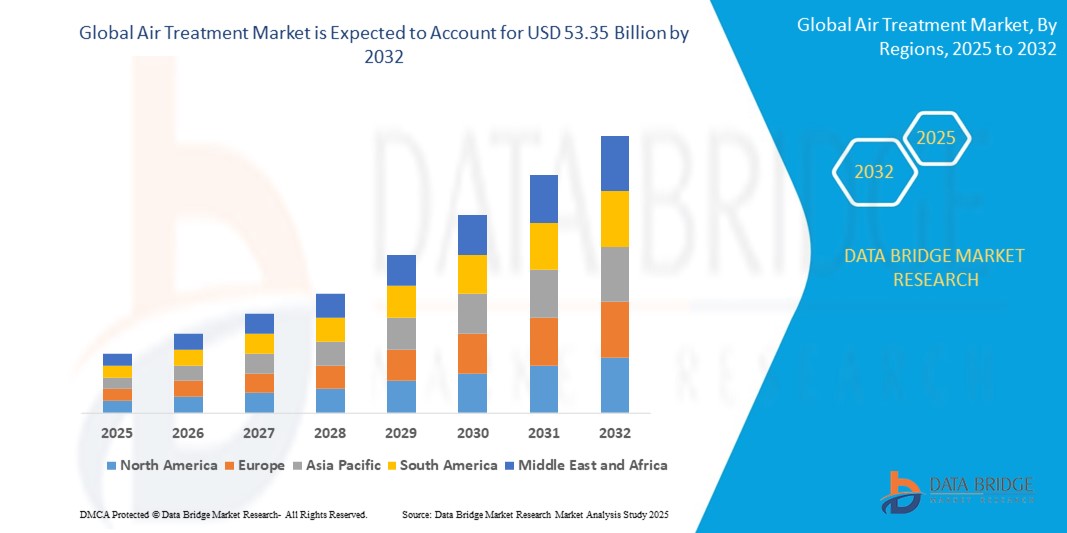
Air Treatment Market Size
- The global air treatment market size was valued at USD 27.78 billion in 2024 and is expected to reach USD 53.35 billion by 2032, at a CAGR of 8.5% during the forecast period
- The air treatment market growth is significantly driven by the increasing industrialization and urbanization, leading to higher levels of air pollution in both outdoor and indoor environments
- The increasing demand for air treatment solutions across various sectors is a significant driver due to rising prevalence of respiratory diseases such as asthma and COPD among the growing global population
Air Treatment Market Analysis
- Air treatment refers to the process of improving the quality of air by removing contaminants, controlling humidity levels, and maintaining a clean and healthy indoor environment. It typically involves the use of systems or devices such as air purifiers, dehumidifiers, humidifiers, and HVAC systems to filter out pollutants such as dust, allergens, bacteria, and volatile organic compounds (VOCs), as well as managing air moisture and temperature
- The expanding adoption of air treatment systems is primarily attributable to the growing demand for cleaner and healthier indoor air quality in residential and commercial buildings, the increasing awareness of health concerns related to air pollution requiring effective purification technologies, and the rising implementation of stringent regulations and standards for air quality control in diverse industrial and healthcare applications
- Asia-Pacific is expected to dominate the air treatment market with a share of 39.4% in 2024 due to region's rapidly increasing population has led to higher demand for clean air, particularly in densely populated urban areas where air pollution levels are rising
- North America is expected to be the fastest growing region in the air treatment market during the forecast period due to heightened awareness of indoor air quality and the increasing prevalence of airborne health issues
- HEPA filters segment is expected to dominate the market with a market share due to their proven effectiveness in capturing microscopic particles and allergens. Widely used in commercial, residential, and healthcare settings, HEPA filters support air quality standards and have gained trust for critical environments requiring high filtration precision
Report Scope and Air Treatment Market Segmentation
|
Attributes |
Air Treatment Key Market Insights |
|
Segments Covered |
|
|
Countries Covered |
North America
Europe
Asia-Pacific
Middle East and Africa
South America
|
|
Key Market Players |
|
|
Market Opportunities |
|
|
Value Added Data Infosets |
In addition to the insights on market scenarios such as market value, growth rate, segmentation, geographical coverage, and major players, the market reports curated by the Data Bridge Market Research also include in-depth expert analysis, geographically represented company-wise production and capacity, network layouts of distributors and partners, detailed and updated price trend analysis and deficit analysis of supply chain and demand. |
Air Treatment Market Trends
“Growing Demand for Industrial-Grade Air Treatment Solutions”
- A significant and accelerating trend in the air treatment market is the increasing integration of advanced air treatment solutions within industrial and manufacturing facilities. This growing adoption is fueled by the need for reliable, high-performance air purification technologies that can enhance operational efficiency, ensure worker safety, and comply with stringent environmental regulations in manufacturing and various other industries
- For instance, major companies at the forefront of industrial air treatment, such as Donaldson Company and Camfil, widely provide high-efficiency filtration systems for dust collection, HVAC, and cleanroom applications. Honeywell and 3M also offer a range of industrial air purifiers and respirators designed for demanding environments. Leading air treatment technology providers such as Munters and Nederman specialize in solutions for process air purification, emission control, and energy efficiency in industrial settings
- This heightened integration of industrial-grade air treatment enables more precise control over air quality within facilities, improves the reliability of manufacturing processes by reducing contamination, and contributes to safer working environments by removing hazardous airborne particles and pollutants. Compared to basic filtration methods, advanced industrial air treatment solutions often incorporate HEPA and ULPA filters, activated carbon, and other specialized technologies to effectively capture and neutralize a wide range of contaminants, leading to reduced operational issues and improved product quality
- The growing emphasis on sustainable manufacturing, stricter environmental compliance, and the increasing focus on employee health and safety are further fueling the importance of industrial-grade air treatment as a critical component in modern industrial strategies
- Organizations are increasingly acknowledging the benefits of using sophisticated air treatment solutions for their ability to maintain clean and controlled environments, protect sensitive equipment, and recover valuable materials from process air, making them ideal for integration into complex industrial systems where operational efficiency and regulatory adherence are crucial. This trend towards greater emphasis on air quality control across industries is driving substantial advancements and investments in the industrial air treatment market
- The demand for robust and reliable air treatment solutions is growing rapidly as the increasing complexity of industrial processes and stricter environmental standards encourage businesses to adopt advanced technologies such as high-efficiency filtration and specialized purification systems that can ensure seamless and dependable operation, ultimately boosting the effectiveness and efficiency of industrial operations and environmental protection programs
Air Treatment Market Dynamics
Driver
“Rising Air Pollution Levels”
- A significant and growing driver for the air treatment market is the rapid increase in air pollution levels globally, both in outdoor and indoor environments. This rise in pollution necessitates reliable and effective air purification solutions for various applications in residential, commercial, industrial, and healthcare sectors, where air quality is becoming an increasingly critical concern
- For instance, major players in the air treatment market, such as Daikin Industries and Sharp Electronics, offer a wide range of air purifiers for homes and offices to combat increasing indoor air pollution. Companies such as IQAir and Blueair specialize in high-performance air purification systems designed to tackle severe air pollution. In the industrial sector, as mentioned previously, Donaldson and Camfil provide solutions for managing industrial emissions and maintaining clean air in manufacturing facilities
- As the levels of particulate matter, harmful gases, and other pollutants rise in urban areas and industrial zones worldwide, the demand for air treatment solutions for mitigating these effects also increases. Air treatment technologies are favored in these situations due to their ability to remove or neutralize a wide spectrum of airborne contaminants, thereby improving public health and creating healthier living and working spaces
- Companies in various sectors are increasingly recognizing the advantages of implementing air treatment solutions for protecting their employees, customers, and products from the detrimental impacts of air pollution. This trend toward addressing rising pollution levels is driving substantial opportunities and growth in the air treatment market
- The demand for efficient and versatile air purification technologies is growing rapidly as the escalating air pollution in many parts of the world encourages individuals, businesses, and governments to adopt air treatment strategies for enhanced health, safety, and environmental quality
Restraint/Challenge
“Limited Consumer Awareness in Developing Markets”
- A notable challenge for the air treatment market in developing economies arises from the inherently lower levels of consumer awareness regarding the benefits and necessity of air purification technologies compared to more developed regions. The lack of widespread knowledge about the health impacts of poor air quality and the availability of effective solutions can limit market penetration
- For instance, while major international air treatment companies such as Philips and Coway have a significant presence in developed markets, their brand recognition and consumer outreach might be less extensive in many developing nations. Local manufacturers might exist, but often lack the marketing resources to significantly raise consumer awareness on a large scale
- Addressing this challenge requires sustained efforts in consumer education and awareness campaigns to highlight the risks associated with air pollution and the advantages of using air treatment products. While air pollution might be a significant problem in developing markets, the demand for air purifiers might be lower due to a lack of understanding or prioritization compared to other essential needs. This contrasts with developed markets where awareness is generally higher, driving greater adoption
- Despite the pressing need for air quality improvement in many developing regions, the limited consumer awareness can hinder the growth potential for both international and local air treatment companies, potentially leading to slower market expansion compared to regions with established consumer understanding
- Overcoming these limitations involves ongoing initiatives by manufacturers, governments, and health organizations to educate the public about the importance of clean air and the effectiveness of air treatment solutions, as well as making these technologies more accessible and affordable to the broader population in developing markets. Understanding the local consumer behavior and information access is vital for effectively addressing this challenge and fostering market growth
Air Treatment Market Scope
The market is segmented on the basis of product, technology, application, and end user.
- By Product
On the basis of product, the market is segmented into dust collectors, fume/smoke collectors, engine exhaust systems, mist eliminators, fire and emergency exhaust systems, and others. The dust collectors segment dominates the largest market revenue share in 2024, driven by their essential role in removing particulate contaminants in industrial settings. Their widespread use across manufacturing, power generation, and processing industries is due to regulatory compliance requirements and worker safety concerns, boosting sustained demand.
The mist eliminators segment is expected to witness the fastest CAGR from 2025 to 2032, driven by increasing deployment in the oil & gas and chemical sectors. Mist eliminators are crucial for removing fine liquid droplets from air or gas streams, supporting equipment protection and emission control. The rising need for cleaner emissions and high-performance separation technology is accelerating adoption across key industries.
- By Technology
On the basis of technology, the market is segmented into HEPA filters, electrostatic precipitators, activated carbon, UV filters, ionic filters, and conventional filters. The HEPA filters segment dominates the largest market revenue share in 2024, driven by their proven effectiveness in capturing microscopic particles and allergens. Widely used in commercial, residential, and healthcare settings, HEPA filters support air quality standards and have gained trust for critical environments requiring high filtration precision.
The activated carbon segment is expected to witness the fastest CAGR from 2025 to 2032, driven by its superior adsorption capabilities for gases and odors. With rising awareness of indoor air pollution and chemical contaminants, activated carbon filters are increasingly adopted in households, commercial buildings, and industrial processes requiring odor and VOC control.
- By Application
On the basis of application, the market is segmented into exhaust air and compressed air. Exhaust Air is further sub-segmented into volatile organic compounds, carbon mono oxide, nitrogen oxides, sulfur dioxide, particulate matter, and lead. The compressed air segment dominates the largest market revenue share in 2024, driven by its integral role in industrial operations requiring clean, dry air to power machinery. Air treatment solutions for compressed air systems help prevent corrosion, contamination, and operational failures, making them essential in high-demand manufacturing settings.
The exhaust air segment is expected to witness the fastest CAGR from 2025 to 2032, driven by stricter environmental norms and emissions control policies. Companies are investing in exhaust air treatment technologies to reduce airborne pollutants and meet sustainability goals, particularly in heavy industries such as metal processing and energy production.
- By End User
On the basis of end user, the market is segmented into manufacturing, automotive, oil & gas, power generation, pulp & paper, commercial, and residential. The manufacturing segment dominates the largest market revenue share in 2024, driven by the need for continuous air purification in production facilities. Air treatment systems help maintain equipment efficiency, product quality, and worker safety in sectors ranging from electronics to food processing, ensuring operational compliance.
The automotive segment is expected to witness the fastest CAGR from 2025 to 2032, driven by growing integration of advanced air filtration in vehicle manufacturing and maintenance. Clean air systems are increasingly critical in spray booths, engine testing, and parts cleaning, while rising demand for in-vehicle air quality solutions supports segment growth.
Air Treatment Market Regional Analysis
- Asia-Pacific dominates the air treatment market with the largest revenue share of 39.4% in 2024, driven by region's rapidly increasing population has led to higher demand for clean air, particularly in densely populated urban areas where air pollution levels are rising
- In addition, the region is home to some of the fastest-growing economies, including China and India, which are experiencing rapid industrialization and urbanization
- The government efforts, along with investments in air treatment technologies, are further accelerating the market’s expansion across Asia-Pacific
China Air Treatment Market Insight
China dominated the Asia-Pacific air treatment market in 2024, accounting for the highest revenue share, driven by rising concerns over indoor air quality and rapid urbanization. The demand for advanced air purifiers and HVAC systems is growing as consumers become more health-conscious and seek protection against airborne pollutants and allergens. In addition, government initiatives to curb air pollution and enforce indoor air quality standards are accelerating product adoption across residential, commercial, and industrial sectors. The proliferation of smart and energy-efficient air treatment systems, integrated with IoT and remote monitoring features, further strengthens market growth in the country.
Europe Air Treatment Market Insight
The European air purifier market is projected to expand considerably. This growth is attributed to rising levels of air pollution, stricter environmental regulations across the region, and a growing understanding of the health risks associated with poor air quality. There is an increasing demand for air purification solutions in residential, industrial, and commercial areas.
U.K. Air Treatment Market Insight
U.K. air purifier market is anticipated to grow noticeably. This expansion is fueled by a growing health consciousness among consumers and an increase in respiratory issues linked to air pollution. Government initiatives aimed at improving air quality are also contributing to the rising adoption of air purification technologies.
Germany Air Treatment Market Insight
The German air purifier market is expected to witness substantial development. This is driven by increasing air pollution in urban areas, coupled with growing health concerns and greater awareness about the significance of indoor air quality. The market is seeing higher adoption rates in both homes and commercial spaces.
North America Air Treatment Market Insight
North America air treatment market is projected to witness steady growth in 2024, fueled by heightened awareness of indoor air quality and the increasing prevalence of airborne health issues. Rising demand for air purifiers, dehumidifiers, and HVAC systems is particularly prominent in the U.S. and Canada, where consumers prioritize health, comfort, and energy efficiency. The region's focus on sustainable living, along with stricter environmental regulations and building standards, is further accelerating the adoption of advanced air treatment solutions. Moreover, technological innovations such as IoT-enabled, smart air treatment systems, are gaining traction as part of broader smart home trends across North America.
U.S. Air Treatment Market Insight
U.S. air purifier market is experiencing significant growth, driven by an increasing awareness of health and the importance of maintaining good indoor air quality in various settings, including homes, businesses, and industrial facilities. The demand for air purifiers in the U.S. is rising due to a greater focus on creating healthier indoor environments.
Air Treatment Market Share
The air treatment industry is primarily led by well-established companies, including:
- Freudenberg SE (Germany)
- Donaldson Company Inc. (U.S.)
- Parker Hannifin Corp (U.S.)
- Ahlstrom-Munksjö (Finland)
- MANN+HUMMEL (Germany)
- Cummins Inc. (U.S.)
- Camfil (Sweden)
- Atlas Copco (Sweden)
- Honeywell International Inc. (U.S.)
- 3M (U.S.)
- DAIKIN INDUSTRIES Ltd. (Japan)
- Robert Bosch GmbH (Germany)
- SAMSUNG (South Korea)
- LG Electronics (South Korea)
- Panasonic Corporation (Japan)
- Winix Inc. (South Korea)
Latest Developments in Global Air Treatment Market
- In July 2024, Daikin strengthened its position in the indoor air quality market with the launch of two new plug-and-play air purifier models, the MCK70Z and MC80Z. Designed to enhance indoor air quality, these models integrate with Daikin’s Onecta app, enabling users to monitor, control, and schedule air purification remotely via smartphone or tablet. By providing real-time insights into both indoor and outdoor air quality—leveraging built-in sensors and Google Maps Platform data—Daikin’s latest offerings cater to rising consumer demand for smart, connected solutions, positioning the company for greater market traction in the growing smart home and air quality segments
- In November 2022, IQAir, the Swiss air quality technology expert, introduced Atem X, a smart, slim, bionic air purifier. It was the latest addition to IQAir’s range of high-performance air purifiers. Atem X was developed to combine four seemingly incompatible characteristics: powerful air purification, quiet operation, low energy consumption, and a slim, beautiful design
- In October 2021, Philips India introduced its New Urban Living Series air purifiers, reflecting the company's ongoing commitment to improving public health by utilizing technology to foster healthier living and prevention

- Interactive Data Analysis Dashboard
- Company Analysis Dashboard for high growth potential opportunities
- Research Analyst Access for customization & queries
- Competitor Analysis with Interactive dashboard
- Latest News, Updates & Trend analysis
- Harness the Power of Benchmark Analysis for Comprehensive Competitor Tracking
Global Air Treatment Market, Supply Chain Analysis and Ecosystem Framework
To support market growth and help clients navigate the impact of geopolitical shifts, DBMR has integrated in-depth supply chain analysis into its Global Air Treatment Market research reports. This addition empowers clients to respond effectively to global changes affecting their industries. The supply chain analysis section includes detailed insights such as Global Air Treatment Market consumption and production by country, price trend analysis, the impact of tariffs and geopolitical developments, and import and export trends by country and HSN code. It also highlights major suppliers with data on production capacity and company profiles, as well as key importers and exporters. In addition to research, DBMR offers specialized supply chain consulting services backed by over a decade of experience, providing solutions like supplier discovery, supplier risk assessment, price trend analysis, impact evaluation of inflation and trade route changes, and comprehensive market trend analysis.
Data collection and base year analysis are done using data collection modules with large sample sizes. The stage includes obtaining market information or related data through various sources and strategies. It includes examining and planning all the data acquired from the past in advance. It likewise envelops the examination of information inconsistencies seen across different information sources. The market data is analysed and estimated using market statistical and coherent models. Also, market share analysis and key trend analysis are the major success factors in the market report. To know more, please request an analyst call or drop down your inquiry.
The key research methodology used by DBMR research team is data triangulation which involves data mining, analysis of the impact of data variables on the market and primary (industry expert) validation. Data models include Vendor Positioning Grid, Market Time Line Analysis, Market Overview and Guide, Company Positioning Grid, Patent Analysis, Pricing Analysis, Company Market Share Analysis, Standards of Measurement, Global versus Regional and Vendor Share Analysis. To know more about the research methodology, drop in an inquiry to speak to our industry experts.
Data Bridge Market Research is a leader in advanced formative research. We take pride in servicing our existing and new customers with data and analysis that match and suits their goal. The report can be customized to include price trend analysis of target brands understanding the market for additional countries (ask for the list of countries), clinical trial results data, literature review, refurbished market and product base analysis. Market analysis of target competitors can be analyzed from technology-based analysis to market portfolio strategies. We can add as many competitors that you require data about in the format and data style you are looking for. Our team of analysts can also provide you data in crude raw excel files pivot tables (Fact book) or can assist you in creating presentations from the data sets available in the report.













