


What is the Aircraft Seating Market Size and Growth Rate?
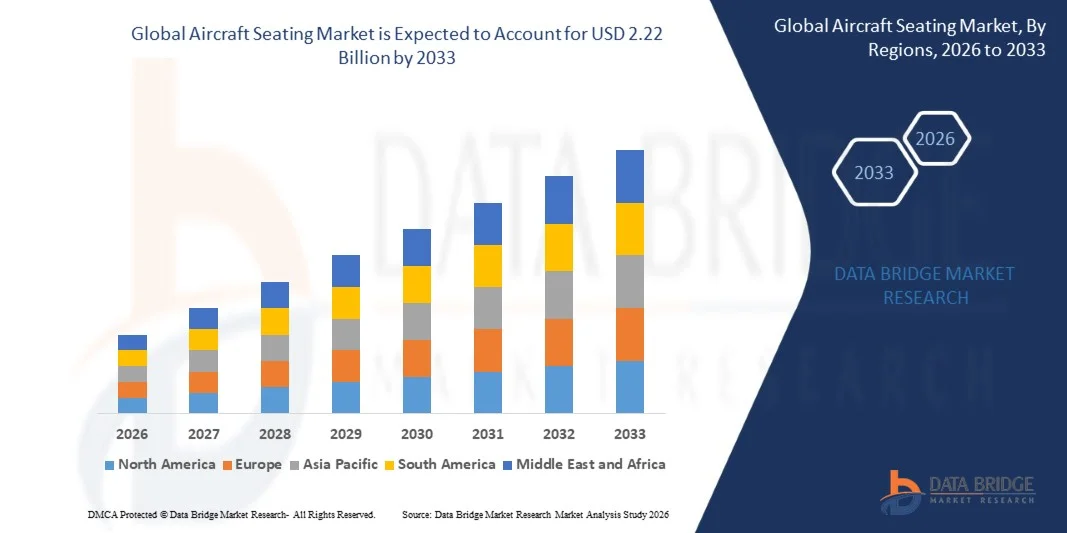
- As per Data Bridge Market Research analysis, the aircraft seating market was valued at USD 8.30 billion in 2025 and is projected to reach USD 13.53 billion by 2033, growing at a CAGR of 6.30% from 2026 to 2033.
- The market is experiencing consistent growth driven by rising global air passenger traffic, increasing aircraft production and fleet modernization programs, and growing demand for lightweight, fuel-efficient, and passenger-centric seating solutions across commercial and business aviation sectors.
- The rapid expansion of low-cost carriers and long-haul international travel, combined with rising demand for premium travel experiences, is accelerating the adoption of next-generation aircraft seating systems. Manufacturers and airline operators are increasingly integrating lightweight composite materials, smart seating technologies, and modular cabin configurations, while growing aircraft retrofit and cabin refurbishment activities continue to support demand for ergonomic and technologically advanced seating solutions with enhanced connectivity and in-flight entertainment integration
Market Size & Forecast
- Global Market Value (2025): USD 8.30 Billion
- Expected Market Value (2033): USD 13.53 Billion
- Forecast CAGR (2026–2033): 6.30%
- Leading Region in 2025: North America
- Fastest Growing Region: Asia Pacific
What are the Major Takeaways of the Aircraft Seating Market?
- North America dominated the aircraft seating market with the largest revenue share of 37.40% in 2025, supported by the presence of leading aircraft manufacturers and seat suppliers, strong aircraft retrofit activities, and sustained commercial aviation demand.
- Asia-Pacific is expected to be the fastest-growing region at a CAGR of 7.10% from 2026 to 2033, fueled by rising air passenger traffic, rapid fleet expansion, and increasing aircraft deliveries across China, India, and Southeast Asia.
- The narrow body aircraft segment led the market with a 52% share in 2025, driven by the high volume of single-aisle aircraft deliveries and their extensive use on domestic and short-to-medium-haul routes.
- Business jet are the fastest-growing aircraft platform type, projected to register a CAGR of 8.2%, reflecting the surge in demand for private and corporate aviation.
- The economy class segment dominated the sear class category with a 48% revenue share in 2025, led by economy seating represents the largest proportion of seats installed in commercial passenger aircraft.
- Passenger seats accounted for 68% of the market share in 2025, preferred by the large number of passenger seats installed across commercial aircraft fleets.
- The carbon fiber composite segment is the fastest-growing material category, with a CAGR of 8.6%, driven by the aviation industry's increasing emphasis on aircraft weight reduction and fuel efficiency.
Report Scope and Aircraft Seating Market Segmentation
|
Attributes |
Aircraft Seating Key Market Insights |
|
Segments Covered |
|
|
Countries Covered |
North America
Europe
Asia-Pacific
Middle East and Africa
South America
|
|
Key Market Players |
|
|
Market Opportunities |
|
|
Value Added Data Infosets |
In addition to the market insights such as market value, growth rate, market segments, geographical coverage, market players, and market scenario, the market report curated by the Data Bridge Market Research team includes in-depth expert analysis, import/export analysis, pricing analysis, production consumption analysis, and pestle analysis. |
What is the Key Trend in the Aircraft Seating Market?
- Aircraft seating manufacturers are increasingly developing lightweight and ergonomically optimized seats to reduce aircraft weight, improve fuel efficiency, enhance passenger comfort, and support airlines’ sustainability objectives across commercial aviation.
- For instance, in April 2024, RECARO Aircraft Seating announced that Malaysia Airlines would equip its new Airbus A330neo aircraft with more than 5,000 CL3810 economy seats, which are nearly 15% lighter than their predecessor while incorporating ergonomic features, USB-C/USB-A power, and improved knee space.
- Advanced materials, including carbon composites, lightweight aluminium, and recycled components, are enabling manufacturers to reduce seat weight while maintaining structural strength, durability, and passenger comfort.
- Airlines and seat manufacturers are also integrating enhanced passenger-experience features, including larger seat pitch, adjustable headrests, USB charging, personal device connectivity, and improved privacy features in next-generation cabin configurations.
- For instance, in November 2024, RECARO Aircraft Seating and Iberia introduced the R3 Economy Class seat on Iberia’s A321XLR, with the lightweight seat weighing nearly 2 kg less than its predecessor and featuring a composite backrest, integrated monitor, USB charging, and an adjustable headrest.
- As airlines increasingly prioritize fuel efficiency, sustainability, passenger comfort, and cabin differentiation, the adoption of lightweight and technologically enhanced aircraft seating is expected to accelerate, reinforcing advanced seat design as a core component of next-generation aircraft interiors
What are the Key Drivers of the Aircraft Seating Market?
- The rising global air passenger traffic and continued aircraft fleet expansion are significantly increasing demand for new aircraft seats, particularly as airlines expand capacity and replace older aircraft with more fuel-efficient models.
- For instance, in September 2024, Air India began a more than USD 400 million cabin-refit program covering 67 legacy aircraft, including the installation of more than 15,000 next-generation seats across Business, Premium Economy, and Economy cabins
- Airlines, aircraft manufacturers, and seating suppliers are increasingly investing in new cabin configurations and seating technologies to accommodate growing passenger volumes while improving comfort, operational efficiency, and aircraft fuel performance.
- For instance, in May 2024, Airbus announced a cabin-retrofit agreement with Thai Airways covering 20 A320ceo aircraft, with 12 reclining Business Class seats to be installed on each aircraft, demonstrating continued demand for upgraded seating as airlines modernize existing fleets.
- With global passenger demand continuing to expand and airlines pursuing fleet modernization, aircraft seating will remain an essential component of new aircraft deliveries, cabin upgrades, and long-term aviation capacity expansion.
What Factors are Challenging the Growth of the Aircraft Seating Market?
- Aircraft seating manufacturers face significant supply chain constraints involving specialized materials, components, certification requirements, and production capacity, which can increase manufacturing costs and delay aircraft cabin completion.
- For instance, in June 2025, Aviation Week reported that Air India’s fleet retrofit programs were facing chronic seat-provider delays, with delays at four of its five seat suppliers; one supplier withdrawal caused a retrofit program to be delayed by two years, while other programs faced delays of around one year.
- These supply disruptions can affect aircraft deliveries and airline fleet deployment, particularly when seat suppliers experience shortages of metals, plastics, specialized components, or transportation capacity across international supply networks.
- For instance, in July 2025, Aviation Week reported that American Airlines’ first Airbus A321XLR had not entered service because it was awaiting seat supply, with the aircraft remaining in Europe until the seat supply-chain challenges were resolved.
- The persistent supply chain constraints and increasing production costs associated with specialized aircraft seating components continue to challenge manufacturers, particularly as airlines face strong passenger demand and aircraft delivery backlogs. These challenges can extend lead times, increase procurement costs, and delay the deployment of new and refurbished aircraft seating systems.
How is the Aircraft Seating Market Segmented?
The aircraft seating market is segmented on the basis of aircraft platform, seat class, seat type, material, technology, and end user.
- By Aircraft Platform
On the basis of aircraft platform, the aircraft seating market is segmented into narrow body aircraft, wide body aircraft, regional aircraft, business jet, military aircraft, and helicopters. The narrow body aircraft segment dominated the market with 52% share in 2025, owing to the high volume of single-aisle aircraft deliveries and their extensive use on domestic and short-to-medium-haul routes. Airlines are increasingly expanding narrow body fleets to meet growing passenger traffic and improve route economics. These aircraft require large volumes of economy and premium seating systems, supporting consistent demand from seat manufacturers. The expansion of low-cost carriers is further increasing demand for efficient narrow body cabin configurations. Growing replacement of aging aircraft with newer fuel-efficient models is also supporting the segment.
The business jet segment is projected to register the fastest growth at a CAGR of 8.2% from 2026 to 2033, driven by increasing demand for private and corporate aviation. Business jets require highly customized seating solutions that emphasize comfort, luxury, ergonomics, and cabin personalization. Rising purchases of private aircraft by corporations and high-net-worth customers are supporting demand for premium seating configurations. Manufacturers are increasingly incorporating electrically adjustable seats, enhanced cushioning, and premium upholstery into business jet interiors. Growing demand for longer-range business jets is also encouraging development of seats designed for extended travel comfort. Increasing cabin customization and refurbishment activities are further creating opportunities for specialized seating suppliers.
- By Seat Class
On the basis of seat class, the aircraft seating market is segmented into economy class, business class, first class, and crew seats. The economy class segment dominated the market with an 48% share in 2025, primarily because economy seating represents the largest proportion of seats installed in commercial passenger aircraft. Rising global passenger traffic is increasing demand for high-capacity economy cabin configurations. Low-cost carriers particularly rely on efficient economy seating layouts to maximize passenger capacity and improve aircraft utilization. Manufacturers are focusing on lightweight economy seats that provide improved comfort while minimizing aircraft weight. Increasing aircraft deliveries and fleet expansion are generating substantial demand for replacement and new-build economy seats.
The business class segment is expected to witness the fastest growth at a CAGR of 7.5% from 2026 to 2033, supported by increasing demand for premium air travel and enhanced passenger experiences. Airlines are investing in lie-flat seats, greater personal space, privacy partitions, and integrated entertainment systems to differentiate premium cabins. Long-haul international routes are particularly supporting demand for advanced business-class seating configurations. Rising demand for premium travel is encouraging airlines to expand higher-value cabin offerings. Manufacturers are developing modular and lightweight business-class seats that combine luxury with improved aircraft efficiency. Increasing cabin modernization and retrofit programs are further creating demand for upgraded business-class seating systems.
- By Seat Type
On the basis of seat type, the aircraft seating market is segmented into passenger seats, cockpit seats, cabin crew seats, troop seats, medical evacuation seats, and VIP seats. The passenger seats segment dominated the market with 68% share in 2025, owing to the large number of passenger seats installed across commercial aircraft fleets. Rising passenger traffic and continued aircraft deliveries are directly increasing demand for passenger seating systems. Airlines require passenger seats across economy, premium economy, business, and first-class cabins, creating a broad demand base. Seat manufacturers are increasingly developing lightweight designs with improved ergonomics, connectivity, and passenger comfort features. Passenger seats also represent a major component of aircraft cabin refurbishment and retrofit programs.
The VIP seats segment is projected to register the fastest growth at a CAGR of 8.4% from 2026 to 2033, driven by increasing demand for customized luxury aircraft interiors. VIP seating is widely used in private jets, executive aircraft, government aircraft, and specialized aviation applications. These seats emphasize personalized design, premium materials, enhanced comfort, and advanced adjustment capabilities. Growing private aviation activity is encouraging aircraft owners and operators to invest in customized cabin interiors. Manufacturers are integrating advanced adjustment functions, premium upholstery, and enhanced comfort features into VIP seats. Rising demand for aircraft refurbishment and bespoke interior upgrades is also supporting the segment.
- By Material
On the basis of material, the aircraft seating market is segmented into aluminium alloy, titanium alloy, carbon fiber composite, glass fiber composite, magnesium alloy, and hybrid material. The aluminium alloy segment dominated the market with a 50.00% share in 2025, supported by its favorable strength-to-weight ratio, durability, corrosion resistance, and established use in aircraft seat structures. Aluminium alloys provide manufacturers with a cost-effective material for producing strong and lightweight seat frames. Their established manufacturing processes and widespread aerospace certification further support adoption. Airlines and aircraft OEMs continue to use aluminium-based structures across large commercial aircraft seating programs. The material provides reliable performance under demanding aircraft operating conditions.
The carbon fiber composite segment is expected to witness the fastest growth at a CAGR of 8.6% from 2026 to 2033, driven by the aviation industry's increasing emphasis on aircraft weight reduction and fuel efficiency. Carbon fiber composites provide high strength and stiffness while offering substantial weight-saving potential compared with conventional metallic materials. Seating manufacturers are increasingly using composite components in backrests, seat structures, and other lightweight applications. Reducing seat weight can contribute to lower aircraft operating costs and improved fuel efficiency across large fleets. Advances in composite manufacturing are also improving design flexibility and production efficiency. Growing sustainability objectives among airlines and aircraft manufacturers are further supporting adoption of lightweight composite seating.
- By Technology
On the basis of technology, the aircraft seating market is segmented into conventional seating, lightweight seating, smart connected seating, IoT-enabled seating, AI-enabled personalized seating, and health monitoring seating. The lightweight seating segment dominated the market with 46% share in 2025, driven by increasing airline efforts to reduce aircraft weight and improve fuel efficiency. Lightweight seats allow airlines to reduce the overall weight of aircraft while maintaining required structural performance and passenger safety. Manufacturers are increasingly using advanced composites, optimized structures, and lightweight materials to achieve weight reductions. The technology is particularly important for high-density commercial aircraft where reductions in individual seat weight can produce meaningful fleet-level benefits. Growing sustainability requirements are further encouraging airlines and OEMs to adopt weight-saving cabin components.
The AI-enabled personalized seating segment is projected to register the fastest growth at a CAGR of 9.0% from 2026 to 2033, supported by increasing demand for personalized and digitally connected passenger experiences. AI-enabled systems can potentially use passenger preferences and contextual data to optimize seat positioning, cabin comfort, and service interactions. Integration with connected cabin systems is creating opportunities for more intelligent and responsive seating environments. Airlines are increasingly seeking technologies that improve passenger satisfaction while creating differentiated premium experiences. Advances in sensors, connectivity, artificial intelligence, and cabin digital platforms are supporting development of smart seating solutions. Increasing interest in health, comfort, and personalization is also encouraging innovation in intelligent seat systems.
- By End User
On the basis of end user, the aircraft seating market is segmented into aircraft OEMs, airlines, MRO providers, aircraft leasing companies, and government & defense. The aircraft OEMs segment dominated the market with 42% share in 2025, supported by strong demand for seating systems installed during the production of new commercial and business aircraft. Increasing aircraft deliveries require large volumes of certified seats across different cabin classes and aircraft platforms. OEMs work closely with seating suppliers to integrate seats into new aircraft cabin designs and configurations. Growing aircraft production programs are therefore generating consistent demand for line-fit seating systems. Increasing focus on lightweight and technologically advanced aircraft interiors is also encouraging OEMs to adopt next-generation seating solutions.
The MRO providers segment is expected to witness the fastest growth at a CAGR of 7.9% from 2026 to 2033, driven by increasing aircraft maintenance, refurbishment, and cabin modernization requirements. Aging aircraft fleets require periodic replacement, repair, and refurbishment of passenger and crew seating systems. Airlines are increasingly using MRO providers to upgrade cabin interiors while extending the operational life of existing aircraft. Retrofit programs are also creating demand for modern seats with improved ergonomics, connectivity, and weight efficiency. Growing aircraft utilization is increasing the need for regular maintenance and component replacement. MRO providers are consequently becoming increasingly important for aftermarket aircraft seating demand.
Which Region Holds the Largest Share of the Aircraft Seating Market?
- North America dominated the aircraft seating market with the largest revenue share of 37.40% in 2025, supported by the presence of leading aircraft manufacturers and seat suppliers, strong aircraft retrofit activities, and sustained commercial aviation demand.
- The region also benefits from strong commercial aviation demand, continuous fleet modernization, growing adoption of lightweight and fuel-efficient seating systems, and investments in premium cabin interiors and next-generation seating technologies. Increasing aircraft replacement programs and aftermarket refurbishment activities further strengthen North America's leadership in the global aircraft seating market.
U.S. Aircraft Seating Market Insight
The U.S. aircraft seating market is witnessing strong growth due to rising commercial aircraft deliveries, fleet modernization programs, and increasing investments in advanced cabin interior solutions. The country’s strong aerospace manufacturing ecosystem, along with the presence of major aircraft manufacturers and leading seating suppliers, is driving demand for lightweight, ergonomic, and premium seating systems. In addition, increasing aircraft retrofit activities and growing demand for enhanced passenger comfort are accelerating seating upgrades across commercial and business aviation fleets.
Asia-Pacific Aircraft Seating Market Insight
The Asia-Pacific aircraft seating market is expected to witness rapid growth, driven by increasing air passenger traffic, expanding airline fleets, and rising aircraft deliveries across countries such as China, India, and Japan. Growing investments in aviation infrastructure, expansion of low-cost carriers, and increasing demand for lightweight and passenger-centric seating solutions are supporting regional market expansion. In addition, the growing presence of aircraft manufacturing and MRO facilities is accelerating seating adoption across commercial aviation applications.
Japan Aircraft Seating Market Insight
The Japan aircraft seating market is witnessing consistent growth due to rising investments in airline fleet modernization, premium cabin upgrades, and advanced aircraft interior technologies. Japanese airlines and aerospace companies are increasingly adopting lightweight and technologically advanced seating systems to improve passenger experience and operational efficiency. Moreover, increasing demand for international air travel, aircraft refurbishment programs, and sustainable aviation solutions is further contributing to market growth in Japan.
China Aircraft Seating Market Insight
The China aircraft seating market is growing rapidly, driven by expanding domestic aviation networks, increasing aircraft fleet size, and rising investments in commercial aircraft manufacturing capabilities. Growing demand for fuel-efficient aircraft, cabin modernization programs, and passenger comfort improvements is significantly boosting market demand. In addition, increasing development of indigenous aviation programs and expansion of airline fleets are positioning China as one of the fastest-growing markets for aircraft seating globally.
U.K. Aircraft Seating Market Insight
The U.K. aircraft seating market is experiencing steady growth, supported by rising adoption of advanced seating technologies across commercial aviation, aircraft manufacturing, and MRO applications. Increasing investments in lightweight seating systems and growing demand for ergonomic, comfortable, and fuel-efficient cabin solutions are contributing to market growth. Furthermore, the presence of established aircraft seating manufacturers and continued development of next-generation cabin technologies are strengthening the U.K.’s position in the global aircraft seating industry.
Germany Aircraft Seating Market Insight
The Germany aircraft seating market is expanding steadily due to the country’s strong aerospace manufacturing base, advanced engineering capabilities, and increasing adoption of next-generation aircraft interior technologies. Aircraft manufacturers, seating suppliers, airlines, and MRO providers are increasingly utilizing lightweight and ergonomically designed seating systems to improve passenger comfort and operational efficiency. Continuous advancements in composite materials, premium cabin interiors, and sustainable seating technologies are further driving market growth in Germany.
Which are the Top Companies in Aircraft Seating Market?
The aircraft seating industry is primarily led by well-established companies, including:
- Safran (France)
- RECARO Aircraft Seating GmbH & Co. KG (Germany)
- JAMCO Corporation (Japan)
- geven spa (Italy)
- Collins Aerospace (U.S.)
- Hong Kong Aircraft Engineering Company Limited (China)
- Aviation Industry Corporation of China, Ltd. (China)
- Thompson Aero Seating Limited (U.K.)
- ZIM Aircraft Seating Group (Germany)
- Mirus Aircraft Seating Ltd (U.K.)
- AirGo Design Pte. Ltd. (Singapore)
- Weihe Aircraft Interior Manufacture Co., Ltd. (China)
- Expliseat SAS (France)
- Aviointeriors S.p.A. (Italy)
- Optimares S.p.A. (Italy)
- Martin-Baker Aircraft Company Limited (U.K.)
- AUTOFLUG GmbH (Germany)
- Iacobucci HF AEROSPACE S.p.A. (Italy)
- Diehl Aviation (Germany)
What are Latest Developments in Aircraft Seating Market?
- In May 2025, RECARO Aircraft Seating announced that China Southern Airlines had selected its R3 Economy Class seats for 10 new Airbus A350-900 aircraft. China Southern became the first airline customer in mainland China to select the R3, which features an ergonomic design, enhanced living space, lumbar support, an adjustable headrest, and an integrated 13.3-inch 4K in-flight entertainment system. The development highlights the increasing adoption of advanced and passenger-centric seating solutions in the Asia-Pacific aviation market.
- In July 2024, RECARO Aircraft Seating was selected by Alaska Airlines to retrofit its Boeing 737-800 and 737 MAX 8 aircraft with R2 economy-class and R5 business-class seats. The retrofit program covers 79 aircraft and is designed to enhance passenger comfort through features such as adjustable headrests, calf rests, integrated device holders, and USB-C connectivity. The development reflects continued airline investment in cabin modernization and upgraded seating experiences.
- In January 2024, RECARO Aircraft Seating announced its selection by Eve Air Mobility to design, certify, and produce seats for Eve’s electric vertical takeoff and landing (eVTOL) aircraft. The project marked RECARO’s first aircraft-seating program for an eVTOL aircraft and includes the planned delivery of 75,000 seats, with deliveries scheduled to begin in the first quarter of 2025. The development demonstrates the expansion of aircraft seating technologies into emerging electric urban air mobility applications
- In March 2022, Mirus Aircraft Seating launched an enhanced derivative of its Hawk economy seat, expanding its certification and availability to Boeing 737 aircraft in addition to the Airbus A320 family. The lightweight seat was designed with an ergonomically sculpted structure to provide greater living space and improved passenger comfort. The development expanded Mirus’ addressable aircraft platform and strengthened its portfolio of next-generation lightweight economy seating.
- In April 2021, Corsair International operated its first commercial Airbus A330neo equipped with Safran Seats, featuring the Z400 lightweight economy seat and Z535 premium-class seat. Corsair became the launch customer for the Z400 on the A330neo, with the seating configuration designed to combine passenger comfort with lightweight construction. The development marked the entry of Safran’s latest-generation seating solutions into commercial A330neo service.

- Interactive Data Analysis Dashboard
- Company Analysis Dashboard for high growth potential opportunities
- Research Analyst Access for customization & queries
- Competitor Analysis with Interactive dashboard
- Latest News, Updates & Trend analysis
- Harness the Power of Benchmark Analysis for Comprehensive Competitor Tracking
Data collection and base year analysis are done using data collection modules with large sample sizes. The stage includes obtaining market information or related data through various sources and strategies. It includes examining and planning all the data acquired from the past in advance. It likewise envelops the examination of information inconsistencies seen across different information sources. The market data is analysed and estimated using market statistical and coherent models. Also, market share analysis and key trend analysis are the major success factors in the market report. To know more, please request an analyst call or drop down your inquiry.
The key research methodology used by DBMR research team is data triangulation which involves data mining, analysis of the impact of data variables on the market and primary (industry expert) validation. Data models include Vendor Positioning Grid, Market Time Line Analysis, Market Overview and Guide, Company Positioning Grid, Patent Analysis, Pricing Analysis, Company Market Share Analysis, Standards of Measurement, Global versus Regional and Vendor Share Analysis. To know more about the research methodology, drop in an inquiry to speak to our industry experts.
Data Bridge Market Research is a leader in advanced formative research. We take pride in servicing our existing and new customers with data and analysis that match and suits their goal. The report can be customized to include price trend analysis of target brands understanding the market for additional countries (ask for the list of countries), clinical trial results data, literature review, refurbished market and product base analysis. Market analysis of target competitors can be analyzed from technology-based analysis to market portfolio strategies. We can add as many competitors that you require data about in the format and data style you are looking for. Our team of analysts can also provide you data in crude raw excel files pivot tables (Fact book) or can assist you in creating presentations from the data sets available in the report.












