


Airport Full Body Scanner (AFBS) Market Size
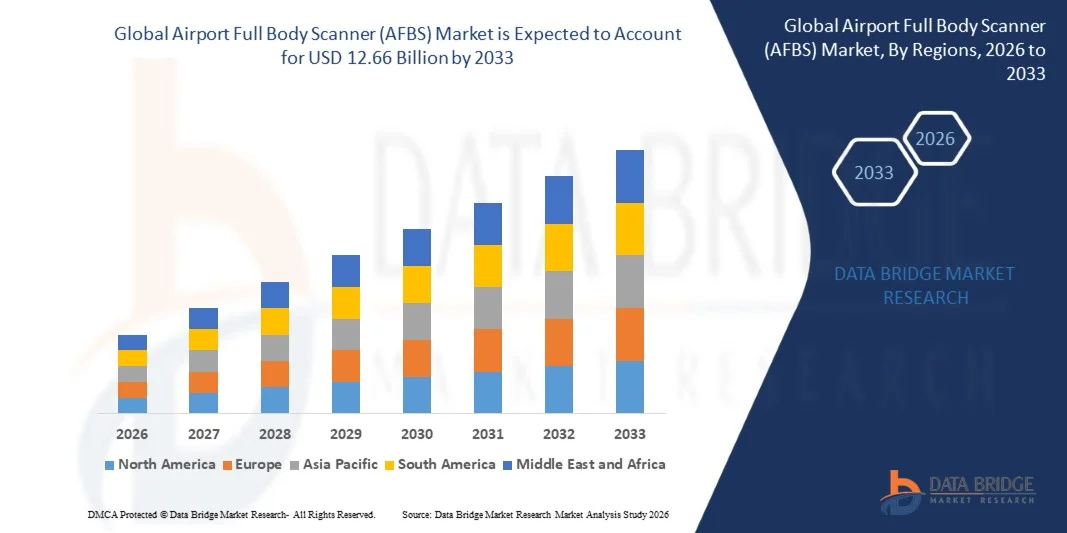
- The global airport full body scanner (AFBS) market size was valued at USD 7.20 billion in 2025 and is expected to reach USD 12.66 billion by 2033, at a CAGR of 7.31% during the forecast period
- The market growth is largely fuelled by the increasing demand for enhanced airport security and passenger safety measures, driven by rising concerns over terrorism and smuggling activities
- Growing air travel traffic globally and the expansion of airports, particularly in developing regions, is further boosting the adoption of full body scanners
Airport Full Body Scanner (AFBS) Market Analysis
- The market is witnessing strong growth due to heightened security regulations across international airports and aviation authorities
- Adoption of advanced screening solutions in both emerging and developed economies is increasing, driven by investments in airport infrastructure modernization
- North America dominated the airport full body scanner (AFBS) market with the largest revenue share of 38.7% in 2025, driven by increasing air travel, stringent airport security regulations, and the growing adoption of advanced passenger screening technologies
- Asia-Pacific region is expected to witness the highest growth rate in the global airport full body scanner (AFBS) market, driven by rising air travel demand, investment in new airports and terminal expansions, adoption of advanced security technologies, and government support for smart airport initiatives
- The commercial service airports segment held the largest market revenue share in 2025, driven by high passenger traffic, stringent security regulations, and the need for advanced screening technologies to ensure passenger safety. Full body scanners at commercial airports often offer faster throughput and higher detection accuracy, making them essential for large-scale operations
Report Scope and Airport Full Body Scanner (AFBS) Market Segmentation
|
Attributes |
Airport Full Body Scanner (AFBS) Key Market Insights |
|
Segments Covered |
|
|
Countries Covered |
North America
Europe
Asia-Pacific
Middle East and Africa
South America
|
|
Key Market Players |
• NUCTECH COMPANY LIMITED (China) |
|
Market Opportunities |
• Increasing Adoption Of AI-Powered Full Body Scanners |
|
Value Added Data Infosets |
In addition to the market insights such as market value, growth rate, market segments, geographical coverage, market players, and market scenario, the market report curated by the Data Bridge Market Research team includes in-depth expert analysis, import/export analysis, pricing analysis, production consumption analysis, and pestle analysis. |
Airport Full Body Scanner (AFBS) Market Trends
“Rising Demand for Enhanced Airport Security and Passenger Safety”
• The growing focus on improving airport security is significantly shaping the AFBS market, as airports and aviation authorities increasingly prioritize technologies that can detect concealed threats efficiently. Full body scanners are gaining traction due to their ability to ensure passenger safety without causing major delays, making them essential for modern airports worldwide. This trend strengthens adoption across commercial, international, and regional airports, encouraging manufacturers to innovate with faster and more accurate scanning technologies
• Increasing global air travel and rising concerns over terrorism, smuggling, and prohibited items have accelerated the deployment of AFBS solutions. Security-conscious airports are actively seeking scanners that comply with international safety standards, prompting partnerships between technology providers and airport operators to enhance threat detection capabilities
• Security regulations and compliance requirements are influencing purchasing decisions, with airports emphasizing automated, high-throughput, and reliable scanning solutions. These factors are helping airports improve passenger experience while maintaining strict safety protocols, and they also drive the adoption of advanced screening technologies with better imaging and detection capabilities
• For instance, in 2024, airports in the U.S. and U.K., including Heathrow and JFK, upgraded their screening systems by incorporating next-generation millimeter-wave and backscatter AFBS technologies. These deployments were implemented to meet stricter regulatory standards and growing passenger volumes, improving throughput while maintaining high security levels
• While demand for AFBS is growing, sustained market expansion depends on continuous R&D, cost-effective production, and integration with airport operations. Manufacturers are also focusing on improving speed, accuracy, and operator training to ensure seamless airport security workflows
Airport Full Body Scanner (AFBS) Market Dynamics
Driver
“Increasing Air Travel and Security Concerns”
• The rising number of air passengers globally is a major driver for the AFBS market. Airports are adopting advanced full body scanning technologies to handle higher passenger volumes efficiently while maintaining strict security protocols
• Growing threats from terrorism, smuggling, and prohibited items are influencing market growth. Full body scanners help detect concealed weapons, explosives, and other dangerous materials, enhancing passenger safety and airport security
• Aviation authorities and airport operators are actively promoting the deployment of AFBS systems through funding, regulations, and modernization programs. These initiatives, combined with technological innovations, are accelerating adoption across airports worldwide
• For instance, in 2023, U.S. airports and European hubs such as Frankfurt and Schiphol reported increased deployment of AFBS units to comply with stricter TSA and EASA security standards. The upgrades also improved passenger throughput and reduced manual pat-downs, enhancing overall operational efficiency
• Although rising air traffic and security regulations support growth, wider adoption depends on cost management, system integration, and maintenance efficiency. Investment in advanced imaging technologies, operator training, and regulatory compliance will be critical for sustained market expansion
Restraint/Challenge
“High Cost and Operational Complexity”
• The relatively high cost of AFBS systems compared to traditional metal detectors remains a key challenge, limiting adoption among budget-constrained airports. High procurement, installation, and maintenance expenses contribute to elevated total cost of ownership
• Operational complexity and the need for trained personnel also restrict adoption. Airports must invest in staff training, system calibration, and regular maintenance to ensure accurate and reliable threat detection
• Space and infrastructure requirements can pose additional challenges, as AFBS units often require dedicated installation areas and integration with existing security checkpoints. Logistical constraints in older airports can affect deployment schedules
• For instance, in 2024, mid-sized airports in Asia-Pacific and Latin America reported delays in AFBS adoption due to high equipment costs and lack of trained operators. Limited funding and complex installation processes slowed the integration of next-generation scanners
• Overcoming these challenges will require cost-effective manufacturing, scalable deployment solutions, and operator training programs. Collaboration between equipment manufacturers, airport authorities, and regulatory bodies can help expand market adoption. Developing modular, lower-cost, and efficient scanners will also be essential for broader penetration across regional and international airports
Airport Full Body Scanner (AFBS) Market Scope
The market is segmented on the basis of product type, end-users, and airport class.
• By Product Type
On the basis of product type, the global airport full body scanner (AFBS) market is segmented into commercial service airports, cargo service airports, reliever airports, and general aviation airports. The commercial service airports segment held the largest market revenue share in 2025, driven by high passenger traffic, stringent security regulations, and the need for advanced screening technologies to ensure passenger safety. Full body scanners at commercial airports often offer faster throughput and higher detection accuracy, making them essential for large-scale operations.
The cargo service airports segment is expected to witness the fastest growth rate from 2026 to 2033, fueled by increasing international trade and the growing need to secure cargo shipments. AFBS solutions for cargo airports help detect concealed contraband and ensure regulatory compliance, making them increasingly important for operational safety and efficiency.
• By End-Users
On the basis of end-users, the AFBS market is segmented into X-ray scanners and millimetre wave scanners. The millimetre wave scanner segment held the largest market share in 2025, owing to its non-invasive screening, high detection capability, and suitability for passenger checkpoints. Millimetre wave scanners are widely adopted for their efficiency and ability to detect both metallic and non-metallic threats without physical contact.
The X-ray scanner segment is projected to witness the fastest growth from 2026 to 2033, driven by advancements in imaging technology and increasing adoption for baggage and cargo screening. X-ray scanners are valued for their precision and reliability in detecting concealed items in luggage and freight, complementing full body scanning systems.
• By Airport Class
On the basis of airport class, the market is segmented into Class A, Class B, and Class C airports. The Class A segment accounted for the largest market share in 2025, supported by the presence of major international hubs with high passenger volumes and strict security requirements. Class A airports prioritize high-speed, high-capacity AFBS solutions to ensure both security and passenger convenience.
The Class B segment is expected to witness the fastest growth rate from 2026 to 2033, driven by the expansion and modernization of regional airports in emerging economies. These airports are increasingly adopting AFBS technologies to meet regulatory standards and enhance passenger confidence while supporting growth in air travel traffic.
Airport Full Body Scanner (AFBS) Market Regional Analysis
• North America dominated the airport full body scanner (AFBS) market with the largest revenue share of 38.7% in 2025, driven by increasing air travel, stringent airport security regulations, and the growing adoption of advanced passenger screening technologies
• Airports in the region prioritize high-throughput scanning systems that improve passenger safety without causing delays, while integrating seamlessly with existing security infrastructure
• The widespread adoption is further supported by well-developed airport infrastructure, high investment in aviation security, and the presence of major international hubs, establishing AFBS as a critical solution for both commercial and cargo airports
U.S. AFBS Market Insight
The U.S. airport full body scanner market captured the largest revenue share in 2025 within North America, fueled by the modernization of airport security systems and increased passenger traffic. Airports are increasingly deploying millimetre wave and X-ray scanners to enhance threat detection capabilities. The growing emphasis on passenger safety, compliance with TSA regulations, and integration with automated threat detection systems is significantly contributing to market expansion. Moreover, ongoing investments in airport infrastructure and technology upgrades are driving AFBS adoption across major and regional airports.
Europe AFBS Market Insight
The Europe airport full body scanner market is expected to witness the fastest growth rate from 2026 to 2033, primarily driven by strict aviation security regulations and the need to modernize aging airport facilities. Rising passenger traffic and the adoption of advanced screening solutions are fostering market growth. European airports are increasingly incorporating AFBS into both new terminals and renovation projects to ensure efficient, high-throughput screening. The emphasis on passenger convenience, safety, and compliance with EU aviation security standards is accelerating adoption across the region.
U.K. AFBS Market Insight
The U.K. airport full body scanner market is expected to witness the fastest growth rate from 2026 to 2033, driven by heightened security concerns, rising passenger volumes, and government initiatives to modernize airport security infrastructure. Airports are adopting next-generation AFBS systems to reduce manual pat-downs and improve screening efficiency. The integration of millimetre wave scanners with automated threat detection enhances passenger safety while maintaining smooth airport operations. Strong e-commerce, travel, and tourism sectors are also contributing to increased demand for AFBS solutions.
Germany AFBS Market Insight
The Germany airport full body scanner market is expected to witness the fastest growth rate from 2026 to 2033, fueled by strict national security regulations and investments in digital and automated screening systems. Airports are deploying advanced X-ray and millimetre wave scanners to improve threat detection and operational efficiency. Germany’s focus on innovation, sustainability, and technological advancement supports the adoption of AFBS in both commercial and cargo airports. The integration of scanners with AI-driven threat detection is also becoming increasingly prevalent, meeting consumer expectations for safe and efficient travel.
Asia-Pacific AFBS Market Insight
The Asia-Pacific airport full body scanner market is expected to witness the fastest growth rate from 2026 to 2033, driven by rapid urbanization, increasing air passenger traffic, and government initiatives to strengthen aviation security. Countries such as China, Japan, and India are investing in modern airport infrastructure, which is accelerating AFBS adoption. The growing focus on smart airports and contactless screening solutions is promoting the deployment of both millimetre wave and X-ray scanners. Furthermore, the region is emerging as a manufacturing hub for AFBS components, enhancing affordability and accessibility across airports.
Japan AFBS Market Insight
The Japan airport full body scanner market is expected to witness the fastest growth rate from 2026 to 2033, due to the country’s advanced aviation technology, high passenger volumes, and focus on automated airport security solutions. Japanese airports are integrating AFBS with other IoT-enabled devices, such as baggage scanners and biometric systems, to improve passenger safety and efficiency. The adoption of next-generation scanners is also influenced by the government’s efforts to streamline airport operations while maintaining high security standards. Aging airport infrastructure modernization programs are further driving the deployment of AFBS across the country.
China AFBS Market Insight
The China airport full body scanner market accounted for the largest revenue share in Asia-Pacific in 2025, attributed to rapid urbanization, expanding middle-class travelers, and increasing air travel demand. Major airports are deploying advanced AFBS systems to comply with stringent national security regulations and to enhance passenger throughput. The country’s push towards smart airports, along with domestic manufacturing of scanner technologies, is supporting widespread adoption. Growing investments in airport infrastructure and aviation safety programs are key factors propelling the market in China.
Airport Full Body Scanner (AFBS) Market Share
The Airport Full Body Scanner (AFBS) industry is primarily led by well-established companies, including:
• NUCTECH COMPANY LIMITED (China)
• Autoclear, LLC. (U.S.)
• Brijot (U.K.)
• TEK84 (U.S.)
• Westminster International Ltd (U.K.)
• QinetiQ (U.K.)
• ODSecurity (U.S.)
• Rohde & Schwarz (Germany)
• VITRONIC (Germany)
• Evolv Technologies, Inc. (U.S.)
• ADANI (India)
• Metrasens (U.K.)
• Canon U.S.A., Inc. (U.S.)
• 3F Advanced System (Germany)
• Artec Europe (U.K.)
• Leidos (U.S.)
• Braun & Co. Limited (U.K.)
• Smiths Detection Group Ltd. (U.K.)
• SCIENTIFIC AMERICAN, A DIVISION OF SPRINGER NATURE AMERICA, INC. (U.S.)
• OSI Systems, Inc. (U.S.)
Latest Developments in Global Airport Full Body Scanner (AFBS) Market
- In August 2025, L3Harris Technologies (U.S.) announced a strategic partnership with a leading AI firm to integrate advanced machine learning algorithms into its full body scanner systems. This development aims to enhance threat detection speed and accuracy, improving airport security efficiency. The move strengthens L3Harris’s technological leadership, positions it competitively in the AFBS market, and supports the adoption of next-generation scanning solutions globally
- In July 2025, Smiths Detection (U.K.) launched a new line of full body scanners designed for high-traffic airports. The product features user-friendly interfaces and faster processing times, addressing the rising demand for efficient passenger screening. This launch enhances operational efficiency at airports, reinforces Smiths Detection’s market presence, and promotes the deployment of advanced AFBS technologies
- In September 2024, Rapiscan Systems (U.S.) completed the acquisition of a company specializing in advanced imaging technology. This acquisition is expected to expand Rapiscan’s capabilities in delivering innovative scanning solutions and facilitate the development of next-generation full body scanners. The move strengthens its competitive edge and accelerates adoption of high-performance AFBS systems across airports worldwide

- Interactive Data Analysis Dashboard
- Company Analysis Dashboard for high growth potential opportunities
- Research Analyst Access for customization & queries
- Competitor Analysis with Interactive dashboard
- Latest News, Updates & Trend analysis
- Harness the Power of Benchmark Analysis for Comprehensive Competitor Tracking
Data collection and base year analysis are done using data collection modules with large sample sizes. The stage includes obtaining market information or related data through various sources and strategies. It includes examining and planning all the data acquired from the past in advance. It likewise envelops the examination of information inconsistencies seen across different information sources. The market data is analysed and estimated using market statistical and coherent models. Also, market share analysis and key trend analysis are the major success factors in the market report. To know more, please request an analyst call or drop down your inquiry.
The key research methodology used by DBMR research team is data triangulation which involves data mining, analysis of the impact of data variables on the market and primary (industry expert) validation. Data models include Vendor Positioning Grid, Market Time Line Analysis, Market Overview and Guide, Company Positioning Grid, Patent Analysis, Pricing Analysis, Company Market Share Analysis, Standards of Measurement, Global versus Regional and Vendor Share Analysis. To know more about the research methodology, drop in an inquiry to speak to our industry experts.
Data Bridge Market Research is a leader in advanced formative research. We take pride in servicing our existing and new customers with data and analysis that match and suits their goal. The report can be customized to include price trend analysis of target brands understanding the market for additional countries (ask for the list of countries), clinical trial results data, literature review, refurbished market and product base analysis. Market analysis of target competitors can be analyzed from technology-based analysis to market portfolio strategies. We can add as many competitors that you require data about in the format and data style you are looking for. Our team of analysts can also provide you data in crude raw excel files pivot tables (Fact book) or can assist you in creating presentations from the data sets available in the report.













