


Allogeneic Human Chondrocyte Market Size
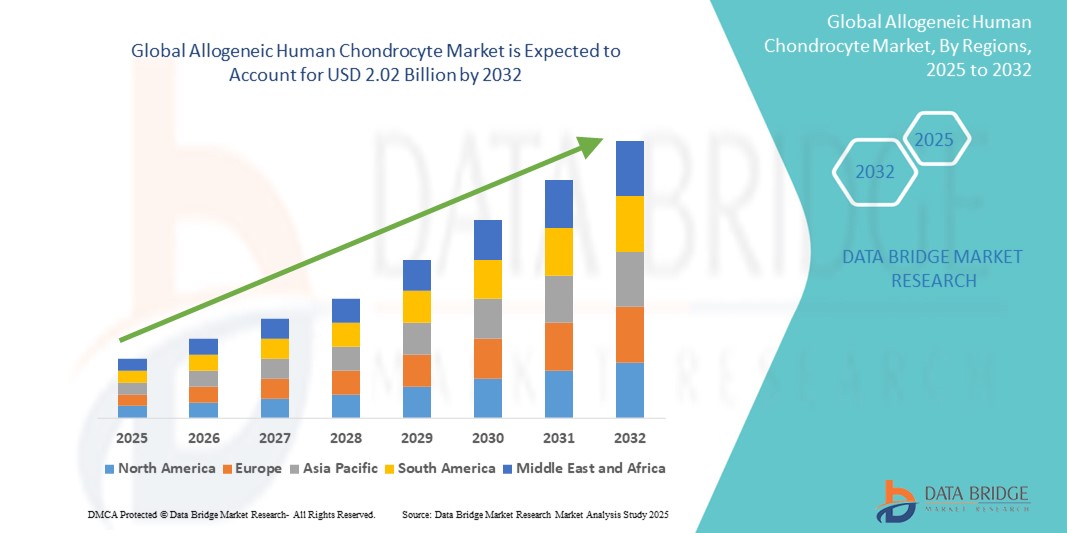
- The global allogeneic human chondrocyte market size was valued at USD 1.28 billion in 2024 and is expected to reach USD 2.02 billion by 2032, at a CAGR of 5.89% during the forecast period
- The market growth is largely driven by increasing incidences of cartilage-related injuries and osteoarthritis, as well as advancements in regenerative medicine and tissue engineering techniques
- Furthermore, the growing demand for off-the-shelf, cell-based therapies that offer reduced recovery time and eliminate donor site morbidity is positioning allogeneic chondrocyte implants as a preferred option. These factors are accelerating the adoption of these therapies, thereby significantly contributing to the market’s expansion
Allogeneic Human Chondrocyte Market Analysis
- Allogeneic human chondrocytes, utilized in cartilage repair therapies, are increasingly recognized as critical components in regenerative medicine and orthopedics due to their scalability, reduced recovery times, and ability to eliminate donor site complications
- The rising demand for allogeneic chondrocyte therapies is primarily driven by the increasing incidence of osteoarthritis, sports injuries, and traumatic joint damage, along with growing awareness of advanced cell-based treatments among clinicians and patients
- North America dominated the allogeneic human chondrocyte market with the largest revenue share of 41.94% in 2024, supported by strong healthcare infrastructure, rising investments in cell therapy research, and the presence of leading biotech firms, with the U.S. at the forefront due to a surge in FDA-approved clinical trials and accelerated product development pipelines
- Asia-Pacific is expected to be the fastest growing region in the allogeneic human chondrocyte market during the forecast period due to increasing healthcare expenditure, expanding patient pools, and progressive government initiatives supporting regenerative therapies
- Osteoarthritis segment dominated the allogeneic human chondrocyte market with a market share of 45.1% in 2024, attributed to its high global prevalence and the urgent need for effective and less invasive cartilage restoration solutions
Report Scope and Allogeneic Human Chondrocyte Market Segmentation
|
Attributes |
Allogeneic Human Chondrocyte Key Market Insights |
|
Segments Covered |
|
|
Countries Covered |
North America
Europe
Asia-Pacific
Middle East and Africa
South America
|
|
Key Market Players |
|
|
Market Opportunities |
|
|
Value Added Data Infosets |
In addition to the insights on market scenarios such as market value, growth rate, segmentation, geographical coverage, and major players, the market reports curated by the Data Bridge Market Research also include in-depth expert analysis, pricing analysis, brand share analysis, consumer survey, demography analysis, supply chain analysis, value chain analysis, raw material/consumables overview, vendor selection criteria, PESTLE Analysis, Porter Analysis, and regulatory framework. |
Allogeneic Human Chondrocyte Market Trends
“Advancements in Off-the-Shelf Cell Therapies and Scaffold-Free Implants”
- A significant and accelerating trend in the global allogeneic human chondrocyte market is the evolution toward off-the-shelf, ready-to-use cell therapies that minimize surgical invasiveness and eliminate the need for donor tissue harvesting, enhancing patient convenience and clinical outcomes
- For instance, companies such as Vericel Corporation and Histogen Inc. are developing scalable allogeneic chondrocyte-based treatments that can be stored and delivered without the delays and complexities associated with autologous cell processing
- Scaffold-free technologies are also gaining traction, allowing chondrocytes to self-assemble into tissue-such as constructs without synthetic carriers, thereby reducing immune response risks and improving integration with native cartilage. This innovation is transforming the treatment of cartilage defects, particularly for patients unsuitable for autologous therapy due to age or comorbidities
- Allogeneic chondrocyte implants now incorporate cell preservation techniques that maintain viability and potency over extended storage periods, improving accessibility for healthcare providers and expanding treatment windows. In addition, the shift toward minimally invasive surgical techniques is being supported by preformed allogeneic cartilage grafts, which are easier to implant and offer shorter recovery times
- These developments are reshaping expectations in orthopedic and sports medicine by offering scalable, repeatable, and cost-efficient alternatives to traditional surgical interventions. Consequently, key companies are investing in biomanufacturing technologies and expanding clinical pipelines to bring next-generation allogeneic therapies to market
- The demand for readily available, safe, and effective cartilage repair solutions is rising across both developed and emerging healthcare systems, with increasing emphasis on reducing surgical morbidity and accelerating rehabilitation timelines
Allogeneic Human Chondrocyte Market Dynamics
Driver
“Rising Prevalence of Cartilage Disorders and Need for Minimally Invasive Therapies”
- The growing incidence of cartilage-related disorders such as osteoarthritis and traumatic joint injuries, particularly among the aging population and active youth, is a key driver for the demand for allogeneic chondrocyte therapies
- For instance, in January 2024, BioTissue Technologies announced a clinical breakthrough in allogeneic cartilage regeneration with its proprietary injectable chondrocyte product showing promising results in early trials, supporting the momentum behind minimally invasive treatments
- Allogeneic chondrocyte implants provide an effective solution that avoids the limitations of autologous harvesting, including donor site morbidity, extended recovery periods, and high costs. These therapies offer streamlined treatment protocols with reduced hospitalization and rehabilitation times
- Furthermore, the expanding focus on regenerative medicine and favorable regulatory support in North America and Europe are encouraging clinical trials and commercialization of advanced chondrocyte products
- The potential for reduced surgical complexity, coupled with rising patient awareness of regenerative alternatives, is significantly boosting the adoption of allogeneic solutions in both outpatient and hospital-based orthopedic care
Restraint/Challenge
“Immune Response Risk and Stringent Regulatory Frameworks”
- One of the main challenges hindering the broader adoption of allogeneic chondrocyte therapies is the potential for immune rejection and variability in patient response, which can affect clinical efficacy and treatment predictability
- Although modern preservation and matching techniques have improved immunocompatibility, concerns persist regarding long-term outcomes and possible adverse reactions in sensitive patient populations
- In addition, the regulatory landscape for cell-based therapies remains highly complex, with stringent safety, efficacy, and manufacturing standards imposed by agencies such as the FDA and EMA. These hurdles can delay product approvals and increase development costs, limiting access for smaller biotechnology firms
- The high cost of cell processing, storage, and distribution especially in the absence of broad insurance coverage also presents an obstacle for widespread adoption in price-sensitive healthcare markets
- Addressing these challenges through improved immunomodulation techniques, robust clinical validation, and harmonization of global regulatory pathways will be essential to expanding the availability and acceptance of allogeneic human chondrocyte therapies on a global scale
Allogeneic Human Chondrocyte Market Scope
The market is segmented on the basis of application, end-users, and distribution channel.
- By Application
On the basis of application, the global allogeneic human chondrocyte market is segmented into osteoarthritis, musculoskeletal system disorders, and others. The osteoarthritis segment dominated the market with the largest market revenue share of 45.1% in 2024, driven by the high global prevalence of osteoarthritis and the rising demand for less invasive and regenerative treatment options. Allogeneic chondrocyte therapies are increasingly preferred for treating osteoarthritis due to their potential to regenerate damaged cartilage without the complications associated with autologous procedures. In addition, the growing geriatric population worldwide further supports the segment’s dominance.
The musculoskeletal system disorders segment is anticipated to witness the fastest growth rate of 20.3% from 2025 to 2032, fueled by the increasing incidence of sports-related injuries and trauma-related cartilage damage among younger demographics. The expanding use of allogeneic cell-based solutions for ligament, tendon, and joint repair is contributing to the accelerated adoption within this segment, particularly in outpatient and sports medicine practices.
- By End-User
On the basis of end-user, the global allogeneic human chondrocyte market is segmented into hospitals, specialty clinics, and ambulatory surgical centers. The hospitals segment held the largest revenue share in 2024, attributed to their comprehensive infrastructure, access to advanced cell therapy technologies, and the availability of multidisciplinary teams for complex cartilage repair procedures. Hospitals are increasingly adopting allogeneic human chondrocyte implants due to growing demand for minimally invasive procedures and improved post-operative care standards.
The ambulatory surgical centers (ASCs) segment is expected to witness the fastest CAGR from 2025 to 2032. ASCs are emerging as a cost-effective alternative for outpatient cartilage repair procedures using allogeneic chondrocytes, driven by faster recovery times, reduced hospital stays, and lower operational costs. Their increasing adoption in developed healthcare systems is a key driver of segmental growth.
- By Distribution Channel
On the basis of distribution channel, the global allogeneic human chondrocyte market is segmented into hospital pharmacy, retail pharmacy, and online pharmacy. The hospital pharmacy segment dominated the market in 2024, primarily due to the hospital-based nature of chondrocyte implantation procedures and the critical role of institutional pharmacies in handling temperature-sensitive biologics. These pharmacies ensure appropriate storage, handling, and direct availability during surgical procedures, supporting the widespread preference in clinical settings.
The online pharmacy segment is projected to register the fastest growth during the forecast period, owing to increasing digitization in healthcare procurement, improved distribution logistics, and growing accessibility of advanced biologics through verified e-commerce medical platforms. The trend is further supported by increased patient awareness and demand for convenient access to regenerative therapies.
Allogeneic Human Chondrocyte Market Regional Analysis
- North America dominated the allogeneic human chondrocyte market with the largest revenue share of 41.94% in 2024, supported by strong healthcare infrastructure, rising investments in cell therapy research, and the presence of leading biotech firms
- Patients and healthcare providers in the region increasingly favor allogeneic chondrocyte therapies for their ability to offer off-the-shelf solutions with shorter recovery times and minimal surgical complexity compared to traditional options
- This widespread adoption is further supported by robust research infrastructure, favorable reimbursement scenarios, and an increasing number of clinical trials and regulatory approvals, positioning North America as a key hub for innovation and commercialization in cartilage regeneration therapy
U.S. Allogeneic Human Chondrocyte Market Insight
The U.S. allogeneic human chondrocyte market captured the largest revenue share of 82% in 2024 within North America, fueled by the growing prevalence of osteoarthritis and the increasing preference for advanced regenerative therapies. High healthcare expenditure, strong clinical research infrastructure, and a supportive regulatory environment contribute significantly to the adoption of allogeneic cell-based therapies. Furthermore, the U.S. market benefits from the presence of leading biotech firms and rising acceptance of minimally invasive orthopedic procedures among both patients and clinicians.
Europe Allogeneic Human Chondrocyte Market Insight
The Europe allogeneic human chondrocyte market is projected to expand at a substantial CAGR throughout the forecast period, primarily driven by the region’s strong emphasis on regenerative medicine and patient-centric care. The increasing burden of joint disorders, coupled with favorable healthcare reimbursement policies and regulatory support, is accelerating clinical adoption. Significant growth is also observed in sports medicine and orthopedic applications, particularly across Germany, France, and the U.K., where clinical trials and academic collaborations are actively advancing therapeutic innovations.
U.K. Allogeneic Human Chondrocyte Market Insight
The U.K. allogeneic human chondrocyte market is anticipated to grow at a noteworthy CAGR during the forecast period, driven by rising demand for biologics in orthopedic treatments and a growing aging population. Increased government support for regenerative medicine research and a strong public-private partnership ecosystem are further fueling innovation in cell therapy. The expanding use of allogeneic cartilage implants in both NHS and private healthcare settings is expected to propel long-term market growth.
Germany Allogeneic Human Chondrocyte Market Insight
The Germany allogeneic human chondrocyte market is expected to expand at a considerable CAGR during the forecast period, fueled by advanced healthcare infrastructure, increasing investment in biopharmaceutical innovation, and a strong clinical focus on joint preservation and cartilage repair. The country’s emphasis on quality, safety, and outcome-driven therapies supports high adoption rates for allogeneic implants in both surgical and outpatient settings, particularly in orthopedic and trauma centers.
Asia-Pacific Allogeneic Human Chondrocyte Market Insight
The Asia-Pacific allogeneic human chondrocyte market is poised to grow at the fastest CAGR of 7.5% during 2025 to 2032, driven by expanding healthcare access, increasing incidence of joint disorders, and the rapid development of regenerative medicine sectors in countries such as China, Japan, and India. Government support for biotech innovation, growing investments in medical infrastructure, and rising public awareness of cell-based therapies are accelerating the adoption of allogeneic chondrocytes across the region.
Japan Allogeneic Human Chondrocyte Market Insight
The Japan allogeneic human chondrocyte market is gaining momentum due to the country’s focus on high-tech, minimally invasive medical solutions and its rapidly aging population. With strong government backing for regenerative therapies and a leading role in tissue engineering research, Japan is increasingly adopting allogeneic chondrocyte implants for osteoarthritis and cartilage injury treatment. Integration with advanced surgical techniques and robotic systems is also supporting market expansion.
India Allogeneic Human Chondrocyte Market Insight
The India allogeneic human chondrocyte market accounted for the largest market revenue share in Asia-Pacific in 2024, attributed to the rising incidence of orthopedic conditions, growing middle-class access to healthcare, and an expanding pool of specialized orthopedic centers. Government initiatives promoting biotechnology, increasing clinical trial activity, and growing domestic production of cell therapies are driving the adoption of cost-effective allogeneic chondrocyte solutions across hospitals and specialty clinics.
Allogeneic Human Chondrocyte Market Share
The allogeneic human chondrocyte industry is primarily led by well-established companies, including:
- Vericel Corporation (U.S.)
- Anika Therapeutics, Inc. (U.S.)
- Histogen Inc. (U.S.)
- Zimmer Biomet (U.S.)
- Smith + Nephew (U.K.)
- B. Braun SE (Germany)
- TETEC Tissue Engineering Technologies AG (Germany)
- Orthocell Limited (Australia)
- Cellec Biotek Co., Ltd. (South Korea)
- MEDIPOST Co., Ltd. (South Korea)
- BioTissue Technologies GmbH (Germany)
- Kuros Biosciences AG (Switzerland)
- Regrow Biosciences Pvt. Ltd. (India)
- Asterias Biotherapeutics, Inc. (U.S.)
- Isto Biologics (U.S.)
- San-Bio Company Limited (Japan)
- RHEACELL GmbH & Co. KG (Germany)
- Osiris Therapeutics, Inc. (U.S.)
- Novocellbio Co., Ltd. (South Korea)
- NuVasive, Inc. (U.S.)
What are the Recent Developments in Global Allogeneic Human Chondrocyte Market?
- In April 2024, Vericel Corporation, a leader in advanced cell therapies for orthopedic applications, announced positive clinical outcomes from its ongoing Phase III trial for an allogeneic human chondrocyte implant targeting knee cartilage defects. The therapy demonstrated significant improvements in pain reduction and joint functionality, reinforcing Vericel’s leadership in regenerative orthopedic solutions and paving the way for expanded indications and regulatory submissions in North America and Europe
- In March 2024, Histogen Inc., a biotechnology firm focused on regenerative medicine, launched a new preclinical development program aimed at producing off-the-shelf allogeneic chondrocyte therapies for osteoarthritis. The company’s novel approach leverages proprietary growth factor technologies to improve chondrocyte viability and integration, highlighting its commitment to advancing minimally invasive therapeutic options for age-related joint degeneration
- In February 2024, TETEC AG, a subsidiary of B. Braun and a pioneer in cell-based cartilage regeneration, announced an expansion of its production capabilities in Germany. This strategic move is intended to support the growing demand for allogeneic chondrocyte implants across Europe. The facility upgrade includes GMP-certified clean rooms and advanced cryopreservation technologies, underscoring TETEC’s commitment to maintaining product quality while scaling up access to innovative cell therapies
- In January 2024, Cellec Biotek Co., Ltd., a South Korea-based biotech company, revealed its collaboration with academic research institutions to develop a scaffold-free 3D culture system for allogeneic chondrocytes. This platform aims to enhance cartilage repair by creating tissue-mimicking constructs without synthetic matrices, thus reducing immune response risks. The partnership is expected to accelerate clinical translation of the technology in Asian and global markets
- In December 2023, Anika Therapeutics, Inc. entered into a joint development agreement with a leading U.S. orthopedic research center to investigate the combined use of hyaluronic acid-based matrices and allogeneic chondrocytes for articular cartilage regeneration. The collaboration focuses on developing next-generation injectable solutions, supporting Anika’s strategy to diversify its regenerative product pipeline and address unmet clinical needs in joint preservation

- Interactive Data Analysis Dashboard
- Company Analysis Dashboard for high growth potential opportunities
- Research Analyst Access for customization & queries
- Competitor Analysis with Interactive dashboard
- Latest News, Updates & Trend analysis
- Harness the Power of Benchmark Analysis for Comprehensive Competitor Tracking
Data collection and base year analysis are done using data collection modules with large sample sizes. The stage includes obtaining market information or related data through various sources and strategies. It includes examining and planning all the data acquired from the past in advance. It likewise envelops the examination of information inconsistencies seen across different information sources. The market data is analysed and estimated using market statistical and coherent models. Also, market share analysis and key trend analysis are the major success factors in the market report. To know more, please request an analyst call or drop down your inquiry.
The key research methodology used by DBMR research team is data triangulation which involves data mining, analysis of the impact of data variables on the market and primary (industry expert) validation. Data models include Vendor Positioning Grid, Market Time Line Analysis, Market Overview and Guide, Company Positioning Grid, Patent Analysis, Pricing Analysis, Company Market Share Analysis, Standards of Measurement, Global versus Regional and Vendor Share Analysis. To know more about the research methodology, drop in an inquiry to speak to our industry experts.
Data Bridge Market Research is a leader in advanced formative research. We take pride in servicing our existing and new customers with data and analysis that match and suits their goal. The report can be customized to include price trend analysis of target brands understanding the market for additional countries (ask for the list of countries), clinical trial results data, literature review, refurbished market and product base analysis. Market analysis of target competitors can be analyzed from technology-based analysis to market portfolio strategies. We can add as many competitors that you require data about in the format and data style you are looking for. Our team of analysts can also provide you data in crude raw excel files pivot tables (Fact book) or can assist you in creating presentations from the data sets available in the report.












