


Alpha-2-Antiplasmin Market Size
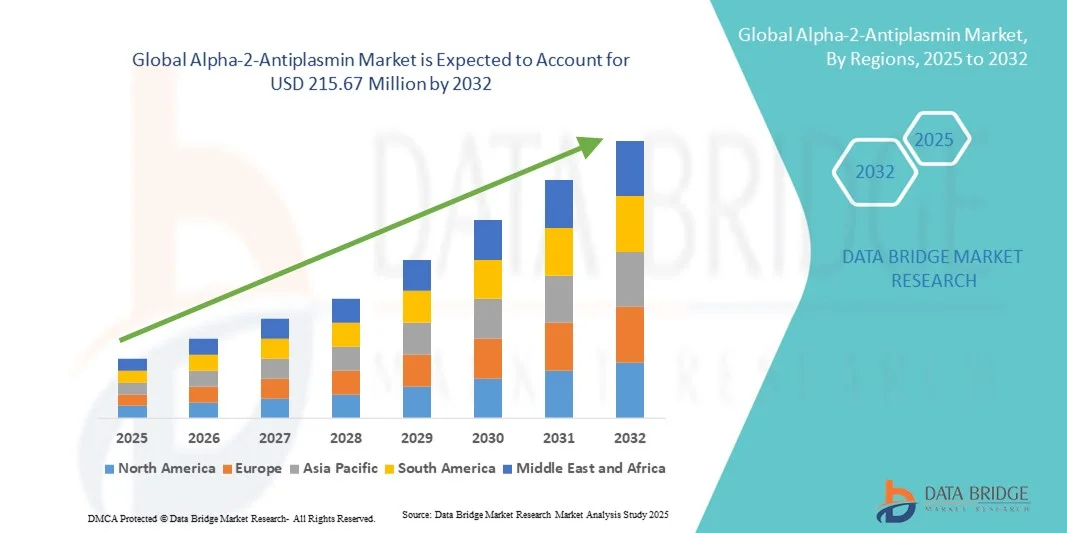
- The global Alpha-2-Antiplasmin market size was valued at USD 150.50 million in 2024 and is expected to reach USD 215.67 million by 2032, at a CAGR of 4.6% during the forecast period
- The market growth is largely fueled by advancements in coagulation testing practices, which enhance the diagnosis and management of thrombotic disorders, driving adoption across healthcare settings
- Furthermore, increasing prevalence of thrombotic disorders, rising healthcare expenditure, and strategic initiatives by key healthcare organizations are establishing Alpha-2-Antiplasmin as a critical component in modern diagnostics. These converging factors are accelerating the uptake of related therapeutics and testing solutions, thereby significantly boosting the industry's growth
Alpha-2-Antiplasmin Market Analysis
- Alpha-2-Antiplasmin, a critical serine protease inhibitor that regulates fibrinolysis, is increasingly vital in managing thrombotic disorders and ensuring effective blood clot stability in both clinical diagnostics and therapeutic applications, due to its role in controlling plasmin activity and maintaining hemostatic balance
- The escalating demand for Alpha-2-Antiplasmin is primarily fueled by the rising prevalence of thrombotic disorders, growing awareness of coagulation-related health risks, and advancements in diagnostic technologies that improve detection and monitoring of related conditions
- North America dominated the Alpha-2-Antiplasmin market with the largest revenue share of 43% in 2024, characterized by advanced healthcare infrastructure, high adoption of innovative diagnostic assays, and a strong presence of key market players, with the U.S. experiencing substantial growth in clinical and research applications, driven by strategic initiatives and product innovations from leading biotechnology and pharmaceutical companies
- Asia-Pacific is expected to be the fastest growing region in the Alpha-2-Antiplasmin market during the forecast period due to increasing healthcare expenditure, growing prevalence of thrombotic disorders, and expanding access to advanced diagnostic solutions
- Enzyme Linked Immuno-Sorbent Assay (ELISA) segment dominated the Alpha-2-Antiplasmin market with a market share of 46.8% in 2024, driven by its high accuracy, widespread clinical adoption, and suitability for both research and diagnostic applications, making it the preferred method for detecting and quantifying Alpha-2-Antiplasmin levels
Report Scope and Alpha-2-Antiplasmin Market Segmentation
|
Attributes |
Alpha-2-Antiplasmin Key Market Insights |
|
Segments Covered |
|
|
Countries Covered |
North America
Europe
Asia-Pacific
Middle East and Africa
South America
|
|
Key Market Players |
|
|
Market Opportunities |
|
|
Value Added Data Infosets |
In addition to the insights on market scenarios such as market value, growth rate, segmentation, geographical coverage, and major players, the market reports curated by the Data Bridge Market Research also include in-depth expert analysis, patient epidemiology, pipeline analysis, pricing analysis, and regulatory framework |
Alpha-2-Antiplasmin Market Trends
Integration with Advanced Diagnostic Technologies
- A prominent and accelerating trend in the global Alpha-2-Antiplasmin market is the integration with advanced diagnostic technologies such as Enzyme-Linked Immunosorbent Assay (ELISA), Immunohistochemistry (IHC), and Flow Cytometry
- For instance, ELISA is widely used for its high sensitivity and specificity in detecting Alpha-2-Antiplasmin levels, enabling accurate diagnosis of thrombotic disorders
- Similarly, IHC techniques, both frozen (IHC-F) and paraffin (IHC-P), are employed to visualize Alpha-2-Antiplasmin expression in tissue samples, aiding in the assessment of clot formation and resolution
- AI integration in diagnostic platforms enhances data analysis, providing more intelligent alerts based on activity patterns and improving diagnostic accuracy. The seamless integration of Alpha-2-Antiplasmin detection with broader diagnostic systems facilitates centralized control over various aspects of coagulation monitoring, creating a unified and automated diagnostic experience
- This trend towards more intelligent, intuitive, and interconnected diagnostic systems is fundamentally reshaping user expectations for coagulation diagnostics. Consequently, companies are developing diagnostic platforms that integrate Alpha-2-Antiplasmin detection with AI and voice control capabilities, enhancing user experience and diagnostic efficiency
- The demand for diagnostic solutions that offer seamless integration of Alpha-2-Antiplasmin detection is growing rapidly across both clinical and research sectors, as professionals increasingly prioritize convenience and comprehensive diagnostic functionality
Alpha-2-Antiplasmin Market Dynamics
Driver
Rising Prevalence of Cardiovascular Diseases
- The increasing prevalence of cardiovascular diseases globally is a significant driver for the heightened demand for Alpha-2-Antiplasmin diagnostics and therapeutics
- For instance, the growing incidence of conditions such as ischemic stroke and deep vein thrombosis is leading to a higher need for accurate diagnostic tools and effective treatment options
- As awareness of these conditions rises, healthcare providers are increasingly incorporating Alpha-2-Antiplasmin testing into routine diagnostics to assess thrombotic risk and guide treatment decisions
- Furthermore, advancements in healthcare infrastructure and diagnostic technologies are facilitating the adoption of Alpha-2-Antiplasmin assays in clinical settings
- The growing emphasis on early detection and personalized treatment strategies is driving the integration of Alpha-2-Antiplasmin measurements into clinical practice. These factors collectively contribute to the expanding market for Alpha-2-Antiplasmin diagnostics and therapeutics
- As a result, companies are focusing on developing innovative Alpha-2-Antiplasmin-based solutions to meet the increasing demand
- The trend towards personalized medicine and targeted therapies further propels the growth of the Alpha-2-Antiplasmin market
Restraint/Challenge
High Production Costs and Limited Awareness in Emerging Markets
- Concerns surrounding the high production costs of Alpha-2-Antiplasmin therapies and limited awareness in emerging markets pose significant challenges to broader market penetration.
- For instance, the complex manufacturing processes and stringent quality control requirements contribute to the elevated costs of Alpha-2-Antiplasmin-based products.
- These high costs can limit accessibility, particularly in low-income countries, hindering widespread adoption and utilization of these therapies
- In addition, limited awareness and understanding of Alpha-2-Antiplasmin's role in coagulation disorders in emerging markets further impede market growth.
- Addressing these challenges through cost-reduction strategies, educational initiatives, and increased accessibility will be crucial for expanding the market reach of Alpha-2-Antiplasmin solutions
- Companies are exploring partnerships and collaborations to enhance distribution networks and raise awareness in underserved regions
- Overcoming these barriers is vital for the sustained growth and adoption of Alpha-2-Antiplasmin diagnostics and therapeutics globally. Efforts to improve affordability and accessibility will play a key role in driving the future expansion of the Alpha-2-Antiplasmin market
Alpha-2-Antiplasmin Market Scope
The market is segmented on the basis of forms, diagnostic technologies, and end users.
- By Forms
On the basis of forms, the Alpha-2-Antiplasmin market is segmented into plasminogen binding and non-plasminogen binding. The Plasminogen Binding segment dominated the market with the largest revenue share in 2024, driven by its critical role in inhibiting plasmin activity and maintaining proper clot formation. This form is widely preferred in clinical diagnostics and research due to its established reliability in assessing thrombotic disorders. Hospitals and diagnostic labs rely heavily on plasminogen binding Alpha-2-Antiplasmin assays for routine testing and risk assessment in cardiovascular patients. The segment benefits from high clinical adoption, extensive research backing, and the availability of standardized testing kits. In addition, the ease of integrating plasminogen binding Alpha-2-Antiplasmin into ELISA and other diagnostic platforms strengthens its market dominance.
The Non-plasminogen Binding segment is anticipated to witness the fastest growth during 2025–2032, fueled by ongoing research exploring its therapeutic potential and applications in specialized coagulation treatments. Non-plasminogen binding forms are gaining attention in personalized medicine approaches, offering targeted interventions in rare thrombotic conditions. Growing investments in biotechnology research, collaborations between academic and commercial organizations, and the development of innovative detection and therapeutic tools are accelerating adoption in clinical and research settings. Furthermore, increasing awareness among clinicians and researchers regarding the unique properties of non-plasminogen binding Alpha-2-Antiplasmin is expected to support market growth.
- By Diagnostic Technologies
On the basis of diagnostic technologies, the Alpha-2-Antiplasmin market is segmented into Enzyme-Linked Immuno-Sorbent Assay (ELISA), Immunohistochemistry – Frozen (IHC-F), Immunohistochemistry – Paraffin (IHC-P), and Flow Cytometry. The ELISA segment dominated the market with the largest revenue share of 46.8% in 2024, driven by its high sensitivity, specificity, and ease of use for quantifying Alpha-2-Antiplasmin levels. Clinical laboratories prefer ELISA for routine diagnostics due to its reproducibility, scalability, and compatibility with automated platforms. ELISA assays are widely used for thrombotic risk assessment, monitoring therapy effectiveness, and research purposes. The strong presence of established ELISA kit manufacturers and standardized protocols further reinforces market leadership. Moreover, ELISA’s cost-effectiveness compared to other diagnostic technologies contributes to its widespread adoption.
The Flow Cytometry segment is expected to witness the fastest growth during 2025–2032, owing to its ability to provide rapid, multi-parametric analysis of blood samples, enabling detailed assessment of Alpha-2-Antiplasmin activity at the cellular level. Flow cytometry is increasingly adopted in advanced research and clinical studies for precise measurement of coagulation dynamics. Its growth is supported by technological advancements, miniaturized cytometers, high-throughput analysis, and increasing demand for personalized diagnostics. In addition, collaborations between diagnostic equipment manufacturers and research institutions are expanding access to flow cytometry solutions.
- By End Users
On the basis of end users, the Alpha-2-Antiplasmin market is segmented into hospitals, clinics, diagnostic labs, private labs, and others. The Hospitals segment dominated the market with the largest revenue share in 2024, driven by the high prevalence of thrombotic disorders and the need for regular diagnostic testing and monitoring in clinical settings. Hospitals offer a structured environment with trained personnel and standardized protocols, making them the primary adopters of Alpha-2-Antiplasmin diagnostics. The segment benefits from integration with advanced laboratory infrastructure, routine patient testing, and institutional purchasing power. Hospitals also invest heavily in state-of-the-art diagnostic tools and research collaborations, further reinforcing their dominance. Furthermore, hospitals’ strong relationships with suppliers ensure timely access to high-quality Alpha-2-Antiplasmin products and kits.
The Diagnostic Labs segment is expected to witness the fastest growth during 2025–2032, fueled by the rise in specialized laboratories offering advanced coagulation testing services. Diagnostic labs are expanding their service portfolios to include Alpha-2-Antiplasmin assays due to growing awareness and demand from both clinical and research sectors. Technological advancements, automation, and increasing outsourcing of diagnostic services support rapid adoption in this segment. These labs often cater to both hospitals and private clients, providing flexible testing solutions. In addition, government and private initiatives to increase access to advanced diagnostics are expected to accelerate growth in the diagnostic labs segment.
Alpha-2-Antiplasmin Market Regional Analysis
- North America dominated the Alpha-2-Antiplasmin market with the largest revenue share of 43% in 2024, characterized by advanced healthcare infrastructure, high adoption of innovative diagnostic assays, and a strong presence of key market players
- Healthcare providers and research institutions in the region prioritize accurate coagulation testing, making Alpha-2-Antiplasmin assays a critical component in routine diagnostics and patient management
- This widespread adoption is further supported by high healthcare expenditure, well-established laboratory networks, and increasing awareness among clinicians about the role of Alpha-2-Antiplasmin in managing thrombotic conditions, establishing it as a preferred solution in both clinical and research settings
U.S. Alpha-2-Antiplasmin Market Insight
The U.S. Alpha-2-Antiplasmin market captured the largest revenue share of 82% in 2024 within North America, fueled by advanced healthcare infrastructure, high adoption of innovative diagnostic technologies, and the increasing prevalence of thrombotic disorders. Hospitals, diagnostic labs, and research institutions are prioritizing accurate coagulation testing, making Alpha-2-Antiplasmin assays a critical component in clinical diagnostics and patient management. The growing emphasis on early detection and personalized treatment approaches further propels market growth. Moreover, the integration of Alpha-2-Antiplasmin testing with automated and high-throughput laboratory platforms is enhancing efficiency and reliability. Strategic initiatives by key biotechnology and pharmaceutical companies to expand product availability also support the market’s expansion. The U.S. continues to lead in research-driven demand for advanced coagulation diagnostics, reinforcing its market dominance.
Europe Alpha-2-Antiplasmin Market Insight
The Europe Alpha-2-Antiplasmin market is projected to expand at a substantial CAGR during the forecast period, primarily driven by the rising prevalence of cardiovascular and thrombotic disorders and growing healthcare expenditure. The increase in urbanization and accessibility to advanced laboratory facilities is fostering the adoption of Alpha-2-Antiplasmin diagnostics. European healthcare providers are also emphasizing preventive care, which is encouraging regular coagulation testing. The market is witnessing significant adoption across hospitals, clinics, and diagnostic labs in both new setups and upgrades of existing healthcare facilities. Furthermore, the presence of regulatory frameworks promoting high-quality diagnostics supports market growth. Collaborations between diagnostic manufacturers and healthcare institutions are accelerating awareness and adoption across the region.
U.K. Alpha-2-Antiplasmin Market Insight
The U.K. Alpha-2-Antiplasmin market is anticipated to grow at a noteworthy CAGR during the forecast period, driven by increasing awareness of thrombotic disorders and demand for accurate coagulation testing. Hospitals and private diagnostic labs are investing in high-precision assays to improve patient outcomes. In addition, government initiatives supporting healthcare modernization and the integration of advanced diagnostic platforms are encouraging adoption. The U.K.’s strong clinical research environment and healthcare infrastructure further facilitate market growth. Furthermore, rising incidence of cardiovascular diseases and proactive patient monitoring practices are stimulating demand. The expansion of specialized diagnostic labs offering Alpha-2-Antiplasmin testing contributes to market momentum.
Germany Alpha-2-Antiplasmin Market Insight
The Germany Alpha-2-Antiplasmin market is expected to expand at a considerable CAGR during the forecast period, fueled by growing awareness of coagulation disorders and the adoption of technologically advanced diagnostic solutions. Germany’s well-developed healthcare infrastructure, combined with its emphasis on precision medicine and research innovation, promotes the use of Alpha-2-Antiplasmin assays. Hospitals and specialized labs are increasingly integrating these assays into routine diagnostics and clinical studies. The trend toward early detection and preventive healthcare is also driving adoption. Furthermore, collaborations between diagnostic companies and research institutions support the development of advanced testing methods. Local demand for accurate, reliable, and standardized diagnostics aligns with market growth objectives.
Asia-Pacific Alpha-2-Antiplasmin Market Insight
The Asia-Pacific Alpha-2-Antiplasmin market is poised to grow at the fastest CAGR of 23% during the forecast period of 2025 to 2032, driven by increasing prevalence of thrombotic and cardiovascular disorders, rising healthcare expenditure, and expanding access to advanced diagnostics. Countries such as China, Japan, and India are witnessing growing investments in healthcare infrastructure and laboratory capabilities. The region’s emerging healthcare awareness programs and government initiatives promoting preventive care are supporting market adoption. Furthermore, local manufacturing and collaborations with global diagnostic firms are improving affordability and accessibility of Alpha-2-Antiplasmin assays. Hospitals, clinics, and private labs in APAC are increasingly adopting these diagnostics for routine testing and research applications. Rapid urbanization and increasing demand for high-quality healthcare are expected to sustain market growth.
Japan Alpha-2-Antiplasmin Market Insight
The Japan Alpha-2-Antiplasmin market is gaining momentum due to the country’s advanced healthcare infrastructure, high-tech culture, and increasing demand for precise coagulation diagnostics. Hospitals and specialized diagnostic labs are adopting Alpha-2-Antiplasmin assays for routine monitoring of thrombotic disorders. The integration of these assays with automated and high-throughput platforms is enhancing efficiency and reliability. Moreover, Japan’s aging population is driving demand for preventive healthcare solutions and advanced diagnostics. Government support for healthcare innovation and research further stimulates market adoption. Collaborations between local and international diagnostic firms are expanding the availability of assays, improving accessibility across the country. The emphasis on accurate, standardized, and high-quality diagnostic testing underpins continued market growth.
India Alpha-2-Antiplasmin Market Insight
The India Alpha-2-Antiplasmin market accounted for the largest revenue share in Asia-Pacific in 2024, attributed to the country’s growing healthcare infrastructure, expanding middle class, and increasing awareness of thrombotic disorders. Hospitals, diagnostic labs, and private labs are increasingly incorporating Alpha-2-Antiplasmin assays for patient monitoring and research purposes. The push toward digital health initiatives and preventive care programs is further driving adoption. Moreover, availability of cost-effective testing kits and local manufacturing enhances accessibility. Rapid urbanization, expanding healthcare coverage, and rising disposable incomes support the growth of advanced diagnostic services. Strong domestic and multinational company presence in India contributes to market development and wider distribution of Alpha-2-Antiplasmin products.
Alpha-2-Antiplasmin Market Share
The Alpha-2-Antiplasmin industry is primarily led by well-established companies, including:
- Abbott (U.S.)
- BD (U.S.)
- BIO/DATA CORPORATION (U.S.)
- Axis-Shield Diagnostics Ltd. (U.K.)
- Helena Laboratories Corporation. (U.S.)
- Sysmex Corporation (Japan)
- Thermo Fisher Scientific Inc. (U.S.)
- F. Hoffmann-La Roche Ltd (Switzerland)
- Grifols, S.A. (Spain)
- Beckman Coulter, Inc. (U.S.)
- Trinity Biotech plc (Ireland)
- HYPHEN BioMed (France)
- Sienco, Inc. (U.S.)
- Labcorp (U.S.)
- Bayer AG (Germany)
- CSL Limited (Australia)
- Octapharma AG (Switzerland)
- Fresenius Kabi AG (Germany)
- Sanquin (Netherlands)
What are the Recent Developments in Global Alpha-2-Antiplasmin Market?
- In December 2024, researchers demonstrated the application of Affimer technology to inhibit α2AP, facilitating enhanced fibrinolysis in plasma and whole blood samples. This approach offers a novel method to modulate fibrinolytic activity, potentially improving outcomes in thrombotic conditions by promoting more efficient clot breakdown
- In October 2024, a study published in ScienceDirect highlighted that α2AP deficiency is associated with increased plasmin generation and bleeding tendencies. This research underscores the importance of α2AP in maintaining hemostatic balance and its potential as a biomarker for bleeding disorders
- In June 2024, a clinical trial (NCT05948566) commenced to evaluate TS23, a monoclonal antibody targeting α2AP, in patients with acute ischemic stroke. The study aims to determine the safety and preliminary efficacy of TS23 in enhancing thrombolysis and improving clinical outcomes by inhibiting α2AP's role in fibrin clot stabilization
- In February 2024, Bayer announced the commencement of a Phase II clinical trial (SIRIUS study) evaluating BAY3018250, a novel anti-α2AP monoclonal antibody, in patients with deep vein thrombosis (DVT). This investigational therapy aims to enhance thrombolysis by targeting α2AP, potentially offering a new approach to treating thrombotic disorders
- In November 2022, CSL entered into a strategic licensing agreement with Translational Sciences to develop TS23, a first-in-class anti-α2AP monoclonal antibody. TS23 is being developed to dissolve thrombi responsible for serious conditions such as pulmonary embolism (PE) and acute ischemic stroke (AIS), marking a significant advancement in thrombolytic therapy

- Interactive Data Analysis Dashboard
- Company Analysis Dashboard for high growth potential opportunities
- Research Analyst Access for customization & queries
- Competitor Analysis with Interactive dashboard
- Latest News, Updates & Trend analysis
- Harness the Power of Benchmark Analysis for Comprehensive Competitor Tracking
Data collection and base year analysis are done using data collection modules with large sample sizes. The stage includes obtaining market information or related data through various sources and strategies. It includes examining and planning all the data acquired from the past in advance. It likewise envelops the examination of information inconsistencies seen across different information sources. The market data is analysed and estimated using market statistical and coherent models. Also, market share analysis and key trend analysis are the major success factors in the market report. To know more, please request an analyst call or drop down your inquiry.
The key research methodology used by DBMR research team is data triangulation which involves data mining, analysis of the impact of data variables on the market and primary (industry expert) validation. Data models include Vendor Positioning Grid, Market Time Line Analysis, Market Overview and Guide, Company Positioning Grid, Patent Analysis, Pricing Analysis, Company Market Share Analysis, Standards of Measurement, Global versus Regional and Vendor Share Analysis. To know more about the research methodology, drop in an inquiry to speak to our industry experts.
Data Bridge Market Research is a leader in advanced formative research. We take pride in servicing our existing and new customers with data and analysis that match and suits their goal. The report can be customized to include price trend analysis of target brands understanding the market for additional countries (ask for the list of countries), clinical trial results data, literature review, refurbished market and product base analysis. Market analysis of target competitors can be analyzed from technology-based analysis to market portfolio strategies. We can add as many competitors that you require data about in the format and data style you are looking for. Our team of analysts can also provide you data in crude raw excel files pivot tables (Fact book) or can assist you in creating presentations from the data sets available in the report.












