


What is the Aluminium-Ion Battery Market Size and Growth Rate?
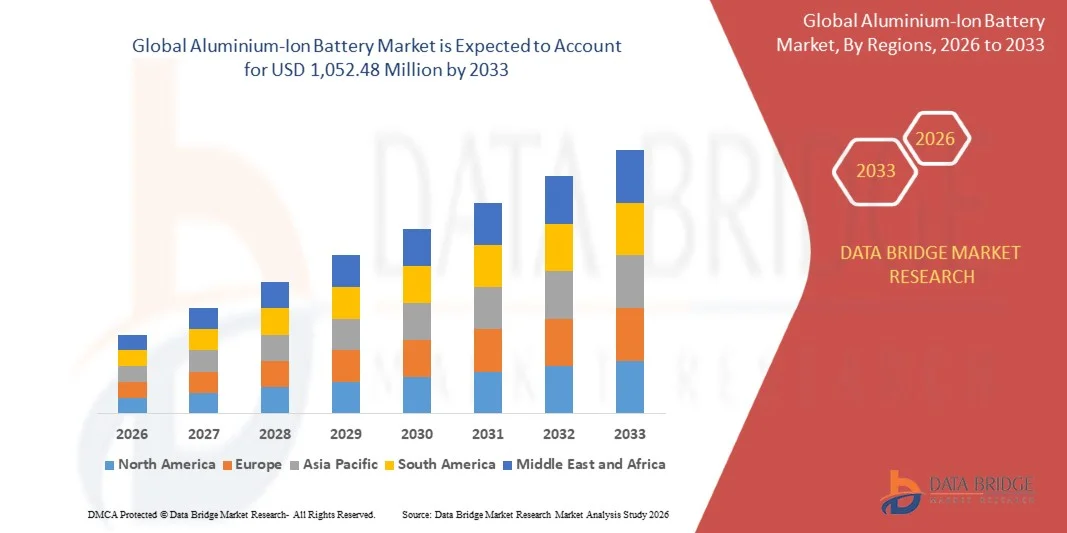
- As per Data Bridge Market Research analysis, the aluminium-ion battery market was valued at USD 280.00 million in 2025 and is projected to reach USD 1,052.48 million by 2033, growing at a CAGR of 18.00% from 2026 to 2033.
- The market is experiencing strong growth driven by increasing demand for next-generation energy storage technologies, growing investments in battery innovation, and rising adoption of safer, fast-charging, and sustainable battery chemistries across electric vehicles, consumer electronics, and grid-scale energy storage applications.
- The growing focus on reducing dependence on lithium-based batteries, combined with continuous advancements in graphene-enhanced electrodes, aluminum-ion cell technology, and cost-effective battery materials, is accelerating commercialization efforts. Increasing investments in renewable energy integration and the expansion of electrification initiatives are encouraging battery manufacturers, research institutions, and automotive companies to develop high-performance aluminum-ion batteries that offer improved safety, rapid charging capability, and long operational life for future energy storage applications.
Market Size & Forecast
- Global Market Value (2025): USD 280.00 Million
- Expected Market Value (2033): USD 1,052.48 Million
- Forecast CAGR (2026–2033): 18.00%
- Leading Region in 2025: North America
- Fastest Growing Region: Asia Pacific
What are the Major Takeaways of the Aluminium-Ion Battery Market?
- North America dominated the aluminum-ion battery market with the largest revenue share of 38.6% in 2025, supported by strong investments in advanced battery research, increasing commercialization of next-generation energy storage technologies, and the presence of leading technology developers
- Asia-Pacific is expected to be the fastest-growing region at a CAGR of 16.8% from 2026 to 2033, fueled by expanding electric vehicle production, growing renewable energy deployment, increasing battery, and supportive government initiatives across China, India, Japan, and South Korea.
- The prismatic segment led the market with a 44.8% share in 2025, driven by superior space utilization, structural stability, and increasing adoption in stationary energy storage and industrial battery systems
- Laminated are the fastest-growing type, projected to register a CAGR of 17.4%, reflecting the surge in demand for lightweight, compact, and flexible battery solutions
- The graphite segment dominated the electrode material category with a 56.3% revenue share in 2025, led by its excellent conductivity, electrochemical stability, and widespread use in aluminum-ion battery research and development
- Cathode accounted for 34.7% of the market share in 2025, preferred by its critical influence on charging performance, conductivity, and overall battery efficiency
- The energy storage systems segment is the fastest-growing application category, with a CAGR of 20.3%, driven by expanding renewable energy deployment and rising investment in grid-scale storage infrastructure
Report Scope and Aluminium-Ion Battery Market Segmentation
|
Attributes |
Aluminium-Ion Battery Key Market Insights |
|
Segments Covered |
|
|
Countries Covered |
North America
Europe
Asia-Pacific
Middle East and Africa
South America
|
|
Key Market Players |
|
|
Market Opportunities |
|
|
Value Added Data Infosets |
In addition to the insights on market scenarios such as market value, growth rate, segmentation, geographical coverage, and major players, the market reports curated by the Data Bridge Market Research also include import export analysis, production capacity overview, production consumption analysis, price trend analysis, climate change scenario, supply chain analysis, value chain analysis, raw material/consumables overview, vendor selection criteria, PESTLE Analysis, Porter Analysis, and regulatory framework. |
What is the Key Trend in the Aluminium-Ion Battery Market?
- Graphene-enhanced aluminum-ion battery technology is emerging as a key market trend, enabling ultra-fast charging, improved power density, enhanced cycle life, and safer energy storage for electric vehicles, consumer electronics, and stationary energy storage applications.
- For instance, in March 2025, Graphene Manufacturing Group (GMG) announced continued commercialization progress for its Graphene Aluminum-Ion Battery with the Battery Innovation Center, advancing cell optimization, scaling activities, and readiness for commercial applications.
- Rapid improvements in graphene-based cathodes and advanced electrolyte technologies are enabling higher charging speeds, better thermal stability, and improved battery durability under demanding operating conditions.
- Battery developers and research institutions are accelerating investments in high-performance aluminum-ion chemistries to address growing demand for sustainable, lithium-free energy storage technologies across multiple industries.
- For instance, in November 2025, Fraunhofer IISB unveiled the world's first aluminum-graphite dual-ion battery system demonstrator under Project INNOBATT, validating aluminum-ion technology beyond laboratory-scale development for grid energy storage applications.
- As commercialization efforts continue to accelerate alongside advances in graphene materials and battery engineering, aluminum-ion batteries are expected to strengthen their position as a promising next-generation alternative for high-power, safe, and sustainable energy storage solutions.
What are the Key Drivers of the Aluminium-Ion Battery Market?
- Growing demand for safer, lower-cost, and rapidly rechargeable battery technologies is significantly increasing investments in aluminum-ion batteries for electric mobility, renewable energy storage, and industrial power applications.
- For instance, in September 2023, Graphene Manufacturing Group (GMG) announced it had successfully developed its first graphene aluminum-ion battery prototype in pouch-cell format with more than 500 mAh capacity, marking a significant milestone toward commercial-scale battery development.
- Battery manufacturers, automotive companies, and research organizations are increasing development of aluminum-ion technologies to reduce dependence on critical lithium resources while improving sustainability and supply-chain resilience.
- For instance, in March 2024, the German Federal Ministry of Education and Research (BMBF) launched the BALU consortium project, bringing together Fraunhofer institutes, the University of Bayreuth, Technical University of Braunschweig, and industry partners to scale aluminum-graphite dual-ion battery production from laboratory research to industry-compatible manufacturing, accelerating commercialization of aluminum-ion battery technology.
- With governments and industries increasingly prioritizing alternative battery chemistries for future electrification and renewable energy integration, aluminum-ion batteries are expected to become an important component of next-generation energy storage ecosystems.
Which Factors are Challenging the Growth of the Aluminium-Ion Battery Market?
- Limited commercial-scale manufacturing, lower energy density than mature lithium-ion batteries, and continued dependence on laboratory-stage development remain major barriers to widespread aluminum-ion battery adoption.
- Commercial deployment continues to require substantial investment in advanced materials, manufacturing optimization, and long-term validation before large-scale industrial production can be achieved.
- For instance, in February 2024, Graphene Manufacturing Group (GMG) stated that while its Graphene Aluminum-Ion Battery achieved more than 1,000 mAh capacity in pouch-cell format, additional development work, performance optimization, and technology readiness improvements remained necessary before large-scale commercial deployment could be achieved.
- Performance optimization relating to energy density, electrolyte stability, and manufacturing scalability continues to slow commercialization compared with well-established lithium-ion battery technologies.
- The continued need for technology validation, manufacturing scale-up, and cost optimization is expected to restrain rapid market penetration until aluminum-ion batteries achieve broader commercial maturity across major end-use industries.
How is the Aluminium-Ion Battery Market Segmented?
The aluminium-ion battery market is segmented on the basis of type, electrode material, component, capacity, and application.
- By Type
On the basis of type, the aluminum-ion battery market is segmented into laminated, prismatic, and cylindrical. The prismatic segment dominated the market with an estimated 44.8% share in 2025, driven by superior space utilization, structural stability, and increasing adoption in stationary energy storage and industrial battery systems. Prismatic cells provide efficient packaging and improved volumetric energy density, making them suitable for large battery packs. Their rigid housing enhances safety and mechanical durability under demanding operating conditions. Manufacturers increasingly prefer prismatic designs for grid-scale and commercial energy storage deployments. Growing investments in advanced battery architectures are further supporting demand. Their compatibility with high-capacity battery systems continues to strengthen segment leadership.
The laminated segment is projected to register the fastest growth at an estimated CAGR of 17.4% from 2026 to 2033, driven by increasing demand for lightweight, compact, and flexible battery solutions. Laminated cells offer improved thermal management and reduced weight compared with conventional battery formats. They are gaining traction in portable electronics and next-generation mobility applications. Ongoing advancements in pouch-cell engineering are improving reliability and performance. Growing emphasis on energy-efficient product design is further accelerating adoption. Expanding commercialization of advanced aluminum-ion batteries is expected to support strong growth.
- By Electrode Material
On the basis of electrode material, the aluminum-ion battery market is segmented into graphite, lithium titanate oxide, and silicon. The graphite segment dominated the market with an estimated 56.3% share in 2025, owing to its excellent conductivity, electrochemical stability, and widespread use in aluminum-ion battery research and development. Graphite-based electrodes enable rapid charging and long cycle life while maintaining cost efficiency. The material benefits from established supply chains and strong manufacturing familiarity. Continuous innovation involving graphene-enhanced graphite structures is improving performance characteristics. Increasing commercialization efforts are further strengthening adoption. Its proven reliability continues to support market dominance.
The silicon segment is projected to register the fastest growth at an estimated CAGR of 18.2% from 2026 to 2033, driven by its potential to significantly improve energy density and battery storage capacity. Silicon-based materials are attracting growing investment from battery developers seeking next-generation performance improvements. Advances in nanostructured silicon technologies are helping overcome durability limitations. Demand for higher-capacity energy storage systems is further supporting growth. Research institutions continue to prioritize silicon-based battery innovation. Increasing focus on advanced electrode materials is expected to accelerate adoption.
- By Component
On the basis of component, the aluminum-ion battery market is segmented into electrolyte, cathode, anode, separator, and others. The cathode segment dominated the market with an estimated 34.7% share in 2025, driven by its critical influence on charging performance, conductivity, and overall battery efficiency. Significant research activity is focused on improving cathode materials to enhance commercial viability. Graphite- and graphene-based cathodes remain central to most aluminum-ion battery designs. Manufacturers continue investing in advanced cathode engineering to improve cycle life and charging speed. Demand for high-performance battery systems is supporting innovation. The strategic importance of cathode technology maintains segment leadership.
The electrolyte segment is projected to register the fastest growth at an estimated CAGR of 18.8% from 2026 to 2033, driven by increasing efforts to improve ionic conductivity, thermal stability, and battery safety. Advanced electrolyte formulations play a crucial role in enhancing battery performance and lifespan. Researchers are developing next-generation electrolyte chemistries to support faster charging capabilities. Growing commercialization activities are accelerating demand for optimized electrolyte solutions. Sustainability and safety considerations are further supporting innovation. Continuous advances in electrolyte technology are expected to drive strong segment expansion.
- By Capacity
On the basis of capacity, the aluminum-ion battery market is segmented into less than 10 kWh, 10–50 kWh, and over 50 kWh. The 10–50 kWh segment dominated the market with an estimated 46.5% share in 2025, owing to its suitability for commercial applications, industrial equipment, and distributed energy storage systems. This capacity range provides a balance between performance, affordability, and operational flexibility. Businesses increasingly deploy these systems for backup power and energy management purposes. Growing renewable energy integration is further supporting adoption. The segment serves a broad range of end users across multiple industries. Its versatility continues to reinforce market leadership.
The over 50 kWh segment is projected to register the fastest growth at an estimated CAGR of 19.1% from 2026 to 2033, driven by increasing investments in utility-scale energy storage and grid modernization projects. Large-capacity battery systems are becoming essential for renewable energy integration and grid stabilization. Governments and utilities are investing heavily in advanced storage technologies. Aluminum-ion batteries offer promising safety and sustainability advantages for large-scale deployment. Rising electricity demand is further accelerating adoption. Growing focus on long-duration energy storage solutions is expected to drive rapid growth.
- By Application
On the basis of application, the aluminum-ion battery market is segmented into consumer electronics, automotive, industrial, energy storage systems, and others. The consumer electronics segment dominated the market with an estimated 38.9% share in 2025, driven by increasing demand for fast-charging, lightweight, and safer rechargeable battery technologies. Smartphones, laptops, wearables, and portable devices require efficient energy storage solutions with enhanced charging performance. Aluminum-ion batteries are gaining attention for their rapid charging capabilities and improved safety profile. Manufacturers are actively evaluating their integration into future electronic products. Growing consumer demand for longer battery life is supporting adoption. Continuous innovation in portable electronics reinforces segment leadership.
The energy storage systems segment is projected to register the fastest growth at an estimated CAGR of 20.3% from 2026 to 2033, driven by expanding renewable energy deployment and rising investment in grid-scale storage infrastructure. Utilities are increasingly exploring alternatives to lithium-based battery technologies. Aluminum-ion batteries offer potential advantages in sustainability, safety, and material availability. Growing smart-grid investments are accelerating demand for advanced storage solutions. Energy transition initiatives across major economies are further supporting growth. Expanding utility-scale storage projects are expected to drive substantial market expansion.
Which Region Holds the Largest Share of the Aluminium-Ion Battery Market?
- North America dominated the aluminum-ion battery market with the largest revenue share of 38.6% in 2025, supported by strong investments in advanced battery research, increasing commercialization of next-generation energy storage technologies, and the presence of leading technology developers
- The region also benefits from growing investments in clean energy infrastructure, rising demand for sustainable alternatives to lithium-ion batteries, and strong government support for energy storage innovation. Increasing collaboration between industry participants, universities, and research organizations to accelerate aluminum-ion battery development and commercialization continues to strengthen North America's leadership position in the global market.
U.S. Aluminium-Ion Battery Market Insight
The U.S. aluminum-ion battery market is witnessing strong growth due to rising investments in advanced battery research, grid-scale energy storage systems, and next-generation electrification technologies. Research organizations, universities, and private companies are increasingly evaluating aluminum-ion batteries as a safer and more sustainable alternative to lithium-based systems. Growing emphasis on domestic energy security and critical mineral diversification is supporting innovation in alternative battery chemistries. Continued expansion of renewable energy infrastructure is creating additional opportunities for advanced storage technologies. Strong federal support for battery innovation is accelerating technology development and commercialization efforts. Graphene Manufacturing Group expanded collaboration with the Battery Innovation Center in Indiana to advance testing and commercialization activities for its Graphene Aluminum-Ion Battery technology
Asia-Pacific Aluminium-Ion Battery Market Insight
The Asia-Pacific aluminum-ion battery market is expected to witness rapid growth, driven by expanding battery manufacturing capacity, increasing renewable energy deployment, and rising investments in next-generation energy storage technologies across China, Japan, South Korea, and India. Growing demand for sustainable and cost-effective battery solutions is encouraging research into alternative battery chemistries. The region benefits from strong electronics manufacturing base and increasing electrification initiatives. Continuous advancements in battery materials and large-scale energy storage projects are supporting market expansion. Increasing government support for clean energy transitions is further accelerating regional growth. Asia-Pacific remains the world's largest battery manufacturing region, accounting for the majority of global battery cell production capacity and investment in advanced battery technologies.
Japan Aluminium-Ion Battery Market Insight
The Japan aluminum-ion battery market is witnessing consistent growth due to rising investments in advanced battery research, energy storage innovation, and sustainable mobility technologies. Universities, research institutes, and technology companies are actively developing next-generation battery materials to improve performance and reduce reliance on scarce resources. Japan's strong expertise in battery engineering and materials science continues to support innovation. Increasing focus on renewable energy integration and grid modernization is creating opportunities for alternative energy storage technologies. Continued investments in research and commercialization are contributing to market development. Japan's national battery strategy aims to strengthen domestic battery innovation and maintain leadership in advanced battery technologies through significant public and private investment.
China Aluminium-Ion Battery Market Insight
The China aluminum-ion battery market is growing rapidly, driven by expanding battery manufacturing infrastructure, increasing investments in energy storage technologies, and strong government support for clean energy development. Research institutions and battery manufacturers are actively exploring aluminum-based battery technologies as alternatives to conventional lithium-ion systems. The country's large-scale renewable energy deployment and electrification initiatives are supporting demand for innovative storage solutions. Continuous advancements in materials science and battery engineering are accelerating commercialization efforts. China's dominant position in the global battery value chain further strengthens growth prospects. China accounted for more than 80% of global battery cell manufacturing capacity in recent years, making it the world's leading hub for battery technology development and production.
U.K. Aluminium-Ion Battery Market Insight
The U.K. aluminum-ion battery market is experiencing gradual growth, supported by increasing investments in next-generation battery technologies, energy storage innovation, and decarbonization initiatives. Growing research activity focused on sustainable alternatives to lithium-ion batteries is contributing to market development. Furthermore, collaborations between universities, research institutions, and battery technology companies are accelerating innovation in aluminum-based energy storage systems. The country's focus on achieving net-zero emissions and strengthening domestic battery capabilities is further supporting growth. Advanced materials research and government-backed clean energy programs continue to position the U.K. as an important innovation center for emerging battery technologies. The U.K. government continued supporting advanced battery innovation through the Faraday Institution, which funds research into next-generation battery chemistries and energy storage technologies.
Germany Aluminium-Ion Battery Market Insight
The Germany aluminum-ion battery market is expanding steadily due to the country's strong battery research ecosystem, advanced manufacturing capabilities, and growing investments in sustainable energy storage solutions. Research organizations, universities, and industrial partners are increasingly exploring alternative battery chemistries to reduce dependence on critical raw materials. Continuous innovation in electrode materials, electrolyte technologies, and battery manufacturing processes is supporting market development. Germany's leadership in renewable energy deployment and industrial electrification further strengthens demand for advanced storage solutions. Government-backed research programs continue to accelerate commercialization efforts across the battery value chain. In March 2024, the German Federal Ministry of Education and Research supported the BALU consortium project to scale aluminum-graphite dual-ion battery production from laboratory research toward industrial manufacturing.
Which are the Top Companies in Aluminium-Ion Battery Market?
The aluminium-ion battery industry is primarily led by well-established companies, including:
- Graphene Manufacturing Group Ltd. (Australia)
- Altech Batteries Ltd (Australia)
- Altech Advanced Materials Germany)
- Phinergy Ltd. (Israel)
- Nexeon Ltd (U.K.)
- Amprius Technologies (U.S.)
- ADVANO Inc. (U.S.)
- Targray Technology International Inc. (Canada)
- Hitachi, Ltd. (Japan)
- Sumitomo Electric Industries, Ltd. (Japan)
- IBIDEN Co., Ltd. (Japan)
- Huawei Technologies Co., Ltd. (China)
- Albufera Energy Storage (Spain)
- Saturnose Pte. Ltd. (Singapore)
- Xinjiang Zhonghe Co., Ltd. (China)
- Indian Oil Corporation Ltd (India)
- Fraunhofer-Gesellschaft (Germany)
- The University of Queensland (Australia)
What are Latest Developments in Aluminium-Ion Battery Market?
- In November 2025, Fraunhofer Institute for Integrated Systems and Device Technology IISB unveiled the world's first complete aluminum-graphite dual-ion battery (AGDIB) system demonstrator under the INNOBATT project. The system integrated battery cells, modules, a battery management system, and recycling concepts, demonstrating that aluminum-ion technology can move beyond laboratory validation toward practical grid-scale energy storage applications. The milestone reinforces the commercial potential of lithium-free, recyclable battery technologies for future stationary energy storage
- In September 2024, researchers from the Centre for Nano and Soft Matter Sciences (CeNS), in collaboration with the Indian Institute of Science (CeNSE, IISc), developed a flexible aqueous aluminum-ion battery capable of retaining more than 96% of its capacity after 150 charge-discharge cycles. The battery continued operating even when bent or folded, demonstrating strong potential for wearable electronics, flexible devices, and safer energy storage applications.
- In March 2024, Fraunhofer IKTS announced the BALU consortium project, funded by the German Federal Ministry of Education and Research (BMBF), to develop production technologies for aluminum-graphite dual-ion batteries. The project focuses on transferring aluminum-ion battery manufacturing from laboratory-scale research to industry-compatible roll-to-roll production while emphasizing recyclable materials and sustainable manufacturing processes
- In February 2024, Graphene Manufacturing Group announced that its Graphene Aluminum-Ion Battery had successfully achieved over 1,000 mAh pouch-cell capacity. The company also outlined commercialization milestones, including technology readiness improvements, third-party validation, and expansion into future commercial applications, marking a significant advancement toward large-scale deployment
- In March 2021, Indian Oil Corporation entered into a joint venture with Phinergy to develop, manufacture, and commercialize aluminum-air battery systems for electric mobility and stationary energy storage applications in India. The collaboration marked one of the first major industrial initiatives focused on commercializing aluminum-based battery technology for large-scale deployment

- Interactive Data Analysis Dashboard
- Company Analysis Dashboard for high growth potential opportunities
- Research Analyst Access for customization & queries
- Competitor Analysis with Interactive dashboard
- Latest News, Updates & Trend analysis
- Harness the Power of Benchmark Analysis for Comprehensive Competitor Tracking
Global Aluminium Ion Battery Market, Supply Chain Analysis and Ecosystem Framework
To support market growth and help clients navigate the impact of geopolitical shifts, DBMR has integrated in-depth supply chain analysis into its Global Aluminium Ion Battery Market research reports. This addition empowers clients to respond effectively to global changes affecting their industries. The supply chain analysis section includes detailed insights such as Global Aluminium Ion Battery Market consumption and production by country, price trend analysis, the impact of tariffs and geopolitical developments, and import and export trends by country and HSN code. It also highlights major suppliers with data on production capacity and company profiles, as well as key importers and exporters. In addition to research, DBMR offers specialized supply chain consulting services backed by over a decade of experience, providing solutions like supplier discovery, supplier risk assessment, price trend analysis, impact evaluation of inflation and trade route changes, and comprehensive market trend analysis.
Data collection and base year analysis are done using data collection modules with large sample sizes. The stage includes obtaining market information or related data through various sources and strategies. It includes examining and planning all the data acquired from the past in advance. It likewise envelops the examination of information inconsistencies seen across different information sources. The market data is analysed and estimated using market statistical and coherent models. Also, market share analysis and key trend analysis are the major success factors in the market report. To know more, please request an analyst call or drop down your inquiry.
The key research methodology used by DBMR research team is data triangulation which involves data mining, analysis of the impact of data variables on the market and primary (industry expert) validation. Data models include Vendor Positioning Grid, Market Time Line Analysis, Market Overview and Guide, Company Positioning Grid, Patent Analysis, Pricing Analysis, Company Market Share Analysis, Standards of Measurement, Global versus Regional and Vendor Share Analysis. To know more about the research methodology, drop in an inquiry to speak to our industry experts.
Data Bridge Market Research is a leader in advanced formative research. We take pride in servicing our existing and new customers with data and analysis that match and suits their goal. The report can be customized to include price trend analysis of target brands understanding the market for additional countries (ask for the list of countries), clinical trial results data, literature review, refurbished market and product base analysis. Market analysis of target competitors can be analyzed from technology-based analysis to market portfolio strategies. We can add as many competitors that you require data about in the format and data style you are looking for. Our team of analysts can also provide you data in crude raw excel files pivot tables (Fact book) or can assist you in creating presentations from the data sets available in the report.













