


What is the Amino Resins Market Size and Overview?
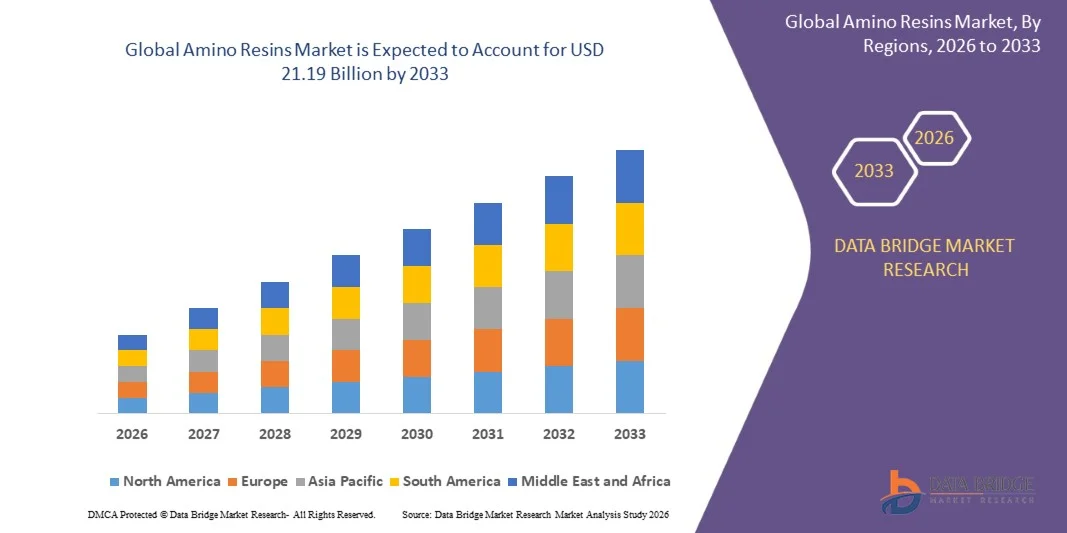
As per Data Bridge Market Research Analysis the Amino Resins Market was valued at USD 12.85 billion in 2025 and is projected to reach USD 21.19 billion by 2033, growing at a CAGR of 6.46% from 2026 to 2033. The market is witnessing steady expansion driven by rising demand for durable, cost-effective, and high-performance thermosetting resins across industries such as construction, automotive, textiles, and wood-based panel manufacturing. Increasing preference for eco-friendly adhesive systems and low-emission resin formulations is further supporting market growth as industries shift toward sustainable material solutions.
The growing use of amino resins, including urea-formaldehyde and melamine-formaldehyde resins, in engineered wood products such as plywood, particleboard, and medium-density fiberboard is significantly boosting demand. In addition, expanding construction activities and furniture manufacturing, particularly in emerging economies, are accelerating consumption. Technological advancements aimed at improving water resistance, thermal stability, and formaldehyde emission reduction are further enhancing product adoption across industrial applications.
Market Size & Forecast
- Global Market Value (2025): USD 12.85 Billion
- Expected Market Value (2033): USD 21.19 Billion
- Forecast CAGR (2026–2033): 6.46%
- Leading Region in 2025: North America
- Fastest Growing Region: Asia-Pacific
What are the Major Takeaways of Amino Resins Market?
- North America dominated the amino resins market with the largest revenue share of 38.6% in 2025, supported by strong demand from the construction, furniture, and automotive interior sectors, along with well-established manufacturing infrastructure and high consumption of engineered wood products.
- Asia-Pacific is expected to be the fastest-growing region, recording a CAGR of 7.2% from 2026 to 2033. Growth is driven by rapid urbanization, expanding furniture production, rising construction activities, and increasing adoption of engineered wood materials in countries such as China, India, and Vietnam.
- The Butylated Urea Resins segment held the largest market revenue share of approximately 34.6% in 2025 driven by its extensive use in plywood, particleboard, and MDF production due to strong adhesion properties, low cost, and fast curing performance in industrial applications.
- The Waterborne Melamine Resins segment is projected to register the fastest growth at a CAGR of 7.9% from 2026 to 2033, driven by increasing regulatory pressure on low-VOC and low-formaldehyde emission systems across Europe, North America, and Asia-Pacific. Rising adoption in environmentally compliant coatings, laminates, and automotive interior applications is further accelerating segment expansion.
- The Particle Board segment held the largest market revenue share of approximately 28.1% in 2025 driven by strong demand from furniture manufacturing and residential construction activities, particularly in emerging economies with high housing development rates.
- The Laminates segment is projected to register the fastest growth at a CAGR of 8.4% from 2026 to 2033, driven by increasing demand for decorative, durable, and cost-efficient surface materials in modern interior design, modular furniture, and commercial infrastructure projects. Rising adoption in premium residential and office spaces is further supporting segment growth.
- The Cabinet and Furniture Making segment held the largest market revenue share of approximately 31.7% in 2025 driven by large-scale consumption of engineered wood panels and laminates in residential and commercial furniture production.
- The Automotive segment is projected to register the fastest growth at a CAGR of 9.2% from 2026 to 2033, driven by increasing use of amino resin-based composites in interior panels, decorative trims, and lightweight structural components aimed at improving durability and reducing manufacturing costs. Rising EV production and interior customization demand are further accelerating segment expansion.
Report Scope and Amino Resins Market Segmentation
|
Attributes |
Amino Resins Key Market Insights |
|
Segments Covered |
· By Type: Butylated Urea Resins, Butylated Melamine Resins, Methylated Melamine Resins, Waterborne Melamine Resins, Butylated Benzoguanamine Resins, and Others · By Application: Particle Board, Plywood, Medium Density Fiberboard (MDF), Roofing Mats, Molding Compound, Adhesives and Coatings, and Laminates · By End User: Architectural, Marine, Heavy-Duty Industries, Automotive, Electric Appliances, Machinery, Metal, Wood and Floor, Construction Material, Cabinet and Furniture Making, Kitchen Utilities, Agriculture, Foam Insulation, and Others |
|
Countries Covered |
North America
Europe
Asia-Pacific
Middle East and Africa
South America
|
|
Key Market Players |
|
|
Market Opportunities |
|
|
Value Added Data Infosets |
|
What is the Key Trend in the Amino Resins Market?
Trend: Growth In Sustainable Resin Systems And Low Formaldehyde Emission Technologies
Increasing demand for eco-friendly, high-performance, and cost-efficient thermosetting resins across wood-based panels, construction materials, automotive interiors, and textile finishing applications. Traditional resin systems based on formaldehyde chemistry are facing regulatory pressure due to emission limits, encouraging manufacturers to adopt low-emission and modified amino resin formulations with improved environmental compliance.
In modern plywood and engineered wood production, manufacturers are increasingly shifting toward low free-formaldehyde urea-formaldehyde and melamine-formaldehyde resins, For instance in MDF and particleboard manufacturing, to meet stringent emission standards such as E1 and E0 grades in Europe and comparable norms in Asia-Pacific markets, improving indoor air quality and regulatory compliance. In the automotive sector, amino resins are being used in decorative laminates and molded interior components, providing high heat resistance and surface durability while reducing overall material costs compared to alternative thermosets.
The rapid expansion of residential and commercial construction activities is also increasing demand for durable adhesives and coatings capable of enhancing structural stability and surface finish quality in furniture and interior applications. In addition, advancements in resin modification technologies, such as methylolation control and bio-based additives, are improving bonding strength and reducing curing time, supporting higher production efficiency. Growing industry adoption in 2025 across Southeast Asia and India has shown improved board strength performance of approximately 10–18% with optimized melamine-urea-formaldehyde blend systems under industrial testing conditions.
Amino Resins Market Dynamics
Key Market Driver: Rising Demand From Wood Panel And Construction Industries
Industries worldwide are experiencing strong demand for engineered wood products driven by urbanization, housing development, and furniture manufacturing growth. Amino resins are widely used as adhesives in plywood, particleboard, and fiberboard due to their strong bonding strength, cost efficiency, and fast curing properties under industrial conditions.
Construction and real estate sectors are increasingly adopting engineered wood solutions as a substitute for traditional solid wood, supporting sustainable material usage and reducing raw material pressure on forests. Manufacturers are also using amino resins in laminates and surface coatings to enhance durability, moisture resistance, and aesthetic finish quality in interior applications. For instance in modular furniture production and prefabricated housing systems, to improve production efficiency and reduce manufacturing costs.
Rapid infrastructure expansion in emerging economies such as India, Vietnam, and Indonesia is further accelerating demand for wood-based panels. Industrial reports from 2024 indicate that engineered wood production in Asia-Pacific grew by approximately 6–9% year-on-year, directly supporting increased consumption of amino resin-based adhesives in continuous manufacturing operations.
Key Restraint/Challenge: Formaldehyde Emission Regulations And Raw Material Price Volatility
Amino resins are primarily based on formaldehyde chemistry, which is increasingly restricted due to health and environmental concerns associated with indoor air quality and long-term exposure risks. Strict regulatory frameworks in regions such as the European Union and North America are limiting allowable emission levels, increasing compliance pressure on manufacturers and raising production costs for modified low-emission formulations.
In addition, fluctuations in raw material prices such as urea, methanol, and formaldehyde significantly impact production economics, creating margin pressure for manufacturers operating in highly competitive markets. Small and medium-scale producers face challenges in upgrading technology to meet emission standards while maintaining cost competitiveness in price-sensitive regions.
Industry evaluations indicate that transitioning to ultra-low emission amino resin systems can increase production costs by approximately 8–12% compared to conventional grades, while requiring additional process modifications and quality control measures to meet E0 and CARB Phase 2 compliance standards.
Key Market Opportunity: Expansion In Green Building And High-Performance Wood Composites
The increasing global focus on sustainable construction and green building certification systems is creating strong opportunities for advanced amino resin formulations with low emissions and improved performance characteristics. Rising demand for eco-certified furniture, modular housing, and energy-efficient building materials is driving adoption across residential and commercial sectors.
Manufacturers are increasingly integrating modified amino resins in cross-laminated timber, decorative laminates, and high-density fiberboards to enhance structural integrity and surface performance while maintaining environmental compliance. For instance in LEED-certified building projects and green housing developments, to meet sustainability benchmarks and indoor air quality requirements.
In addition, ongoing innovation in hybrid resin systems combining amino resins with bio-based polymers is opening new opportunities in automotive interiors, packaging materials, and industrial coatings. Pilot-scale adoption in 2025 across European furniture manufacturers has demonstrated improved moisture resistance of approximately 12–20% and reduced curing time by nearly 15% in optimized melamine-formaldehyde hybrid systems under controlled production environments.
How is the Amino Resins Market Segmented?
The market is segmented on the basis of type, application, and end-user.
- By Type
On the basis of type, the amino resins market is segmented into Butylated Urea Resins, Butylated Melamine Resins, Methylated Melamine Resins, Waterborne Melamine Resins, Butylated Benzoguanamine Resins, and Others. The Butylated Urea Resins segment held the largest market revenue share of approximately 34.6% in 2025 driven by its extensive use in plywood, particleboard, and MDF production due to strong adhesion properties, low cost, and fast curing performance in industrial applications.
The Waterborne Melamine Resins segment is projected to register the fastest growth at a CAGR of 7.9% from 2026 to 2033, driven by increasing regulatory pressure on low-VOC and low-formaldehyde emission systems across Europe, North America, and Asia-Pacific. Rising adoption in environmentally compliant coatings, laminates, and automotive interior applications is further accelerating segment expansion.
- By Application
On the basis of application, the amino resins market is segmented into Particle Board, Plywood, Medium Density Fiberboard (MDF), Roofing Mats, Molding Compound, Adhesives and Coatings, and Laminates. The Particle Board segment held the largest market revenue share of approximately 28.1% in 2025 driven by strong demand from furniture manufacturing and residential construction activities, particularly in emerging economies with high housing development rates.
The Laminates segment is projected to register the fastest growth at a CAGR of 8.4% from 2026 to 2033, driven by increasing demand for decorative, durable, and cost-efficient surface materials in modern interior design, modular furniture, and commercial infrastructure projects. Rising adoption in premium residential and office spaces is further supporting segment growth.
- By End User
On the basis of end user, the amino resins market is segmented into Architectural, Marine, Heavy-Duty Industries, Automotive, Electric Appliances, Machinery, Metal, Wood and Floor, Construction Material, Cabinet and Furniture Making, Kitchen Utilities, Agriculture, Foam Insulation, and Others. The Cabinet and Furniture Making segment held the largest market revenue share of approximately 31.7% in 2025 driven by large-scale consumption of engineered wood panels and laminates in residential and commercial furniture production.
The Automotive segment is projected to register the fastest growth at a CAGR of 9.2% from 2026 to 2033, driven by increasing use of amino resin-based composites in interior panels, decorative trims, and lightweight structural components aimed at improving durability and reducing manufacturing costs. Rising EV production and interior customization demand are further accelerating segment expansion.
Which Region Holds the Largest Share of the Amino Resins Market?
North America Amino Resins Market Insight
North America dominated the amino resins market with the largest revenue share of 38.6% in 2025, supported by strong demand from the construction, furniture, and engineered wood industries, along with well-established manufacturing infrastructure. The region benefits from high consumption of plywood, particleboard, and MDF in residential and commercial construction activities, as well as increasing adoption of durable adhesive systems in automotive interior applications. Strict environmental regulations and growing demand for low-emission resin formulations are further encouraging the use of advanced amino resin technologies across industrial applications.
U.S. Amino Resins Market Insight
The U.S. amino resins market captured the largest revenue share in North America in 2025, driven by high demand from the housing sector, renovation activities, and large-scale furniture manufacturing industries. Increasing preference for engineered wood products in sustainable construction and interior design is significantly boosting resin consumption. In addition, strong demand from automotive OEMs for lightweight interior components and durable laminates is further supporting market expansion, along with widespread adoption of low-formaldehyde and CARB-compliant resin systems.
Europe Amino Resins Market Insight
The Europe amino resins market is expected to witness the fastest growth rate from 2026 to 2033, primarily driven by stringent environmental regulations on formaldehyde emissions and strong emphasis on sustainable building materials. Rising adoption of eco-certified wood-based panels and green construction practices is accelerating demand across residential and commercial sectors. Increasing use of waterborne and low-emission melamine resin systems in laminates, coatings, and furniture applications is further supporting regional growth.
U.K. Amino Resins Market Insight
The U.K. amino resins market is expected to witness steady growth from 2026 to 2033, driven by rising demand for modular furniture, home renovation activities, and sustainable interior materials. Increasing awareness regarding indoor air quality and formaldehyde emission standards is encouraging manufacturers to adopt low-VOC resin systems. In addition, growth in commercial infrastructure and office refurbishment projects is contributing to higher consumption of laminates and engineered wood products.
Germany Amino Resins Market Insight
The Germany amino resins market is expected to witness strong growth from 2026 to 2033, supported by the country’s advanced manufacturing base, strict environmental compliance standards, and high adoption of engineered wood products. Demand for high-performance adhesives in automotive interiors, furniture production, and construction materials is steadily increasing. Germany’s focus on sustainable and energy-efficient building practices is further accelerating the shift toward low-emission and waterborne amino resin formulations.
Asia-Pacific Amino Resins Market Insight
The Asia-Pacific amino resins market is expected to witness the fastest growth rate from 2026 to 2033, supported by rapid urbanization, expanding construction activities, and rising furniture production in countries such as China, India, and Vietnam. Increasing demand for affordable housing and modular furniture is driving strong consumption of plywood, MDF, and particleboard. In addition, the region’s growing manufacturing base and cost-effective production capabilities are enhancing availability and adoption of amino resin-based products across industrial applications.
Japan Amino Resins Market Insight
The Japan amino resins market is expected to witness steady growth from 2026 to 2033 due to high demand for precision-engineered wood products, advanced interior materials, and durable coatings. The market is driven by strong emphasis on high-quality construction standards and compact urban housing solutions. Increasing integration of amino resins in automotive interiors and electronics-related applications is further supporting demand, along with growing adoption of low-emission resin technologies aligned with environmental regulations.
China Amino Resins Market Insight
The China amino resins market accounted for the largest market revenue share in Asia-Pacific in 2025, attributed to massive construction activity, strong furniture manufacturing output, and rapid urbanization. China remains a global hub for engineered wood production, with extensive use of amino resins in plywood, MDF, and particleboard manufacturing. Expanding real estate development, rising middle-class consumption, and strong domestic chemical manufacturing capabilities are key factors driving continued market growth across the country.
Which are the Top Companies in Amino Resins Market?
The Amino Resins industry is primarily led by well-established companies, including:
• BASF SE (Germany)
• Cardolite Corporation (U.S.)
• Kukdo Chemical Co., Ltd. (South Korea)
• Evonik Industries AG (Germany)
• Aditya Birla Group Chemicals (India)
• Mitsubishi Chemical Corporation (Japan)
• Arkema (France)
• Hexion (U.S.)
• Huntsman International LLC (U.S.)
• DuPont (U.S.)
• DAIKIN (Japan)
• Bostik (France)
• H.B. Fuller Company (U.S.)
• Sika AG (Switzerland)
• Freudenberg SE (Germany)
• DOW (U.S.)
• Solvay (Belgium)
• Momentive (U.S.)
• Georgia-Pacific (U.S.)
• Sealants International Ltd (U.K.)
What are Latest Developments in Amino Resins Market?
- In October 2025, Perdaman Industries awarded an AUD 90 million UF-80 supply contract to Hexion Australia for Project Ceres, enabling localized production support for a 2.3 million tpy urea complex, strengthening regional resin supply chains and improving feedstock security for amino resin-based applications
- In May 2024, BASF completed the divestiture of its Ludwigshafen melamine unit with a capacity of 51,000 tpy, leading to a structural shift in its melamine-formaldehyde resin value chain and impacting regional feedstock availability in Europe while encouraging market redistribution among other suppliers
- In April 2023, BASF SE and SWISS KRONO Group expanded their long-term collaboration to develop biomass-balanced amino resins, aiming to reduce product carbon footprint while maintaining performance standards, thereby accelerating demand for sustainable and low-emission resin solutions in the European wood panel industry

- Interactive Data Analysis Dashboard
- Company Analysis Dashboard for high growth potential opportunities
- Research Analyst Access for customization & queries
- Competitor Analysis with Interactive dashboard
- Latest News, Updates & Trend analysis
- Harness the Power of Benchmark Analysis for Comprehensive Competitor Tracking
Global Amino Resin Market, Supply Chain Analysis and Ecosystem Framework
To support market growth and help clients navigate the impact of geopolitical shifts, DBMR has integrated in-depth supply chain analysis into its Global Amino Resin Market research reports. This addition empowers clients to respond effectively to global changes affecting their industries. The supply chain analysis section includes detailed insights such as Global Amino Resin Market consumption and production by country, price trend analysis, the impact of tariffs and geopolitical developments, and import and export trends by country and HSN code. It also highlights major suppliers with data on production capacity and company profiles, as well as key importers and exporters. In addition to research, DBMR offers specialized supply chain consulting services backed by over a decade of experience, providing solutions like supplier discovery, supplier risk assessment, price trend analysis, impact evaluation of inflation and trade route changes, and comprehensive market trend analysis.
Data collection and base year analysis are done using data collection modules with large sample sizes. The stage includes obtaining market information or related data through various sources and strategies. It includes examining and planning all the data acquired from the past in advance. It likewise envelops the examination of information inconsistencies seen across different information sources. The market data is analysed and estimated using market statistical and coherent models. Also, market share analysis and key trend analysis are the major success factors in the market report. To know more, please request an analyst call or drop down your inquiry.
The key research methodology used by DBMR research team is data triangulation which involves data mining, analysis of the impact of data variables on the market and primary (industry expert) validation. Data models include Vendor Positioning Grid, Market Time Line Analysis, Market Overview and Guide, Company Positioning Grid, Patent Analysis, Pricing Analysis, Company Market Share Analysis, Standards of Measurement, Global versus Regional and Vendor Share Analysis. To know more about the research methodology, drop in an inquiry to speak to our industry experts.
Data Bridge Market Research is a leader in advanced formative research. We take pride in servicing our existing and new customers with data and analysis that match and suits their goal. The report can be customized to include price trend analysis of target brands understanding the market for additional countries (ask for the list of countries), clinical trial results data, literature review, refurbished market and product base analysis. Market analysis of target competitors can be analyzed from technology-based analysis to market portfolio strategies. We can add as many competitors that you require data about in the format and data style you are looking for. Our team of analysts can also provide you data in crude raw excel files pivot tables (Fact book) or can assist you in creating presentations from the data sets available in the report.













