


What is the Antihistamine Eye Drops Market Size and Growth Rate?
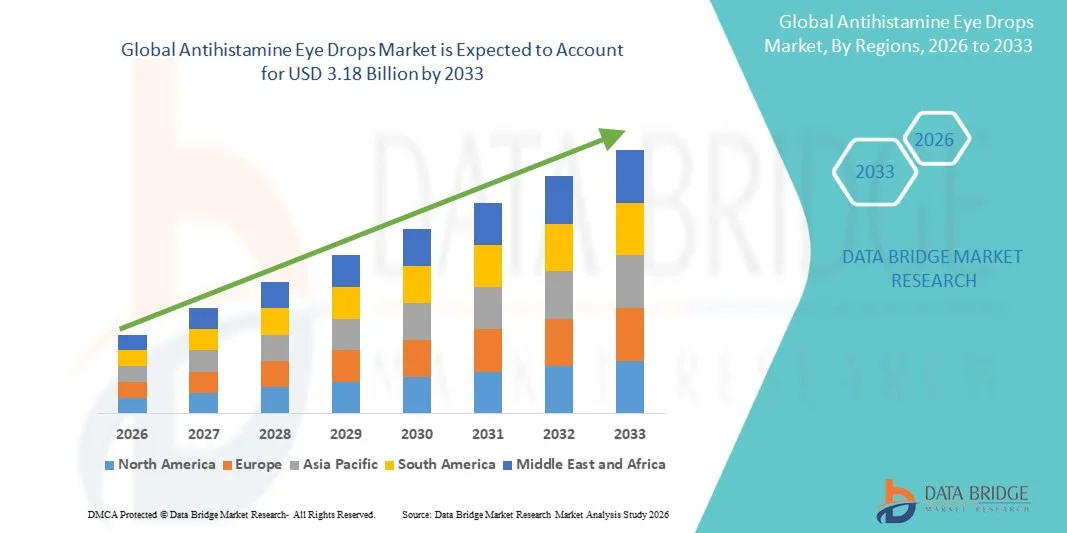
- As per Data Bridge Market Research analysis, the antihistamine eye drops market was valued at USD 1.94 billion in 2025 and is projected to reach USD 3.18 billion by 2033, growing at a CAGR of 6.40% from 2026 to 2033.
- The market is experiencing consistent growth driven by the rising prevalence of allergic conjunctivitis, increasing availability of over-the-counter options, and expanding applications across seasonal, perennial, and chronic ocular allergy management through retail, hospital, and online pharmacies.
- The increasing shift toward prescription-to-OTC switches, preservative-free formulations, and once-daily dosing, combined with growing patient awareness of ocular allergy symptoms and rising environmental allergen exposure, is supporting market adoption. Antihistamine eye drops are being applied across allergic conjunctivitis treatment, seasonal allergy relief, contact lens wearer comfort, and ophthalmic drugs self-care, offering patients fast and lasting relief from itchy, red, and watery eyes through convenient eye drops.
Market Size & Forecast
- Global Market Value (2025): USD 1.94 Billion
- Expected Market Value (2033): USD 3.18 Billion
- Forecast CAGR (2026–2033): 6.40%
- Leading Region in 2025: North America
- Fastest Growing Region: Asia-Pacific
What are the Major Takeaways of the Antihistamine Eye Drops Market?
- North America dominated the antihistamine eye drops market with the largest revenue share of 39.72% in 2025, supported by high prevalence of ocular allergies, wide availability of over-the-counter products, and strong presence of leading eye care companies.
- Asia-Pacific is expected to be the fastest-growing region at a CAGR of 8.13% from 2026 to 2033, fueled by rising allergy prevalence, growing urban air pollution, expanding access to ophthalmic care, and increasing local generic manufacturing.
- The olopatadine segment led the market with a 46.8% share in 2025, driven by its established efficacy, dual antihistamine and mast cell stabilizing action, and wide availability across prescription and over-the-counter products.
- Alcaftadine is the fastest-growing drug type, projected to register a CAGR of 8.60%, reflecting demand for once-daily dosing and broader histamine receptor activity.
- The prescription segment dominated the type category with a 58.24% revenue share in 2025, led by branded and specialty formulations recommended by eye care professionals for moderate to severe ocular allergy.
- Seasonal allergic conjunctivitis accounted for 52.36% of the market share in 2025, supported by high pollen exposure and recurring annual demand for symptom relief.
- The perennial allergic conjunctivitis segment is the fastest-growing indication category, with a CAGR of 7.60%, driven by increasing exposure to indoor allergens such as dust mites and pet dander.
Report Scope and Antihistamine Eye Drops Market Segmentation
|
Attributes |
Antihistamine Eye Drops Key Market Insights |
|
Segments Covered |
|
|
Countries Covered |
North America
Europe
Asia-Pacific
Middle East and Africa
South America
|
|
Key Market Players |
|
|
Market Opportunities |
|
|
Value Added Data Infosets |
In addition to the insights on market scenarios such as market value, growth rate, segmentation, geographical coverage, and major players, the market reports curated by the Data Bridge Market Research also include in-depth expert analysis, patient epidemiology, pipeline analysis, pricing analysis, and regulatory framework. |
What is the Key Trend in the Antihistamine Eye Drops Market?
- Antihistamine eye drops are increasingly evolving from prescription-only therapies into widely accessible, self-selected consumer health products, supported by prescription-to-OTC switches, higher-strength once-daily formulations, and store-brand equivalents.
- For instance, in February 2020, according to Alcon, the U.S. Food and Drug Administration approved Pataday Once Daily Relief (olopatadine 0.2%) and Pataday Twice Daily Relief (olopatadine 0.1%) for over-the-counter sale, with approximately 66 million Americans suffering from ocular allergies but only 7 million using an OTC allergy eye drop, highlighting the scale of the OTC opportunity.
- Preservative-free formulations are gaining importance as patients and eye care professionals seek options with a lower risk of irritation, particularly for frequent users and contact lens wearers.
- Dual-acting molecules that combine antihistamine and mast cell stabilizing activity are becoming the standard of care, while new delivery approaches such as drug-eluting contact lenses are being explored to combine vision correction with allergy relief.
- As OTC access, preservative-free formulations, once-daily dosing, and novel delivery formats continue to advance, antihistamine eye drops are expected to expand beyond prescription treatment into mainstream self-care for seasonal, perennial, and contact lens-related ocular allergy.
What are the Key Drivers of the Antihistamine Eye Drops Market?
- The rising prevalence of allergic conjunctivitis, driven by pollen, dust, pet dander, air pollution, and changing allergen seasons, is significantly increasing demand for fast-acting, easy-to-use antihistamine eye drops.
- For instance, in July 2020, according to Alcon, allergies were the sixth-leading cause of chronic illness in the U.S., generating approximately USD 2.7 billion in over-the-counter retail sales, as the company announced FDA approval of Pataday Once Daily Relief Extra Strength (olopatadine 0.7%) for OTC sale, highlighting the scale of consumer demand for allergy relief.
- Greater availability of over-the-counter and generic products, wider retail and online access, and growing patient awareness of ocular allergy symptoms are enabling more patients to self-treat without a prescription.
- With ocular allergies becoming more common and treatment options becoming more accessible, antihistamine eye drops can support faster symptom relief, improved patient compliance, and wider adoption across both prescription and self-care settings.
What Factors Are Challenging the Growth of the Antihistamine Eye Drops Market?
- Antihistamine eye drops can cause side effects such as stinging, burning, blurred vision, headache, and dryness, and preserved formulations can irritate the ocular surface, which may limit long-term use among sensitive patients and contact lens wearers.
- For instance, in February 2026, according to Ocular Therapeutix (Form 10-K), the use of oral antihistamine medications as well as antihistamine eye drops for allergic conjunctivitis may dry out the eye and exacerbate discomfort for some patients, highlighting tolerability challenges that can limit adoption.
- Many patients with ocular allergies remain undiagnosed or manage symptoms with oral medications or lubricants, while moderate to severe cases may require corticosteroids, immunomodulators, or other therapies that antihistamine eye drops cannot fully replace.
- The market is highly competitive, with numerous branded, generic, and store-brand products competing on price, particularly after patent expiries and OTC switches, which can lead to price erosion and lower profit margins for manufacturers.
- The combination of tolerability concerns, underdiagnosis, competition from alternative therapies, and price erosion from generics can constrain adoption and profitability, particularly in mature markets where low-cost OTC and generic options are widely available.
How is the Antihistamine Eye Drops Market Segmented?
The antihistamine eye drops market is segmented on the basis of drug, type, indication, and distribution channel.
- By Drug
On the basis of drug, the antihistamine eye drops market is segmented into olopatadine, ketotifen, alcaftadine, azelastine, epinastine, and others. The olopatadine segment dominated the market with 46.8% share in 2025, supported by its established efficacy, dual antihistamine and mast cell stabilizing action, and availability in multiple strengths. Olopatadine is available in both prescription and over-the-counter products, which extends its reach across patient groups. Once-daily and twice-daily options allow patients and physicians to match dosing to symptom severity. A broad range of branded and generic products improves affordability and access. Strong brand awareness among eye care professionals and consumers further supports demand.
The alcaftadine segment is projected to register the fastest growth at a CAGR of 8.60% from 2026 to 2033, driven by demand for once-daily dosing and broader activity across histamine receptors. Alcaftadine is used for the prevention of itching associated with allergic conjunctivitis and is now available over the counter in the U.S. Its once-daily use supports patient compliance. Growing generic availability is improving affordability. Increasing physician familiarity and consumer awareness are further supporting adoption.
- By Type
On the basis of type, the antihistamine eye drops market is segmented into prescription and OTC. The prescription segment dominated the market with 58.24% share in 2025, supported by branded and specialty formulations recommended by eye care professionals for moderate to severe ocular allergy. Prescription products include higher-strength and newer molecules that may not yet be available over the counter. Reimbursement and physician recommendation support their use in patients with persistent symptoms. Ophthalmologists and optometrists continue to guide treatment for complex cases and for patients with other eye conditions.
The OTC segment is projected to register the fastest growth at a CAGR of 8.9% from 2026 to 2033, driven by prescription-to-OTC switches, wider retail availability, and growing self-medication for seasonal allergies. Once-daily and extra-strength formulations are making over-the-counter products more competitive with prescription options. Store-brand and generic versions are improving affordability. Consumer marketing during allergy season is raising awareness. Online availability further supports easy access.
- By Indication
On the basis of indication, the antihistamine eye drops market is segmented into seasonal allergic conjunctivitis, perennial allergic conjunctivitis, vernal and atopic keratoconjunctivitis, and others. The seasonal allergic conjunctivitis segment dominated the indication category with 52.36% share in 2025, supported by high pollen exposure and recurring annual demand for symptom relief. Symptoms such as itching, redness, and watering typically respond quickly to antihistamine drops, encouraging repeat purchases each season. Spring and autumn allergy peaks drive predictable demand. Awareness campaigns by manufacturers and pharmacies during allergy season further support the segment.
The perennial allergic conjunctivitis segment is projected to register the fastest growth at a CAGR of 7.60% from 2026 to 2033, driven by increasing exposure to indoor allergens such as dust mites, pet dander, and mold. Patients with year-round symptoms require longer treatment and more frequent refills. Preservative-free and well-tolerated formulations are increasingly preferred for continued use. Urbanization and time spent indoors are raising exposure. Growing diagnosis by eye care professionals is also supporting the segment.
- By Distribution Channel
On the basis of distribution channel, the antihistamine eye drops market is segmented into hospital pharmacies, retail pharmacies, and online pharmacies. The retail pharmacies segment dominated the distribution channel category with 47.34% share in 2025, supported by easy access, pharmacist advice, and the wide availability of OTC and prescription antihistamine eye drops. Chain and independent pharmacies stock a broad range of branded and store-brand products. Pharmacists guide product selection and usage, and patients can fill prescriptions and buy OTC products in one visit. Promotions during allergy season also support sales.
The online pharmacies segment is projected to register the fastest growth at a CAGR of 9.40% from 2026 to 2033, driven by growing e-commerce penetration, home delivery, and subscription and repeat-purchase options. Online platforms allow patients to compare brands, strengths, and prices. Telehealth services are enabling prescriptions to be issued and filled remotely. Discounts and convenience are attracting younger consumers.
Which Region Holds the Largest Share of the Antihistamine Eye Drops Market?
- North America dominated the antihistamine eye drops market with the largest revenue share of 39.72% in 2025, supported by high prevalence of ocular allergies, wide availability of over-the-counter products, and strong presence of leading eye care companies.
- The region also benefits from high consumer awareness, established prescription-to-OTC switch pathways, strong retail and online pharmacy networks, and the presence of leading branded and generic manufacturers. Increasing use of antihistamine eye drops for seasonal and perennial allergies and continued product launches continue to strengthen North America’s position in the global market.
U.S. Antihistamine Eye Drops Market Insight
The U.S. antihistamine eye drops market is witnessing strong growth due to high prevalence of ocular allergies, wide availability of over-the-counter olopatadine, ketotifen, and alcaftadine products, and an active generic industry. The country’s well-developed retail pharmacy network, along with increasing online sales and consumer awareness campaigns during allergy season, is driving demand for a range of antihistamine eye drops. In addition, growing preference for once-daily and preservative-free formulations is accelerating adoption across prescription and self-care settings.
Asia-Pacific Antihistamine Eye Drops Market Insight
The Asia-Pacific antihistamine eye drops market is expected to witness rapid growth, driven by rising allergy prevalence, increasing urban air pollution, and expanding access to ophthalmic care across countries such as China, India, and Japan. Growing consumer spending on eye health, expanding pharmacy networks, and rising availability of affordable generic products are supporting regional market expansion. In addition, the region’s strong generic pharmaceutical manufacturing base and growing e-pharmacy adoption are accelerating demand for antihistamine eye drops.
Japan Antihistamine Eye Drops Market Insight
The Japan antihistamine eye drops market is witnessing consistent growth due to high prevalence of seasonal pollen allergies, an aging population, and strong consumer demand for eye care products. Patients, ophthalmologists, and pharmacies are increasingly using antihistamine eye drops for allergy relief, supported by the presence of domestic eye care and pharmaceutical companies. Moreover, strong demand for quality, safety, and convenient self-care products is further contributing to market growth in Japan.
China Antihistamine Eye Drops Market Insight
The China antihistamine eye drops market is growing rapidly, driven by rising allergy prevalence, increasing urban air pollution, and expanding access to ophthalmic care in hospitals and retail pharmacies. Growing consumer awareness of eye health is significantly boosting market demand. In addition, strong domestic pharmaceutical manufacturing, growth of online pharmacies, and increasing availability of generic products are positioning China as a key growth market for antihistamine eye drops across Asia-Pacific.
U.K. Antihistamine Eye Drops Market Insight
The U.K. antihistamine eye drops market is experiencing steady growth, supported by increasing prevalence of seasonal allergies, availability of pharmacy-sold antihistamine products, and growing consumer self-care. Pharmacists, optometrists, and general practitioners are increasingly recommending antihistamine eye drops for allergic eye symptoms. Furthermore, growing awareness of hay fever and expanding online pharmacy services are supporting wider adoption of antihistamine eye drops in the U.K.
Germany Antihistamine Eye Drops Market Insight
The Germany antihistamine eye drops market is expanding steadily due to the country’s well-established pharmacy system, high awareness of allergies, and strong presence of pharmaceutical and eye care companies. Ophthalmologists, pharmacists, and patients are increasingly utilizing antihistamine eye drops for seasonal and perennial allergy relief. Continuous advancements in preservative-free formulations, along with Germany’s focus on product quality and patient safety, are further driving market growth in the country.
Which are the Top Companies in Antihistamine Eye Drops Market?
The antihistamine eye drops industry is primarily led by well-established companies, including:
- Alcon Inc. (Switzerland)
- Novartis AG (Switzerland)
- AbbVie Inc. (U.S.)
- Santen Pharmaceutical Co., Ltd. (Japan)
- Sun Pharmaceutical Industries Ltd. (India)
- Bausch + Lomb Corporation (Canada)
- Johnson & Johnson Vision Care, Inc. (U.S.)
- Rohto Pharmaceutical Co., Ltd. (Japan)
- Laboratoires Théa (France)
- Dr. Reddy’s Laboratories Ltd. (India)
- Glenmark Pharmaceuticals Ltd. (India)
- Gland Pharma Limited (India)
- Aurobindo Pharma Limited (India)
- Alembic Pharmaceuticals Limited (India)
- Cipla Ltd. (India)
- Lupin Limited (India)
- Zydus Lifesciences Limited (India)
- Teva Pharmaceutical Industries Ltd. (Israel)
- Sandoz Group AG (Switzerland)
- Perrigo Company plc (Ireland)
What are Latest Developments in Antihistamine Eye Drops Market?
- In January 2026, Dr. Reddy’s Laboratories announced the first-to-market U.S. launch of olopatadine hydrochloride ophthalmic solution USP, 0.7% (OTC), the generic equivalent of Extra Strength Pataday Once Daily Relief, available in a 2.5 mL bottle and adding to its OTC eye care portfolio that includes the 0.2% and 0.1% strengths.
- In January 2026, Gland Pharma Limited received U.S. FDA approval for olopatadine hydrochloride ophthalmic solution USP, 0.7%, a generic equivalent to Alcon’s Pataday Once Daily Extra Strength eye drops, adding to olopatadine generic approvals in both the 0.2% and 0.7% strengths and widening lower-cost store-brand options for consumers.
- In March 2025, Glenmark Pharmaceuticals Inc., USA received final U.S. FDA approval for olopatadine hydrochloride ophthalmic solution USP, 0.2% (OTC), determined by the FDA to be bioequivalent to Pataday Once Daily Relief, widening the availability of lower-cost equivalents of the leading OTC olopatadine product that Alcon switched to OTC status in February 2020.
- In February 2021, Bausch + Lomb launched Alaway Preservative Free (ketotifen fumarate ophthalmic solution 0.035%) antihistamine eye drops in the U.S., the first and only over-the-counter preservative-free antihistamine eye itch relief drop approved by the FDA, rolling out to major U.S. retailers with relief lasting up to 12 hours per dose and a lower risk of irritation associated with preservatives.
- In January 2020, Eyevance Pharmaceuticals announced the U.S. launch of ZERVIATE (cetirizine ophthalmic solution) 0.24%, the first novel prescription-only treatment for allergic conjunctivitis in 10 years in the U.S., adding a new prescription option to a category dominated by long-established molecules and by drops later switched to OTC status.

- Interactive Data Analysis Dashboard
- Company Analysis Dashboard for high growth potential opportunities
- Research Analyst Access for customization & queries
- Competitor Analysis with Interactive dashboard
- Latest News, Updates & Trend analysis
- Harness the Power of Benchmark Analysis for Comprehensive Competitor Tracking
Data collection and base year analysis are done using data collection modules with large sample sizes. The stage includes obtaining market information or related data through various sources and strategies. It includes examining and planning all the data acquired from the past in advance. It likewise envelops the examination of information inconsistencies seen across different information sources. The market data is analysed and estimated using market statistical and coherent models. Also, market share analysis and key trend analysis are the major success factors in the market report. To know more, please request an analyst call or drop down your inquiry.
The key research methodology used by DBMR research team is data triangulation which involves data mining, analysis of the impact of data variables on the market and primary (industry expert) validation. Data models include Vendor Positioning Grid, Market Time Line Analysis, Market Overview and Guide, Company Positioning Grid, Patent Analysis, Pricing Analysis, Company Market Share Analysis, Standards of Measurement, Global versus Regional and Vendor Share Analysis. To know more about the research methodology, drop in an inquiry to speak to our industry experts.
Data Bridge Market Research is a leader in advanced formative research. We take pride in servicing our existing and new customers with data and analysis that match and suits their goal. The report can be customized to include price trend analysis of target brands understanding the market for additional countries (ask for the list of countries), clinical trial results data, literature review, refurbished market and product base analysis. Market analysis of target competitors can be analyzed from technology-based analysis to market portfolio strategies. We can add as many competitors that you require data about in the format and data style you are looking for. Our team of analysts can also provide you data in crude raw excel files pivot tables (Fact book) or can assist you in creating presentations from the data sets available in the report.












