


What is the Aramid Fiber for Defense Market Size and Growth Rate?
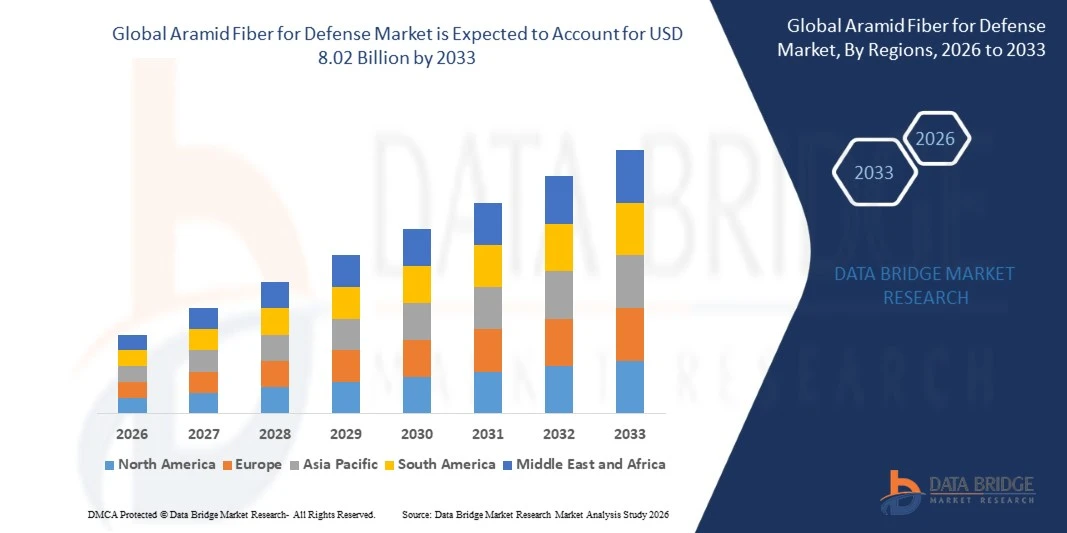
- As per Data Bridge Market Research analysis, the aramid fiber for defense market was valued at USD 4.3 Billion in 2025 and is projected to reach USD 8.02 Billion by 2033, growing at a CAGR of 8.01% from 2026 to 2033.
- The market is expanding due to increasing demand for lightweight and high-strength materials in defense platforms, rising military expenditure, modernization of aircraft and naval systems, and increasing adoption of advanced materials to enhance fuel efficiency, durability, ballistic protection, and operational performance across defense applications.
- Aramid fibers for defense combine high strength-to-weight ratios, impact resistance, thermal stability, chemical resistance, and durability, enabling their use across military aircraft, naval vessels, armored vehicles, missiles, unmanned systems, body armor, helmets, and other protective equipment. Their adoption is increasing as defense manufacturers integrate advanced composites, carbon fiber, glass fiber, aramid fiber, and other high-performance materials into next-generation military platforms to reduce weight, enhance survivability, improve ballistic protection, and support mission performance.
Market Size & Forecast
- Global Market Value (2025): USD 4.3 Billion
- Expected Market Value (2033): USD 8.02 Billion
- Forecast CAGR (2026–2033): 8.01%
- Leading Region in 2025: North America
- Fastest Growing Region: Asia-Pacific
What are the Major Takeaways of the Aramid Fiber for Defense Market?
- North America dominated the global aramid fiber for defense market with the largest revenue share of 36.4% in 2025, supported by strong defense spending, advanced military modernization programs, and increasing demand for lightweight ballistic protection materials across the U.S. Defense sector.
- Asia-pacific is expected to be the fastest-growing region, registering a CAGR of 9.20% from 2026 to 2033, driven by increasing defense budgets, military modernization initiatives, expanding aerospace and defense manufacturing capabilities, and growing adoption of advanced composite materials across China, India, And Japan.
- The para-aramid fiber segment dominated the fiber type category with a market share of 61.5% in 2025 and is assumed to supported by its superior tensile strength, high modulus, lightweight characteristics, and impact resistance, which make it suitable for ballistic protection applications.
- The filament yarn segment dominated the product form category with a market share of 34.8% in 2025, supported by its extensive utilization in ballistic fabrics, composite reinforcement, and high-strength protective materials.
- The ballistic protection grade segment dominated the grade category with a market share of 42.6% in 2025, owing to increasing demand for body armor, ballistic helmets, protective shields, and military armor systems.
- The flame and heat-resistant class segment is expected to register the fastest growth, with a CAGR of 7.70%, supported by increasing demand for thermal protection materials across military uniforms, aerospace systems, and specialized protective equipment.
- The personnel protection segment dominated the application category with a market share of 31.9% in 2025, supported by increasing adoption of body armor, ballistic helmets, protective clothing, and tactical equipment
Report Scope and Aramid Fiber for Defense Market Segmentation
|
Attributes |
Aramid Fiber for Defense Key Market Insights |
|
Segments Covered |
|
|
Countries Covered |
North America
Europe
Asia-Pacific
Middle East and Africa
South America
|
|
Key Market Players |
|
|
Market Opportunities |
|
|
Value Added Data Infosets |
In addition to the market insights such as market value, growth rate, market segments, geographical coverage, market players, and market scenario, the market report curated by the Data Bridge Market Research team includes in-depth expert analysis, import/export analysis, pricing analysis, production consumption analysis, and pestle analysis. |
What is the Key Trend in the Aramid Fiber for Defense Market?
- Increasing demand for lightweight ballistic protection and high-performance protective materials is becoming a major trend in the global aramid fiber for defense market, as defense organizations increasingly seek to reduce soldier and platform weight while maintaining ballistic protection, strength, durability, and mobility. Para-aramid fibers are increasingly incorporated into body armor, helmets, protective panels, vehicle armor, and other defense equipment because of their high strength-to-weight ratio, impact resistance, and ballistic performance.
- Next-generation ballistic protection and multi-threat protection are gaining importance as military forces seek materials capable of addressing ballistic, thermal, mechanical, and environmental threats simultaneously.
- For instance, in September 2025, the U.S. Army awarded USD 65.5 million in delivery orders to Hardwire LLC and Leading Technology Composites, Inc. for the production of 72,179 Lightweight Small Arms Protective Inserts. The LSAPI plates are approximately 30% lighter than the previous-generation ESAPI plates and are designed to reduce the soldier's combat load while maintaining ballistic protection. The program represents a direct example of increasing defense-sector demand for lightweight, high-performance protective materials.
- Overall, the global aramid fiber for defense market is increasingly shaped by lightweight ballistic protection, advanced fiber-reinforced composites, multi-threat protection, soldier mobility, thermal resistance, advanced manufacturing, and supply-chain localization. Defense manufacturers are therefore moving beyond the conventional use of aramid fibers for basic ballistic protection and increasingly developing engineered material systems that combine weight reduction, impact resistance, flexibility, thermal protection, durability, and enhanced survivability across personnel protection.
What are the Key Drivers of the Aramid Fiber for Defense Market?
- Increasing demand for lightweight and high-performance protective materials is becoming a major driver of the global aramid fiber for defense market, as defense forces increasingly require materials that provide high strength, impact resistance, ballistic protection, and durability without adding significant weight. Aramid fibers are increasingly incorporated into body armor, ballistic helmets, protective clothing, armored vehicle components, aircraft structures, and other defense equipment, enabling improved mobility, endurance, and protection
- Growing demand for advanced ballistic and personnel protection systems is further supporting market growth. Aramid fibers, particularly para-aramid grades, provide high tensile strength and energy absorption, making them suitable for soft armor, ballistic helmets, shields, protective panels, and other soldier-protection systems.
- For instance, in March 2025, the U.S. Army awarded DuPont Specialty Products USA LLC a purchase order for 300 yards of Kevlar EXO fabric, with a ceiling value of approximately USD 13,692, for delivery under an Army research and development procurement. The procurement provides a recent example of defense-sector demand for advanced para-aramid materials intended for protective applications.
- Overall, the global aramid fiber for defense market is increasingly shaped by ballistic protection requirements, soldier modernization, lightweighting, military aviation, flame and heat resistance, advanced protective equipment, armored platforms, and the development of next-generation composite materials. Defense organizations are therefore moving beyond conventional textile applications and increasingly adopting engineered aramid systems that provide multiple performance advantages, including high strength-to-weight ratios, impact absorption, thermal resistance, durability, and enhanced personnel and platform protection.
What Factors are Challenging the Growth of the Aramid Fiber for Defense Market?
- High production costs and complex manufacturing processes remain major challenges in the global aramid fiber for defense market, particularly for high-performance para-aramid and specialized aramid grades. Manufacturing requires sophisticated polymerization, spinning, finishing, and conversion processes, while defense applications also require extensive qualification and testing. These factors can increase the cost of ballistic protection systems and restrict adoption in cost-sensitive defense programs.
- Competition from alternative high-performance fibers and composite materials is increasing pressure on aramid fiber adoption. Ultra-high-molecular-weight polyethylene (UHMWPE), carbon fiber composites, ceramic armor systems, and hybrid composite materials are increasingly being evaluated for applications requiring high ballistic efficiency, lightweighting, structural performance, or specialized protection.
- For instance, In April 2026, DuPont completed the divestiture of its Aramids business, including the Kevlar and Nomex brands, to Arclin in a transaction valued at approximately USD 1.8 billion. Arclin stated that the acquired business included manufacturing operations in Europe and Asia and approximately 1,800 employees, while also highlighting plans to invest in manufacturing capabilities and innovation.
- Overall, the global aramid fiber for defense market is challenged by high manufacturing costs, stringent qualification requirements, competition from UHMWPE and advanced composites, supply-chain concentration, increasing multifunctional protection requirements, and the need for continuous material innovation. Defense manufacturers and material suppliers are therefore focusing on next-generation aramid grades, hybrid ballistic systems, lightweight protective structures, localized production, and strategic partnerships to improve performance, supply resilience, and cost efficiency across personnel protection, ground platforms, airborne systems, naval platforms, and defense components.
How is the Aramid Fiber for Defense Market Segmented?
The global aramid fiber for defense market is segmented on the basis of fiber type, product form, grade, performance, application, and end user.
- By Fiber Type
On the basis of fiber type, the global aramid fiber for defense market is segmented into para-aramid fiber, meta-aramid fiber, and other aramid fiber types. The para-aramid fiber segment dominated the market with a share of 61.5% in 2025, driven by its superior tensile strength, high modulus, lightweight characteristics, and excellent impact resistance, making it highly suitable for ballistic protection applications. Para-aramid fibers are extensively used in body armor, ballistic helmets, armored vehicle components, and military protective equipment.
The meta-aramid fiber segment is projected to register the fastest growth at a CAGR of 7.4% from 2026 to 2033, supported by increasing demand for flame-resistant and heat-protection materials in defense applications. Its thermal stability, flame resistance, and electrical insulation properties make it suitable for protective clothing, firefighting equipment, aerospace systems, and specialized military applications.
- By Product Form
On the basis of product form, the global aramid fiber for defense market is segmented into filament yarn, staple fiber, aramid pulp, aramid paper, aramid felt & mat, and other product forms. The filament yarn segment dominated the market with a share of 34.8% in 2025, supported by its extensive utilization in ballistic fabrics, composite reinforcement, and high-strength protective materials. Filament yarn provides high mechanical strength, durability, flexibility, and compatibility with woven ballistic structures used in body armor, helmets, and military protective systems.
The aramid pulp segment is projected to register the fastest growth at a CAGR of 7.5% from 2026 to 2033, driven by increasing adoption in friction materials, composite reinforcement, and specialized defense components. Aramid pulp improves mechanical strength, wear resistance, toughness, and durability in composite systems, supporting its increasing use in advanced military equipment and defense components.
- By Grade
On the basis of grade, the global aramid fiber for defense market is segmented into ballistic protection grade, flame and heat-protection grade, friction, sealing & mechanical reinforcement grade, general-purpose defense grade, and other specialized grades. The ballistic protection grade segment dominated the market with a share of 42.6% in 2025, owing to increasing demand for body armor, ballistic helmets, protective shields, and military armor systems. These grades provide high impact resistance, energy absorption, durability, and lightweight protection for defense personnel and platforms.
The flame and heat-protection grade segment is projected to register the fastest growth at a CAGR of 7.6% from 2026 to 2033, supported by increasing requirements for thermal-resistant materials in combat uniforms, aerospace defense applications, and specialized protective equipment. Growing emphasis on personnel protection under extreme operating conditions is further supporting demand.
- By Performance
On the basis of performance, the global aramid fiber for defense market is segmented into high-tenacity class, high-modulus class, high-elongation & fatigue-resistant class, flame and heat-resistant class, electrical-insulating class, and chemically resistant class. The high-tenacity class segment dominated the market with a share of 39.7% in 2025, supported by its extensive use in ballistic protection systems requiring high tensile strength, impact resistance, durability, and lightweight performance. High-tenacity aramid fibers are widely incorporated into armor systems and protective equipment where strength and reliability are critical.
The flame and heat-resistant class segment is projected to register the fastest growth at a CAGR of 7.7% from 2026 to 2033, driven by increasing demand for thermal protection materials across military uniforms, aerospace systems, protective equipment, and high-temperature defense applications.
- By Application
On the basis of application, the global aramid fiber for defense market is segmented into personnel protection, ground defense platforms, airborne defense platforms, naval defense platforms, military mechanical & structural components, and other defense applications. The personnel protection segment dominated the market with a share of 31.9% in 2025, driven by increasing adoption of body armor, ballistic helmets, protective clothing, tactical equipment, and other soldier protection systems. Aramid fibers provide lightweight protection while maintaining high strength, impact resistance, and durability.
The ground defense platforms segment is projected to register the fastest growth at a CAGR of 7.8% from 2026 to 2033, supported by increasing use of aramid fiber composites in armored vehicles and military ground systems. Lightweight composite armor can help reduce vehicle weight while supporting mobility, fuel efficiency, and survivability. Increasing investments in military vehicle modernization are expected to further support segment growth.
- By End User
On the basis of end user, the global aramid fiber for defense market is segmented into defense material converters, armor & protective equipment manufacturers, defense platform oems, defense component & system manufacturers, government defense production facilities, and other defense-related industrial users. The armor & protective equipment manufacturers segment dominated the market with a share of 36.5% in 2025, supported by extensive utilization of aramid fibers in ballistic vests, helmets, shields, protective clothing, and other defense protection systems. Increasing procurement of advanced soldier protection equipment is further supporting demand from this segment.
The defense platform OEMs segment is projected to register the fastest growth at a CAGR of 7.6% from 2026 to 2033, driven by increasing integration of aramid fiber composites into military vehicles, aircraft structures, naval platforms, and other next-generation defense systems. OEMs are increasingly adopting lightweight advanced materials to reduce platform weight while maintaining structural durability and operational performance.
Which Region Holds the Largest Share of the Aramid Fiber for Defense Market?
- North America accounted for the largest share of the global aramid fiber for defense market, with a 36.4% revenue share in 2025, supported by strong defense spending, advanced military modernization programs, established aerospace and defense manufacturing capabilities, and increasing demand for lightweight ballistic protection materials across the U.S. defense sector.
- The region also benefits from extensive adoption of advanced materials in body armor, ballistic helmets, armored vehicles, military aircraft, tactical equipment, and other defense platforms. Strong research and development capabilities, the presence of established defense manufacturers, and continued investments in soldier protection and weight reduction are further supporting the adoption of high-performance aramid fiber solutions across North America.
U.S. Aramid Fiber for Defense Market Insight
The U.S. aramid fiber for defense market is supported by strong demand for lightweight, high-strength, and ballistic-resistant materials across military protection systems. Para-aramid fibers are widely used in soft armor, helmets, and protective equipment, while ongoing Army modernization is driving research into improved protection and weight reduction. In 2026, the U.S. Army continued advancing soldier protection technologies, including body armor and combat helmets, reinforcing opportunities for high-performance aramid fibers in next-generation defense equipment.
Canada Aramid Fiber for Defense Market Insight
The Canada aramid fiber for defense market is expanding as defense modernization, aerospace development, and demand for lightweight protective materials increase. Canada’s Defence Industrial Strategy prioritizes aerospace, land systems, personnel protection, advanced materials, and resilient domestic supply chains, supporting opportunities for aramid fiber applications in body armor, helmets, aircraft components, armored vehicles, and other military equipment. New investments are being directed toward defense innovation and next-generation aerospace capabilities, strengthening demand for high-strength, lightweight, and heat-resistant aramid-based materials.
Asia-Pacific Aramid Fiber for Defense Market Insight
The Asia-Pacific aramid fiber for defense market is witnessing strong growth, supported by rising defense expenditure, military modernization programs, and increasing demand for lightweight and high-performance protective materials. Growing investments in armored vehicles, aircraft, naval platforms, unmanned systems, body armor, and ballistic protection are accelerating aramid fiber adoption. Increasing domestic defense manufacturing capabilities in China, India, South Korea, Japan, and Australia are further supporting demand for advanced fibers that provide high strength, durability, thermal resistance, and ballistic protection.
China Aramid Fiber for Defense Market Insight
China’s aramid fiber for defense market is witnessing increasing demand, supported by rising military expenditure, defense modernization, and growing domestic capabilities in advanced materials. Aramid fibers are increasingly utilized in body armor, helmets, protective textiles, aircraft structures, armored vehicles, and other lightweight defense systems due to their high strength-to-weight ratio, ballistic resistance, and thermal stability. China’s broader aramid fiber market is also supported by strong demand from military, aerospace, and security applications.
Japan Aramid Fiber for Defense Market Insight
Japan’s aramid fiber for defense market is supported by the country’s ongoing defense modernization and increasing investment in advanced military capabilities. Demand for aramid fibers is expected to be supported by their lightweight, high-strength, thermal resistance, and ballistic protection properties across body armor, helmets, aircraft, naval platforms, armored vehicles, and other defense equipment. Japan’s focus on strengthening domestic defense production and supply-chain resilience further supports market development.
Germany Aramid Fiber for Defense Market Insight
Germany’s aramid fiber for defense market is supported by increasing defense modernization, rising investment in military equipment, and growing demand for lightweight, durable, and high-performance protective materials. The Bundeswehr has also accelerated procurement of personal protective equipment, including ballistic protection systems, combat clothing, and soldier equipment. These developments are expected to support demand for aramid fibers in body armor, helmets, protective clothing, vehicle components, and other defense applications.
U.K. Aramid Fiber for Defense Market Insight
The U.K. aramid fiber for defense market is supported by rising defense investment, military modernization, and increasing demand for lightweight, high-strength, and ballistic-resistant materials. Continued investments in advanced military platforms, personal protection systems, autonomous technologies, and defense innovation are expected to support the adoption of aramid fibers in body armor, helmets, aircraft components, and other protective applications.
Which are the Top Companies in Aramid Fiber for Defense Market?
The Aramid Fiber for Defense industry is primarily led by well-established companies, including:
- Barrday Inc. (Canada)
- BGF Industries, Inc. (U.S.)
- Chomarat (France)
- CULIMETA (Germany)
- Glen Raven, Inc. (U.S.)
- Güth & Wolf GmbH (Germany)
- Habasit AG (Switzerland)
- Hexcel Corporation (U.S.)
- HS HYOSUNG ADVANCED MATERIALS (South Korea)
- Huvis Corp (South Korea)
- IBQ Fabrics S.L. (Spain)
- JPS Composite Materials (U.S.)
- Kermel S.A.S. (France)
- Kolon Industries, Inc. (South Korea)
- Mid-Mountain Materials, Inc. (U.S.)
- Milliken (U.S.)
- Muratex Textile Industries Pty Ltd. (Australia)
- PORCHER INDUSTRIES (France)
- TenCate Fabrics (Netherlands)
- SAATI S.p.A. (Italy)
What are Latest Developments in Aramid Fiber for Defense Market?
- In April 2026, Arclin completed the acquisition of DuPont’s Aramids business, including the Kevlar and Nomex brands, for approximately USD 1.8 billion. The transaction expanded Arclin’s capabilities in high-performance aramid materials used across defense, protection, and other life-critical applications.
- In June 2026, Arclin and BSST introduced a next-generation explosive ordnance disposal (EOD) suit featuring Kevlar EXO aramid fiber. The solution is designed to provide advanced fragment protection while reducing suit weight and improving operator mobility and endurance.
- In November 2025, Teijin Aramid launched Twaron Next, a more sustainable para-aramid fiber incorporating circular or bio-based raw materials. The material maintains the performance characteristics of conventional Twaron and is intended for applications including ballistic protection.
- In August 2025, Teijin Aramid announced ISCC PLUS certification for its Twaron production processes, supporting the use of certified circular and bio-based feedstocks and improving traceability across the aramid fiber value chain.
- In April 2025, Kevlar EXO aramid fiber received a Gold Edison Award in the Critical Safety Material Advancements category. The technology was recognized for its ballistic protection, flexibility, flame resistance, and higher strength compared with standard aramid body-armor fibers.

- Interactive Data Analysis Dashboard
- Company Analysis Dashboard for high growth potential opportunities
- Research Analyst Access for customization & queries
- Competitor Analysis with Interactive dashboard
- Latest News, Updates & Trend analysis
- Harness the Power of Benchmark Analysis for Comprehensive Competitor Tracking
Data collection and base year analysis are done using data collection modules with large sample sizes. The stage includes obtaining market information or related data through various sources and strategies. It includes examining and planning all the data acquired from the past in advance. It likewise envelops the examination of information inconsistencies seen across different information sources. The market data is analysed and estimated using market statistical and coherent models. Also, market share analysis and key trend analysis are the major success factors in the market report. To know more, please request an analyst call or drop down your inquiry.
The key research methodology used by DBMR research team is data triangulation which involves data mining, analysis of the impact of data variables on the market and primary (industry expert) validation. Data models include Vendor Positioning Grid, Market Time Line Analysis, Market Overview and Guide, Company Positioning Grid, Patent Analysis, Pricing Analysis, Company Market Share Analysis, Standards of Measurement, Global versus Regional and Vendor Share Analysis. To know more about the research methodology, drop in an inquiry to speak to our industry experts.
Data Bridge Market Research is a leader in advanced formative research. We take pride in servicing our existing and new customers with data and analysis that match and suits their goal. The report can be customized to include price trend analysis of target brands understanding the market for additional countries (ask for the list of countries), clinical trial results data, literature review, refurbished market and product base analysis. Market analysis of target competitors can be analyzed from technology-based analysis to market portfolio strategies. We can add as many competitors that you require data about in the format and data style you are looking for. Our team of analysts can also provide you data in crude raw excel files pivot tables (Fact book) or can assist you in creating presentations from the data sets available in the report.












