


What is the Armor Ceramics Market Size and Growth Rate?
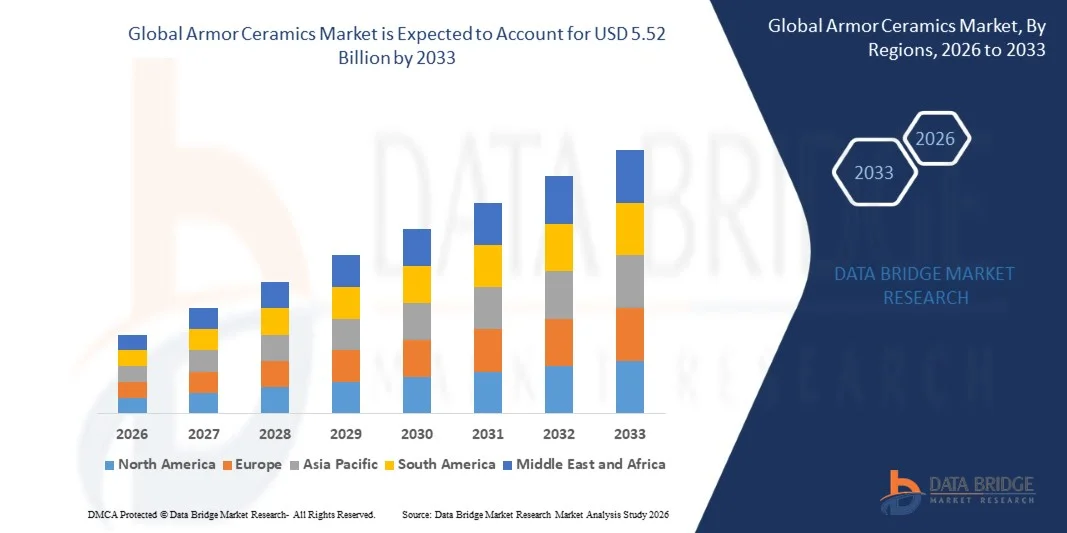
- As per Data Bridge Market Research analysis, the armor ceramics market was valued at USD 3.10 billion in 2025 and is projected to reach USD 5.52 billion by 2033, growing at a CAGR of 7.50% from 2026 to 2033.
- The market is experiencing consistent growth driven by increasing military modernization initiatives, rising geopolitical tensions, and expanding demand for lightweight ballistic protection systems across defense and homeland security sectors. Ceramic armor materials are increasingly adopted in body armor, armored vehicles, military aircraft, and naval defense applications.
- The increasing need for advanced protection systems, combined with rising cross-border disputes, terrorist activities, and advancements in material technologies and manufacturing techniques, is compelling defense organizations and security agencies to adopt ceramic armor solutions. Lightweight materials such as alumina, boron carbide, and silicon carbide are increasingly replacing traditional steel armor in applications where reduced weight, ballistic performance, and enhanced protection are required.
Market Size & Forecast
- Global Market Value (2025): USD 3.10 Billion
- Expected Market Value (2033): USD 5.52 Billion
- Forecast CAGR (2026–2033): 7.50%
- Leading Region in 2025: North America
- Fastest Growing Region: Asia Pacific
What are the Major Takeaways of the Armor Ceramics Market?
- North America dominated the armor ceramics market with the largest revenue share of 32.7% in 2025, supported by significant defense spending, military modernization programs, and strong demand for advanced ballistic protection systems.
- Asia-Pacific is expected to be the fastest-growing region at a CAGR of 9.5% from 2025 to 2032, fueled by increasing defense budgets, rising geopolitical tensions, and growing investments in military vehicle protection and advanced armor technologies across China, India, and Japan.
- The silicon carbide (SiC) segment led the market with a 34.0% share in 2025, driven by its superior hardness, lightweight characteristics, and strong ballistic resistance.
- Ceramic matrix composites (CMCs) are the fastest-growing material type, projected to register a CAGR of 9.0%, reflecting the surge in demand for lightweight armor with improved toughness and survivability.
- The ceramic plates segment dominated the product form category with a 40.0% revenue share in 2025, led by widespread adoption in personal protective equipment and military body armor.
- Hot pressing accounted for 35.0% of the market share in 2025, preferred by its ability to produce dense ceramics with high strength and hardness.
- The multi-hit protection segment is the fastest-growing protection level category, with a CAGR of 9.0%, driven by increasing demand for armor systems capable of sustaining repeated ballistic impacts.
Report Scope and Armor Ceramics Market Segmentation
|
Attributes |
Armor Ceramics Key Market Insights |
|
Segments Covered |
|
|
Countries Covered |
North America
Europe
Asia-Pacific
Middle East and Africa
South America
|
|
Key Market Players |
|
|
Market Opportunities |
|
|
Value Added Data Infosets |
In addition to the market insights such as market value, growth rate, market segments, geographical coverage, market players, and market scenario, the market report curated by the Data Bridge Market Research team includes in-depth expert analysis, import/export analysis, pricing analysis, production consumption analysis, and pestle analysis.7 |
What is the Key Trend in the Armor Ceramics Market?
- Defense manufacturers are increasingly developing lightweight ceramic-composite armor systems that combine high ballistic protection with reduced weight, supporting greater soldier mobility and improved platform efficiency across modern military applications.
- For instance, in September 2025, the U.S. Army awarded USD 65.5 million for 72,179 Lightweight Small Arms Protective Inserts, with the new plates approximately 30% lighter than ESAPI Generation III while maintaining ballistic protection.
- Advanced silicon carbide and boron carbide ceramics are increasingly being combined with polymer and fiber backings to improve protection-to-weight ratios and enhance the performance of next-generation armor systems.
- Researchers are also developing advanced ceramic architectures, including transition layers and engineered composite structures, to address ceramic brittleness and improve multi-hit ballistic performance in vehicle and personal protection applications.
- For instance, in September 2025, a study published in the International Journal of Impact Engineering reported a 3D-winding constraint structure for SiC ceramic armor that reduced the ceramic panel damage area by 88.08% during multiple-impact testing.
- As defense programs increasingly prioritize lighter equipment, modular protection, and improved multi-hit performance, the development of advanced ceramic-composite architectures is expected to remain a central trend in the armor ceramics market.
What are the Key Drivers of the Armor Ceramics Market?
- The rising military modernization programs and increasing requirements for lightweight ballistic protection are driving defense organizations to adopt ceramic armor for personnel, vehicles, aircraft, and other military platforms.
- For instance, in September 2025, the U.S. Army awarded USD 65.5 million for 72,179 Lightweight Small Arms Protective Inserts (LSAPI), which are approximately 30% lighter than the previous-generation inserts while maintaining ballistic protection. The procurement demonstrates growing military demand for lightweight protection that reduces soldier load while preserving protection levels.
- Growing emphasis on soldier mobility is encouraging manufacturers to replace heavier metallic protection with silicon carbide, boron carbide, and other advanced ceramics offering lower density and high hardness for ballistic protection.
- For instance, in September 2024, India’s DRDO and IIT Delhi developed ABHED lightweight bulletproof jackets using indigenous boron carbide ceramic materials and polymers. The armor plates passed required R&D trials and met the highest threat levels while remaining below the Indian Army’s specified maximum weight limits, highlighting the role of lightweight ceramic materials in modern personal protection.
- With defense forces increasingly prioritizing mobility, survivability, and weight-efficient protection, continued investment in advanced ceramic materials and composite armor technologies will support demand across military and security applications.
What Factors are Challenging the Growth of the Armor Ceramics Market?
- Advanced armor ceramics require sophisticated manufacturing processes, specialized equipment, high-temperature sintering, and strict quality control, increasing production complexity and limiting cost-effective large-scale manufacturing.
- For instance, in March 2026, an article published in Molecules reported that solid-state sintering of silicon carbide armor ceramics typically requires temperatures of approximately 2,100–2,300°C and achieves only 90–95% relative density, highlighting the high-temperature processing and densification challenges that can increase manufacturing costs.
- These manufacturing requirements can increase production costs, particularly for silicon carbide and boron carbide ceramics that require controlled densification and advanced processing technologies to achieve defense-grade performance.
- For instance, in August 2025, a study published in Ceramics International reported that pressureless sintering of boron carbide requires temperatures typically above 2,000°C, resulting in high energy consumption and demanding equipment requirements. The study also noted that spark plasma sintering can be cost-prohibitive and is generally restricted to small-scale components, creating scalability challenges for armor-ceramic production.
- The high manufacturing complexity, material costs, and challenges associated with densification and ceramic brittleness continue to constrain broader adoption, particularly where procurement programs require affordable, scalable, and consistently manufactured ballistic protection systems.
How is the Armor Ceramics Market Segmented?
The armor ceramics market is segmented on the basis of material type, product form, manufacturing process, density, protection level, and distribution channel.
- By Material Type
On the basis of material type, the armor ceramics market is segmented into alumina (Al₂O₃), silicon carbide (SiC), boron carbide (B₄C), aluminum nitride (AlN), silicon nitride (Si₃N₄), ceramic matrix composites (CMCs), and other armor ceramics. The silicon carbide (SiC) segment dominated the market with 34.0% share in 2025, driven by its superior hardness, lightweight characteristics, and strong ballistic resistance. Silicon carbide provides an effective balance between protection and weight for modern military applications. It is increasingly used in body armor, armored vehicles, aircraft, and other defense platforms. Its lower density compared with traditional metallic armor supports improved mobility and operational efficiency. Growing military modernization programs are supporting demand for advanced SiC-based protection systems.
The ceramic matrix composites (CMCs) segment is projected to register the fastest growth at a CAGR of 9.0% from 2026 to 2033, driven by demand for lightweight armor with improved toughness and survivability. CMCs combine ceramic matrices with reinforcing materials to improve resistance to cracking and impact damage. Their lightweight characteristics make them suitable for personnel protection and mobile military platforms. Increasing emphasis on protection-to-weight ratios is encouraging defense manufacturers to explore composite ceramic architectures. Advancements in manufacturing technologies are also helping expand their potential applications. Growing research into next-generation ballistic materials is further supporting commercialization.
- By Product Form
On the basis of product form, the armor ceramics market is segmented into ceramic tiles, ceramic plates, ceramic panels, ceramic inserts, ceramic components, transparent ceramic panels, ceramic armor kits, and others. The ceramic plates segment dominated the market with 40.0% share in 2025, supported by widespread adoption in personal protective equipment and military body armor. Ceramic plates provide effective protection against high-velocity rifle and armor-piercing threats while maintaining comparatively low weight. They are extensively used by military personnel, law enforcement agencies, and security organizations. Increasing procurement of lightweight ballistic protection is strengthening demand for ceramic plate systems. Advances in silicon carbide, boron carbide, and alumina formulations are improving plate performance.
The ceramic armor kits segment is projected to register the fastest growth at a CAGR of 8.5% from 2026 to 2033, driven by increasing demand for integrated and modular protection systems. Armor kits combine ceramic components with backing materials and other protective elements for specific platforms or missions. They enable defense organizations to customize protection according to threat and weight requirements. Increasing military vehicle modernization is creating demand for complete, ready-to-integrate armor packages. Modular designs can also simplify replacement and upgrading of damaged protection components. Manufacturers are increasingly developing lightweight kits that improve mobility without compromising ballistic performance.
- By Manufacturing Process
On the basis of manufacturing process, the armor ceramics market is segmented into hot pressing, pressureless sintering, hot isostatic pressing (HIP), spark plasma sintering (SPS), injection molding, slip casting, tape casting, additive manufacturing (3D printing), and others. The hot pressing segment dominated the market with 35.0% share in 2025, supported by its ability to produce dense ceramics with high strength and hardness. Hot pressing is widely used for manufacturing advanced ceramic armor components requiring consistent ballistic performance. The process enables controlled densification and reduced porosity in ceramic materials. These characteristics are particularly important for silicon carbide and boron carbide armor systems. Established industrial capabilities and proven processing reliability support its extensive defense-sector use.
The additive manufacturing (3D printing) segment is projected to register the fastest growth at a CAGR of 10.0% from 2026 to 2033, driven by increasing demand for complex geometries and customized ceramic components. Additive manufacturing provides greater design flexibility than many conventional ceramic-processing methods. It enables rapid prototyping and production of specialized structures for advanced armor applications. Researchers are increasingly exploring 3D-printed ceramics for lightweight and architecturally optimized protection systems. The technology can also reduce material waste and support customized component production. Improvements in ceramic feedstocks, printing precision, and post-processing are expanding commercial possibilities.
- By Density
On the basis of density, the armor ceramics market is segmented into lightweight armor ceramics, medium density armor ceramics, and high density armor ceramics. The lightweight armor ceramics segment dominated the market with 45.0% share in 2025, driven by growing demand for weight-efficient ballistic protection. Lightweight ceramic materials provide high hardness and protection while reducing the burden placed on soldiers and military platforms. They are increasingly used in body armor, tactical equipment, and mobile defense systems. Lower armor weight can improve soldier mobility, vehicle maneuverability, and operational endurance. Rising military emphasis on survivability without excessive equipment weight is strengthening demand.
The medium density armor ceramics segment is projected to register the fastest growth at a CAGR of 8.0% from 2026 to 2033, supported by demand for a balance between ballistic protection and weight efficiency. Medium-density ceramics can provide greater structural robustness than ultra-lightweight materials while remaining lighter than high-density alternatives. They are suitable for military vehicles, body armor, and protective components requiring enhanced durability. Increasing demand for versatile armor systems is encouraging manufacturers to develop optimized medium-density formulations. Improvements in ceramic compositions and composite backing technologies are further expanding their applications. Defense modernization programs are increasing requirements for adaptable protection across different threat levels.
- By Protection Level
On the basis of protection level, the armor ceramics market is segmented into handgun protection, rifle protection, armor-piercing protection, blast protection, fragmentation protection, and multi-hit protection. The rifle protection segment dominated the market with 38.0% share in 2025, supported by widespread demand for protection against high-velocity rifle ammunition. Ceramic armor is extensively used for military and law enforcement applications requiring higher ballistic protection than handgun-resistant systems. Silicon carbide, boron carbide, and alumina are commonly incorporated into rifle-resistant armor configurations. Increasing defense procurement is supporting demand for advanced rifle protection equipment. Growing battlefield threats are also encouraging adoption of higher-performance protective systems
The multi-hit protection segment is projected to register the fastest growth at a CAGR of 9.0% from 2026 to 2033, driven by increasing demand for armor systems capable of sustaining repeated ballistic impacts. Modern military operations can expose personnel and platforms to multiple successive threats. This is increasing interest in ceramic structures with improved damage tolerance and residual protection. Manufacturers are developing advanced ceramic-composite configurations to limit crack propagation following impact. Increasing procurement of sophisticated military vehicles and tactical body armor is supporting this requirement. Research into layered ceramics and improved backing materials is further enhancing multi-hit performance.
- By Distribution Channel
On the basis of distribution channel, the armor ceramics market is segmented into direct sales, OEMs, defense contractors, government procurement, integrators, and others. The defense contractors segment dominated the market with 35.0% share in 2025, supported by their established relationships with military organizations and government procurement agencies. Defense contractors integrate ceramic armor into vehicles, aircraft, personnel protection systems, and other military platforms. They also provide testing, integration, maintenance, and lifecycle support. Large defense programs commonly require suppliers capable of meeting stringent qualification and certification requirements. Increasing military modernization programs are strengthening partnerships between ceramic manufacturers and defense contractors
The government procurement segment is projected to register the fastest growth at a CAGR of 8.5% from 2026 to 2033, driven by rising defense expenditure and increasing acquisition of advanced protective equipment. Governments are investing in modern body armor, armored vehicles, aircraft protection, and other ballistic systems. Growing geopolitical tensions are encouraging military organizations to upgrade legacy protection capabilities. Domestic defense-manufacturing initiatives are also increasing government demand for locally produced armor ceramics. Large-scale procurement programs can create sustained demand for certified and standardized ceramic protection systems. Increasing emphasis on soldier survivability and military readiness is further supporting procurement activity.
Which Region Holds the Largest Share of the Armor Ceramics Market?
- North America dominated the armor ceramics market with the largest revenue share of 32.7% in 2025, supported by significant defense spending, military modernization programs, and strong demand for advanced ballistic protection systems.
- The region also benefits from significant investments in advanced defense technologies, growing adoption of silicon carbide and boron carbide ceramic materials, and continuous procurement of body armor, armored vehicles, and aerospace protection systems by military and security organizations. Increasing focus on next-generation soldier protection equipment and enhanced battlefield survivability continues to strengthen North America’s leadership position in the global armor ceramics market.
U.S. Armor Ceramics Market Insight
The U.S. armor ceramics market is witnessing strong growth due to rising defense expenditure, military modernization programs, and increasing procurement of advanced ballistic protection systems. The country’s established defense manufacturing ecosystem, along with growing adoption of silicon carbide, boron carbide, and lightweight ceramic armor technologies, is driving demand across personnel protection, armored vehicles, aerospace, and homeland security applications. In addition, growing emphasis on soldier survivability, lightweight equipment, and next-generation military platforms is accelerating adoption of advanced armor ceramics.
Asia-Pacific Armor Ceramics Market Insight
The Asia-Pacific armor ceramics market is expected to witness rapid growth, driven by increasing defense expenditure, military modernization, and rising investments in advanced ballistic protection technologies across countries such as China, India, and Japan. Growing geopolitical tensions, expanding procurement of armored vehicles, and increasing demand for lightweight personal protection systems are supporting regional market expansion. In addition, the growing development of domestic defense manufacturing capabilities and advanced ceramic-material technologies is accelerating adoption across military and security applications.
Japan Armor Ceramics Market Insight
The Japan armor ceramics market is witnessing consistent growth due to rising investments in defense modernization, advanced protection technologies, and next-generation military equipment. Defense organizations and manufacturers are increasingly adopting high-performance ceramic materials for personnel protection, armored vehicles, and aerospace applications. Moreover, increasing integration of lightweight ceramic composites and the country’s focus on enhancing defense capabilities are further contributing to market growth.
China Armor Ceramics Market Insight
The China armor ceramics market is growing rapidly, driven by increasing defense modernization, expanding military capabilities, and rising government investment in advanced ballistic protection systems. Growing adoption of silicon carbide, boron carbide, and other lightweight ceramic materials across military vehicles, body armor, and aerospace applications is significantly boosting market demand. In addition, rising domestic production capabilities, increasing investment in defense research, and rapid advancements in ceramic processing technologies are positioning China as one of the fastest-growing markets for armor ceramics globally.
U.K. Armor Ceramics Market Insight
The U.K. armor ceramics market is experiencing steady growth, supported by rising defense modernization initiatives, increasing procurement of lightweight protective equipment, and growing adoption of advanced ballistic materials. Defense manufacturers and military organizations are increasingly utilizing ceramic armor for personnel protection, armored vehicles, and other defense applications. Furthermore, advancements in ceramic composites, lightweight armor technologies, and advanced manufacturing processes are improving protection performance and supporting market growth in the U.K.
Germany Armor Ceramics Market Insight
The Germany armor ceramics market is expanding steadily due to the country’s strong defense manufacturing capabilities, advanced materials research, and increasing investment in military modernization. Defense companies and research institutions are increasingly utilizing ceramic materials for body armor, armored vehicles, aerospace protection, and other military applications. Continuous advancements in silicon carbide and ceramic-composite technologies, along with growing focus on lightweight and high-performance protection systems, are further driving market growth in Germany.
Which are the Top Companies in Armor Ceramics Market?
The armor ceramics industry is primarily led by well-established companies, including:
- CoorsTek Inc. (U.S.)
- CeramTec GmbH (Germany)
- Compagnie de Saint-Gobain (France)
- Morgan Advanced Materials plc (U.K.)
- KYOCERA Corporation (Japan)
- Schunk GmbH (Germany)
- Rauschert (Germany)
- Blasch Precision Ceramics, Inc. (U.S.)
- Superior Technical Ceramics (U.S.)
- McDanel Advanced Ceramic Technologies (U.S.)
- Precision Ceramics USA (U.S.)
- Elan Technology (U.S.)
- 3M Company (U.S.)
- JAPAN FINE CERAMICS CO., LTD. (Japan)
- Ortech, Incorporated (U.S.)
- Dynamic-Ceramic Limited (U.K.)
- International Syalons Ltd (U.K.)
- Sinoma Advanced Materials Co., Ltd. (China)
- IBIDEN CO.,LTD. (Japan)
- CeraNova Corporation (U.S.)
What are Latest Developments in Armor Ceramics Market?
- In September 2025, the U.S. Army awarded USD 65.5 million in delivery orders to Hardwire LLC and Leading Technology Composites, Inc. for the production of 72,179 Lightweight Small Arms Protective Inserts (LSAPI). The new plates are approximately 30% lighter than the Army’s existing ESAPI Generation III inserts while maintaining ballistic protection and improving soldier mobility. The procurement marks the transition of LSAPI into production under the Soldier Protection System and highlights continued military demand for lightweight advanced armor materials.
- In September 2024, DRDO and IIT Delhi announced the development of ABHED (Advanced Ballistics for High Energy Defeat), a lightweight bulletproof jacket incorporating indigenous boron carbide ceramic material and polymers. The armor plates successfully completed the required research and development trials and were designed to meet the highest threat levels while remaining below the weight limits specified by the Indian Army. The development demonstrates increasing use of boron carbide ceramics in lightweight personal ballistic protection.
- In April 2024, DRDO announced the development of a lightweight bulletproof jacket capable of protecting against BIS Level 6 threats. The jacket uses a monolithic ceramic hard armor plate with polymer backing and was successfully tested against multiple hits from 7.62 × 54R API ammunition. The development demonstrates continued advancement of ceramic-based armor systems toward higher multi-hit protection while reducing weight and improving wearer comfort.
- In April 2024, researchers from Eskişehir Osmangazi University, STM, FNSS and Türkiye’s defense institutions published the development of a ceramic/composite add-on armor system for armored vehicles. The system used an innovative cylindrical ceramic geometry combined with an ultra-high-molecular-weight polyethylene composite backing to protect against 14.5 × 114 mm API/B32 ammunition. Ballistic testing showed localized ceramic damage, supporting improved multi-hit resistance, while the lightweight composite backing helped reduce armor areal density.
- In January 2021, the U.S. Army reported the development of an automated research approach for identifying high-performing ceramic materials for hard armor. Army researchers combined robotics, automated material characterization and artificial intelligence to accelerate the evaluation of ceramic specimens and identify materials with improved ballistic protection. The work was developed with an industrial manufacturing partner and was intended to support faster development and production of advanced ceramic armor materials.

- Interactive Data Analysis Dashboard
- Company Analysis Dashboard for high growth potential opportunities
- Research Analyst Access for customization & queries
- Competitor Analysis with Interactive dashboard
- Latest News, Updates & Trend analysis
- Harness the Power of Benchmark Analysis for Comprehensive Competitor Tracking
Data collection and base year analysis are done using data collection modules with large sample sizes. The stage includes obtaining market information or related data through various sources and strategies. It includes examining and planning all the data acquired from the past in advance. It likewise envelops the examination of information inconsistencies seen across different information sources. The market data is analysed and estimated using market statistical and coherent models. Also, market share analysis and key trend analysis are the major success factors in the market report. To know more, please request an analyst call or drop down your inquiry.
The key research methodology used by DBMR research team is data triangulation which involves data mining, analysis of the impact of data variables on the market and primary (industry expert) validation. Data models include Vendor Positioning Grid, Market Time Line Analysis, Market Overview and Guide, Company Positioning Grid, Patent Analysis, Pricing Analysis, Company Market Share Analysis, Standards of Measurement, Global versus Regional and Vendor Share Analysis. To know more about the research methodology, drop in an inquiry to speak to our industry experts.
Data Bridge Market Research is a leader in advanced formative research. We take pride in servicing our existing and new customers with data and analysis that match and suits their goal. The report can be customized to include price trend analysis of target brands understanding the market for additional countries (ask for the list of countries), clinical trial results data, literature review, refurbished market and product base analysis. Market analysis of target competitors can be analyzed from technology-based analysis to market portfolio strategies. We can add as many competitors that you require data about in the format and data style you are looking for. Our team of analysts can also provide you data in crude raw excel files pivot tables (Fact book) or can assist you in creating presentations from the data sets available in the report.












