


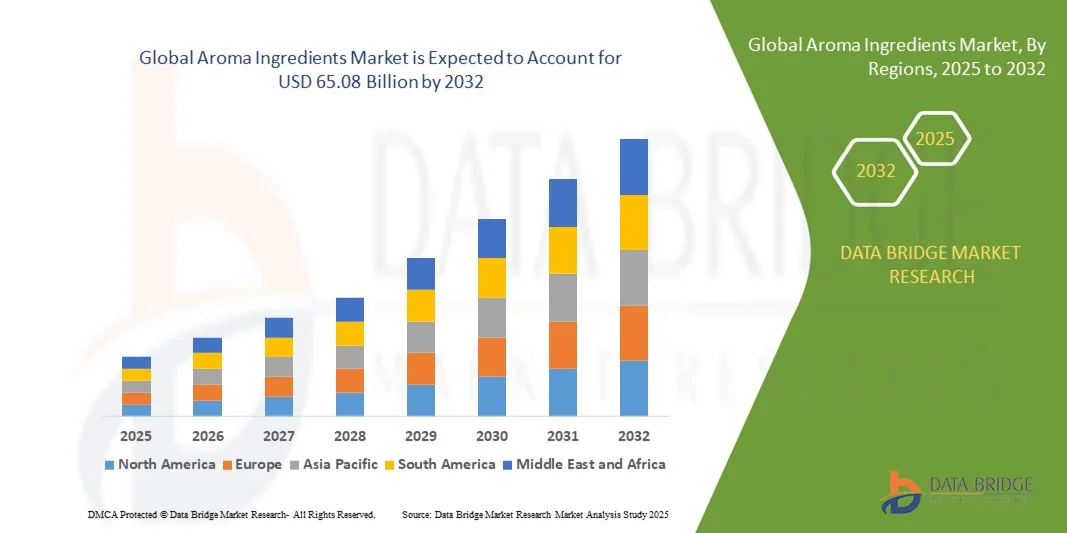
What is the Global Aroma Ingredients Market Size and Growth Rate?
- The global aroma ingredients market size was valued at USD 30.80 billion in 2024 and is expected to reach USD 65.08 billion by 2032, at a CAGR of 9.80% during the forecast period
- The increase in health consciousness among consumers among population across the globe acts as one of the major factors driving the growth of aroma ingredients market. The rise in demand for natural ingredients along with growing emphasis on preventive care and incidences of chronic diseases among consumers accelerate the aroma ingredients market growth
- The increase in demand for essential oils or aroma oils owning to their therapeutic properties and their extensive use in the production of numerous personal care products including deodorants, perfumes and colognes among others further influences the aroma ingredients market
What are the Major Takeaways of Aroma Ingredients Market?
- Change in consumer lifestyle, growth in awareness, increase in disposable income, growth in personal care sector and surging healthcare expenditure positively affect the aroma ingredients market
- Furthermore, innovations and increase in demand for novel products especially in cosmetics, toiletries and skin care and hair care products extends profitable opportunities to the aroma ingredients market players
- Europe dominated the aroma ingredients market with the largest revenue share of 37.6% in 2024, driven by the region’s long-established fragrance and flavor industry, strong demand for premium personal care and fine fragrance products, and a growing shift toward natural and sustainable ingredients
- The Asia-Pacific aroma ingredients market is anticipated to grow at the fastest CAGR of 9.8% during the forecast period of 2025 to 2032, driven by rapid urbanization, rising disposable incomes, and the expanding personal care and fragrance industries in countries such as China, India, and Japan
- The Synthetic Ingredients segment dominated the market with the largest revenue share of 64.5% in 2024, owing to their cost-effectiveness, stability, and consistent quality
Report Scope and Aroma Ingredients Market Segmentation
|
Attributes |
Aroma Ingredients Key Market Insights |
|
Segments Covered |
|
|
Countries Covered |
North America
Europe
Asia-Pacific
Middle East and Africa
South America
|
|
Key Market Players |
|
|
Market Opportunities |
|
|
Value Added Data Infosets |
In addition to the insights on market scenarios such as market value, growth rate, segmentation, geographical coverage, and major players, the market reports curated by the Data Bridge Market Research also include in-depth expert analysis, pricing analysis, brand share analysis, consumer survey, demography analysis, supply chain analysis, value chain analysis, raw material/consumables overview, vendor selection criteria, PESTLE Analysis, Porter Analysis, and regulatory framework. |
What is the Key Trend in the Aroma Ingredients Market?
Sustainability and Bio-based Ingredient Innovation
- A major and accelerating trend in the global aroma ingredients market is the growing shift toward sustainable and bio-based ingredient development. Manufacturers are focusing on replacing synthetic components derived from petrochemicals with natural and renewable sources to meet consumer and regulatory demands for eco-friendly products
- For instance, Symrise AG introduced its “Symrise Green Chemistry” initiative to produce aroma molecules using biotechnological fermentation from renewable raw materials. Similarly, Givaudan SA is investing heavily in white biotechnology to develop natural fragrance compounds with reduced environmental footprints
- Bio-based aroma ingredients offer enhanced biodegradability, lower toxicity, and minimal environmental impact compared to their synthetic counterparts. Companies are also exploring upcycled raw materials, such as by-products from food and agriculture industries, to enhance sustainability and reduce waste
- This growing emphasis on green chemistry and traceable sourcing is reshaping the competitive landscape, as brands strive to align with sustainability goals and consumer preference for natural fragrances. The trend supports long-term environmental stewardship while ensuring product innovation in the aroma sector
- Companies such as Firmenich SA and International Flavors & Fragrances Inc. (IFF) are at the forefront of developing biodegradable, renewable, and carbon-efficient aroma molecules, reinforcing their leadership in sustainable ingredient innovation
- This trend toward eco-conscious product formulations is expected to redefine the future of fragrance creation, positioning sustainability as a core growth driver across global markets
What are the Key Drivers of Aroma Ingredients Market?
- The increasing demand for natural and organic personal care products, coupled with rising awareness about health, wellness, and environmental impact, is driving the growth of the aroma ingredients market globally
- For instance, in March 2024, Givaudan SA launched “MoodScentz+,” a line of aroma ingredients scientifically designed to enhance emotional well-being through natural scent formulations—reflecting the industry’s pivot toward functional and sustainable products
- Consumers are increasingly seeking plant-derived, allergen-free, and eco-labeled fragrances in cosmetics, household care, and fine fragrances, prompting brands to integrate natural essential oils and bioengineered aroma molecules
- In addition, the expanding applications of aroma ingredients in flavors, pharmaceuticals, and aromatherapy are fueling market demand, supported by rapid urbanization and rising disposable incomes in emerging economies
- Technological advancements in fermentation, enzyme catalysis, and extraction techniques are enabling the cost-effective production of natural aroma ingredients, further boosting market adoption across multiple industries
Which Factor is Challenging the Growth of the Aroma Ingredients Market?
- A key challenge hindering the growth of the aroma ingredients market is the high cost and supply chain complexity associated with natural raw materials. Fluctuations in crop yields due to climate change and regional instability significantly impact the availability and pricing of natural ingredients such as jasmine, rose, and sandalwood
- For instance, price volatility in essential oils has pressured manufacturers to explore synthetic alternatives or reformulate blends to maintain product consistency
- In addition, ensuring quality control, traceability, and compliance with international regulations such as IFRA (International Fragrance Association) standards poses significant operational challenges. The complex approval processes for new natural ingredients further delay commercialization
- High R&D investment costs and limited scalability of bio-based production technologies also restrict smaller manufacturers from competing with established global players
- Addressing these challenges through vertical integration, sustainable sourcing partnerships, and advanced biotechnology will be crucial for ensuring consistent supply, affordability, and long-term market resilience
How is the Aroma Ingredients Market Segmented?
The market is segmented on the basis of type, product, and application.
- By Type
On the basis of type, the aroma ingredients market is segmented into Synthetic Ingredients and Natural Ingredients. The Synthetic Ingredients segment dominated the market with the largest revenue share of 64.5% in 2024, owing to their cost-effectiveness, stability, and consistent quality. Synthetic aroma molecules enable manufacturers to replicate natural scents while ensuring large-scale availability and uniformity across formulations. They also provide enhanced performance in various applications such as personal care and household products, where fragrance longevity and stability are crucial.
The Natural Ingredients segment is expected to witness the fastest growth rate of 8.9% from 2025 to 2032, driven by the rising consumer preference for eco-friendly, plant-based, and sustainable fragrance components. The growing trend toward clean-label products and increasing awareness about the potential side effects of synthetic chemicals are further fueling the demand for natural aroma ingredients in premium and organic product lines.
- By Product
On the basis of product, the aroma ingredients market is segmented into Essential Oils and Aroma Oils. The Essential Oils segment accounted for the largest market revenue share of 58.3% in 2024, supported by increasing utilization in personal care, aromatherapy, and household products. Essential oils derived from natural sources such as lavender, citrus, and sandalwood are widely recognized for their therapeutic properties and aromatic richness, which drive consumer preference.
The Aroma Oils segment is projected to register the fastest CAGR of 9.2% from 2025 to 2032, fueled by its growing use in fine fragrances and cosmetic formulations. These oils offer a diverse range of synthetic and blended aroma profiles, allowing formulators to create long-lasting and customizable scents. The development of innovative aroma oil blends catering to specific moods and preferences is further accelerating demand across various industrial and consumer applications.
- By Application
On the basis of application, the aroma ingredients market is segmented into Homecare, Personal Care, Fine Fragrances and Perfumes, and Others. The Personal Care segment dominated the market with the largest revenue share of 46.7% in 2024, driven by high consumption of aroma-based products such as soaps, shampoos, lotions, and deodorants. Increasing awareness of self-care, hygiene, and well-being has significantly boosted demand for premium and naturally scented personal care formulations.
The Fine Fragrances and Perfumes segment is anticipated to witness the fastest growth rate of 10.1% from 2025 to 2032, propelled by rising demand for luxury and niche fragrances and expanding consumer spending on personal grooming. The growing influence of customized scent profiles and celebrity-endorsed perfume launches continues to attract younger consumers, particularly in emerging economies, contributing to the robust expansion of this segment in the forecast period.
Which Region Holds the Largest Share of the Aroma Ingredients Market?
- Europe dominated the aroma ingredients market with the largest revenue share of 37.6% in 2024, driven by the region’s long-established fragrance and flavor industry, strong demand for premium personal care and fine fragrance products, and a growing shift toward natural and sustainable ingredients
- European consumers are increasingly favoring eco-friendly, traceable, and ethically sourced aroma compounds, encouraging manufacturers to invest in green chemistry and biotechnology-based production
- The region’s market expansion is further supported by stringent environmental regulations, advanced R&D capabilities, and the presence of leading global fragrance houses, making Europe the core hub for aroma ingredient innovation and production
France Aroma Ingredients Market Insight
The France aroma ingredients market captured the largest share within Europe in 2024, owing to its dominance in the global perfume and cosmetic industry. France’s long-standing expertise in fine fragrances and the presence of major global companies such as Givaudan SA and Firmenich SA have reinforced its leadership. The growing consumer preference for natural and sustainable raw materials, combined with the continuous launch of high-end perfumes, is expected to drive steady growth in the coming years.
Germany Aroma Ingredients Market Insight
The Germany aroma ingredients market is projected to grow at a robust CAGR during the forecast period, supported by its strong chemical manufacturing base and rising investments in green chemistry. German consumers are prioritizing environmental responsibility and ingredient transparency, encouraging local manufacturers to develop biotechnologically produced aroma molecules. In addition, the demand for aroma ingredients in household care and industrial fragrance applications continues to expand, driven by the preference for high-quality and sustainable scent formulations.
U.K. Aroma Ingredients Market Insight
The U.K. aroma ingredients market is expected to expand steadily through 2032, supported by the growing consumption of premium personal care, home fragrance, and wellness products. Increasing demand for clean-label and vegan-friendly ingredients, along with the rising popularity of aromatherapy and natural oils, is propelling market growth. The region’s robust retail infrastructure and consumer interest in luxury scents and organic cosmetics also contribute to the sustained expansion of the U.K. aroma industry.
Which Region is the Fastest Growing Region in the Aroma Ingredients Market?
The Asia-Pacific aroma ingredients market is anticipated to grow at the fastest CAGR of 9.8% during the forecast period of 2025 to 2032, driven by rapid urbanization, rising disposable incomes, and the expanding personal care and fragrance industries in countries such as China, India, and Japan. The increasing demand for natural and affordable aroma formulations, along with the region’s emergence as a manufacturing hub for aroma ingredients, is fueling market expansion. Furthermore, the growing influence of Western lifestyle trends and increasing investments by international fragrance companies in local production facilities are boosting regional growth.
China Aroma Ingredients Market Insight
The China aroma ingredients market accounted for the largest share in the Asia-Pacific region in 2024, supported by a rapidly growing cosmetics and homecare sector. China’s expanding middle-class population and strong domestic manufacturing base are driving the consumption of flavors and fragrances across multiple industries. Government support for biotechnology and sustainable chemistry is also accelerating the adoption of eco-friendly aroma production methods, positioning China as a major contributor to the regional market.
Japan Aroma Ingredients Market Insight
The Japan aroma ingredients market is experiencing strong momentum due to its advanced technological expertise and focus on premium quality. Japanese consumers place a high emphasis on purity, minimalism, and wellness-oriented products, fostering the demand for natural aroma ingredients in personal care and aromatherapy. The integration of biotechnology and precision fermentation techniques by Japanese manufacturers is further enhancing product innovation and driving market growth.
India Aroma Ingredients Market Insight
The India aroma ingredients market is projected to witness substantial growth, fueled by the rising consumption of cosmetics, home fragrances, and traditional essential oils. India’s abundant availability of natural raw materials such as sandalwood, jasmine, and rose provides a strategic advantage for aroma producers. In addition, the expansion of the personal care and Ayurveda-based wellness industries is contributing to increased adoption of both natural and blended aroma ingredients, solidifying India’s role as a key growth engine in the Asia-Pacific region.
Which are the Top Companies in Aroma Ingredients Market?
The aroma ingredients industry is primarily led by well-established companies, including:
- Givaudan (Switzerland)
- Firmenich SA (Switzerland)
- International Flavors & Fragrances Inc. (IFF) (U.S.)
- Symrise (Germany)
- Takasago International Corporation (Japan)
- Frutarom (Israel)
- MANE (France)
- Sensient Technologies Corporation (U.S.)
- T. Hasegawa Co., Ltd. (Japan)
- S H Kelkar and Company Limited (India)
- Bell Flavors & Fragrances (U.S.)
- Huabao International Holdings Limited (China)
- KAO Corporation (Japan)
- Vigon International, Inc. (U.S.)
- MJ Biopharm Pvt. Ltd. (India)
- Atul Ltd (India)
- BERJÉ Inc. (U.S.)
- Nactis Flavours (France)
- Zanos Ltd (U.K.)
What are the Recent Developments in Global Aroma Ingredients Market?
- In October 2024, Prigiv began operations at its newly established Mahad Fragrance Ingredients plant, a joint venture between Givaudan and Privi. Privi holds a majority stake of 51%, while Givaudan owns the remaining 49%. The facility aims to produce a diverse range of enhanced fragrance products, with plans to expand production gradually over the next two to three years. This collaboration strengthens both companies’ positions in the global aroma ingredients market and emphasizes their commitment to sustainable growth and innovation
- In March 2023, BASF invested in a new citral production plant in China to expand its aroma ingredients business. The plant is scheduled to become operational by 2026 and is part of BASF’s strategy to meet the rising global demand for flavor and fragrance ingredients. The investment also underscores the company’s dedication to sustainability and green manufacturing initiatives. This move marks a significant step in BASF’s long-term growth and innovation roadmap
- In February 2023, Givaudan and Amyris entered into a long-term partnership agreement, wherein Amyris will continue to produce sustainable ingredients for Givaudan’s cosmetic applications while providing access to its biotechnology innovation capabilities. In return, Givaudan will serve as the commercialization partner for Amyris’s upcoming eco-friendly beauty ingredients. This collaboration reinforces both companies’ commitment to sustainable innovation and strengthens their presence in the global fragrance and personal care sector
- In November 2022, Mohawk Industries, a global leader in flooring solutions, announced the acquisition of Elizabeth, a Brazil-based flooring company. This acquisition enables Mohawk Industries to expand its presence in South America and enhance its production capabilities. Elizabeth, in turn, benefits from Mohawk’s strong distribution network and extensive resources. The partnership reflects both companies’ dedication to high quality and sustainable practices, marking a strategic milestone in their global expansion efforts
- In July 2022, AHF Products acquired certain assets from Armstrong Flooring, including the rights to its brand name and three manufacturing facilities located in Lancaster, Beech Creek (PA), and Kankakee (IL). As North America’s largest hardwood flooring manufacturer, AHF expanded its reach across various flooring categories, including commercial brands such as Bruce Contract and Parterre. This acquisition further enhances AHF’s manufacturing strength and brand portfolio, supporting its long-term goal of market leadership and operational excellence

- Interactive Data Analysis Dashboard
- Company Analysis Dashboard for high growth potential opportunities
- Research Analyst Access for customization & queries
- Competitor Analysis with Interactive dashboard
- Latest News, Updates & Trend analysis
- Harness the Power of Benchmark Analysis for Comprehensive Competitor Tracking
Global Aroma Ingredients Market, Supply Chain Analysis and Ecosystem Framework
To support market growth and help clients navigate the impact of geopolitical shifts, DBMR has integrated in-depth supply chain analysis into its Global Aroma Ingredients Market research reports. This addition empowers clients to respond effectively to global changes affecting their industries. The supply chain analysis section includes detailed insights such as Global Aroma Ingredients Market consumption and production by country, price trend analysis, the impact of tariffs and geopolitical developments, and import and export trends by country and HSN code. It also highlights major suppliers with data on production capacity and company profiles, as well as key importers and exporters. In addition to research, DBMR offers specialized supply chain consulting services backed by over a decade of experience, providing solutions like supplier discovery, supplier risk assessment, price trend analysis, impact evaluation of inflation and trade route changes, and comprehensive market trend analysis.
Data collection and base year analysis are done using data collection modules with large sample sizes. The stage includes obtaining market information or related data through various sources and strategies. It includes examining and planning all the data acquired from the past in advance. It likewise envelops the examination of information inconsistencies seen across different information sources. The market data is analysed and estimated using market statistical and coherent models. Also, market share analysis and key trend analysis are the major success factors in the market report. To know more, please request an analyst call or drop down your inquiry.
The key research methodology used by DBMR research team is data triangulation which involves data mining, analysis of the impact of data variables on the market and primary (industry expert) validation. Data models include Vendor Positioning Grid, Market Time Line Analysis, Market Overview and Guide, Company Positioning Grid, Patent Analysis, Pricing Analysis, Company Market Share Analysis, Standards of Measurement, Global versus Regional and Vendor Share Analysis. To know more about the research methodology, drop in an inquiry to speak to our industry experts.
Data Bridge Market Research is a leader in advanced formative research. We take pride in servicing our existing and new customers with data and analysis that match and suits their goal. The report can be customized to include price trend analysis of target brands understanding the market for additional countries (ask for the list of countries), clinical trial results data, literature review, refurbished market and product base analysis. Market analysis of target competitors can be analyzed from technology-based analysis to market portfolio strategies. We can add as many competitors that you require data about in the format and data style you are looking for. Our team of analysts can also provide you data in crude raw excel files pivot tables (Fact book) or can assist you in creating presentations from the data sets available in the report.













