


Arthropod-Borne Viral Infections Testing Market Size
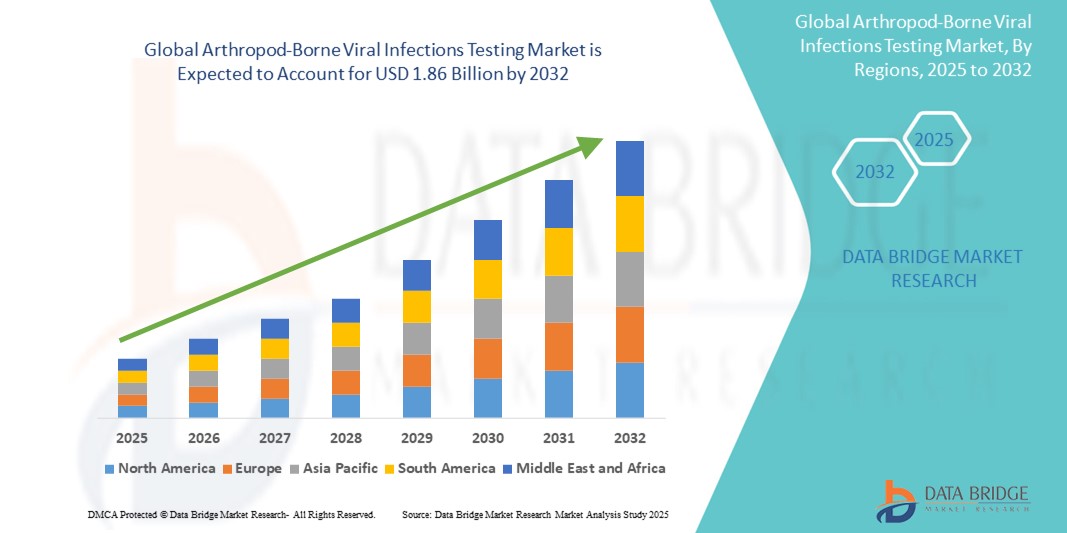
- The global arthropod-borne viral infections testing market size was valued at USD 1.20 billion in 2024 and is expected to reach USD 1.86 billion by 2032, at a CAGR of 5.65% during the forecast period
- The market growth is largely fueled by the increasing incidence of vector-borne diseases such as Zika, Dengue, Chikungunya, and West Nile Virus, which has prompted enhanced surveillance and diagnostic efforts across endemic and emerging regions
- Furthermore, the rising focus on rapid and accurate diagnostic methods, supported by public health initiatives and global funding for epidemic preparedness, is establishing advanced testing technologies as critical tools for early detection and containment. These converging factors are accelerating the development and adoption of arthropod-borne viral infections testing solutions, thereby significantly boosting the industry’s growth
Arthropod-Borne Viral Infections Testing Market Analysis
- Arthropod-borne viral infections testing, which involves diagnostic tools to detect viruses transmitted by vectors such as mosquitoes and ticks, is becoming an essential component of global infectious disease management, particularly in endemic and emerging regions, due to its critical role in timely outbreak response and public health preparedness
- The escalating demand for testing solutions is primarily fueled by rising global temperatures and urbanization, which are expanding vector habitats, along with the increasing frequency of arboviral outbreaks such as Dengue, Zika, and Chikungunya, prompting the need for rapid and reliable diagnostic methods
- Asia-Pacific dominated the arthropod-borne viral infections testing market with the largest revenue share of 36.9% in 2024, driven by a high prevalence of mosquito-borne diseases, expanding healthcare infrastructure, and strong governmental initiatives for disease surveillance, with India emerging as the leading country due to its large population base and increasing investments in diagnostic capacity
- Middle East and Africa is expected to be the fastest growing region in the market during the forecast period, supported by improving healthcare access, rising awareness of vector-borne disease risks, and growing investments in public health diagnostics, particularly in South Africa, Egypt, and Saudi Arabia
- Immunoassays segment dominated the arthropod-borne viral infections testing market with a market share of 44.6% in 2024, driven by its high sensitivity, rapid turnaround time, and widespread availability for detecting a broad range of arboviral pathogens
Report Scope and Arthropod-Borne Viral Infections Testing Market Segmentation
|
Attributes |
Arthropod-Borne Viral Infections Testing Key Market Insights |
|
Segments Covered |
|
|
Countries Covered |
North America
Europe
Asia-Pacific
Middle East and Africa
South America
|
|
Key Market Players |
|
|
Market Opportunities |
|
|
Value Added Data Infosets |
In addition to the insights on market scenarios such as market value, growth rate, segmentation, geographical coverage, and major players, the market reports curated by the Data Bridge Market Research also include in-depth expert analysis, pricing analysis, brand share analysis, consumer survey, demography analysis, supply chain analysis, value chain analysis, raw material/consumables overview, vendor selection criteria, PESTLE Analysis, Porter Analysis, and regulatory framework. |
Arthropod-Borne Viral Infections Testing Market Trends
“Technological Advancements in Rapid and Multiplex Testing Platforms”
- A significant and accelerating trend in the global arthropod-borne viral infections testing market is the advancement and deployment of rapid diagnostic tests (RDTs) and multiplex molecular assays. These technologies offer the ability to simultaneously detect multiple arboviruses—such as Dengue, Zika, and Chikungunya—in a single patient sample, thus improving diagnostic accuracy and time-to-result
- For instance, CDC-endorsed Trioplex real-time RT-PCR assays have been widely adopted to test for Zika, Dengue, and Chikungunya viruses in one go, reducing diagnostic delays and enhancing outbreak response. Similarly, companies such as Bio-Rad and Thermo Fisher Scientific are developing multiplex PCR kits with higher throughput and automated workflows
- The development of point-of-care testing devices that use immunochromatographic and microfluidic platforms enables quick results in field settings and remote areas, which is critical during outbreak scenarios. These technologies are helping healthcare workers identify infected individuals faster, improving patient outcomes and curbing disease transmission
- Integration with digital reporting systems and surveillance platforms further enhances public health preparedness. Many diagnostic platforms now include cloud connectivity and mobile app integration to enable real-time data sharing and epidemiological tracking
- This trend towards more efficient, portable, and integrated testing solutions is redefining expectations for arboviral diagnostics, making them more accessible, faster, and field-deployable. Companies such as SD Biosensor and QuidelOrtho are expanding their portfolios to include AI-enhanced and smartphone-compatible diagnostics tailored for low-resource and high-incidence regions
- The demand for next-generation diagnostic platforms is growing rapidly across both government and private healthcare sectors as they seek improved capabilities for epidemic response, routine screening, and disease surveillance in endemic zones
Arthropod-Borne Viral Infections Testing Market Dynamics
Driver
“Rising Outbreak Frequency and Vector Expansion Due to Climate Change”
- The increasing frequency and geographic spread of arboviral disease outbreaks—fueled by climate change, urbanization, and global travel—is a major driver for the demand for advanced testing solutions. Expanding habitats for mosquitoes and ticks are pushing arboviruses into new territories, heightening the need for early detection and containment
- For instance, according to WHO, Dengue has become endemic in over 100 countries, with a substantial increase in reported cases in South Asia, Latin America, and Africa. This growing burden has prompted governments and health agencies to invest in widespread testing infrastructure and vector-borne disease surveillance systems
- Moreover, rapid globalization and cross-border movement have heightened the risk of introducing arboviruses into non-endemic areas, increasing the importance of robust screening at airports, seaports, and other entry points
- Diagnostic innovation has also been spurred by international funding and public-private collaborations. Organizations such as FIND (Foundation for Innovative New Diagnostics) and PATH are actively supporting the development and deployment of affordable and scalable diagnostic solutions in resource-limited settings
- These dynamics are driving the market growth by elevating awareness, funding, and the urgency for accessible, accurate, and timely diagnostic tools across both outbreak-prone and surveillance-focused regions
Restraint/Challenge
“Limited Access to Testing in Remote and Low-Resource Settings”
- Despite growing demand, limited access to reliable diagnostic tools in rural and low-income regions remains a key barrier to the wider adoption of arboviral testing. Challenges include lack of trained personnel, inadequate laboratory infrastructure, and weak supply chains for test kits and reagents
- For instance, in sub-Saharan Africa and parts of Southeast Asia, delays in diagnosis often result from the absence of decentralized or field-based testing capabilities, contributing to underreporting and delayed response to outbreaks
- The reliance on centralized laboratories for molecular and serological tests, combined with the high cost of imported test kits, restricts diagnostic coverage in many endemic areas. Furthermore, regulatory hurdles and the lack of harmonized validation standards for new diagnostic technologies can delay their deployment in low-resource regions
- To overcome these issues, global health agencies and diagnostic companies are focusing on the development of low-cost, easy-to-use, and rugged testing platforms suited for field use. However, until such technologies are widely distributed, diagnostic gaps will persist
- Bridging this access gap through innovations in portable diagnostics, strengthening local manufacturing, capacity building for healthcare workers, and streamlining regulatory approvals will be essential to ensure equitable access and accelerate market expansion
Arthropod-Borne Viral Infections Testing Market Scope
The market is segmented on the basis of test type and end user.
- By Test Type
On the basis of test type, the arthropod-borne viral infections testing market is segmented into molecular tests, cultural tests, immunoassays, and others. The immunoassays segment dominated the market with the largest revenue share of 44.6% in 2024, driven by its high sensitivity, rapid result turnaround, and cost-effectiveness in detecting a wide range of arboviral infections such as Dengue, Zika, and Chikungunya. ELISA-based immunoassays are widely used in endemic regions and public health laboratories due to their scalability and ease of implementation. Their availability in both centralized and decentralized settings makes them ideal for outbreak response and surveillance programs.
The molecular tests segment is anticipated to witness the fastest growth rate from 2025 to 2032, propelled by increasing demand for accurate, early-stage detection and the expanding use of multiplex PCR platforms. Molecular diagnostics, particularly real-time RT-PCR, are critical in confirming infections during the viremic phase and are becoming more accessible due to innovations in portable and automated platforms. The growing emphasis on integrated disease surveillance and international travel screening is further supporting the adoption of molecular test kits.
- By End User
On the basis of end user, the arthropod-borne viral infections testing market is segmented into hospitals, research centers, and diagnostic centers. The hospitals segment dominated the market with the largest revenue share of 46.7% in 2024, owing to their central role in delivering primary diagnostics during outbreaks, emergency care, and routine screening. Hospitals often have the infrastructure to perform both immunoassays and molecular tests and are closely linked with national surveillance systems, making them the first point of contact for suspected cases.
The diagnostic centers segment is expected to witness the fastest CAGR during the forecast period, driven by the decentralization of healthcare services and the rising demand for quick, affordable testing in both urban and rural settings. Independent and chain diagnostic labs are increasingly equipped with rapid test kits and portable PCR systems, making them accessible hubs for arboviral diagnostics, especially during seasonal spikes or outbreak alerts.
Arthropod-Borne Viral Infections Testing Market Regional Analysis
- Asia-Pacific dominated the arthropod-borne viral infections testing market with the largest revenue share of 36.9% in 2024, driven by a high prevalence of mosquito-borne diseases, expanding healthcare infrastructure, and strong governmental initiatives for disease surveillance
- Countries in the region, particularly India, Indonesia, and the Philippines, are experiencing rising demand for early diagnostic solutions due to recurrent outbreaks of Dengue, Chikungunya, and Japanese Encephalitis
- This dominance is further supported by expanding healthcare infrastructure, increased public health funding, and strategic partnerships with international organizations to deploy rapid, affordable testing technologies in both urban and rural settings, positioning Asia-Pacific as a key hub for vector-borne disease diagnostics
India Arthropod-Borne Viral Infections Testing Market Insight
India accounted for the largest market revenue share in Asia-Pacific in 2024, driven by a consistently high burden of mosquito-borne diseases and a robust push toward improved diagnostic infrastructure. Government programs such as the National Vector Borne Disease Control Programme (NVBDCP) are fueling large-scale testing initiatives. In addition, the rising availability of low-cost rapid test kits and expanding healthcare access in rural areas are supporting growth. India's increasing involvement in manufacturing diagnostic equipment and kits also strengthens its position in the regional market.
Japan Arthropod-Borne Viral Infections Testing Market Insight
The Japan arthropod-borne viral infections testing market is experiencing steady growth, backed by the country’s advanced healthcare infrastructure and a strong public health surveillance system. Though the prevalence of vector-borne diseases is lower than in tropical regions, Japan’s focus on early detection, laboratory precision, and preparedness for emerging threats such as imported Dengue and Zika cases supports sustained demand. The market benefits from high government spending on disease control, integration of AI in diagnostics, and strong institutional support for epidemiological research.
Middle East & Africa Arthropod-Borne Viral Infections Testing Market Insight
The Middle East & Africa region is expected to witness the fastest CAGR during the forecast period (2025–2032), driven by increasing public health awareness, improving diagnostic capacity, and international funding for vector-borne disease control. As outbreaks of Rift Valley Fever, Dengue, and Chikungunya become more frequent, governments are ramping up investments in disease surveillance and laboratory expansion. The demand for portable, cost-effective rapid testing kits is rising, particularly in underserved and remote regions.
South Africa Arthropod-Borne Viral Infections Testing Market Insight
South Africa is emerging as a leading market in the Middle East & Africa region due to its well-established public health infrastructure and its role as a diagnostic hub in Sub-Saharan Africa. The country is actively engaged in vector-borne disease research and benefits from collaborations with international health organizations. Increasing incidence of arboviral infections and government-led awareness campaigns are prompting broader testing adoption, especially in high-risk provinces.
Egypt Arthropod-Borne Viral Infections Testing Market Insight
The Egypt arthropod-borne viral infections testing market is gaining traction due to rising Dengue outbreaks and expanded disease monitoring programs. The government’s increased attention to mosquito control and vector surveillance, along with partnerships with regional diagnostic manufacturers, is contributing to better testing accessibility. Growth is supported by modernization of public health labs and educational efforts to improve early diagnosis and containment of infections.
Saudi Arabia Arthropod-Borne Viral Infections Testing Market Insight
Saudi Arabia’s market is expanding steadily, supported by strong investments in healthcare infrastructure and the need for stringent disease monitoring due to high international travel, especially during Hajj and Umrah seasons. The government is prioritizing infectious disease preparedness, including arboviruses such as Rift Valley Fever and Dengue, leading to increased deployment of rapid and molecular diagnostic solutions. Integration of smart surveillance systems with healthcare networks is expected to further bolster market development.
Arthropod-Borne Viral Infections Testing Market Share
The Arthropod-Borne Viral Infections Testing industry is primarily led by well-established companies, including:
- Thermo Fisher Scientific Inc. (U.S.)
- F. Hoffmann-La Roche Ltd (Switzerland)
- Abbott (U.S.)
- Bio-Rad Laboratories, Inc. (U.S.)
- Siemens Healthineers AG (Germany)
- bioMérieux SA (France)
- Qiagen N.V. (Netherlands)
- Danaher Corporation (U.S.)
- SD Biosensor, Inc. (South Korea)
- BD (U.S.)
- Merck KGaA (Germany)
- QuidelOrtho Corporation (U.S.)
- Cepheid (U.S.)
- GenMark Diagnostics, Inc. (U.S.)
- Hologic, Inc. (U.S.)
- Lucira Health, Inc. (U.S.)
- OraSure Technologies, Inc. (U.S.)
- Coris BioConcept (Belgium)
- Euroimmun Medizinische Labordiagnostika AG (Germany)
- Tecan Group Ltd. (Switzerland)

- Interactive Data Analysis Dashboard
- Company Analysis Dashboard for high growth potential opportunities
- Research Analyst Access for customization & queries
- Competitor Analysis with Interactive dashboard
- Latest News, Updates & Trend analysis
- Harness the Power of Benchmark Analysis for Comprehensive Competitor Tracking
Data collection and base year analysis are done using data collection modules with large sample sizes. The stage includes obtaining market information or related data through various sources and strategies. It includes examining and planning all the data acquired from the past in advance. It likewise envelops the examination of information inconsistencies seen across different information sources. The market data is analysed and estimated using market statistical and coherent models. Also, market share analysis and key trend analysis are the major success factors in the market report. To know more, please request an analyst call or drop down your inquiry.
The key research methodology used by DBMR research team is data triangulation which involves data mining, analysis of the impact of data variables on the market and primary (industry expert) validation. Data models include Vendor Positioning Grid, Market Time Line Analysis, Market Overview and Guide, Company Positioning Grid, Patent Analysis, Pricing Analysis, Company Market Share Analysis, Standards of Measurement, Global versus Regional and Vendor Share Analysis. To know more about the research methodology, drop in an inquiry to speak to our industry experts.
Data Bridge Market Research is a leader in advanced formative research. We take pride in servicing our existing and new customers with data and analysis that match and suits their goal. The report can be customized to include price trend analysis of target brands understanding the market for additional countries (ask for the list of countries), clinical trial results data, literature review, refurbished market and product base analysis. Market analysis of target competitors can be analyzed from technology-based analysis to market portfolio strategies. We can add as many competitors that you require data about in the format and data style you are looking for. Our team of analysts can also provide you data in crude raw excel files pivot tables (Fact book) or can assist you in creating presentations from the data sets available in the report.













